



















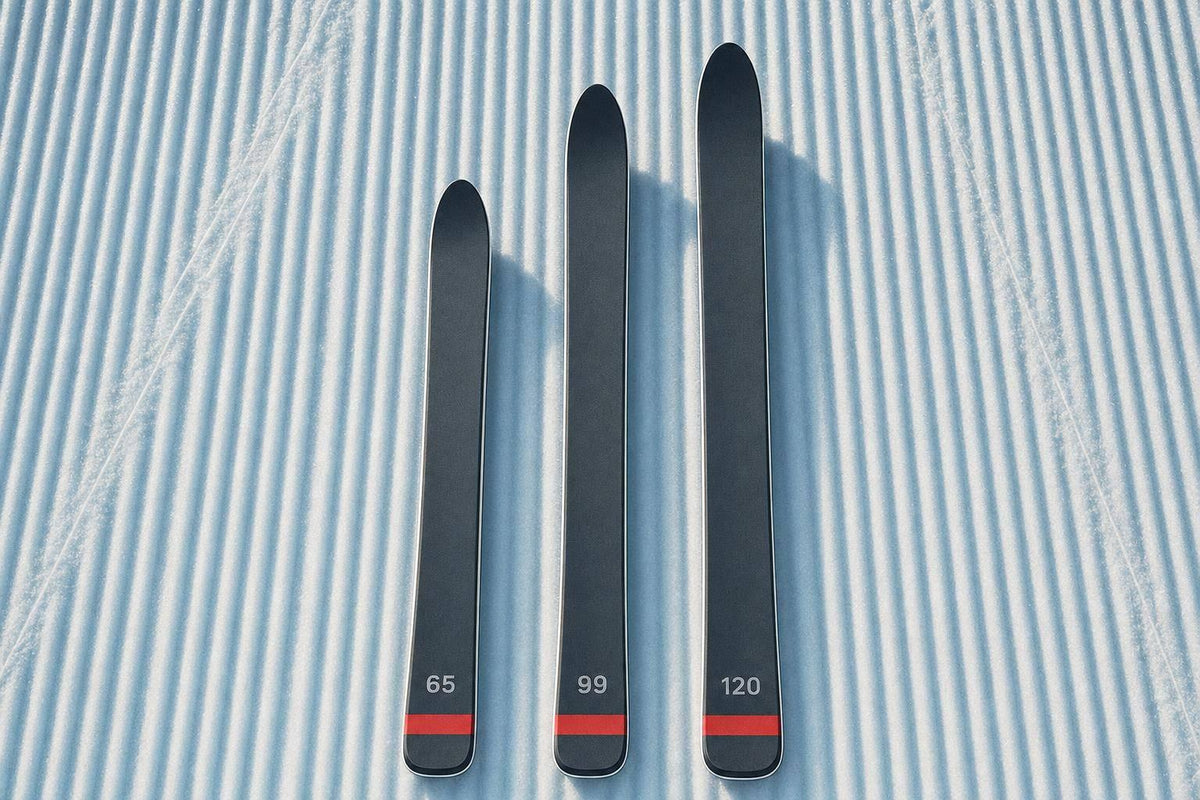
If I had to give one short answer, it’s this: for icy East Coast groomers, I’d start with the Snowfeet* 99 cm. It hits the sweet spot between grip, control, and easy packing. If you ski faster and want more calm on hard snow, I’d go 120 cm. If you care most about travel and playful laps, I’d look at 65 cm.
East Coast snow is often firm, scraped off, and slick. That means your gear needs to do 3 things well:
- Hold an edge on hardpack
- Turn fast on narrow, busy runs
- Stay calm enough when the trail gets rough
This article compares 6 setups:
- Snowfeet* 65 cm
- Snowfeet* 99 cm
- Snowfeet* POWDER 99 cm
- Snowfeet* 120 cm
- A 170 cm frontside ski
- Older snowblades like Salomon Snowblades / Summit EZ
My quick take:
- Best all-around: Snowfeet* 99 cm
- Best for more grip and speed control: Snowfeet* 120 cm
- Best for packing light: Snowfeet* 65 cm
- Best for mixed snow: Snowfeet* POWDER 99 cm
- Best pure ice tool at higher speed: 170 cm frontside ski
On paper, longer skis still hold the top spot for hard ice and higher speed. But for a lot of resort riders, that’s only part of the story. A short setup that’s easy to carry, easy to turn, and still grips well enough can be the better call day to day.
Snowboarder tries Snowfeet* | Which Snowfeet* Short Ski is the Best? | Snowblades 44, 65, 99 Review
Quick Comparison
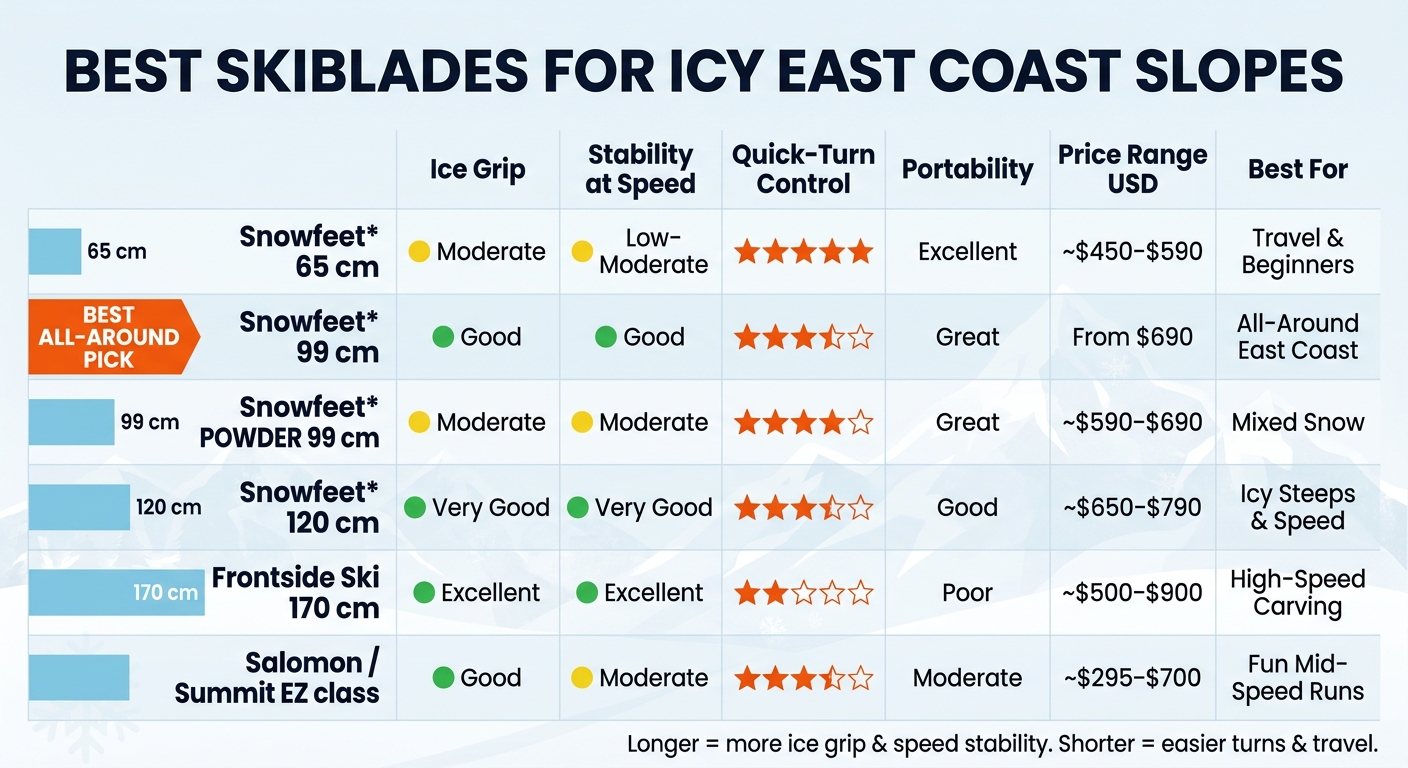
Best Skiblades for Icy East Coast Slopes: Side-by-Side Comparison
| Option | Ice grip | Speed feel | Turn feel | Best for |
|---|---|---|---|---|
| Snowfeet* 65 cm | Moderate | Low to mid | Very fast | Travel, beginners, short easy laps |
| Snowfeet* 99 cm | Good | Good | Fast | Most East Coast riders |
| Snowfeet* POWDER 99 cm | Moderate | Moderate | Fast | Mixed snow, chopped-up afternoons |
| Snowfeet* 120 cm | Very good | Very good | Medium | Firmer runs, stronger riders |
| Frontside ski 170 cm | Top-tier | Top-tier | Slower | Fast carving on icy groomers |
| Salomon / Summit EZ class | Good | Moderate | Medium | Fun low- to mid-speed days |
A few numbers help frame it:
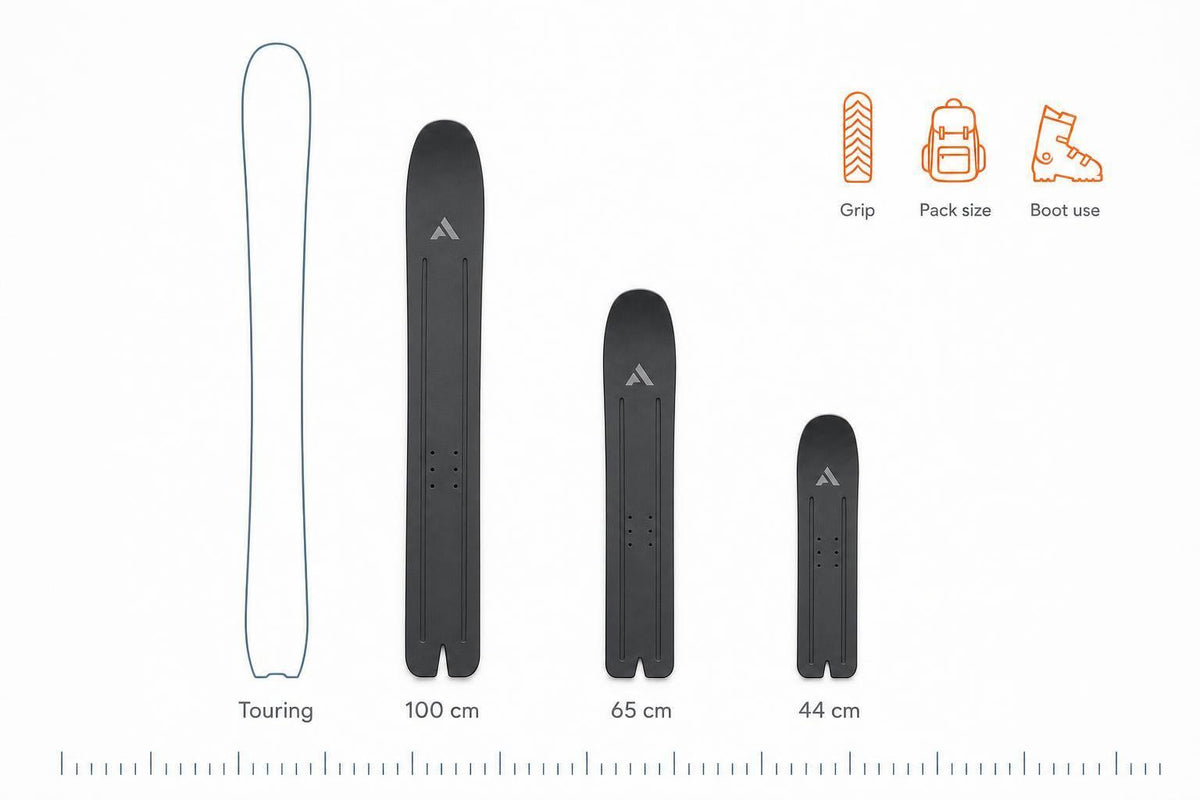
- The jump from 65 cm to 99 cm adds about 52% more length
- The jump from 99 cm to 120 cm adds about 21% more length
- A 170 cm ski is about 72% longer than a 99 cm skiblade
That extra length is why full skis feel calmer at speed. But it’s also why they’re more of a pain in the parking lot, lodge, car, and lift line. Yep, the walk from the lot counts too :)
If you want a simple rule, here it is: pick 99 cm for balance, 120 cm for firmer and faster days, and 65 cm if packing light matters most.
If you want to see how each one stacks up on ice grip, speed feel, and travel use, the full article breaks it down.
1. Snowfeet* Skiblades 65 cm
If max agility matters more than stability, the 65 cm is the smallest Snowfeet* option. It’s the most nimble pick in the lineup, but it also gives up the most stability on icy East Coast hardpack.
That trade-off is very real. At 65 cm, these skiblades turn the fastest, but they feel the least settled once you pick up speed. They fit beginners, casual riders, and park skiers who want quick moves more than a planted feel. If firm snow confidence is your top thing, the longer 99 cm or 120 cm options will feel easier and more forgiving. On true East Coast boilerplate, the short length is playful and reactive, but it’s not the easiest ride when conditions get scraped off and slick.
The big win here is portability. The short length is easy to pack, easy to carry, and light for travel. That makes it a smart pick if convenience comes first. Go with the 65 cm only if portability and fast turns matter more than confidence on firm, chattery runs.
If you want more stability without giving up that short-ski feel, the 99 cm model is the next move.
2. Snowfeet* Skiblades 99 cm
The 99 cm Snowfeet* Skiblades are the best all-around pick for East Coast hardpack. They’re short enough to turn fast, but long enough to feel planted. That middle ground matters most on scraped-off groomers, where quick turns and edge hold matter more than flat-out speed.
Edge grip is better than the 65 cm version. The extra running length gives you more contact with the snow, so you can hold an edge through a full turn on scraped-off pitches instead of feeling twitchy halfway through. Keep the edges sharp if you want the best bite on boilerplate. Still, they won’t match a 170 cm frontside carver on true blue ice. The edge is shorter, and there’s no way around that. If you start charging steep hardpack at high speed, they’ll begin to feel nervous. That’s where old-school carvers still have the edge. But for linking short- to medium-radius turns on a busy blue or a moderate black, the 99 cm length does the job well.
On normal East Coast groomers, the 99 cm length feels stable and still stays easy to redirect on narrow, crowded runs. The centered stance feels steady and easy to manage, which helps on icy pitches. In tight spots like lift-line traffic, icy cat tracks, or a surprise mogul field, they’re more predictable than the 65 cm version and quicker to redirect than the 120 cm short skis.
A few setup notes:
- Alpine boots give you the sharpest edge response on ice.
- Snowboard boots feel more comfortable, but they soften the response.
- They’re light enough to carry through a full resort day.
- Their compact size also makes travel easy.
If you want the same length with a looser feel in softer snow, the POWDER 99 is next.
3. Snowfeet* POWDER Skiblades 99 cm
Compared with the standard 99 cm, the POWDER version gives up a bit of ice bite and gives you more room for error. The length stays the same, but the base is wider. That makes it a better pick for mixed conditions, especially when smooth groomers turn into chopped-up messes by noon. The extra width helps in soft patches and broken snow.
On ice, edge grip is a touch softer than the standard 99 cm. The wider platform spreads your weight across more surface area. That’s nice in softer snow, but it also means less concentrated edge pressure on hardpack. So yes, it still carves on firm snow. It just won’t dig in as hard as the narrower 99 cm when things get slick. If your home mountain is icy most of the season, the standard 99 cm will grip better.
It still feels quick enough for tight East Coast runs, which matters when trails get narrow and busy. But its big plus is how much smoother it feels in refrozen chunks and piled-up snow near the sides of the trail. That’s where this model starts to make a lot of sense. Compared with the standard 99 cm, it trades some sharpness on ice for a smoother, more forgiving ride in mixed snow.
This is the one for riders who want a single skiblade that still feels good after the morning corduroy is gone and the mountain gets a little beat up.
For icy East Coast mornings, alpine ski boots give you sharper energy transfer and better edge hold. Snowboard boots feel more laid-back, but they dull the response on hard snow. And, like the other 99 cm option, it’s still much easier to pack than 170 cm frontside skis. If you want more stability and a steadier feel than either 99 cm model, move up to the 120 cm short skis.
4. Snowfeet* Short Skis 120 cm
If the 99 cm models feel a bit too loose on icy East Coast groomers, the 120 cm Short Skis are the next move. They sit in a nice middle ground: more planted on firm snow, but still way less work than full-length skis.
The biggest step up is edge grip. Compared with the shorter Snowfeet* models, the 120 cm version gives you more edge on the snow and a deep sidecut. In plain English, that means a stronger hold on scraped-off hardpack. When the surface gets polished and slick, these are much better at carving instead of washing out into a skid. And on East Coast ice, that matters. A lot.
Stability at speed also gets better here. The 120 cm feels calmer than the shorter Snowfeet* options, but it still turns and pivots much more easily than a 170 cm frontside ski. That’s a sweet setup for busy resort days.
Here’s where they work well:
- Hardpack and firm groomers
- Narrow, crowded runs
- Days when you want fast turns without hauling around long skis
They hold a clean line on the kind of hard snow you get at many East Coast resorts. No, they won’t match a dedicated 170 cm frontside ski at race speeds. But for a normal day on packed trails, they do the job well. The short length and tight sidecut also help when traffic gets messy. You can change direction fast and pivot in tight spots without the swing weight of longer skis. That’s a big plus when the run feels more like a slalom course through people :)
Boot options are simple. The 120 cm Short Skis are built mainly for standard ski boots and ski bindings. That gives you sharp power transfer and precise edge response. They’re also much easier to travel with than full-length skis, which keeps things simple off the mountain too.
If you’re comparing Snowfeet* to a normal frontside ski, this is the model that makes the most sense to stack up against a 170 cm setup.
sbb-itb-17ade95
5. Typical Frontside Skis (170 cm class)
Compared with the 120 cm Snowfeet* Short Skis, a 170 cm frontside ski gives up some quick pivoting for more confidence once you pick up speed. This is the long-ski yardstick for icy East Coast groomers: strong edge hold, steady speed, and clean carving.
Edge grip on ice is where these skis pull ahead. Their build bites into refrozen snow and stays calmer when the trail gets chattery.
Stability at speed is the other big plus. At 170 cm, you get more running length under your feet. That helps the ski track straighter, smooth out rutted snow, and feel calmer when you push the pace on a steep blue or black groomer. If you’re an advanced East Coast skier and like to ski fast, that extra length can make a big difference.
The downside? Slower pivoting, plus more baggage, more storage needs, and more gear to haul than Snowfeet*. That’s the trade. For casual riders, or for people who care more about easy travel and playful laps than top-end grip, the performance gap gets smaller fast. Meanwhile, the convenience gap gets much bigger.
So, the long-ski edge matters most for aggressive skiers. Most resort riders, though, may get more day-to-day use out of Snowfeet*.
That sets the performance baseline before looking at older short-ski designs. Next up: older snowblade designs like Salomon Snowblades and Summit EZ.
6. Typical Snowblade Competitor (Salomon Snowblades / Summit EZ class)
Salomon Snowblades and Summit EZ skiboards land in that in-between zone: not as tiny as short skiblades, not as long as full skis. But let’s be honest, they still sit much closer to standard alpine gear than Snowfeet*. A good current example is the Summit EZ 95 cm - a 95 cm skiboard with a sharp-edge setup, priced from $295 to $595 based on the binding setup.
Salomon Snowblades are mostly older gear at this point, and you’ll usually find them on the used market. They still matter, though. They show what older short-ski designs do well, and where Snowfeet* takes a simpler path.
Ice grip is good when the edges are sharp. That’s the catch. On icy patches, edge sharpness makes a big difference, and dull edges can wreck your confidence fast.
Stability at speed is decent for the size. At 95 cm, the Summit EZ feels more planted than ultra-short blades on groomed corduroy. Still, it gets knocked around more than a 170 cm frontside ski once the hardpack turns choppy.
Quick turns are one of its strong points. On crowded East Coast runs, that short length makes it easy to pivot and thread through narrow, busy trails without much drama.
The biggest downside next to Snowfeet* is travel and boot setup. Most snowblades in this class use standard ski bindings, which means you’ll usually need ski boots too. Snowfeet* is easier to pack, easier to carry, and just less of a hassle on a packed resort day. That’s why this class makes a good benchmark for the side-by-side comparison below.
How They Compare: Ice Grip, Stability, Control, and Travel
Here’s the clean side-by-side look at the six options that matter most on East Coast ice. And yeah, the trade-offs show up fast once you line them up.
| Option | Ice Grip | Stability at Speed | Quick-Turn Control | Portability & Boot Options | Ideal Rider | Best East Coast Use Case |
|---|---|---|---|---|---|---|
| Snowfeet* Skiblades 65 cm | Moderate | Low–Moderate | ★★★★★ | Excellent - fits ski and snowboard boots, packs in luggage | Beginners, casual riders, travelers | Groomed blues/greens, crowded runs, short resort days |
| Snowfeet* Skiblades 99 cm | Good | Good | ★★★★☆ | Great - compact enough for travel, ski-boot compatible | Intermediate to advanced recreational riders | All-day hardpack and icy groomers - best all-around pick |
| Snowfeet* POWDER Skiblades 99 cm | Moderate on ice | Moderate | ★★★★☆ | Great - same compact length, easy to pack | Mixed-conditions riders, spring slush days | Variable surfaces, freeze-thaw cycles - not the top pure-ice choice |
| Snowfeet* Short Skis 120 cm | Very Good | Very Good | ★★★☆☆ | Good - still more portable than 170 cm skis, but needs a longer bag | Skiers who want stability and speed | Icy steeps, faster groomers, late-day refrozen hardpack |
| Typical 170 cm Frontside Ski | Excellent | Excellent | ★★☆☆☆ | Poor - bulky bags, roof racks, standard ski boots required | Dedicated performance skiers | High-speed carving on demanding East Coast groomers |
| Salomon Snowblades / Summit EZ class | Good (when edges are sharp) | Moderate | ★★★☆☆ | Moderate - shorter than 170 cm but still uses ski boots | Playful riders familiar with blade-style skiing | Fun, lower-speed runs and park environments |
Start with the model that matters most for hardpack: for most East Coast riders, the 99 cm model gives the best mix of edge hold and fast direction changes.
- 99 cm standard - the best mix of grip and quick turns for most East Coast resort days.
- 120 cm - pick this for faster, icier groomers where stability matters more than pivot speed.
- 65 cm - the easiest to carry and the fastest to learn on, but it gives up stability on ice.
- POWDER 99 - the wider platform helps in softer or chopped-up snow, but it loses some bite on pure ice. Pick it only if you split time between hardpack and softer snow.
Pros and Cons of Each Option
Here’s the quick breakdown for picking the right Snowfeet* length for icy East Coast runs. On hardpack, every choice comes with a trade-off.
| Option | Pros | Cons | Best For | Price Range (USD) |
|---|---|---|---|---|
| Snowfeet* Skiblades 65 cm | Easiest learning curve; ultra-portable; works with ski or snowboard boots | Feels less secure on steep, icy runs; not ideal for riders who want to push pace | Beginners, casual resort riders, travelers | ~$450–$590 |
| Snowfeet* Skiblades 99 cm | Best all-around balance of edge grip and quick turns; versatile across groomed runs | Less stability than 120 cm or 170 cm skis; not built for high-speed carving | Intermediate recreational riders, all-day hardpack sessions | From $690 |
| Snowfeet* POWDER Skiblades 99 cm | Wider platform handles soft snow and variable conditions well; good for mixed terrain | Wider shape gives up some ice bite on boilerplate hardpack | Mixed-conditions days, freeze-thaw cycles, softer snow trips | ~$590–$690 |
| Snowfeet* Short Skis 120 cm | Strong edge hold on icy groomers; best stability in the Snowfeet* lineup; still more portable than 170 cm skis | Slower to pivot than shorter models; less nimble in tight turns | Faster riders, icy steeps, late-day refrozen hardpack | ~$650–$790 |
| Typical 170 cm Frontside Ski | Best at high-speed carving and ice grip | Bulky and heavy; poor portability; requires dedicated ski boots | Advanced carvers, speed-focused riders | ~$500–$900 (with bindings) |
| Salomon Snowblades / Summit EZ class | Shorter than 170 cm skis; approachable for beginners | Requires ski boots; less portable than Snowfeet* models | Beginners to intermediates, fun-focused riders at moderate speeds | ~$295–$700 |
The pattern is pretty clear: 65 cm leans into portability, 99 cm hits the middle ground, and 120 cm leans into stability.
Long skis still have the edge when speed gets high and the ice gets nasty. That part is real. But for most casual East Coast resort riders, Snowfeet* models are easier to deal with day to day and simpler to handle once you're out there.
Salomon Snowblades and Summit EZ land somewhere between short skiblades and full skis. But there’s a catch: they still need ski boots, and they’re not as easy to carry around as Snowfeet*.
Final Verdict: Which Length Fits Your East Coast Skiing
Pick the length that lines up with how you ski: your speed, how often you hit ice, and how much you care about easy packing.
Here’s the short version: start with 99 cm, move to 120 cm if you want more speed control, drop to 65 cm if portability comes first, or go with POWDER 99 for softer snow.
If you spend most of your time on icy groomers at moderate speed, 99 cm Skiblades are the best all-around pick. If you want the safest bet for most East Coast days, start there.
If you like that same easy feel but want more calm on ice, step up to 120 cm. Choose the 120 cm Short Skis if you want more control at speed and stronger edge hold than the 99 cm. The downside? They’re less nimble in tight spots and harder to pack. That’s the trade.
If packing light matters more than speed, go with 65 cm. Choose the 65 cm if easy transport and playful laps matter more than confidence at higher speeds on ice.
The POWDER 99 makes sense for riders who split their time between hardpack and softer, chopped-up snow. On pure ice, the standard 99 cm is still the sharper tool.
If you ski fast on icy groomers, a 170 cm frontside ski still gives you the best top-end grip and stability. But for most casual riders, Snowfeet* is the better fit. For most East Coast skiers, Snowfeet* gives up little that matters and gives you a lot back in ease, fun, and convenience.
FAQs
Do I need sharp edges for East Coast ice?
Yes. Sharp edges matter on East Coast ice. Firm, machine-made snow and icy patches demand solid grip and control.
Snowfeet* Skiblades are made for that kind of surface. They use metal edges and a deep parabolic sidecut, which helps them bite into slick snow with more precision.
For the best hold:
- Keep the edges tuned
- Lean into your carves
- Stay centered and let the edges do the work
On ice, dull edges are like bald tires. They’ll slide when you need them to grip most.
Should I choose 99 cm or 120 cm for my skill level?
It comes down to what matters more to you: easy handling or more stability at speed.
For most resort riders, the 99 cm is the best all-around pick. It gives you a nice middle ground: stable enough to feel in control, but still easy to turn and manage on groomed runs. If you want one option that does a bit of everything without a fuss, this is it.
Go with the 120 cm if you want more confidence when you’re moving fast, stronger carving, and a ride that feels closer to regular skis. The trade-off? It’s less nimble and a bit heavier to carry around.
Are Snowfeet* skiblades harder to learn than regular skis?
No. Snowfeet* skiblades are usually easier to learn than regular skis.
Why? Their short, lightweight build makes turning and stopping much easier to pick up. For a lot of riders, the basics click within a day - sometimes in just a few runs.
They also take less muscle to control and often feel more natural on hardpack and ice. That can help new riders build confidence faster than with full-length skis.











コメントを残す
このサイトはhCaptchaによって保護されており、hCaptchaプライバシーポリシーおよび利用規約が適用されます。