



















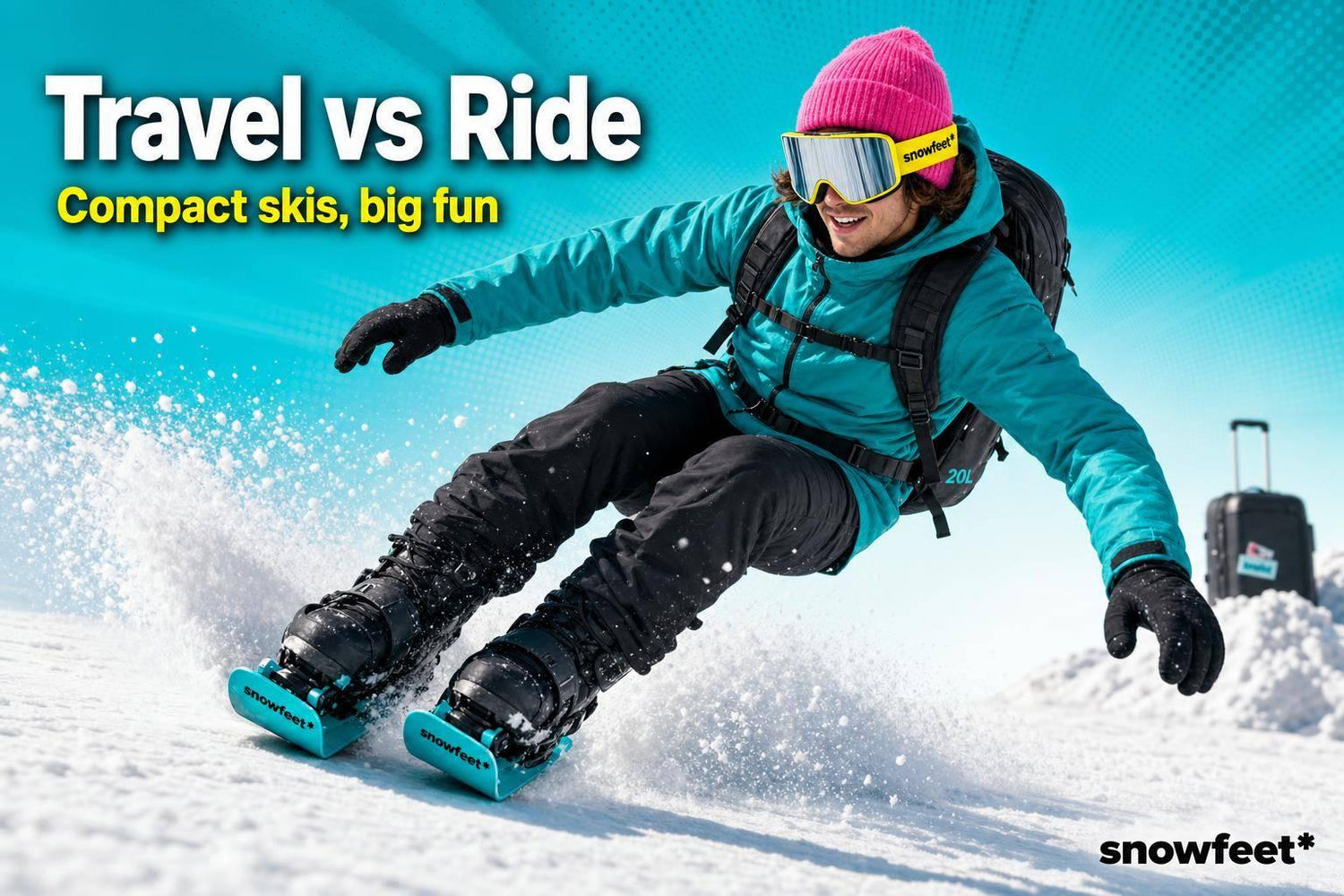
Oui, si votre objectif principal est de voyager plus facilement, le matériel de ski compact peut en valoir la peine. D’après ce que je constate, Snowfeet* est surtout adapté aux escapades de week-end, aux voyageurs légers, aux débutants et aux familles qui privilégient un format compact, un rangement simple et l’absence de longue housse à skis plutôt que la puissance maximale en descente.
Voici la version courte :
- _Snowfeet existe en 3 tailles :_* 44 cm, 50 cm et 65 cm
- Les skis classiques mesurent souvent environ 150–180 cm et plus
- La courte longueur signifie que Snowfeet* peut se ranger dans de nombreuses valises, sacs de voyage, coffres et placards
- Les prix commencent à $299
- Le compromis est simple : vous profitez de voyages plus faciles, mais renoncez à une partie de la stabilité, de la vitesse et de la portance en poudreuse
- Idéal pour :
- Skiskates de 44 cm : voyageurs légers, pratique ludique
- PRO de 50 cm : débutants, familles, prix d’entrée plus accessible
- Skiblades de 65 cm : les pratiquants en station qui recherchent des sensations plus proches de celles des skis
Si vous prenez souvent l’avion, détestez les coffres de toit ou ne voulez pas traîner un équipement gigantesque dans un aéroport comme si vous déménagiez, ce type de configuration est une option intelligente :) Si vos voyages sont entièrement consacrés à la poudreuse profonde, aux terrains escarpés et au carving à grande vitesse, les skis classiques ou un snowboard restent plus adaptés.
Les skiskates les plus polyvalents au monde - Snowfeet* PRO
Comparaison rapide
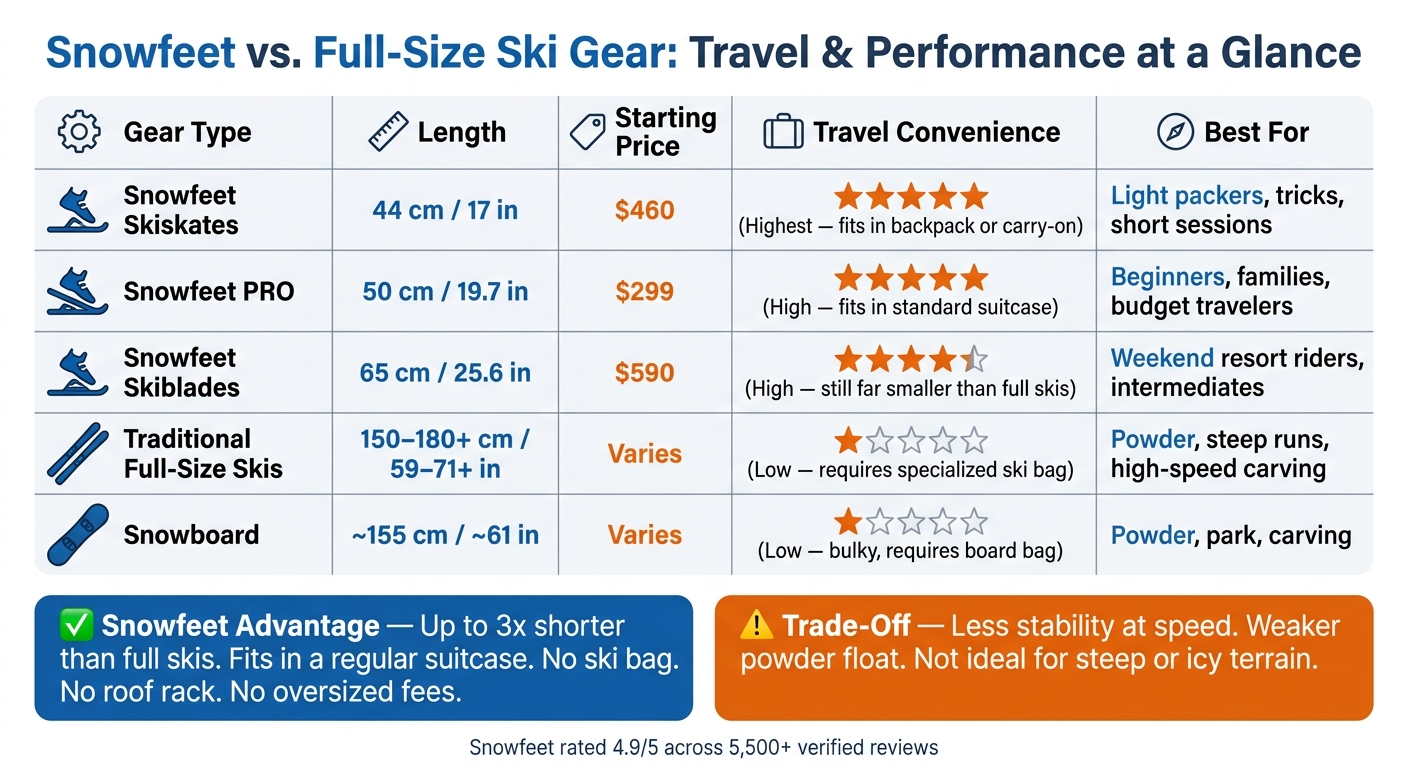
Snowfeet contre le matériel de ski classique : comparaison voyage et performance
| Matériel | Longueur | Idéal pour | Principal avantage | Principal inconvénient | Prix de départ |
|---|---|---|---|---|---|
| Skiskates Snowfeet* | 44 cm / 17 po | Voyageurs légers, figures, courtes sessions | Se range dans de nombreux sacs | Le moins stable à vitesse élevée | $460 |
| PRO Snowfeet* | 50 cm / 19,7 po | Débutants, familles, pratiquants privilégiant les voyages | Le prix d’entrée le plus accessible, facile à ranger | Moins bonne accroche des carres sur les descentes raides | $299 |
| Skiblades Snowfeet* | 65 cm / 25,6 po | Journées en station sur pistes damées, skieurs intermédiaires | Les sensations les plus proches de celles des skis | Toujours moins performant en neige profonde | $590 |
| Skis grandeur classique | 150–180+ cm / 59–71+ po | Pistes damées rapides, poudreuse, descentes raides | Plus stable et mieux ancré | Difficile à ranger et à transporter | - |
| Snowboard | ~155 cm / 61 po | Poudreuse, carving, snowpark | Une meilleure portance que le matériel court | Volumineux à transporter | - |
Mon avis : le matériel de ski compact est un choix axé d’abord sur le voyage, et non sur la performance. Et si c’est le problème que vous cherchez à résoudre, Snowfeet* s’en sort très bien.
Comment Snowfeet* facilitent les voyages
C’est ici que l’avantage en voyage cesse de sembler séduisant sur le papier et commence à être utile lors de vrais déplacements.
Comment le matériel court se range dans les bagages en soute et les bagages à main
Snowfeet* résout le principal problème des voyages : la longueur. Les skis adultes standard mesurent environ 170 cm, soit environ 67 pouces. Un snowboard mesure environ 155 cm, soit 61 pouces. Tous deux nécessitent généralement un sac à skis ou un sac pour planche, ce qui complique les déplacements à l’aéroport et peut entraîner une prise en charge comme bagage hors format.
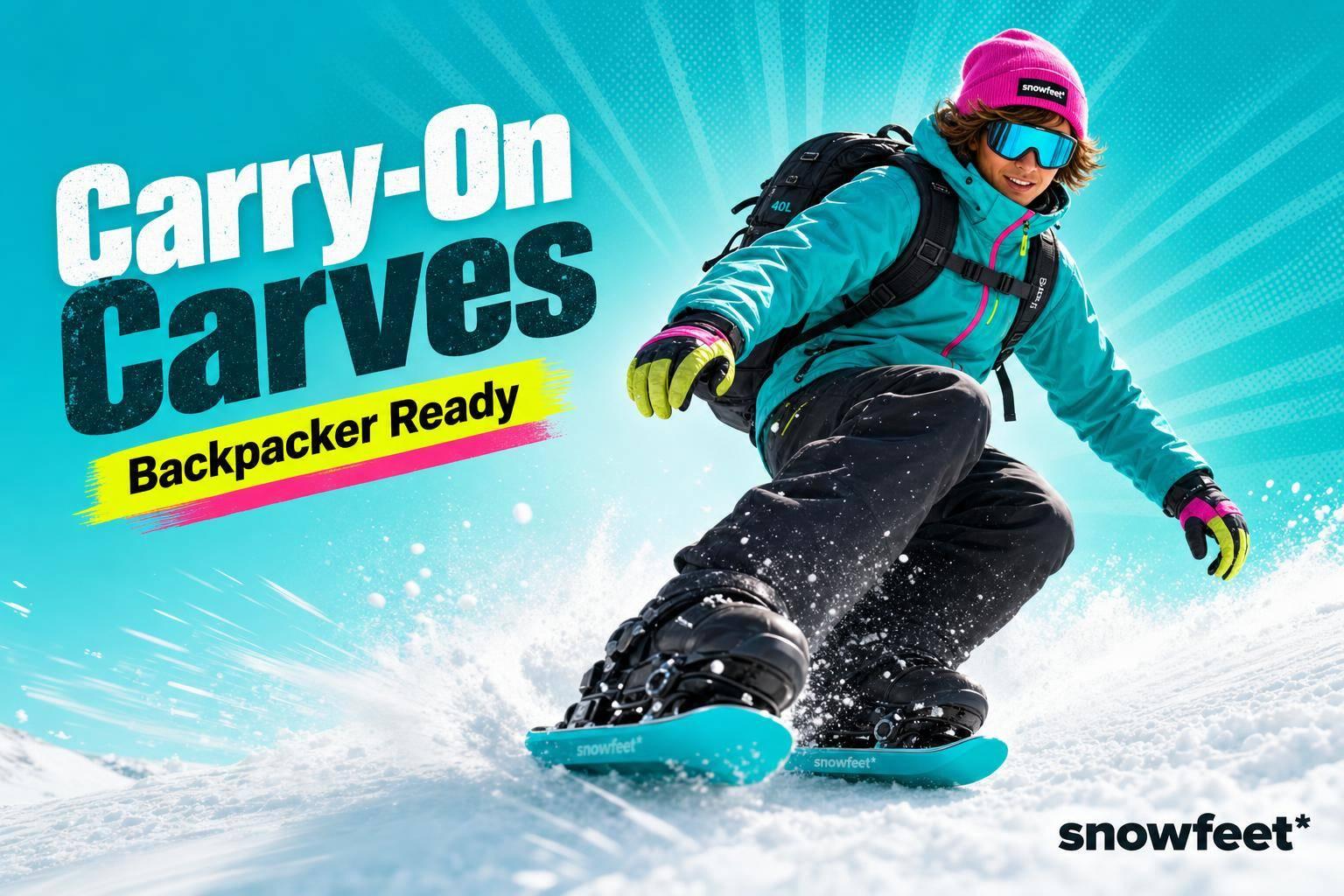
Snowfeet* existe en plusieurs tailles bien plus courtes : 44 cm (17 po), 50 cm (19,7 po) et 65 cm (25,6 po). Ces modèles peuvent donc tenir dans une valise standard enregistrée ou un sac de voyage. Les Skiskates de 44 cm sont souvent suffisamment petits pour de nombreux bagages cabine ou sacs à dos, selon les règles de taille de la compagnie aérienne. Alors oui, pas besoin de sac à skis ni de longue housse à traîner dans le terminal.
| Produit | Longueur | Sac généralement nécessaire | Facilité de transport |
|---|---|---|---|
| Skiskates | 44 cm (17 po) | Sac à dos / bagage cabine | La plus élevée — tient dans la plupart des sacs standard |
| Snowfeet PRO | 50 cm (19,7 po) | Valise standard / sac de voyage | Élevée — très facile à ranger |
| Skiblades | 65 cm (25,6 po) | Valise standard / sac de voyage | Élevée — tout de même bien plus petit que des skis traditionnels |
| Skis traditionnels | ~170 cm (~67 po) | Sac spécialisé pour skis | Faible — long et encombrant à enregistrer |
| Snowboard | ~155 cm (~61 po) | Sac spécialisé pour planche | Faible — encombrant et plus difficile à manipuler |
Comment un équipement compact trouve sa place dans les voitures, les coffres et les espaces de rangement à la maison
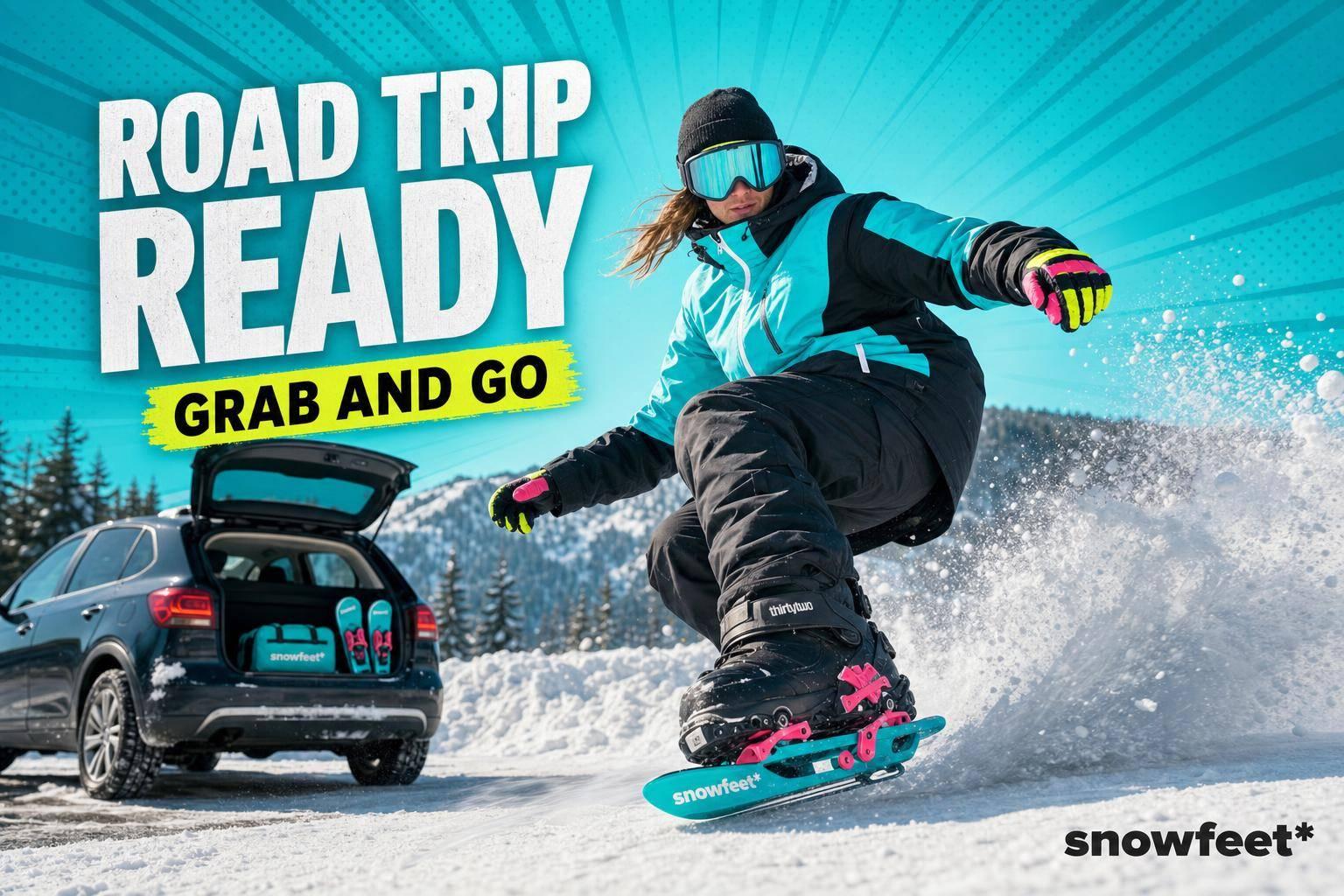
Les trajets en voiture sont eux aussi plus simples. La galerie de toit est l’un des plus grands désagréments des séjours au ski. Les skis traditionnels en nécessitent souvent une. L’équipement Snowfeet* n’en a pas besoin. Il tient dans le coffre d’une voiture compacte, sur la banquette arrière ou même dans un véhicule de transport avec chauffeur, sans transformer tout le trajet en casse-tête logistique.
Snowfeet* est également plus léger et plus facile à transporter que des skis traditionnels.
Et cela est tout aussi utile à la maison que sur la route. L’équipement Snowfeet* peut rester sur une étagère ou dans un coin de placard, être rangé entre deux sorties et être prêt pour une escapade improvisée le week-end. Pas besoin de support mural. Pas besoin d’aménager le garage. Il suffit de le prendre et de partir.
| Type de produit | Tient dans le coffre d’une voiture compacte | Nécessite une galerie de toit | Encombrement pour le rangement à la maison |
|---|---|---|---|
| Snowfeet* (44–65 cm) | Oui | Non | Minimale — étagère ou coin de placard |
| Skis traditionnels | Rarement | Généralement oui | Grande — support mural ou espace dans le garage |
| Snowboard | Rarement | Souvent oui | Moyenne à grande |
Compatibilité avec les chaussures et conséquences pour voyager léger
De nombreux modèles Snowfeet* sont compatibles avec des chaussures d’hiver robustes ou des chaussures de snowboard, ce qui permet souvent de ne pas emporter de sac à chaussures séparé. Les Snowfeet PRO de 50 cm se distinguent ici, car ils sont compatibles avec des chaussures d’hiver robustes. Les Skiskates et les Skiblades existent également en versions conçues pour les chaussures de snowboard, et certains modèles sont aussi vendus avec des fixations pour chaussures de ski.
Pour les familles, cela peut réduire considérablement les contraintes d’un séjour. Si chacun peut utiliser les chaussures d’hiver qu’il possède déjà, les bagages sont plus simples à préparer, le chargement et le déchargement demandent moins d’efforts, et il y a moins d’équipements à surveiller. En contrepartie, la vitesse et la stabilité sont inférieures à celles des skis traditionnels.
Voilà l’avantage côté transport ; la suite concerne ce que vous abandonnez une fois sur la neige.
sbb-itb-17ade95
Ce que vous abandonnez par rapport aux skis traditionnels
L’équipement compact résout un gros problème de transport. Sur ce point, c’est évident. Mais il ne peut pas tout faire comme des skis grandeur classique ou un snowboard.
La question principale est donc simple : quelles performances abandonnez-vous une fois sur la neige ?
Vitesse, stabilité et performances en neige profonde
Les skis plus longs sont plus stables lorsque la vitesse augmente. Ils gardent davantage de carre en contact avec la neige, ce qui compte beaucoup lors de virages appuyés, dans des conditions difficiles ou lors de descentes rapides sur des pistes damées et pentues.
Un équipement plus court offre moins de contact avec les carres. Il peut donc sembler plus saccadé, moins fermement posé et un peu moins rassurant lorsque vous commencez à accélérer.
La poudreuse est un autre point faible des équipements compacts. Les skis courts offrent moins de portance dans la neige profonde que les skis longs. Si votre séjour est entièrement consacré à la poudreuse légère, aux descentes répétées en haute montagne ou aux descentes rapides, les skis grandeur classique ou un snowboard restent les meilleurs choix.
Snowfeet* face aux skis longs, aux snowboards et aux autres marques de skis courts
Il existe d’autres options de skis courts. Mais Snowfeet* reste la solution la plus axée sur le voyage. Sa conception privilégie avant tout un rangement compact, ce qui est exactement ce qui compte le plus pour de nombreux voyageurs.
| Modèle / marque | Longueur | Idéal pour | Principal compromis |
|---|---|---|---|
| Snowfeet* Skiskates | 44 cm (17 po) | Glisse, petites pentes, figures | Moins stables à grande vitesse |
| Snowfeet* PRO | 50 cm (19,7 po) | Pistes damées, glisse polyvalente | Moins d’accroche sur les terrains escarpés |
| Snowfeet* Skiblades | 65 cm (25,6 po) | Virages, vitesses modérées | Moins de portance dans la neige poudreuse |
| Skis grandeur classique | 150+ cm (59+ po) | Poudreuse profonde, vitesse élevée, virages | Encombrants à transporter |
| Snowboard | ~155 cm (~61 po) | Poudreuse, snowpark, virages | Encombrants à transporter |
| Salomon Snowblades | 90–99 cm (35–39 po) | Virages avec des skis courts | Moins pratiques à transporter que Snowfeet* |
La section suivante associe chaque modèle Snowfeet* au type de séjour et au budget auxquels il convient le mieux.
Quel modèle Snowfeet* convient à votre séjour et à votre budget ?
Skiskates 44 cm, PRO 50 cm et Skiblades 65 cm côte à côte
Chaque modèle convient à un type de séjour différent. Les principaux éléments à comparer sont le rangement, le type de chaussures et les sensations sur la neige.
| Modèle | Longueur | Prix de départ | Options de chaussures | Sensations sur la neige | Idéal pour |
|---|---|---|---|---|---|
| Snowfeet PRO | 50 cm (19,7 po) | $299 | Chaussures de ski ; certaines versions pour chaussures de snowboard | Tolérants, polyvalents | Débutants, familles, voyageurs soucieux de leur budget |
| Skiskates | 44 cm (17 po) | $460 | Chaussures de ski ; certaines versions conviennent aux chaussures de snowboard ou aux bottes d’hiver à semelle rigide | Agiles, sensations proches du skateboard | Voyageurs qui voyagent léger, amateurs de figures |
| Skiblades | 65 cm (25,6 po) | $590 | Chaussures de ski | Stables, sensations les plus proches des skis traditionnels | Skieurs de station le week-end, skieurs de niveau intermédiaire |
Snowfeet* affiche une note de 4,9/5 sur plus de 5 500 avis vérifiés. De nombreux utilisateurs soulignent les deux mêmes avantages : il est facile à ranger et évite les files d’attente pour la location. À lui seul, cet aspect peut rendre une journée de ski plus agréable :)
Quand un équipement compact vaut son prix
Une fois les modèles comparés, l’étape suivante est simple : lequel vous offre le meilleur retour sur investissement pour votre voyage ?
Le PRO à 299 $ est le plus facile à choisir. Son prix de départ est le plus bas, il est compatible avec certains modèles de chaussures de snowboard et se montre tolérant pour les personnes qui essaient un équipement de ski compact pour la première fois. Si vous cherchez le point d’entrée le plus sûr, c’est celui qu’il vous faut.
Les Skiskates à 460 $ conviennent aux personnes qui aiment garder leur équipement dans le coffre tout l’hiver et profiter de séances rapides dès qu’une occasion se présente. Ils sont plus ludiques et peu encombrants, ce qui compte beaucoup si vous détestez transporter du matériel supplémentaire.
Les Skiblades à 590 $ conviennent aux skieurs qui veulent passer une journée entière en station et retrouver des sensations proches de celles des skis classiques, sans avoir à traîner un sac à skis sur le parking. Voilà tout leur intérêt.
À qui profite le plus l’équipement de ski portable
Après le prix, tout est une question d’adéquation. Pas l’adaptation aux chaussures, mais l’adaptation à la personne.
Les débutants et les familles tireront souvent le meilleur parti des PRO 50 cm. Ils sont tolérants d’une extrémité à l’autre, coûtent moins cher et offrent un juste milieu appréciable aux voyageurs qui veulent un équipement compact sans renoncer à trop de contrôle.
Les voyageurs qui voyagent léger sont le public idéal pour les Skiskates 44 cm. Si votre journée d’hiver peut inclure du ski, de la randonnée, des raquettes ou simplement beaucoup de déplacements, ils s’imposent rapidement. Ils tiennent dans un sac à dos standard pour les journées de randonnée et de ski, et Snowfeet* indique que la prise en main prend environ 5 minutes pour les personnes ayant déjà pratiqué le patinage.
Les adeptes des stations le temps d’un week-end qui souhaitent passer une journée entière sur des pistes damées se tourneront probablement vers les Skiblades 65 cm. Ils offrent la meilleure stabilité des trois options compactes, gèrent mieux les conditions variables en station et tiennent toujours dans un bagage enregistré sans frais de format hors normes.
Conclusion : Snowfeet* vaut-il la peine d’être emporté en voyage ?
La réponse courte pour la plupart des voyageurs
L’équipement de ski compact remplit très bien une mission : simplifier les déplacements à ski.
Les produits Snowfeet* mesurent deux à trois fois moins que des skis classiques, ce qui leur permet de tenir dans une valise enregistrée standard. Ils sont également plus faciles à ranger dans le coffre d’une voiture, un placard ou un sac de week-end. Pour les courts séjours, c’est leur principal atout.
Le compromis est assez simple. Les skis classiques restent supérieurs en matière de vitesse, de flottaison dans la poudreuse et de stabilité sur les terrains pentus ou verglacés. Il s’agit donc d’un choix axé sur le voyage, et non sur la performance.
Pour les voyageurs, le meilleur choix dépend d’un seul élément : l’importance accordée à la facilité de transport par rapport aux performances sur la neige. La compatibilité avec les chaussures permet également de voyager léger, ce qui constitue un avantage appréciable. Pour les personnes qui pratiquent le week-end, les débutants, les familles et celles qui aiment voyager léger, ce compromis penchera généralement en faveur de Snowfeet*.
Si la facilité de transport compte davantage que les performances maximales, Snowfeet* est le meilleur choix.
FAQ
Puis-je utiliser Snowfeet* au lieu de louer du matériel pour un week-end ?
Oui : les produits Snowfeet* peuvent être une excellente alternative à la location pour un week-end.
Leur format compact permet de les glisser facilement dans un sac à dos ou même une valise standard. Cela signifie moins de tracas à la station et moins de temps passé au magasin de location. Sympa, non ? :)
Ils fonctionnent également avec des chaussures d’hiver ordinaires ou des chaussures de snowboard, ce qui simplifie grandement les déplacements et réduit l’encombrement. Vous n’avez pas besoin de transporter tout un tas d’équipement simplement pour profiter de la neige.
Emporter votre propre équipement peut vous aider à :
- économiser sur les frais de location
- éviter les longues files d’attente à la location
- utiliser un équipement qui vous est déjà familier dès votre arrivée
Pour un court séjour, ce type de praticité peut faire une grande différence.
Snowfeet* convient-il aux débutants sur les pistes de station ?
Oui : les produits Snowfeet* conviennent très bien aux débutants sur les pistes de station.
Leur conception courte et légère est bien moins intimidante que celle des skis classiques de 1,80 m. C’est important lorsque l’on débute. Au lieu de lutter avec de longs skis, vous pouvez vous concentrer sur l’équilibre, les virages et les arrêts. Beaucoup de débutants commencent à se sentir à l’aise après seulement quelques descentes.
Elles donnent également davantage la sensation de patins à glace ou de rollers. La prise en main peut donc sembler moins abrupte. Pour beaucoup de débutants, cela les rend plus faciles à faire tourner, à arrêter et à contrôler.
Autre avantage appréciable : elles fonctionnent avec des chaussures d’hiver ordinaires. Vous pouvez ainsi éviter les chaussures de ski rigides qui mettent souvent les débutants mal à l’aise et leur font mal aux pieds.
Ai-je besoin de chaussures spéciales pour voyager avec Snowfeet* ?
Non. L’équipement Snowfeet* utilise des fixations réglables : vous n’aurez donc peut-être pas besoin d’acheter des chaussures spéciales.
Cela signifie que vous pouvez souvent utiliser des chaussures que vous possédez déjà, comme :
- chaussures de randonnée hivernale robustes
- chaussures de snowboard
Lorsque vous achetez Snowfeet*, choisissez simplement le type de fixation adapté aux chaussures que vous souhaitez utiliser.
Si vous voulez un contrôle optimal, vous pouvez également choisir des fixations compatibles avec les chaussures de ski.
Articles de blog associés
- Quels sont les meilleurs skis pour de rapides escapades le temps d’un week-end à la montagne ?
- À quoi sont destinés les « skis freeride » ? À la découverte des aventures hors-piste (2026)
- Des alternatives amusantes aux skis pour votre prochaine escapade hivernale
- La nouvelle façon de glisser sur la neige dont personne ne parle











Laisser un commentaire
Ce site est protégé par hCaptcha, et la Politique de confidentialité et les Conditions de service de hCaptcha s’appliquent.