



















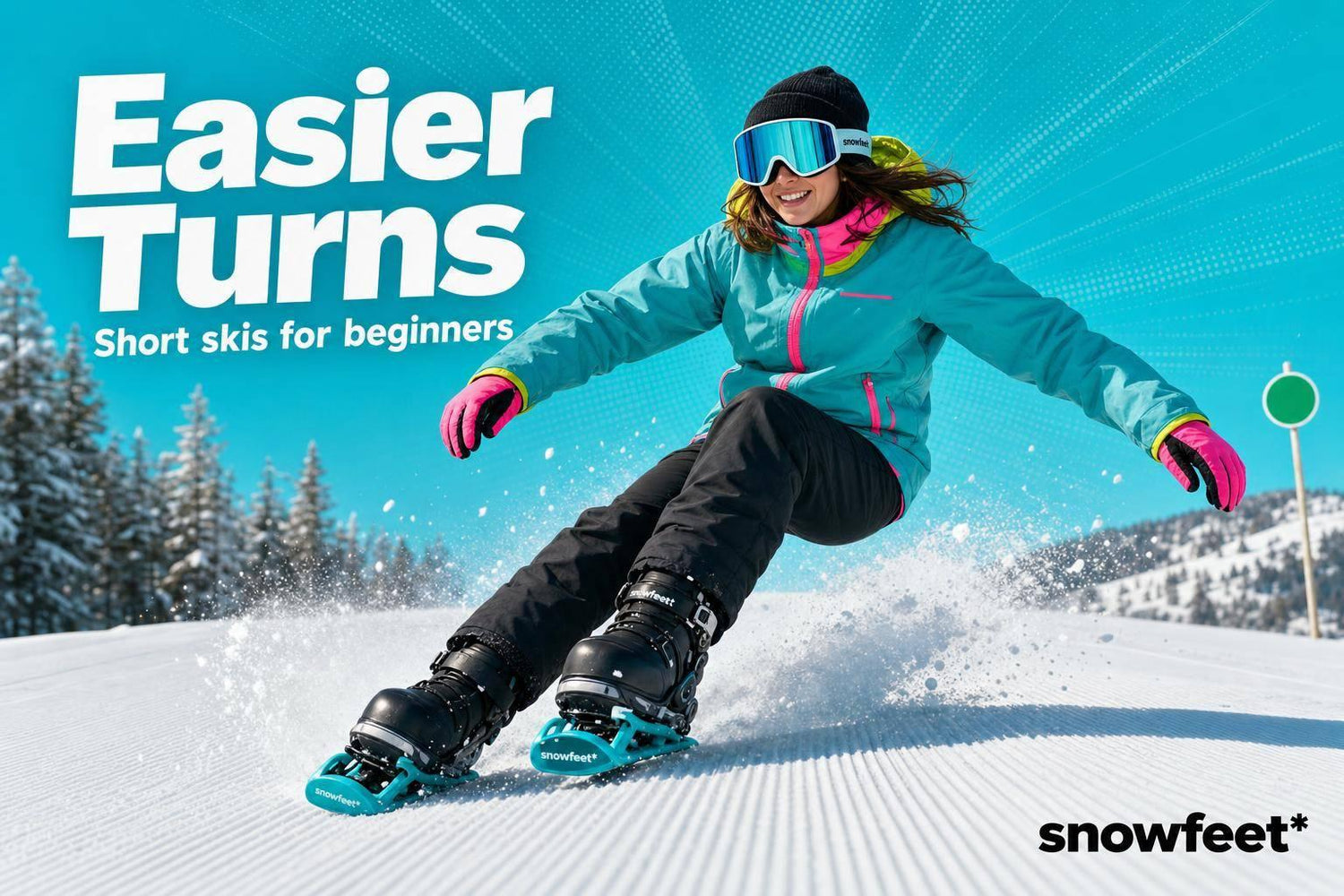
Short skis are easier for most new skiers because they take less effort to turn, stop, and carry. If a standard ski is often 59 to 71 inches long, a short ski may be just 17 to 39 inches. That smaller size gives you less ski to fight with on green runs, in lift lines, and on the chair.
If I had to sum it up in plain English, it’s this:
- Short skis turn with less effort
- They feel less bulky at low speed
- They’re easier to carry and line up
- They help nervous beginners feel more in control
- Long skis still do better at high speed, deep snow, and steep runs
For most first-day resort skiers in the U.S., that trade-off makes sense. You’re not bombing black diamonds. You’re trying to link turns, stop without panic, and avoid doing the awkward ski-walk from the parking lot like a baby giraffe :)
Snowboarder tries Snowfeet* | Which Snowfeet* Short Ski is the Best? | Snowblades 44, 65, 99 Review
Quick comparison
| Option | Length | Feels Like | Best For | Main Trade-Off |
|---|---|---|---|---|
| Standard adult skis | 59–71 in | More ski in front and behind you | Faster skiing, steeper terrain, powder | Harder to turn at low speed |
| Short skiblades | 26 in / 39 in | More direct, less bulky | Most beginners on groomed runs | Less calm at high speed |
| Skiskates | 17 in | Skate-like, very short | Nervous beginners, easy slopes | Least stable when going straight fast |
So, if you’re new, short skis often make the first day feel simpler: less weight, less awkwardness, and less work per turn. That’s the whole game at the start.
Why Long Skis Feel Harder To Control
Long Skis Require Wider Turns and More Commitment
Long skis like bigger, slower turns. That means a beginner has to commit sooner and with more force before the ski starts to respond. The turning radius is larger, so the ski doesn’t want to snap into a quick turn. To get it moving, you need to press harder and be more decisive.
That’s a tough ask when you’re still learning balance and edge control. It can feel less like guiding the ski and more like wrestling it a bit.
Shorter skis are easier at beginner speeds because they react to small shifts in weight. A little input goes a longer way. That’s why new skiers often feel more in control on shorter skis.
Longer Skis Are Harder To Carry and Manage
This doesn’t just show up on the mountain. It starts in the parking lot.
Long skis are bulkier and heavier, so they’re tougher to carry, tougher to move through a lodge or lift line, and more awkward on a chairlift. For kids, teens, and smaller adults, that extra length can make the whole day feel more stressful before the first run even starts.
Shorter, lighter gear takes some of that hassle off the table. From the walk in to the lift line, it’s just easier to handle. And for many new skiers, that alone is a pretty strong reason to go shorter.
Where Long Skis Still Perform Better
Long skis do have their place. They’re more stable at high speeds, float better in deep powder, and hold better on steep terrain.
But that’s not where most beginners spend their time. Most are skiing groomed runs at lower speeds, where quick turns and easy control matter more. In that setting, the upsides of long skis just don’t help as much as shorter skis do.
sbb-itb-17ade95
Why Short Skis Are Easier for New Skiers
Long skis can feel slow and awkward at first. Short skis change that fast. They react sooner, feel easier to steer, and give new skiers less ski to wrestle with.
Faster Turns and Better Control at Low Speeds
A shorter ski is easier to pivot. That means beginners can turn with less effort and less fight. On easy groomed runs, that quicker response helps new skiers stay calm and in control while they build confidence.
Lighter Weight and Easier Handling On and Off the Slope
That shorter length helps before you even start skiing. Short skis are easier to carry through the parking lot, move in the lift line, and deal with on a chairlift. Less awkward gear means fewer clumsy moments. And, honestly, that matters a lot when you're new.
A Better Fit for Groomed Resort Slopes
Snowfeet* skiblades also give you a wider base underfoot, which helps with stability on groomed resort runs. At the same time, they stay much easier to turn than long skis. So they line up better with the kind of terrain most beginners ski.
Once you know short skis fix the control problem, the next step is picking the right length.
How To Pick the Right Short Ski Length
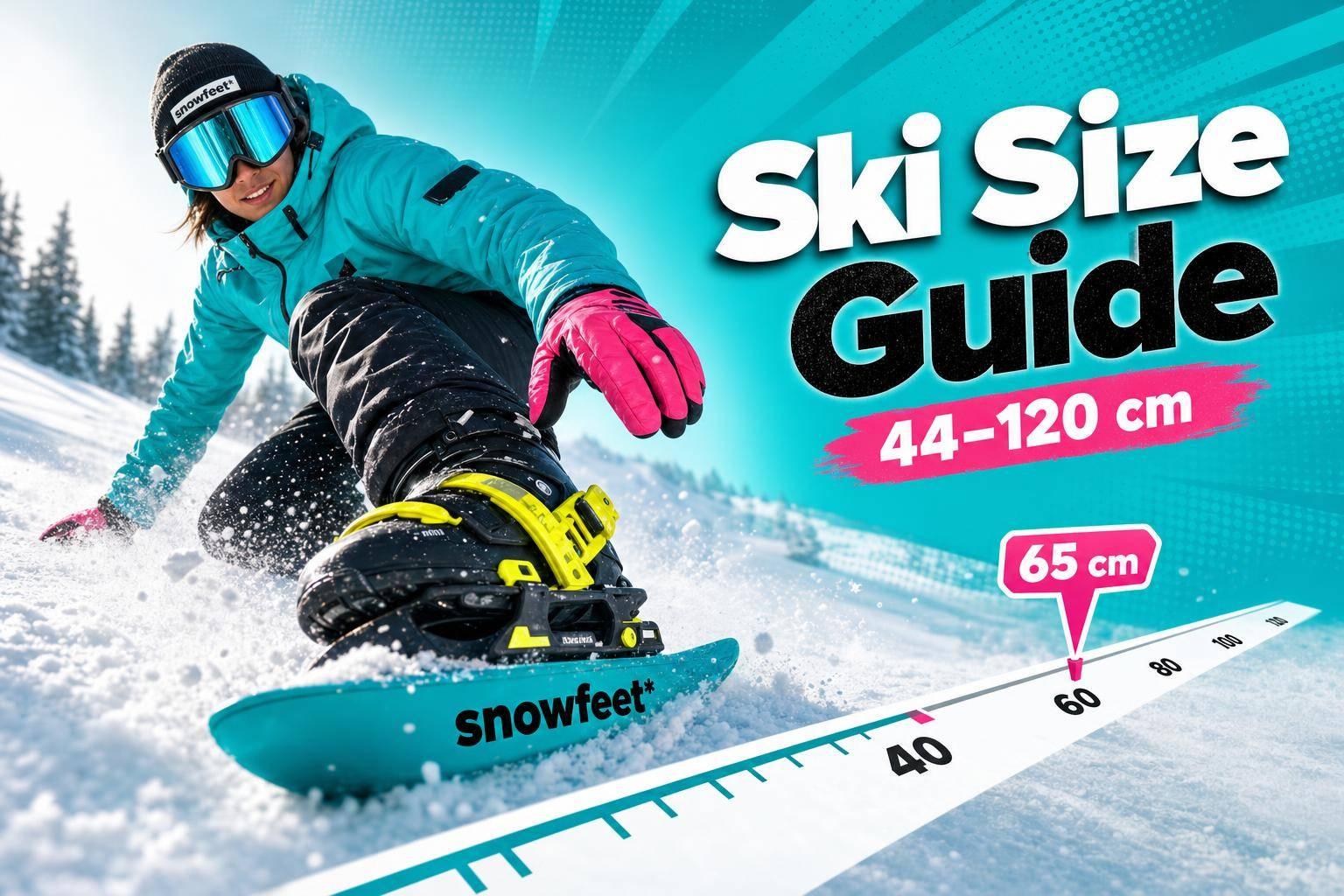
The right length comes down to three things: how comfortable you are with speed, your body size, and where you plan to ski. Snowfeet* offers three lengths that fit the most common beginner needs.
Snowfeet* Skiskates 44 cm: Best for Easy, Low-Pressure Skiing
At 44 cm, these feel a lot like skates on snow. There’s almost no tail behind your boot, which means they turn fast and feel easy to control. That makes them a good match for easy beginner slopes and for anyone who wants to cruise without a lot of pressure.
Snowfeet* Skiblades 65 cm: A Balanced Option for Most Beginners
The 65 cm Skiblades are the best all-around pick for most first-time U.S. resort skiers. They feel more stable than the 44 cm Skiskates when you glide straight or start going a bit faster. You also get more edge contact, which helps with grip on groomed resort snow, especially on green and easy blue runs at most resorts.
Snowfeet* Skiblades 99 cm: More Stability for Faster Learners
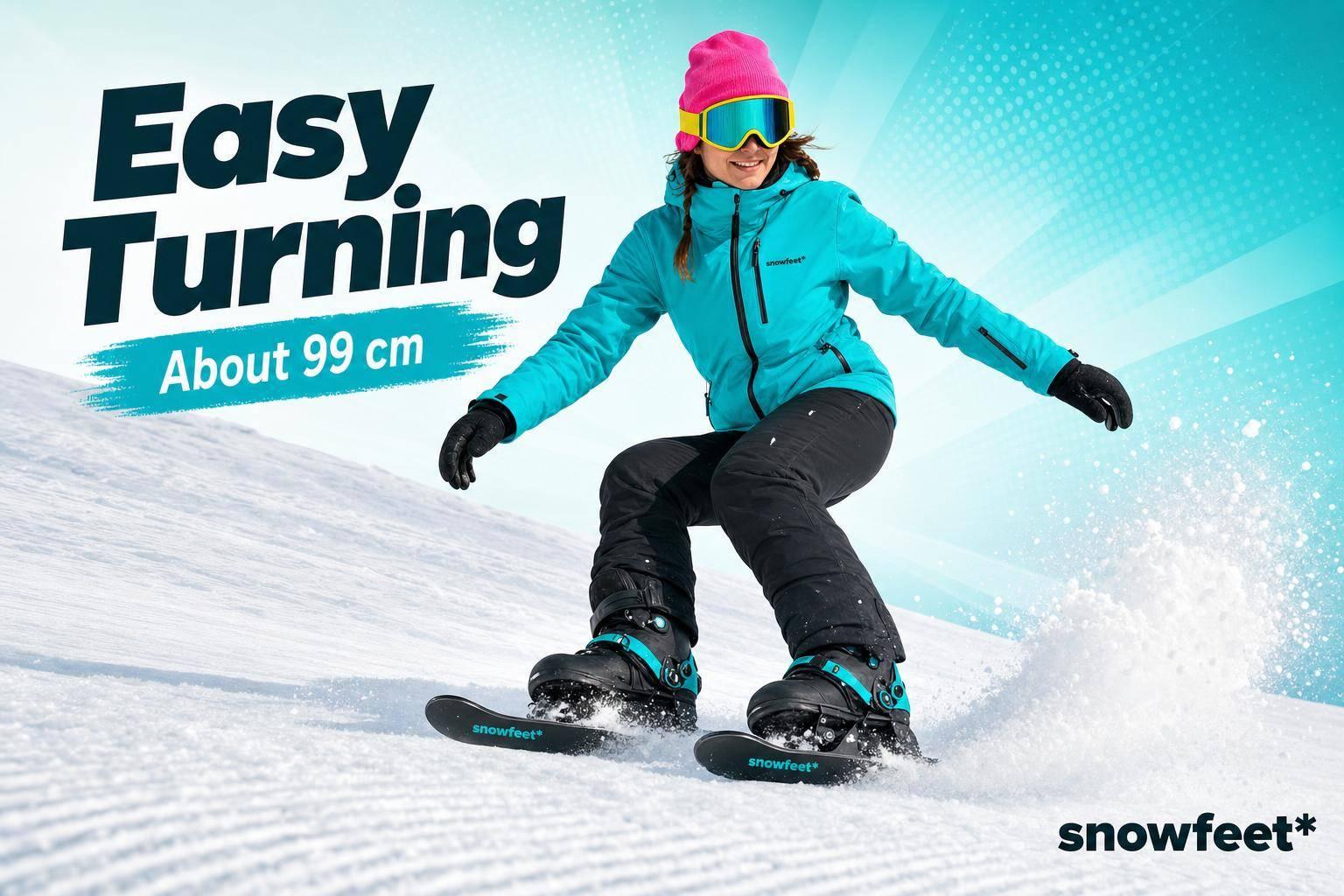
The 99 cm Skiblades are a smart fit for beginners who are taller, heavier, or think they’ll improve fast. The added length gives you more stability when skiing straight or making longer turns on green and easy blue runs. If you skate, play hockey, or just want a steadier ride, the 99 cm gives you more space to grow into.
Use the quick comparison below to match the length to how you like to learn.
| Model | Length | Best For | Starting Price |
|---|---|---|---|
| Skiskates | 44 cm | Easy beginner slopes, nervous beginners, skate-feel fans | $460 |
| Skiblades | 65 cm | Most beginners, typical resort greens, all-around use | $590 |
| Skiblades | 99 cm | Athletic or bigger beginners, longer runs, faster learners | $690 |
Next, compare these beginner-friendly lengths with traditional skis.
Short Skis vs Long Skis: Which Is the Better Choice for Beginners
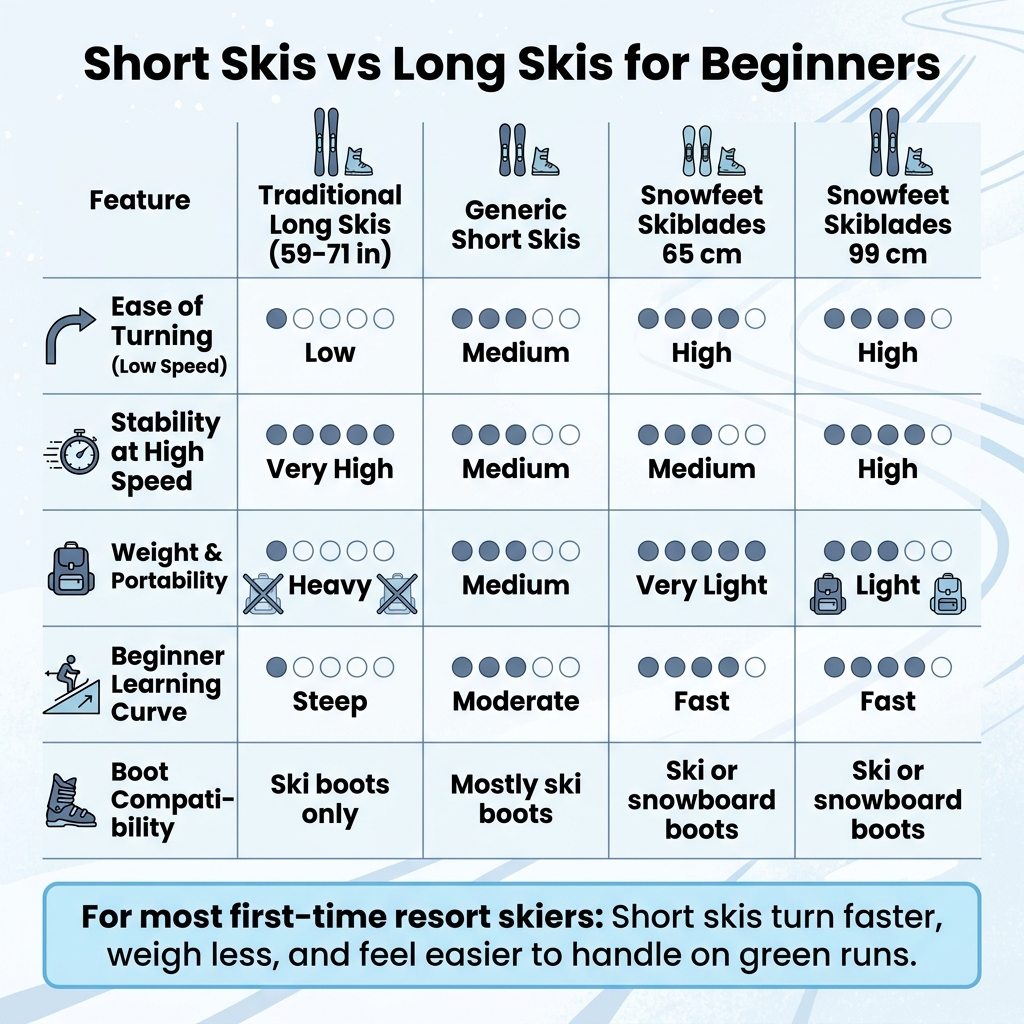
Short Skis vs Long Skis for Beginners: Full Comparison
For most first-time U.S. resort skiers, short skis are the easier pick. They turn faster, feel lighter, and stay easier to handle at low speeds. That matters a lot on day one.
Long skis still do better at speed and in powder. But on beginner runs, those perks usually aren’t what people notice first. What beginners feel first is simple: How hard is it to turn? How heavy is this gear? Can I stay in control when I’m going slow?
Comparison Table: Long Skis, Generic Short Skis, and Snowfeet* Models
| Feature | Traditional Long Skis | Generic Short Skis | Snowfeet* Skiskates 44 cm | Snowfeet* Skiblades 65 cm | Snowfeet* Skiblades 99 cm |
|---|---|---|---|---|---|
| Ease of Turning (Low Speed) | Low | Medium | Very High | High | High |
| Stability (High Speed) | Very High | Medium | Low | Medium | High |
| Weight & Portability | Heavy / Low | Medium | Very Light (fits in a backpack) | Light (fits in a backpack) | Light (fits in a backpack) |
| Beginner Learning Curve | Steep | Moderate | Very Fast | Fast | Fast |
| Boot Compatibility | Ski boots only | Mostly ski boots | Snowboard or winter boots | Ski or snowboard boots | Ski or snowboard boots |
This is where Snowfeet* pulls ahead for many new skiers. The gear is shorter, lighter, and less of a hassle than long skis. You’re not wrestling with bulky equipment before you even get to the lift. That alone can make the first day feel less like a gym session and more like fun :)
Long skis still have the edge on speed, powder, and steep terrain. But for beginners, Snowfeet* is easier to turn, lighter to carry, and less intimidating. Generic short skis and snowblades land somewhere in the middle. They’re easier than long skis, sure, but they don’t match the portability or boot options that Snowfeet* models bring.
Key Takeaways for First-Time and Casual U.S. Skiers
Short skis win for beginners because they fix the stuff that trips people up on day one:
- Slow turns feel easier
- Carrying gear takes less effort
- Lift lines are less awkward
Snowfeet* also fits three clear beginner-friendly setups:
- 44 cm for compact, playful fun
- 65 cm for a balanced learning option
- 99 cm for more stability
And here’s a big plus: you’re not locked into stiff ski boots. For casual beginners, that makes Snowfeet* short skis the more practical and less intimidating place to start.
FAQs
Are short skis too unstable for beginners?
No. Short skis are often easier to control than long skis when you’re new to the sport.
They keep your feet closer to your center of gravity, which helps with balance and makes movement feel more natural. They’re also easier to turn and stop on, and that can mean fewer edge catches and fewer falls. Long skis do give you more stability at higher speeds, but for beginners, they’re often less forgiving.
What short ski length should I start with?
For the best start, go with the shortest options. They give you more control and take less effort to manage. Start with 38 cm Mini Ski Skates or 44 cm Skiskates so you can dial in your balance and learn how to shift your weight the right way.
Once that feels solid, step up to the 65 cm Snowfeet Skiblades. They give you more room for carving and better edge control.
The 99 cm and 120 cm models bring more stability, which can help intermediate riders or people riding on mixed terrain. But if you're new, stick with the 38 cm to 65 cm range. It's the fastest way to build confidence without making the learning curve steeper than it needs to be.
Can I use regular winter boots with Snowfeet*?
Yes. A lot of Snowfeet* products work with regular winter boots, so you don’t need heavy ski boots.
Most models, including Mini Ski Skates and skiskates, come with adjustable bindings that fit the winter shoes or snowboard boots you already own. That’s a big plus if you want to get out on the snow without hauling around a bunch of extra gear.
Some longer models, like the 99 cm or 120 cm skiblades, may use bindings made for ski boots or snowboard boots for added support.











Hinterlassen Sie einen Kommentar
Diese Website ist durch hCaptcha geschützt und es gelten die allgemeinen Geschäftsbedingungen und Datenschutzbestimmungen von hCaptcha.