



















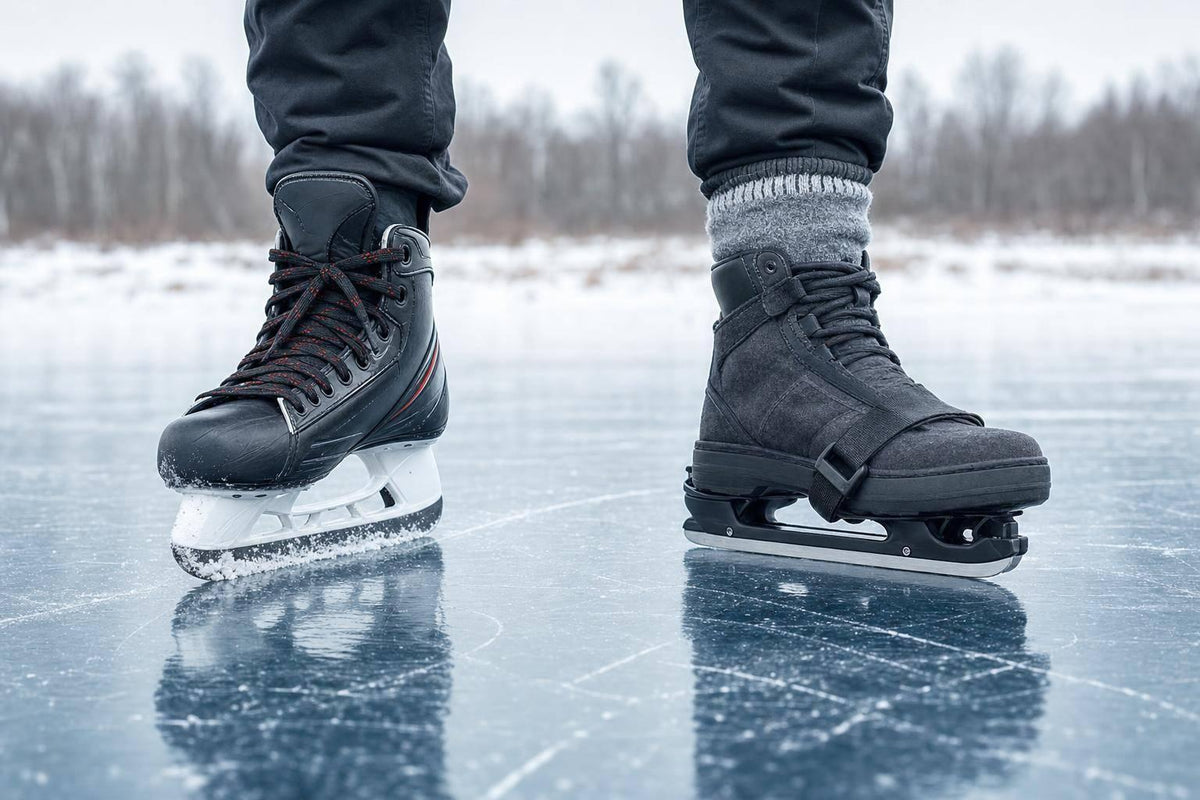
If I’m just heading out for easy pond laps, I’d pick Icefeet. If I want hard stops, tight turns, and pond hockey moves, I’d grab hockey skates instead.
Here’s the short answer:
- Icefeet work best for beginners, families, and travel
- Hockey skates work best for skaters who want more control
- Icefeet use your own winter boots, so feet often stay warmer
- Hockey skates need more fit work, more break-in, and more sharpening
- Price matters too: the article puts Icefeet at $199, while many hockey skates for casual use land around $80–$200
So, if your day looks like slow laps, skating with kids, or tossing gear in the car at the last minute, Icefeet make more sense. If your day looks like cuts, stops, and pickup hockey, hockey skates still win.
Finally… Ice Skates Anyone Can Use!
Quick Comparison
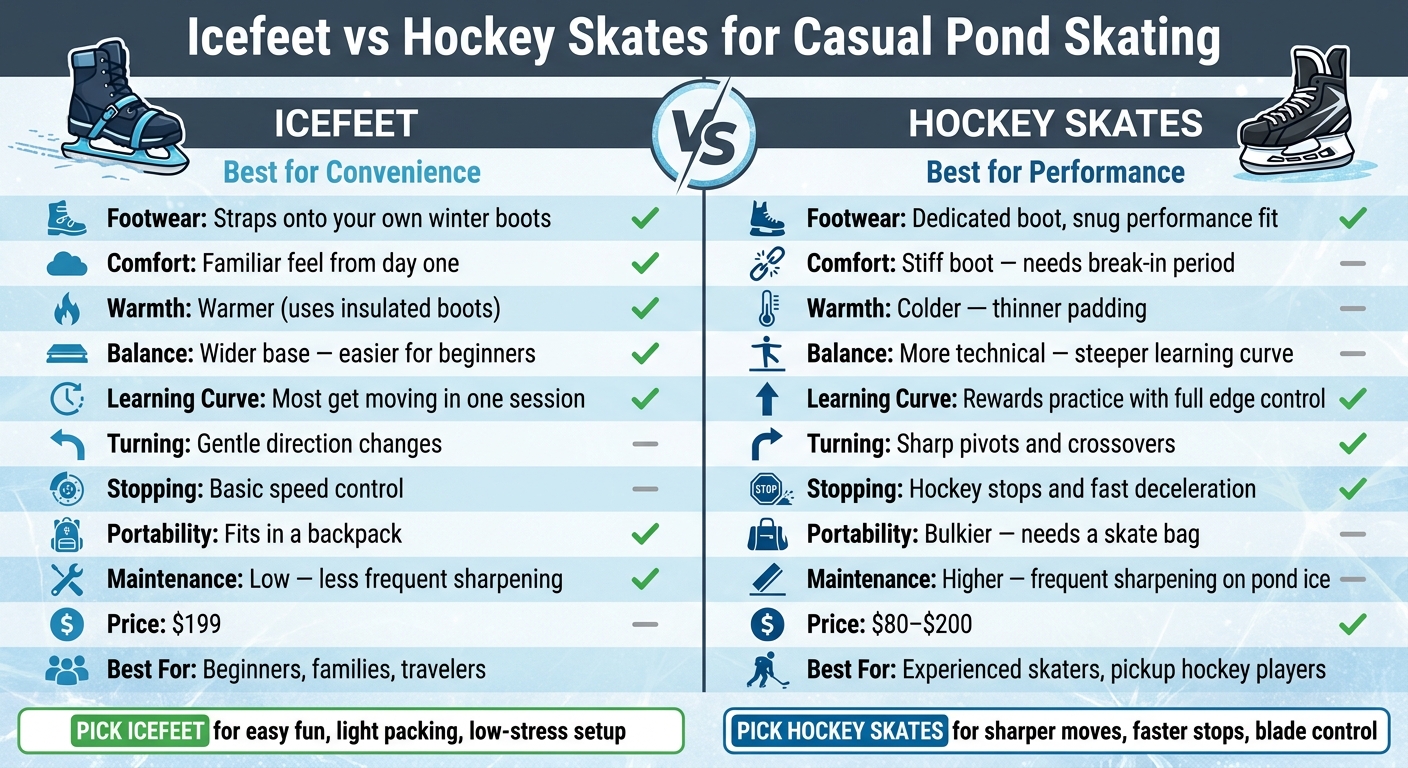
Icefeet vs Hockey Skates: Casual Pond Skating Comparison
| What matters | Icefeet | Hockey skates |
|---|---|---|
| Best for | Casual pond skating | Pond hockey and skill work |
| Footwear | Straps onto winter boots | Dedicated skate boot |
| Comfort on day one | Higher for most people | Often stiff at first |
| Warmth | Often warmer | Often colder |
| Balance for first-timers | Easier for many beginners | Takes more practice |
| Turning and stopping | Basic control | Strong control |
| Portability | Fits in a backpack | Bulkier to carry |
| Upkeep | Low | More sharpening |
A few plain facts stand out. Hockey skates often fit 1–2 sizes smaller than street shoes. Icefeet skip that issue since I use boots I already own. And for casual outdoor skating, that simple setup can mean the difference between “let’s go skate” and “uh, maybe next weekend” :)
If I had to boil it down:
- Pick Icefeet for easy fun, light packing, and a lower-stress setup
- Pick hockey skates for sharper moves, faster stops, and more blade control
That’s the whole matchup in plain English.
Icefeet: why Snowfeet* works well for relaxed outdoor skating
Snowfeet* Icefeet clip onto your winter boots, so you can skate without a separate boot setup. That’s a big plus for casual pond laps and spur-of-the-moment outings. On cold, bumpy pond ice, comfort and stability often matter more than hard-charging performance.
Boot compatibility, comfort, and first-time use
Icefeet fit most winter or hiking boots with firm soles and decent ankle support, and they work across a broad range of adult sizes. Using your own insulated boots helps keep your feet warmer and more comfortable on rough natural ice. They also cost less than many full skate setups, which makes them easier on the wallet. And since the setup is so simple, Icefeet tend to feel less intimidating for first-time skaters.
Balance, learning curve, and low-speed control
The two-blade design gives you a wider base, which makes Icefeet easier to balance on than single-blade skates. Most first-timers can get upright and moving fast, then ease into gentle turns, simple weaving around rough patches, and slow cruising with kids. That’s pretty much how most people skate on a frozen pond anyway. For laid-back outings, that ease can matter just as much as the feel on the ice.
Portability and best use cases
They’re light, compact, and easy to toss in a backpack or car trunk. That small size makes them handy for day trips and last-minute pond sessions. Icefeet are a good fit for families, beginners, and travelers who want simple, no-fuss skating.
Hockey skates still come out on top if you want sharper turns, harder stops, and a more locked-in feel. Next, hockey skates take over when control and edge work matter more than convenience.
sbb-itb-17ade95
Hockey skates: where they still have the edge
Hockey skates still win on speed, edge control, and hard stops. That extra precision matters most when you want fast skating, sharp turns, or pond hockey, not just an easy lap around the ice.
Fit, support, and on-ice feel
A hockey skate is one boot-and-blade unit. That setup locks in your heel, supports your ankle, and gives you close control over the blade. You feel more connected to the ice, which is great when you want each move to be crisp.
The catch? Fit can be a bit of a project. Most hockey skates run 1–2 sizes smaller than street shoes, so it often takes some trial and error to get it right. Higher-end models can be heat-molded to match your foot shape, which helps a lot. Even so, you should still expect a break-in period before the boot feels comfortable. So, yeah, it asks for more time and effort up front than strapping Icefeet onto boots you already own.
Turning, stopping, and hockey-style movement
The single blade on a hockey skate is shorter and more curved than a recreational blade. That means less contact with the ice, but a much tighter turning radius. In plain English: it turns fast and reacts fast.
That shape helps skilled skaters move from edge to edge in a snap, do crossovers, pivot cleanly, and hit hard hockey stops. On rough pond ice, a medium sharpening gives a good middle ground between grip and glide.
For casual laps on a pond, that much edge control is nice to have, but you may not need it. This is where hockey skates shine if you're playing pond hockey or working on actual skating skills.
Trade-offs for casual pond sessions
Off the ice, hockey skates are awkward to walk in and a little annoying to carry. They also need more frequent sharpening and inspection on rough natural ice. For a casual skater, that can feel like more hassle than the skate itself.
Those trade-offs show up clearly in the side-by-side comparison below.
Side-by-side comparison: Icefeet vs hockey skates on a frozen pond
Comparison table: fit, balance, control, portability, and maintenance
Here’s the plain-English version: Icefeet lean toward convenience and easy setup, while hockey skates give you more edge control and precision.
| Category | Icefeet (Snowfeet*) | Hockey Skates |
|---|---|---|
| Footwear | Straps onto your own winter boots | Dedicated boot with a snug, performance-focused fit |
| Comfort | Familiar boot feel from day one | Stiff boot; usually needs a break-in period |
| Warmth | Insulated winter boots can keep feet warmer | Thinner padding; some outdoor skaters add warmer socks or boot covers |
| Balance | Lower profile and wider base; often easier for beginners | More technical at first, but better once you know how to use edges |
| Learning curve | Most people get moving in one short session | Steeper at first; rewards practice with full technical control |
| Turning | Good for gentle direction changes | Sharp, precise; built for quick pivots and crossovers |
| Stopping | Basic speed control and gentle stops | Hockey stops and faster deceleration |
| Portability | Fits in a backpack or carry-on bag | Bulkier; usually needs a dedicated skate bag |
| Safety | Familiar boot feel; less ankle support than hockey skates | Firm ankle support; can feel less stable for true beginners at first |
| Maintenance | Occasional blade drying; often less frequent sharpening for casual use | Sharpen more often on rough pond ice |
| Best for | Beginners, families, travelers, casual cruisers | Experienced skaters, pickup hockey players |
What the trade-offs mean day to day
This is where the choice gets simple. On a frozen pond, the “better” option depends on what kind of day you want.
A first-timer will often feel steadier in Icefeet. Why? They’re using the winter boots already on their feet, so the setup feels more familiar and less intimidating. That alone can calm the nerves a bit.
A parent hauling gear for three kids will spot the difference fast. Several pairs of Icefeet can fit into one backpack. Three pairs of hockey skates? That’s a lot more stuff to lug around, and you’ll likely need a separate skate bag. Not a deal-breaker, but yeah, your shoulders may have opinions :)
A traveler heading to a winter cabin or mountain town gets a clear perk with Icefeet too. They can go into a backpack or carry-on bag without much fuss. Hockey skates take up more space, which makes light packing harder.
A pickup hockey player on a backyard pond will still want hockey skates. That’s the tool for sharper turns, hard stops, and fast play. If the plan is cruising and having fun, Icefeet make life easy. If the plan is to cut, stop, and move hard on the ice, hockey skates still have the edge.
Final verdict: which option fits your skating style
After looking at comfort, balance, control, and portability, the split is pretty simple. For most casual pond skaters, Icefeet come out ahead.
Here’s the short version: Icefeet lean toward convenience, while hockey skates lean toward performance. That’s the trade-off in a nutshell.
Best choice for beginners, families, and travelers
If you’re new to skating, heading out with kids, or just want to glide around on natural ice, Snowfeet* Icefeet make things easier. They’re compact, easy to carry, and ready to use without piling on extra gear.
That matters more than people think. When a setup is simple, you’re more likely to toss it in the car, walk to the pond, and get skating without a whole production. For families and casual skaters, that’s a big win.
Best choice for experienced skaters and pickup hockey
Hockey skates are the better pick if you want full-on hockey performance: speed, agility, fast turns, and hard stops. If your pond time looks more like a pickup game than an easy cruise, hockey skates in the $80–$200 range give you the edge control and blade precision that Icefeet aren’t built to match.
Plain and simple, if you know how to use that extra control, hockey skates still have the upper hand.
Key points before you buy
Icefeet win on convenience. They’re easier to learn, easier to pack, and a better fit for laid-back pond sessions. Hockey skates win on performance, but mostly for skaters who can make the most of it.
For most casual pond skating in the U.S., Snowfeet* Icefeet at $199 are the easier, more approachable pick.
FAQs
Can I use Icefeet on rough pond ice?
Icefeet work best on smooth, clean, flat ice. Think backyard rinks or a well-kept frozen pond.
Their double-blade design helps with balance on even ice. But once the surface gets rough, bumpy, slushy, or covered with snow, things change fast.
On that kind of ice, performance drops. They can start to feel shaky and less stable.
If you want something for mixed winter terrain or uneven surfaces, Snowfeet PRO or Skiskates are a better fit.
What boots work best with Icefeet?
Icefeet work best with stiff, waterproof winter boots that have a flat sole and solid ankle support. The adjustable bindings fit many boots in U.S. sizes 4.5 to 14.5. But fit is only part of the story. A firmer boot helps lock your foot in place, which gives you better steering and cleaner edge control.
Softer or bulky boots can let your foot move around inside the binding. That can make control feel loose and can lead to discomfort. If you want more support and a more secure feel, snowboard boots are a great step up.
Are hockey skates worth it for casual skating?
Traditional hockey skates make sense if you want to work on sport-specific skills, like hockey moves, figure skating basics, or tight edge control. They give you more speed, sharper turns, and a more locked-in feel. The trade-off? You’ll need a dedicated skate boot, and that boot is often stiff at first. Break-in can take a bit.
For most casual pond skaters, families, and beginners, Snowfeet Icefeet are the better pick. They strap onto your own winter boots, which makes things simpler and more stable. Less fuss, less gear drama, more time on smooth ice :)











Efterlad en kommentar
Denne side er beskyttet af hCaptcha, og hCaptchas Politik om beskyttelse af persondata og Servicevilkår er gældende.