



















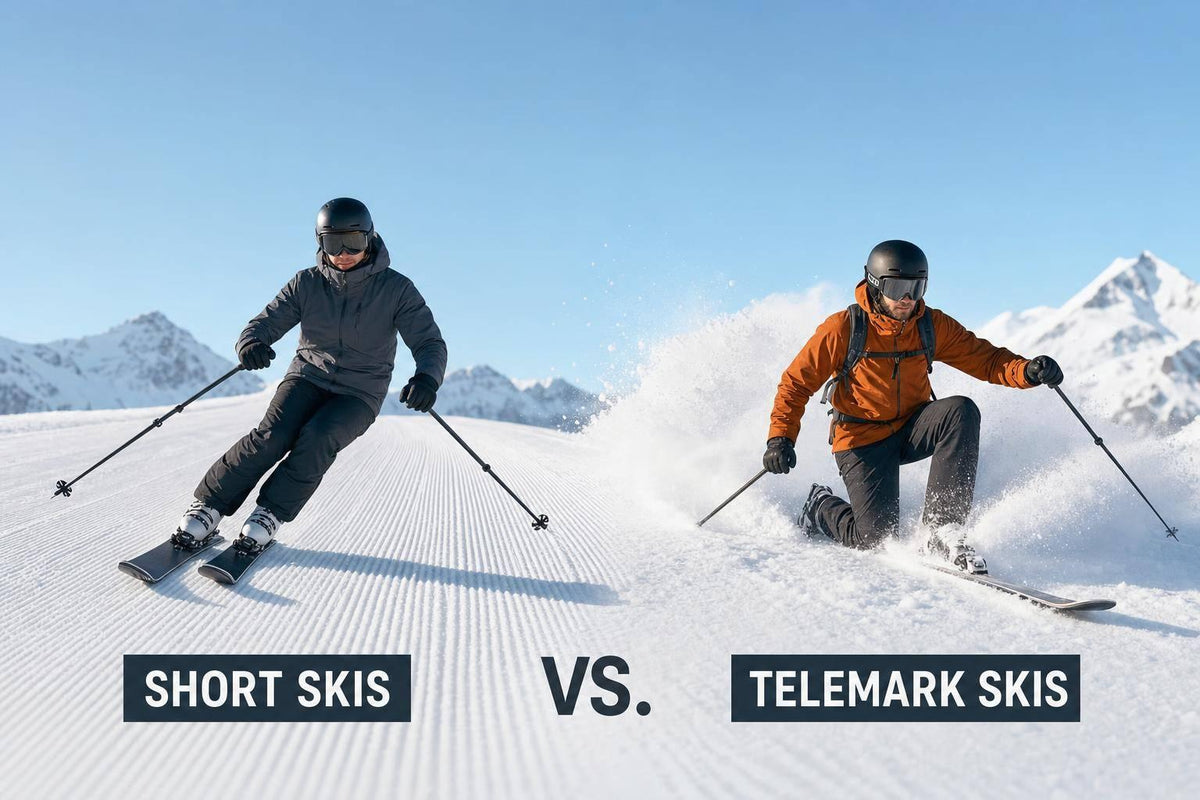
If you want free-heel skiing with less hassle, short skis are the easy win. From what I see, telemark still makes sense for deep snow, long descents, and people who love the tele turn. But for most riders in the U.S., short skis are easier to learn, cost less up front, and are way easier to pack.
Here’s the short version:
- Telemark skis give you more stability at speed and in deeper snow
- Snowfeet* short skis feel easier on day one and take less work to use
- WALKSKI sits in the middle as a compact free-heel touring option
- Telemark setups often start around $920+
- Snowfeet* options start around $460
- Most riders can get used to short skis in a day or a weekend
- Telemark can take a full season or more to feel smooth
So, if you want fun groomer laps, park time, short trips, or gear that fits in your trunk without a fight, I’d point you toward short skis first. If you want the full free-heel style and don’t mind the work, telemark still has its place.
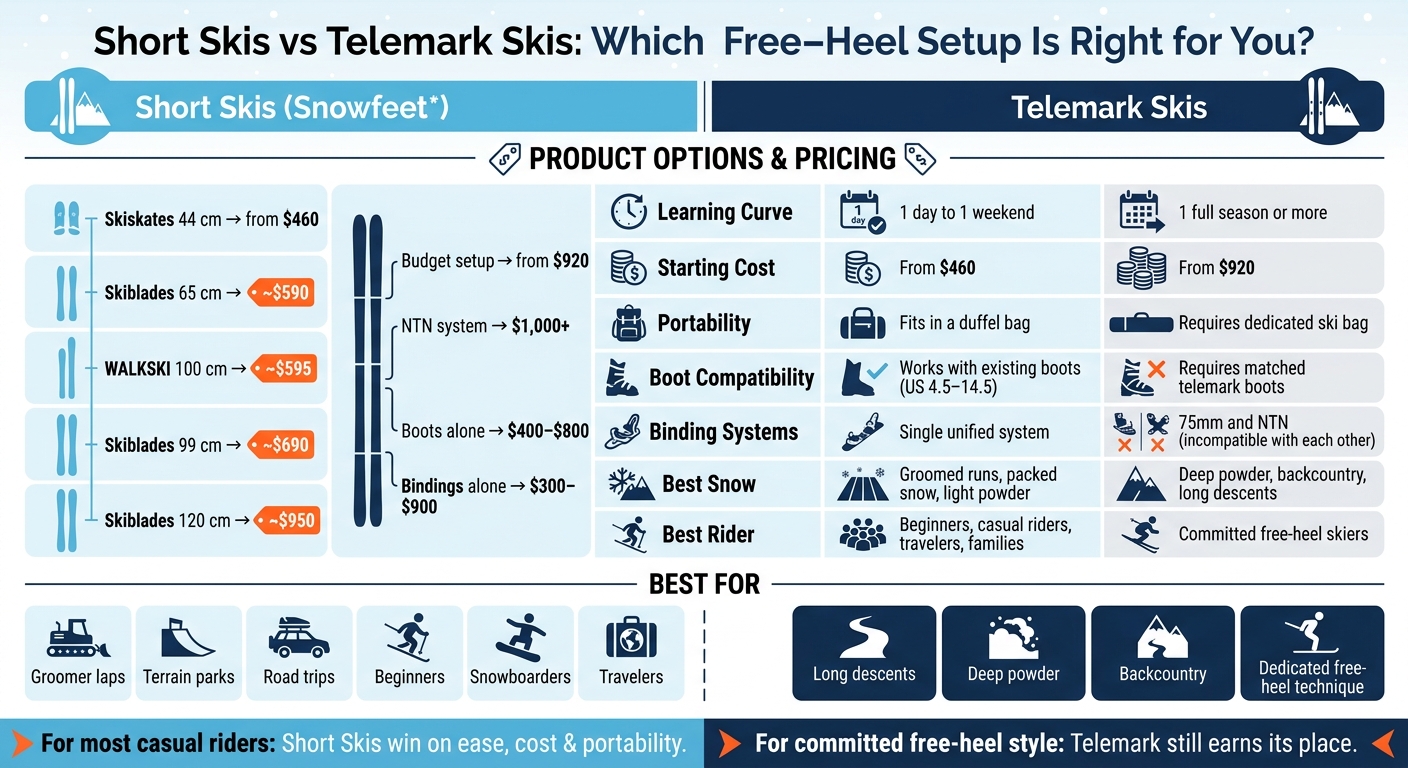
Short Skis vs Telemark Skis: Cost, Learning Curve & Best Use Comparison
Snowboarder tries Snowfeet* | Which Snowfeet* Short Ski is the Best? | Snowblades 44, 65, 99 Review
Quick Comparison
| Option | Learning curve | Cost | Best for | Main trade-off |
|---|---|---|---|---|
| Skiskates (44 cm) | Easiest | From $460 | Skate-like feel, packed snow, small hills | Least stable at speed |
| Skiblades (65 cm) | Easy | About $590 | Groomers, park laps, playful turns | Less support in rough snow |
| Skiblades (99 cm) | Easy to medium | About $690 | Groomers, mixed snow, more control | Less nimble than shorter models |
| Skiblades (120 cm) | Easy to medium | About $950 | Riders who want more ski underfoot | Bigger and less portable |
| WALKSKI (100 cm) | Medium | About $595 | Touring, short trips, free-heel use | Not built for long, hard-charging descents |
| Telemark skis | Hardest | $920 to $1,000+ | Deep snow, long descents, tele style | More gear, more cost, steeper learning curve |
A few things stand out fast:
- Price gap: about $460 vs. $920+
- Gear load: short skis can use boots you may already own
- Time to learn: short skis often click much sooner
- Use case: telemark shines more in a smaller slice of skiing
If I were helping a friend pick, I’d keep it simple:
short skis for easy fun, telemark for full free-heel commitment. That’s the heart of this comparison :)
2. How They Feel on Snow: Turning, Stability, and Learning Curve
Why Snowfeet* short skis feel easier and more playful
Short skis react fast. There’s just less ski under your foot, so even small shifts can start a turn. That’s a big reason Skiskates (44 cm / about 17 inches) and Skiblades (65 cm / about 26 inches) feel fun right away.
Here’s the simple version: when you lean back too much or turn a bit too hard, a short ski will often slide or pivot instead of grabbing all at once. That makes the ride feel less punishing, which is a big deal when you’re still getting the hang of things.
Most beginners, snowboarders, and skaters get comfortable on Snowfeet* gear within a day or a weekend. It’s not that the snow gets easier. The gear just doesn’t fight you.
Skiskates and 65 cm Skiblades turn the fastest and feel the most forgiving. If you want a bit more calm underfoot, the 99 cm and 120 cm Skiblades bring more stability on groomers and in rougher snow, but they still keep that playful feel.
That quick, easy feel is the big contrast with telemark. With telemark, smooth turns can feel amazing, but only after the technique starts to click.
Where telemark skis feel smoother but more demanding
Telemark has that smooth, flowing turn people love. But, uh, it asks a lot from you.
The classic lunge means you have to manage a deep split stance, bend both ankles and knees on their own, and control pressure across two skis at the same time, all while staying centered over a free heel. That’s a lot to juggle. It can take at least a full season of focused practice before linked telemark turns feel natural and under control.
Early falls are common, and the physical work is no joke. Your quads, glutes, and core are working hard on every run. Telemark pays you back for skill, but there’s a steep learning phase first.
For long, fast descents, telemark skis give you better edge grip and more stability. That’s a real plus for committed skiers. But for casual riders on groomed terrain, the 99 cm and 120 cm Skiblades offer enough stability without all the extra technique, which makes them the more practical pick for most people.
sbb-itb-17ade95
3. Gear, Cost, and Portability: Which Setup Is More Practical
Snowfeet* setup simplicity for casual riders and travelers
Once the on-snow feel is clear, the next big thing is simple: how much stuff do you need to deal with? That’s where Snowfeet* stands out. It’s easier to own, easier to pack, and easier to travel with. For casual riders, that means more time having fun and less time messing with gear.
Most Snowfeet* models fit a broad range of boot sizes, from U.S. men’s 4.5 to 14.5, and they work with boots you may already have, like snowboard boots, ski boots, or sturdy winter boots. That’s a big plus. One setup can adjust to different boot sizes at home, and the WALKSKI (100 cm) and longer Skiblades follow that same simple idea. No shop stop. No extra fuss.
Packing is easy too. The shorter models can slide into a duffel bag or fit in your car trunk without a dedicated ski bag. That may sound like a small thing, but if you’re flying, heading out on a road trip, or just tired of dragging around long gear, it matters a lot.
Why telemark gear takes more commitment
Telemark is a different story. You need matched boots, bindings, and full-length skis. That means more gear, more cost, and, yeah, more hassle. The 75 mm and NTN systems don’t work with each other, and neither works with standard alpine bindings.
The price gap is hard to ignore too. A budget telemark setup starts at around $920, and NTN systems go past $1,000. Snowfeet*, by contrast, skips the extra boot-and-binding purchases that telemark usually calls for.
Here’s how Snowfeet* pricing stacks up:
- Skiskates (44 cm): start around $460
- 65 cm Skiblades and WALKSKI 100 cm: about $590–$595
- 99 cm Skiblades: about $690
- 120 cm Short Skis: $950
For casual riders, that extra telemark cost and setup work can feel like a lot to take on. And that gap gets even clearer once you line up each option with the kind of terrain and rider it fits best.
4. Best Terrain and Best Rider: Who Each Option Suits
Once the gear question is sorted out, the next thing is simple: where does each setup work best?
When Snowfeet* is the better choice for most people
For most casual riders, Snowfeet* makes more sense on the terrain they actually use. Skiskates do well on groomers and packed snow. The 65 cm Skiblades are a good match for carving and terrain parks. The 99 cm and 120 cm models give you more stability. And WALKSKI is the touring pick.
So, if your day looks like groomed runs, mellow hills, park laps, or a quick trip with easy-to-pack gear, Snowfeet* is usually the better fit.
It also works well for a pretty broad mix of riders:
- beginners
- casual riders
- snowboarders
- families
- travelers
That’s a big reason Snowfeet* lines up with the kind of skiing most casual riders actually do.
| Model | Best Terrain | Best Rider |
|---|---|---|
| Skiskates 44 cm | Groomed slopes, packed snow, gentle hills | Skaters, beginners |
| Skiblades 65 cm | Groomed runs, terrain parks, carving | Park riders, snowboarders |
| Skiblades 99 cm | Groomed runs, light powder | Casual to intermediate riders |
| Short Skis 120 cm | Groomed runs, more stability | Riders wanting more stability |
| WALKSKI 100 cm | Backcountry trails, uphill climbs, flat terrain, downhill skiing | New tourers |
| Telemark skis | Groomed slopes, backcountry, deep powder, long descents | Committed free-heel skiers |
Telemark still wins in a smaller slice of the map.
When telemark skis still make more sense
Telemark still has its place, just in a narrower lane. If you care most about long descents, deep snow, and dedicated free-heel technique, telemark still makes sense.
That means telemark is still the better call for riders who are all-in on the style and want that classic free-heel feel, especially in deep powder or on long downhill lines.
That trade-off leads to the final question: which free-heel setup gives you the most fun for the least effort?
5. Final Verdict: The Easier Path to Free-Heel Fun
After looking at feel, gear, and terrain, the answer is pretty simple: for most casual U.S. resort riders, Snowfeet* short skis are the easier pick.
Here’s why. You get free-heel fun with one lighter setup. Telemark gear, on the other hand, gets expensive fast. Boots alone cost $400–$800, and bindings add another $300–$900 on top. That stings a bit. Snowfeet* Skiblades start at about $590, with one setup and no extra parts to buy.
There’s also the learning curve. Telemark can take a season or two before it feels natural. Snowfeet* is a lot less demanding. Most riders feel solid on them within a single day. That’s a huge deal if you want to spend your time riding, not fighting your gear.
That said, telemark still has its place. If you want that classic telemark feel, plan to ride longer descents, or spend time in deeper snow, it can still be the right move. But for most other riders, Snowfeet* is the more practical path.
If you want the right Snowfeet* fit, use this quick guide:
| Your Situation | Best Snowfeet* Pick |
|---|---|
| Want the most compact, skate-like feel | Skiskates 44 cm |
| Want easy, playful short-ski turns on groomers | Skiblades 65 cm |
| Want more stability, still short and light | Skiblades 99 cm |
| Want a balanced touring and all-around option | WALKSKI 100 cm |
| Want the best bridge to a longer-ski feel | Skiblades 120 cm |
If you want the easiest free-heel setup, start with the model that fits how you ride most often. For most riders, the Skiblades 65 cm hit the sweet spot for ease and playfulness. If you want a bit more ski underfoot, the 99 cm or WALKSKI 100 cm are smart next picks.
FAQs
Can I use my regular winter boots with Snowfeet*?
Yes - most Snowfeet* products work with regular winter boots. That’s one of the big differences from classic skis, which usually need stiff alpine ski boots.
Skiskates, Skiblades, and WALKSKI come with universal or adjustable bindings that fit:
- winter boots
- hiking boots
- snowboard boots
For better control and comfort, pick boots with good ankle support. It makes a big difference once you’re out on the snow.
If you want the most secure fit and the most stability - especially on 120 cm models - many riders still go with ski boots.
Which Snowfeet* model is best for beginners?
For most beginners, the Snowfeet* Skiblades 65 cm are the best overall pick. They hit a sweet spot between quick control and steady balance, so they feel easier to manage and way less intimidating than long skis.
If you want more stability and control, the 99 cm or 120 cm Skiblades are great picks too. If easy carrying matters most, or you come from a skating background, the 44 cm Skiskates can feel natural right away.
Are short skis okay for light powder and choppy snow?
Yes. Short skis can handle light powder and choppy snow, but they don’t feel the same as longer skis.
Models like the 99 cm Skiblades and 120 cm Short Skis give you more stability and more surface area underfoot. That helps them do well in light powder up to about 4 in. (10 cm) and in small chop. The POWDER 99 cm is wider, so it floats better.
That said, long skis still do a better job in deep powder and high-speed crud. Short skis can hang in softer snow, sure, but once things get deeper or rougher, longer skis have the edge.











Efterlad en kommentar
Denne side er beskyttet af hCaptcha, og hCaptchas Politik om beskyttelse af persondata og Servicevilkår er gældende.