



















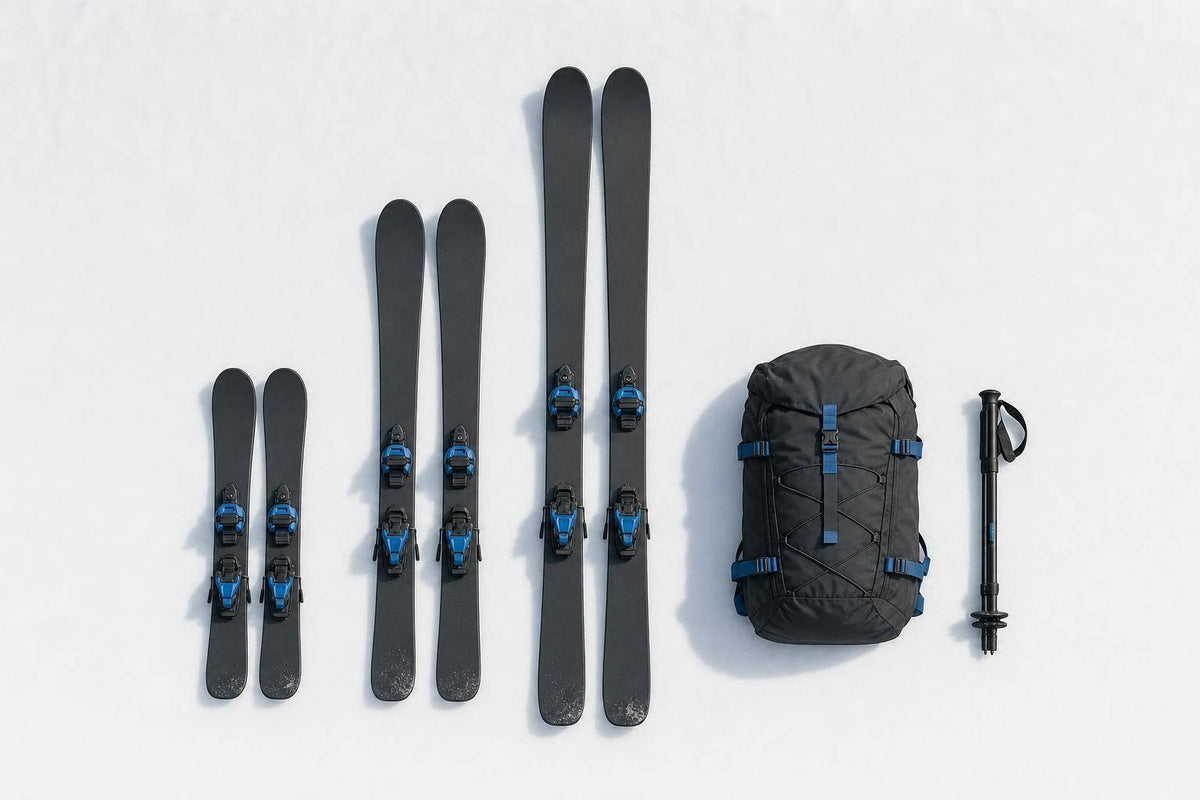
If I wanted one short answer: pick the ski by snow type and how much time it spends on your pack.
For most people, the split is simple:
- WALKSKI 100 cm: best for mixed routes, climbs, and short descents
- NORDIC 90 cm: best for packed trails and smooth kick-and-glide travel
- Skiblades 65 cm: best if the downhill matters more than the approach
- Skiskates 44 cm: best if pack space matters most
This lineup runs from 44 cm to 100 cm and starts at $460 to $595+ based on model, with some prices in the article going up to $785 for certain setups. The big tradeoff is simple: shorter = easier to carry; longer = better glide and more control. That’s the whole game here.
Snowboarder tries Snowfeet* | Which Snowfeet* Short Ski is the Best? | Snowblades 44, 65, 99 Review
Quick Comparison
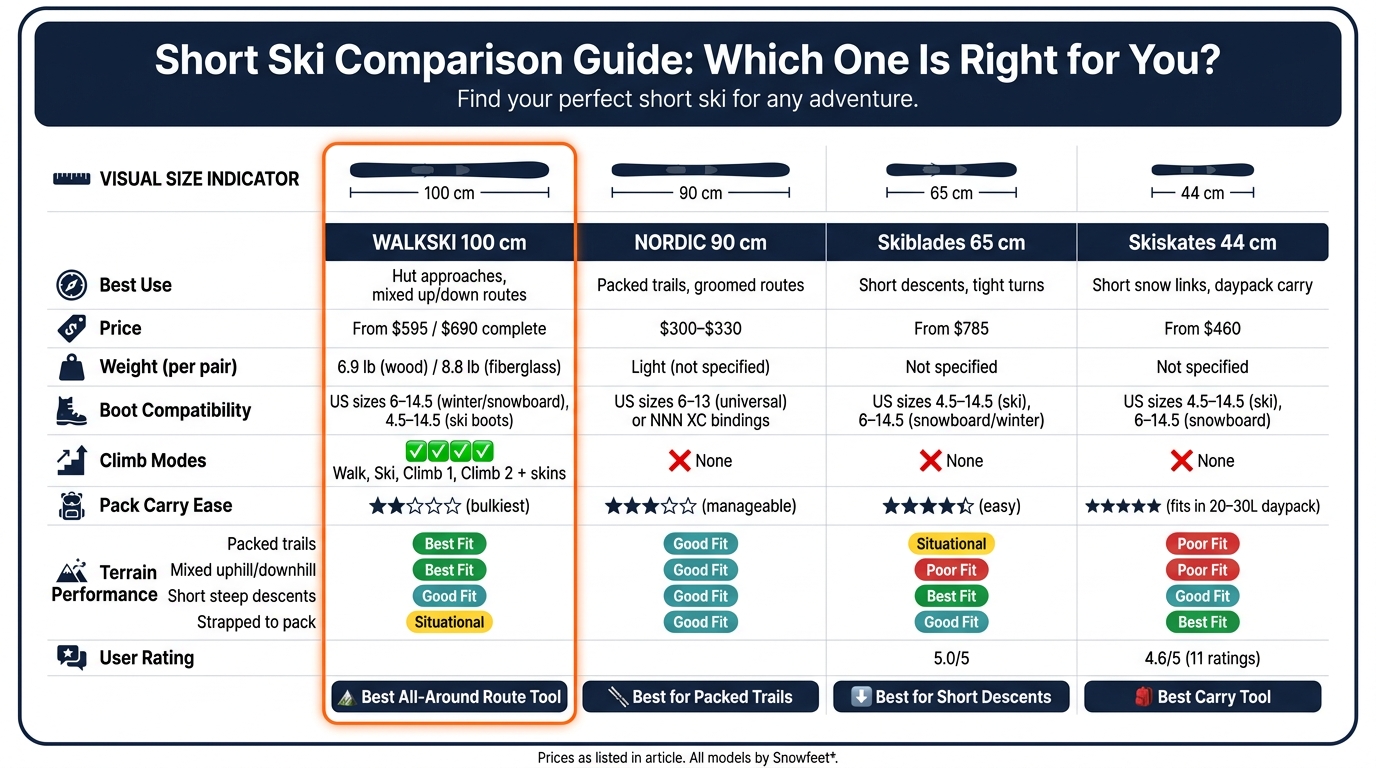
Short Ski Comparison: WALKSKI vs NORDIC vs Skiblades vs Skiskates
| Model | Best Use | Main Strength | Main Tradeoff | Price in Article |
|---|---|---|---|---|
| WALKSKI 100 cm | Hut approaches, rolling backcountry, mixed up/down routes | Climb modes, skins, more control | Bigger on a pack | From $595 / also listed at $690 complete |
| NORDIC 90 cm | Packed trails, groomed routes, firm snow | Smooth glide, light feel | Weak in deep snow and steep descents | $300–$330 / also listed from $450 |
| Skiblades 65 cm | Short descents, tight turns, short exits | Better downhill feel in a small size | Less glide over distance | From $590 / also listed at $785 |
| Skiskates 44 cm | Short snow links, daypack carry | Smallest size, fits many 20–30 L packs | Low stability, poor float | From $460 |
What stood out to me most is this: the 100 cm WALKSKI is the best route tool, while the 44 cm Skiskates are the best carry tool. So, if you hike more than you ski, go shorter. If you travel farther on snow, add length and keep life easier on the flats. Simple stuff :)
1. Snowfeet* WALKSKI Backcountry Touring 100 cm
At 100 cm (about 3.3 ft), the WALKSKI hits a sweet spot between pack size, glide, and control for actual approach travel. It tracks well on packed snow, moves nicely over rolling terrain, and straps to a pack when you need to boot a section. That last part matters more than people think. Nobody wants long skis flopping around on their back like awkward antennae :)
If your route is mostly packed track and classic stride travel, the 90 cm NORDIC may be a better fit.
The binding is where this setup gets fun. It has four modes built for approach use:
- Walk for a free heel on flat terrain
- Ski for a locked heel on descents
- Climb 1 with a low riser for moderate grades
- Climb 2 with a high riser for steeper pitches
Removable climbing skins come in the box.
That means on a normal hut approach, you can skin uphill, flip to a riser when the slope kicks up, then lock the heel and ski back down. No binding swap needed. That’s a big deal if you want less fiddling and more moving.
Boot fit is another strong point. The universal binding works with standard winter boots, snowboard boots, and ski boots across US sizes 6–14.5 for winter and snowboard boots, and 4.5–14.5 for ski boots. So, you can get out there without buying a whole new touring boot setup. For a lot of people, that’s the difference between “maybe later” and “let’s go this weekend.”
Weight stays pretty reasonable for what this ski can do. The wood-core version comes in at 6.9 lb per pair, while the fiberglass version weighs 8.8 lb per pair. If you plan to carry them often, wood is the smarter pick.
Price helps, too. At $690 complete, the WALKSKI costs a lot less than the roughly $2,200 average for a standard ski touring setup. If your approaches are shorter or you expect more carry sections, the 90 cm NORDIC is the lighter, smaller option.
2. Snowfeet* NORDIC Cross-country 90 cm
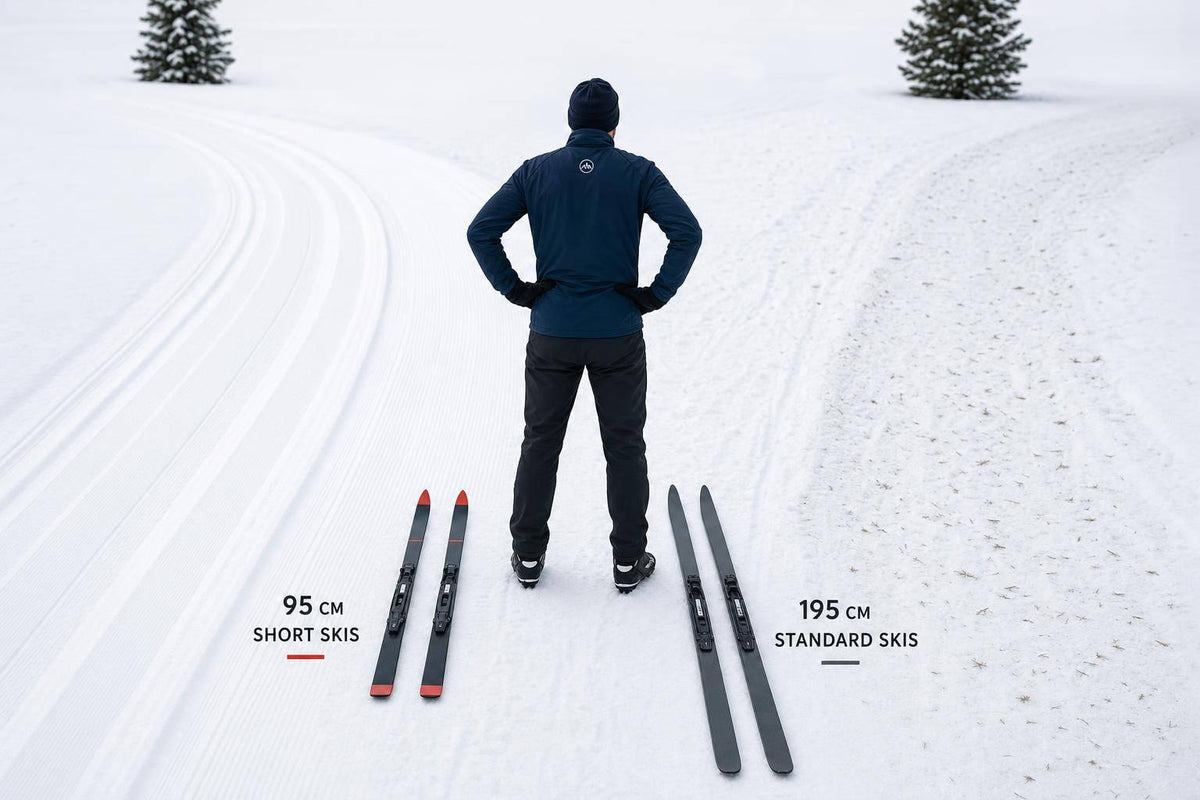
At 90 cm (about 35 inches), the Snowfeet* NORDIC Cross-country 90 cm is Snowfeet*’s shortest cross-country option. It’s light, easy to pack, and built for firm snow. In the lineup, it sits between the touring-focused WALKSKI and the tiny Skiblades.
Compared with the 100 cm WALKSKI, the NORDIC feels easier to handle on packed trails and groomed tracks. That makes it the simpler pick when you want a smooth, efficient approach without hauling full touring gear.
It works best on packed trails, groomed tracks, gentle grades, and set tracks in open forest. For hikers and climbers, that means quick movement on firm snow, easy control, and less bulk hanging off your pack. But there’s a catch: it does poorly in deep, loose snow and on steep, technical descents. So, this one is happiest on rolling terrain and controlled approaches.
One of the biggest selling points is boot compatibility. You can choose from:
- Universal bindings for winter boots in US sizes 6–13
- Rottefella NNN pro XC bindings for cross-country boots
For most hikers and climbers, the universal binding is the easy call. You can use the boots you already own and get moving. If you already have XC boots and want better power transfer on groomed snow, the pro XC setup is the better fit.
It also packs without much fuss. You can strap it to a pack or just carry it by hand for short bootpacks.
Pricing is about $300–$330. That puts it at a nice entry point for hikers and climbers who want a light approach ski without paying for a full touring setup.
If you want even more maneuverability and an easier carry, the 65 cm Skiblades push that idea even further.
3. Snowfeet* Skiblades 65 cm
At 65 cm - about 25.5 inches - Snowfeet* Skiblades are the compact pick for hikers who want an easy carry on the way up and a fun ride on the way down. The wood core helps with durability, and the short length is easy to pack.
These Skiblades blend ski-style glide with skate-style quickness. If the descent is the main event, this is where they shine. They work well for short descents, tight turns, and short exits. For long tours, though, they’re not the move. That’s why they make more sense as a down-first pick than the 90 cm NORDIC when the approach is short and the downhill is the payoff.
They lean hard into maneuverability, not stability. So, they’re a better match for short descents than all-day tours.
Boot fit is one of the big perks here. The bindings fit:
- Ski boots: US sizes 4.5 to 14.5
- Snowboard or winter boots: US sizes 6 to 14.5
That means you can often use boots you already own, which is nice - no awkward trailhead gear swap.
The Skiblades have a 5.0/5 rating from verified buyers. Pricing starts at $785.
If you want an even smaller carry setup, the 44 cm Skiskates take it one step further.
sbb-itb-17ade95
4. Snowfeet* Skiskates 44 cm
At 44 cm (17 inches), Skiskates are the shortest model from Snowfeet*. That makes them the easiest to toss in a pack and go. They fit in most 20–30 L daypacks.
These work best on packed or groomed snow. Think forest roads, hut tracks, and firm sidecountry. The wood core gives them more of a ski feel, which is nice. But there’s a catch: they have almost no flotation in deep powder. So if you’re heading into untracked backcountry snow, this isn’t the tool for the job. Skiskates make more sense for short, snow-covered links between spots than for all-day touring.
Boot options are pretty broad, which keeps things simple:
- Ski boot version: US sizes 4.5–14.5
- Snowboard boot version: US sizes 6–14.5
Compared with 65 cm Skiblades, Skiskates are smaller and easier to pack. On the flip side, they’re less stable and don’t glide as well. So, yeah, you save space, but you give up some smoothness on snow.
Right now, they have a 4.6/5 rating from 11 ratings, with reviewers saying they’re best on hard snow. Pricing starts at $460.
If pack carry matters most, Skiskates are the clear pick.
Next, compare how each model handles real approaches, from packed trails to short bootpacks and descents.
How Each Model Performs in Real Approach Situations
Approach performance comes down to terrain. You feel it in stride on packed snow, support on climbs, control on short descents, and how annoying the skis are when they’re hanging off your pack. So, the big thing here is simple: which model works best in each type of approach?
On packed trails and forest roads, the 100 cm WALKSKI is the best all-around pick. It gives you the smoothest travel for actual approach miles. The 90 cm NORDIC is close behind, especially on rolling terrain where you want decent glide without hauling a longer ski. The 65 cm Skiblades can handle firm, compacted snow, but they don’t track as well. The 44 cm Skiskates are the weakest choice for real distance travel, and they tend to bog down in clumpy snow. That picture changes once the route starts mixing climbs and descents.
For mixed uphill and downhill routes, the WALKSKI stands out as the only true mixed-route tool in this group. The NORDIC still works well on mostly flat or gently rolling approaches. But once climbing becomes a real part of the day, the Skiblades and Skiskates start to show their limits. They don’t have skins or risers, so steeper approaches take more effort and feel less efficient. Then, once the climb ends and the descent turns short and steep, things shift again.
On short steep descents, the 65 cm Skiblades take the top spot. They’re the best option here if your goal is tight, quick downhill control. The 44 cm Skiskates are the most nimble, but they’re also the least forgiving. Fun? Sure. Easy? Not so much. The 90 cm and 100 cm models feel more stable and more predictable on the way down, though they give up some maneuverability.
When skis spend part of the day strapped to a pack, the ranking is pretty straightforward:
- Skiskates (44 cm): easiest to carry
- Skiblades (65 cm): next easiest
- NORDIC (90 cm): still manageable
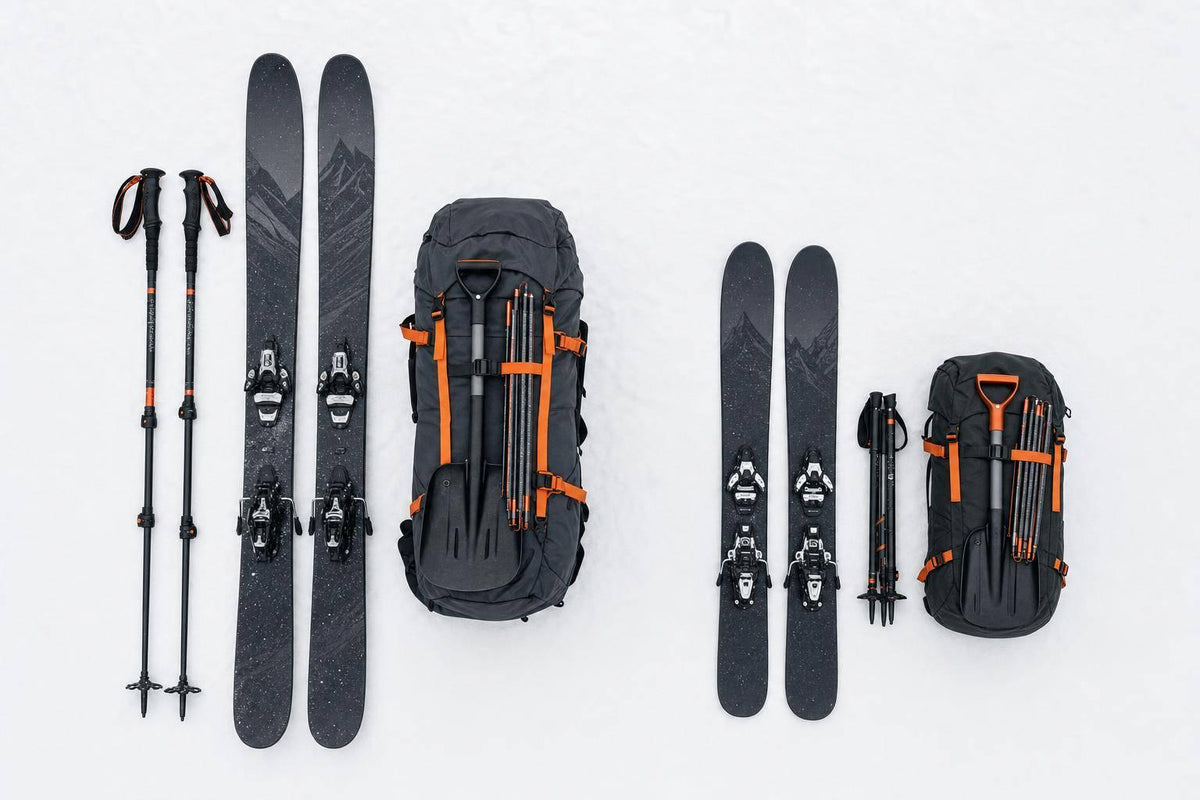
- WALKSKI (100 cm): the bulkiest of the group
| Scenario | WALKSKI 100 cm | NORDIC 90 cm | Skiblades 65 cm | Skiskates 44 cm |
|---|---|---|---|---|
| Packed trails & forest roads | Best fit | Good fit | Situational | Poor fit |
| Mixed uphill/downhill to huts | Best fit | Good fit | Poor fit | Poor fit |
| Short steep descents | Good fit | Good fit | Best fit | Good fit |
| Strapped to a pack | Situational | Good fit | Good fit | Best fit |
Next: the key pros and cons that matter most on real approaches.
Pros and Cons
Each model does one thing well. And each gives something up. That’s why the “best” pick changes with the route.
So, don’t read this as a dry spec sheet. Read it like a route match.
If you want the ski that works across the most approach days, start here.
The WALKSKI 100 cm is the best all-around pick for real approach travel. It’s the only model in this group with walk, ski, and climb modes, which makes a big difference on longer approaches and uphill sections. The downside is plain: it’s the bulkiest one to haul around.
The NORDIC 90 cm fits packed snow and rolling terrain best. It glides well and feels natural if you already know how to move on XC gear. But once the slope kicks up, things get tougher. There are no skins, no risers, and less climbing efficiency.
The Skiblades 65 cm shine when the downhill is the fun part. They’re compact, nimble, and easy to stash. The catch is distance. You get less glide with each stride, and they bog down faster in soft snow.
The Skiskates 44 cm win the portability contest, hands down. They tuck into a pack with far less fuss than the others. But for serious approach travel, they’re the weakest tool here. On steep or soft snow, stability drops off fast. These make more sense as a short-link tool than as a full approach ski.
| Model | Biggest Advantages | Biggest Limitations | Ideal User |
|---|---|---|---|
| WALKSKI 100 cm | Most float and stability of the four on ungroomed snow; walk, ski, and climb modes | Bulkiest to carry | Backcountry hikers, hut-trippers, approach-focused mountaineers |
| NORDIC 90 cm | Smooth glide on firm snow; natural kick-and-glide stride | No skins or risers; weak on steep climbs | XC skiers using their skills for winter access |
| Skiblades 65 cm | Best short-descent control; compact and easy to stow | Less glide per stride; sinks in soft snow | Mixed-terrain hikers who prioritize agility over distance |
| Skiskates 44 cm | Maximum portability; fits inside most daypacks | Minimal float and stability; not suited for long approaches or steep terrain | Minimalists needing a short-link tool near huts or trailheads |
Conclusion
After looking at carry weight, stride efficiency, and downhill control, one thing is pretty clear: the route should pick the ski.
Choose by route:
- WALKSKI for mixed approaches
- NORDIC for packed trails
- Skiblades for short descents
- Skiskates for max packability
The WALKSKI 100 cm is the top pick for most approach-first users. It handles mixed terrain and short to moderate approaches to huts, trailheads, or climbing zones better than any other model in this group.
The NORDIC 90 cm makes the most sense when your route stays on packed trails and you want smooth, efficient kick-and-glide travel.
For short outings with more downhill time on low-angle terrain, the Skiblades 65 cm are the better match.
And if the ski needs to fit inside a pack and only comes out for short snow sections, the Skiskates 44 cm win on plain convenience. Simple as that.
That said, deep powder and long days still lean toward traditional touring skis. But for approach-first use, Snowfeet* gives you a lighter, simpler, and more affordable setup than traditional touring gear.
FAQs
Which Snowfeet* model is best for beginners?
It depends on what kind of riding you want to do.
For backcountry touring, the Snowfeet WALKSKI 100 cm is the best pick. The shorter length makes turns and control easier than with long, standard skis. And its four-mode binding works with regular winter boots, which is a nice little win if you don’t want to deal with full ski gear.
For casual riding on resort slopes, sledding hills, or even in the backyard, go with the Snowfeet PRO 50 cm. It gives you more stability than the 38 cm model, but it’s still easy to carry around. Kind of a sweet spot, honestly.
Can I use regular winter boots with these short skis?
Yes - most Snowfeet models work with regular winter boots. That’s a big plus compared with classic ski setups, which usually need special alpine touring boots.
Here’s the simple breakdown:
- Snowfeet WALKSKI (100 cm), NORDIC (90 cm), and PRO (50 cm) are made for standard winter boots, hiking boots, or snowboard boots.
- Skiskates (44 cm) and Skiblades (65–99 cm) usually work better with ski boots or snowboard boots.
For the best ride, go with waterproof boots that have good ankle support. You’ll get better control and stay more comfortable out on the snow.
Are short skis good enough for deep snow and long tours?
Short skis usually aren’t the best pick for deep, unconsolidated powder or long, all-day backcountry tours.
Models like the Snowfeet WALKSKI 100 cm and POWDER skiblades are super easy to turn and a lot of fun in light powder up to 4 inches. But when the snow gets deep, they just don’t have enough surface area to stay on top the way longer skis can.
For long tours, traditional touring skis are still the better call for glide and stability. Short skis make more sense for shorter outings, rolling terrain, and packed trails where portability and quick transitions matter most.











Zanechte komentář
Tento web je chráněn službou hCaptcha a vztahují se na něj Zásady ochrany osobních údajů a Podmínky služby společnosti hCaptcha.