




















Skiing as an adult might seem intimidating, but it’s easier than you think - especially with the right gear. Short skis, like those from Snowfeet*, simplify the learning process and make skiing more approachable. Unlike longer skis, these are lightweight, easier to control, and less tiring, helping beginners gain confidence quickly.
Key Takeaways:
- Short skis are easier to turn, stop, and balance on, making them ideal for beginners.
- Snowfeet* offers various options, like 38 cm Mini Ski Skates ($250) for casual use or 99 cm Skiblades ($675) for more stability.
- Proper safety gear (helmet, goggles, gloves) and warm clothing are essential.
- Basic fitness exercises, like squats and planks, can prepare your body for skiing.
- Start on flat ground, practice stopping and turning, and gradually move to gentle slopes.
Whether you’re tackling bunny slopes or exploring new styles like freestyle skiing, Snowfeet* makes the process smoother and more fun. Ready to hit the slopes? Let’s dive in!
How to Start Skiing | 15 Beginner Questions Answered
Picking Your First Skiing Gear
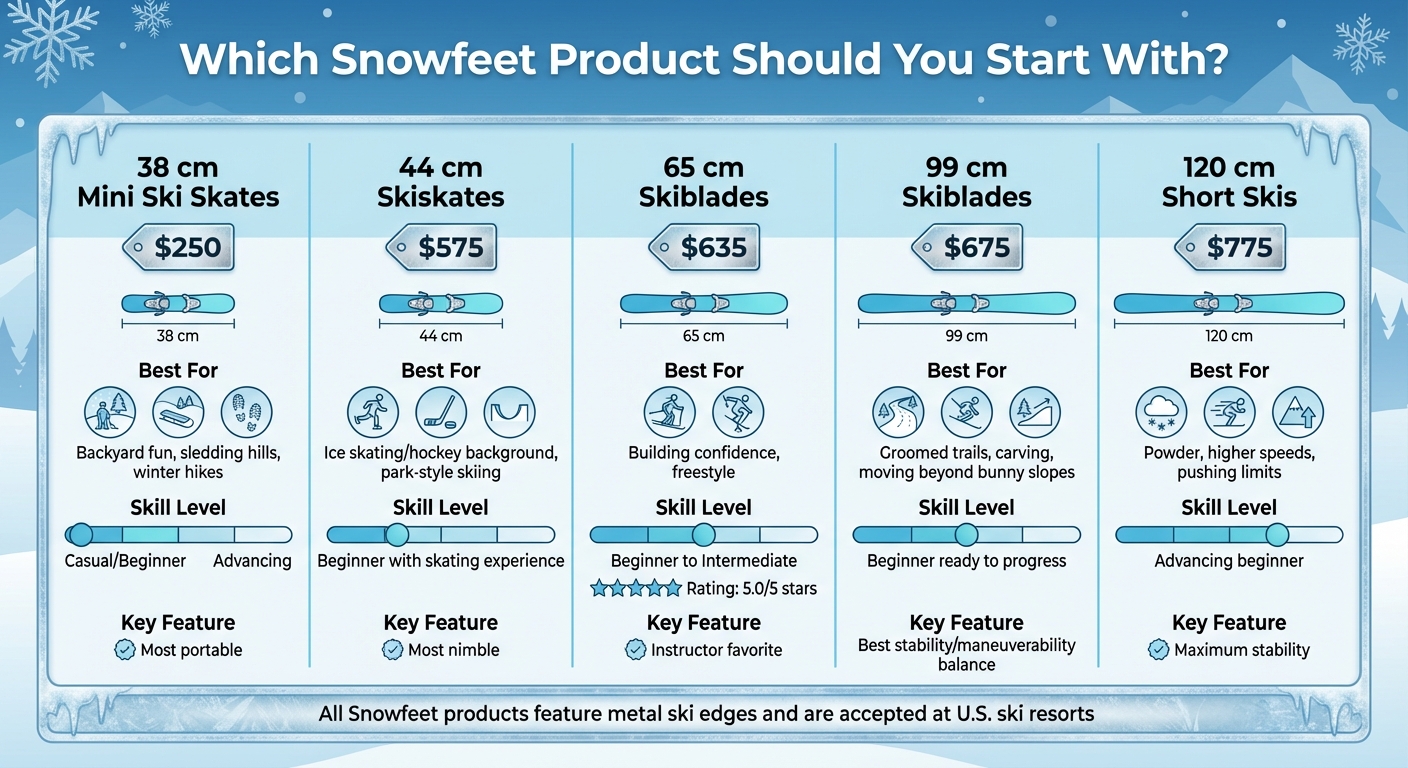
Snowfeet Product Comparison Guide for Beginner Adult Skiers
Why Shorter Skis Are Easier to Learn On
Picture trying to park a big semi-truck versus a small compact car - that’s the difference between long skis and Snowfeet* products. Shorter skis are much easier to handle, especially at the slower speeds where beginners spend most of their time. Turning and stopping become way less of a challenge.
With less length to manage, balancing is simpler, and you don’t have to work as hard. This gives you the chance to focus on nailing down your technique. While top brands like Burton and Atomic make great gear, their longer skis often require more strength and coordination - something most adult beginners are still working on. That’s why shorter options, like Snowfeet*, make learning smoother and more fun.
Which Snowfeet* Product to Start With
If agility and ease are what you’re after, Snowfeet* has something for every kind of skier. Here’s a quick guide to help you pick the right fit:
- 99 cm Skiblades ($675): These strike a great balance between stability and maneuverability, making them ideal for beginners who are ready to move beyond the bunny slopes. They’re perfect for carving on groomed trails.
- 44 cm Skiskates ($575): If you’ve got experience with ice skating or hockey, these are a natural choice. They’re nimble and great for park-style skiing.
- 38 cm Mini Ski Skates ($250): Looking for something you can easily carry around? These are perfect for backyard fun, sledding hills, or even winter hikes.
- 65 cm Skiblades ($635): Loved by ski instructors and freestyle fans, these are great for building confidence. They’re super agile and fun to use.
- 120 cm Short Skis ($775): Ready to tackle powder or carve at higher speeds? These offer more stability and are a solid choice as you start pushing your limits.
Safety Gear You Need for U.S. Ski Conditions
When it comes to safety, don’t cut corners. U.S. ski temperatures typically hover between 15°F and 32°F, so dressing in layers is key. Start with a moisture-wicking base layer, add an insulated mid-layer, and top it off with a waterproof jacket.
Make sure to grab these essentials, too:
- A certified helmet (most U.S. resorts require one)
- UV-protective goggles
- Insulated gloves
- Wool or synthetic socks
This no-nonsense approach to safety gear pairs perfectly with the simplicity of Snowfeet* products, letting you focus on gaining confidence and enjoying every moment on the slopes.
Getting Your Body and Mind Ready
Simple Exercises to Build Skiing Fitness
You don’t need a fancy gym membership to get ready for Snowfeet*. Just carve out 20–30 minutes, three to four times a week, for about 4–6 weeks before hitting the slopes. These short workouts can make a big difference in how comfortable you feel out there. The key? Focus on strengthening your legs, core, and balance - because those are the muscles that’ll do most of the work with Snowfeet*.
Here’s what to include in your routine:
- Leg Strength: Squats, wall sits, and lunges are perfect for building strength and preparing for side-to-side movements.
- Core Stability: Glute bridges and planks will help keep your pelvis and spine steady as you carve through turns.
- Ankle Support: Calf raises will boost your ankle control, which is crucial for staying secure in your bindings.
For each exercise, aim for 2–3 sets of 10–15 reps. If you’re doing planks or wall sits, hold them for about 20–40 seconds.
Balance drills are just as important. Try standing on one leg for 30–45 seconds. To make it trickier (and more effective), move your free leg gently or turn your head. You can even stand on a cushion or folded towel to mimic the uneven feel of snow. Just keep something nearby, like a wall or chair, for support in case you wobble.
Before you head out to the slopes, spend 5–10 minutes on a dynamic warm-up. Do things like leg swings, hip circles, ankle rolls, or walking lunges with a twist. These moves will loosen up your joints and get your heart pumping. This is especially helpful if you’re skiing in colder U.S. resorts, where muscles can feel tight first thing in the morning. Once your body’s ready, it’s time to prep your mindset.
Managing Fear and Setting Realistic Goals
Feeling a bit nervous about trying something new? Totally normal. The good news is Snowfeet* are designed to give you more control and help you pick things up quickly.
To ease into it, head to the slopes during quieter times - think midweek mornings or non-holiday periods. Fewer people around means less pressure and more space to practice. Keep your sessions short and manageable: do a run or two, then take a break. Fatigue can make you more prone to mistakes, and that’s the last thing you want when you’re learning.
Set some simple, achievable rules for yourself. For example, decide ahead of time to stop and reset if you feel like things are getting out of control. This helps you stay in charge and builds your confidence.
When it comes to goals, keep them specific and realistic. On your first day, aim to:
- Stand and shuffle on flat ground.
- Glide in a straight line.
- Practice stopping safely 5–10 times.
sbb-itb-17ade95
Your First Day on Snowfeet*: Step-by-Step
Getting Comfortable with Snowfeet* on Flat Ground
Before you hit the slopes, take a moment to adjust your Snowfeet* bindings at home. Make sure they fit snugly with your winter boots. If necessary, tweak the straps to keep your boots secure.
When you get to the resort, find a flat, quiet spot to get started. Snowboard boots are a solid choice for ski slopes, but waterproof winter shoes with good ankle support can work fine on easier terrain. Keep your posture in check - placing one foot slightly ahead of the other and leaning your upper body forward can help with balance.
To start gliding, push off with one foot at a time, kind of like hockey skating. Spend 10–15 minutes shuffling around, getting a feel for how your Snowfeet* move and practicing shifting your weight side to side. Once you're comfortable, you're ready to try a gentle slope.
Sliding, Stopping, and Turning on Easy Slopes
Now that you've got the basics down, it's time to take on the bunny slope. This is the gentlest run and perfect for building confidence. Let gravity pull you downhill by pointing your Snowfeet* straight down the slope. Keep your knees bent and your weight centered. To stop, rotate both Snowfeet* so they’re perpendicular to the slope, distributing your weight evenly to create a controlled skid. If you want to slow down more gradually, use the built-in heel brake by pressing down gently.
Turning is straightforward - just shift your weight slightly to one side, and your Snowfeet* will follow. Start with wide, easy turns to build your confidence. Unlike regular skis, which are long and need precise alignment, Snowfeet* respond quickly to even small movements. Practice stopping after each turn until it feels second nature.
Using Ski Lifts with Snowfeet*
Once you’re comfortable on the slopes, using ski lifts will make your day smoother and more fun. Magic carpets are the easiest - just step on and ride to the top. Chairlifts are simple, too. Approach them as you would with regular skis. Most resorts in the U.S. are Snowfeet*-friendly, so if anyone asks, just mention that Snowfeet* have metal ski edges, meeting the same requirements as traditional skis.
When it’s your turn, glide up to the chairlift, sit down, and rest your Snowfeet* on the footrest. As you near the top, stand up and glide forward smoothly to exit.
“Getting on and off the chairlift with Snowfeet was simple and stress-free - way easier than snowboarding or skiing”.
Pro skater Logan (@xskyskaterx) shared:
“The feet themselves are so easy to get through the ski line and onto the lift!”
Moving Beyond Beginner Skills with Snowfeet*
Moving from Green to Blue Runs
Once you've got green runs down, it's time to take on the challenge of blue runs. Snowfeet* can make that transition smoother and quicker than you might expect. If you’ve mastered stopping and linking turns on gentler slopes, you’re ready for the next step. With Snowfeet*, the skills you’ve built - like weight distribution and edge control - translate seamlessly to steeper terrain.
Blue runs bring more speed and steeper inclines, which can feel a bit intimidating at first. But here’s the good news: Snowfeet* are far more forgiving than traditional skis. Long skis (typically 170–180 cm) require precise technique at high speeds, but Snowfeet* respond instantly to even the smallest weight shifts. A shoulder-width stance with your weight centered over your midfoot is key. This stance gives you stability without needing the aggressive forward lean that long skis often demand.
Start small - shorter blue runs are perfect for building confidence. Practice stopping by evenly distributing your weight across both feet and pushing the edges sideways to create friction. Thanks to Snowfeet’s* metal edges, you’ll get a solid grip comparable to traditional skis but with less equipment to manage. This setup helps you stay in control, giving you the confidence to tackle the variety blue runs offer.
Trying Different Styles: Freestyle, Carving, and Backyard Fun
Once blue runs feel like second nature, Snowfeet* unlock a whole new level of fun. Unlike traditional skis or snowboards, Snowfeet* are versatile enough to let you explore multiple styles. They’re like having three sports in one - you can ski downhill, glide cross-country, or even skate.
For carving, the 65 cm Skiblades (rated 5.0/5) are perfect for groomed runs, allowing you to dig into turns with precision. If you’re into terrain parks, Snowfeet* make spins and tricks far easier than with bulky snowboards or long skis. And their portability? Game-changing. You’re not limited to ski resorts anymore - you can take Snowfeet* to your backyard, local parks, or even hiking trails after a fresh snowfall.
Looking to experiment with tricks or different styles? The 44 cm Skiskates (rated 5.0/5, starting at $490) are a great choice. They’re nimble enough for freestyle moves while still offering stability at speed. Unlike traditional ski brands like Rossignol or K2, Snowfeet* bring a level of convenience and adaptability that’s hard to beat. Once you’ve explored these unique styles, you might find yourself ready for an upgrade.
When to Upgrade Your Snowfeet* Gear
Feeling like you’ve outgrown the beginner stage? That’s when it’s time to consider upgrading. If you’re ready for steeper terrain, the 99 cm Skiblades are a fantastic option. They offer enhanced stability without compromising ease of control. Priced from $590 and rated 5.0/5, these longer blades are great for powder days and higher speeds, while still being far easier to handle than traditional skis.
For those who started with entry-level models and now want something more advanced, the Snowfeet* X is worth a look. It’s built for serious riders, featuring premium materials, smoother adjustments, and bindings that can handle aggressive use. The difference is noticeable - this gear is designed to keep up with you as you push your limits.
Upgrade when your current Snowfeet* start feeling like they’re holding you back. Whether you’re tackling black diamond runs, spending hours in deep powder, or chasing speed on groomed slopes, the 99 cm Skiblades or Snowfeet POWDER (starting at $675) are built to handle it all. Plus, they’re still way easier to manage both on and off the mountain.
Conclusion: Why Snowfeet* Makes Skiing Easy and Fun
Skiing as an adult doesn’t have to feel intimidating. Snowfeet* tackles the usual beginner hurdles - like heavy gear and complicated techniques - making it easier for newcomers to dive in and enjoy. With over 50,000 riders worldwide, it’s clear that shorter skis are transforming the way people learn to ski.
Snowfeet* also stands out for its affordability. Whether you go for the budget-friendly Snowfeet* Basic or the versatile 65 cm Skiblades, these options are much easier on the wallet compared to traditional setups from brands like Rossignol or K2.
Another big plus? Snowfeet* speeds up the learning process. Thanks to their shorter length (ranging from 38 cm to 120 cm), you’ll quickly get the hang of turning, stopping, and balancing. Unlike traditional skis that demand a lot of technique and forward lean, Snowfeet* respond to even small weight shifts, making them feel intuitive and easy to control.
Portability is another win. These compact skis fit in almost any bag, so you can take them anywhere - whether it’s a ski resort, a local hill, hiking trails, or even your snowy backyard. No more lugging around bulky equipment, which means more time skiing and less time dealing with logistics.
From the 44 cm Skiskates priced at $440 to the 99 cm Skiblades at $540, Snowfeet* offers award-winning gear that’s been recognized as an ISPO innovation finalist and an A’design winner. So, why wait? With Snowfeet*, you’ll hit the slopes with lightweight, beginner-friendly gear that makes skiing genuinely fun and easy.
FAQs
Why are short skis a great choice for beginners?
Short skis are a fantastic choice for beginners. Why? They’re lighter, easier to handle, and don’t demand as much physical effort as traditional long skis. Their smaller size makes them super easy to maneuver, so you can nail those quick turns and build confidence faster out on the slopes.
Another perk? They’re more forgiving, which means you can ease into skiing without feeling overwhelmed. Models like Snowfeet’s Skiblades or Skiskates are also incredibly portable and versatile - perfect if you want to enjoy the snow without lugging around heavy gear. Whether you’re just starting out or dipping your toes into freestyle skiing, short skis offer a fun, approachable way to enjoy the slopes.
Which Snowfeet product is best for my skill level?
For those just starting out, shorter options like the 44 cm Skiskates or 65 cm Skiblades are a great choice. They’re lightweight, super easy to handle, and help you build confidence on the slopes in no time. If you’ve got more experience under your belt, longer Skiblades in the 99-120 cm range are worth considering. They offer better stability, smoother turns, and a more exciting ride.
Snowfeet gear is all about making skiing enjoyable and accessible for everyone. Plus, they’re way more portable and versatile than traditional long skis. Whether you’re just getting started or looking to push your skills, there’s a Snowfeet option that’s perfect for you!
What safety gear do I need to ski with Snowfeet in the U.S.?
When you're hitting the slopes with Snowfeet, having the right safety gear is key to keeping things fun and safe. Start with a certified ski or snowboard helmet - it's your best defense against bumps, falls, or unexpected collisions. Pair that with protective goggles to shield your eyes from snow, wind, and those sneaky UV rays that can still catch you on cloudy days.
If you're new to Snowfeet, adding wrist guards is a smart move to reduce the risk of hand or wrist injuries during falls. For even more protection, knee pads and padded shorts can make a big difference, especially while you're getting the hang of things. And don’t forget the essentials: warm, waterproof gloves and layered clothing to stay cozy and dry no matter how chilly it gets.
With the right gear, you’ll feel more confident and ready to enjoy everything Snowfeet has to offer, all while staying safe and comfortable.












Leave a comment
This site is protected by hCaptcha and the hCaptcha Privacy Policy and Terms of Service apply.