



















Ever wish you could combine the freedom of snowboarding with the control of skiing? That’s exactly what short skis with snowboard bindings offer. These compact skis (17 to 47 inches long) pair with soft, comfy snowboard boots instead of stiff ski boots, making them easier to use, carry, and learn. Popularized by Snowfeet*, this setup is perfect for beginners, park riders, or anyone looking for a fun, lightweight alternative to bulky gear.
Key Benefits:
- Comfortable Boots: Use flexible snowboard boots instead of rigid ski boots.
- Compact Size: Fits in a backpack - no roof racks or oversized bags needed.
- Easy Learning Curve: Feels natural, like skating or walking.
- Versatile Use: Great for terrain parks, groomed slopes, or even backyard snow.
Snowfeet* leads the pack with models like the 44 cm Skiskates ($575) and 99 cm Skiblades ($675), designed specifically for snowboard bindings. With over 50,000 riders and glowing reviews, this gear is shaking up winter sports. Ready to ditch the bulk? Let’s dive in.
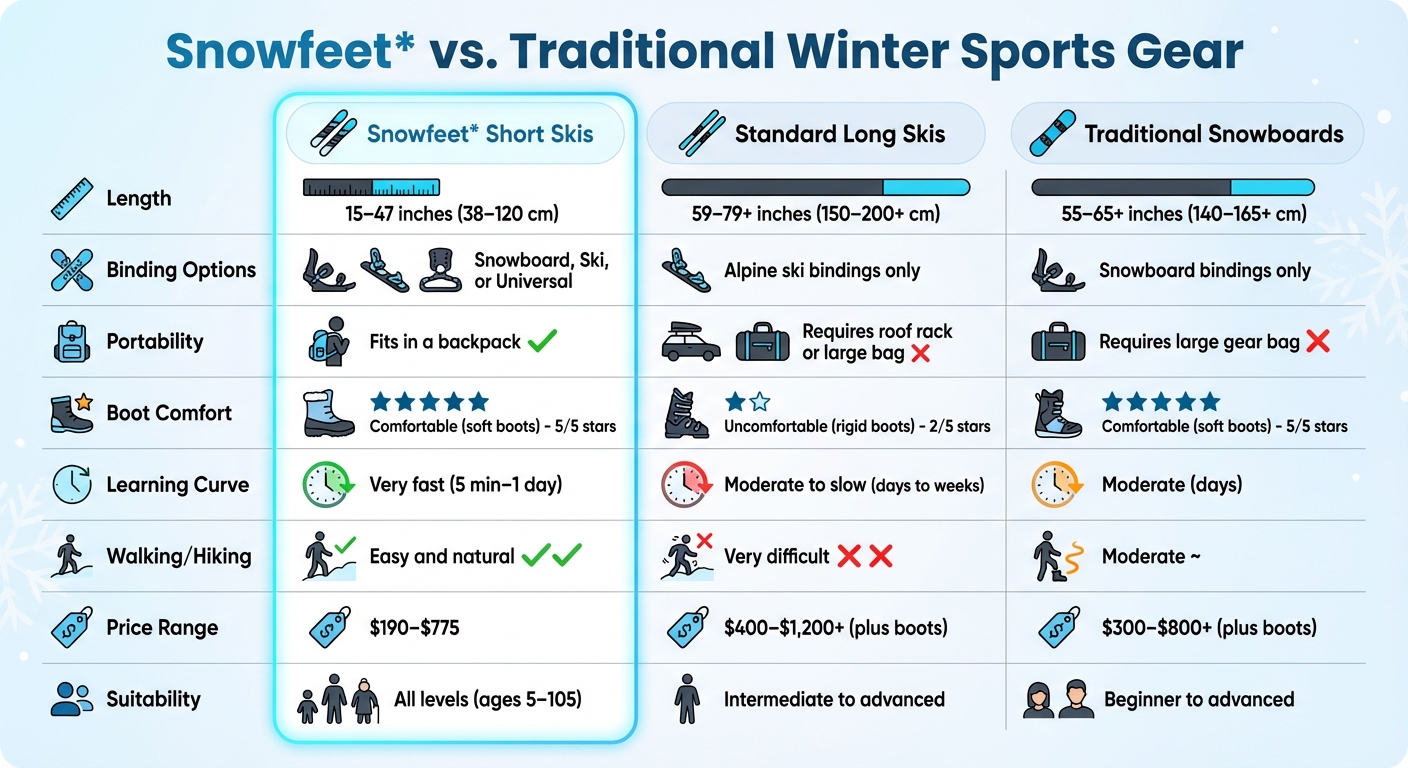
Snowfeet Short Skis vs Traditional Skis and Snowboards Comparison Chart
What Are Skis with Snowboard Bindings?
Skis with snowboard bindings are essentially short skis - usually under 39 inches (about 100 cm) - that use bindings designed for soft, flexible snowboard boots instead of the stiff, traditional ski boots. These setups borrow the familiar strap-based bindings from snowboards, complete with toe and ankle straps and a highback, but they’re adjusted to fit the slimmer profile of short skis.
Here’s the main difference: comfort and mobility. Traditional ski bindings require rigid boots, which can cost anywhere from $200 to $600 and often feel clunky when walking. On the other hand, snowboard bindings on short skis let you use softer boots, making walking around the slopes much easier. Since snowboard bindings are generally wider than short skis, most setups include a riser plate to prevent the binding from scraping the snow during sharp turns. Let’s break down how these bindings work on skis.
How Snowboard Bindings Work on Skis
The mechanics are pretty simple. Snowboard bindings are mounted onto short skis using the standard four-hole pattern. To make them work for skiing, an extra third strap is typically added. This strap ensures your foot stays securely in place during carving, while still allowing the ankle flexibility needed for tricks and quick turns.
The riser plate plays a crucial role here. Without it, the wider base of the binding could drag in the snow during tight turns, which would hurt your responsiveness. Snowfeet* has designed their products with this in mind. Their 44 cm Skiskates (starting at $575) and 99 cm Skiblades (starting at $675) are built for seamless compatibility, offering a smooth experience compared to retrofitting traditional snowboard bindings onto regular skis. This thoughtful design makes a noticeable difference on the slopes, as we’ll explore in the next section.
Common Uses for Short Skis with Snowboard Bindings
This setup shines in places where full-size skis might feel unnecessary. Terrain parks are a perfect match - the shorter length and flexible boot system make tricks like spins, jumps, and rail slides feel more natural. They’re also great for groomed slopes, where quick, playful carving takes priority over outright speed. And because of their compact size (some models even fit in a backpack), they’re ideal for hiking trails, backyard snow, or quick runs on smaller local hills - no need to lug around bulky gear.
Another advantage is their non-release design. Unlike traditional release bindings, these bindings stay attached during falls, which is especially useful on shorter skis that don’t put as much strain on your legs. While these features apply to all short skis, they’re particularly effective in Snowfeet* models, which are designed to maximize versatility.
Snowboard Binding Compatibility with Snowfeet* Short Skis
Snowfeet* Models and Snowboard Binding Compatibility
Snowfeet* has carved out a niche with its short skis designed specifically for snowboard bindings. Unlike brands like Rossignol, Salomon, or K2, Snowfeet* offers models that come equipped with their own proprietary bindings. These bindings are narrower than standard snowboard bindings, which helps prevent edge catching during sharp turns. Here’s a quick rundown of their lineup:
- 44 cm Skiskates (starting at $575)
- 65 cm Skiblades (from $635)
- 99 cm Skiblades (from $675)
These models feature bindings tailored for short skis, eliminating the need for riser plates that are usually required with regular snowboard bindings to avoid snow drag. Snowfeet* bindings also include a third strap, which ensures a snug fit and better control during those high-intensity carves. They’re compatible with snowboard boots ranging from US sizes 6 to 14.5 (EU 38–49).
"At Snowfeet we developed unique snowboard bindings specifically designed for skiboards. They are affordable, easily adjustable to snowboard boots of any size, with an anti-slippery surface for perfect shoe grip." - Snowfeet Team
If you’re looking at the 99 cm POWDER skis (from $675), these are built with a wider waist to handle deep snow while still accommodating snowboard boots. On the other hand, the 100 cm Walkski (starting at $595) features a universal free-heel binding that works with both winter boots and snowboard boots, making it ideal for backcountry adventures. However, the 120 cm Freedom short skis ($775) are an exception - they’re designed for traditional release ski bindings due to their length and the added safety needed for high-speed carving.
Installing Snowboard Bindings on Short Skis
To make the most of Snowfeet* short skis, proper binding installation is key. If you’re planning to use your own snowboard bindings, it’s important to understand the mounting systems. Most standard snowboard bindings use 2x4 or 4x4 hole patterns. For instance, Burton’s Re:Flex bindings are compatible with both, making them a versatile choice. However, steer clear of EST bindings, as they’re limited to Burton’s Channel mounting system and won’t work with traditional hole patterns.
Snowfeet* simplifies things by offering integrated binding systems designed specifically for their skis. This means you can pair your existing snowboard boots with ease. Plus, they offer three binding options - Basic, Standard, and Pro X - so you can choose the one that fits your needs without any complicated setup.
Benefits of Snowboard Bindings on Snowfeet* Short Skis
Better Flexibility and Control
Using snowboard bindings with Snowfeet* short skis gives you a level of ankle movement that traditional ski setups simply can’t match. With rigid ski boots, your ankles are locked in place, limiting your range of motion. But snowboard boots? They let your ankles flex naturally, giving you the freedom to explore different riding styles, carve with precision, and nail tricks without feeling like you’re battling your gear. Snowfeet* models, ranging from 44 to 120 cm, are lightweight and super responsive, making sharp turns, quick stops, and tight pivots a breeze. The snowboard bindings hold your boots securely but still allow the flexibility you need for those fast maneuvers and jumps.
"Snowboard bindings allow for more natural movement of the ankles, which can be appealing to skiers looking to experiment with different styles and techniques." - Snowfeet Team
This added control works hand-in-hand with the portability of Snowfeet* skis, creating a setup that’s as practical as it is fun.
Easy to Carry and Store
Snowfeet* short skis are built with convenience in mind. Their compact size means you can toss them into your backpack - no need for roof racks or bulky storage solutions. Perfect for those last-minute mountain trips! And let’s not forget the snowboard boots. Unlike stiff ski boots, they’re comfortable enough to wear like regular winter shoes, letting you walk from your car to the lift without needing to change. Talk about hassle-free.
Easier to Learn
Combining portability, control, and comfort, Snowfeet* short skis with snowboard bindings make learning a breeze. Most people pick up the basics in just five minutes. The design feels natural - more like ice skating or inline skating - so even if you’re new to winter sports, you’ll feel at ease. Plus, the soft, flexible snowboard boots take away the stress that often comes with traditional, rigid ski boots. Instead of worrying about discomfort, you can focus on having fun and building your skills. Snowfeet* proves that shorter skis and comfy bindings make winter sports approachable for everyone.
"These skiblades are so much fun and easy to control. Never going back to regular skis." - Andrew B., Verified User
With all these perks, it’s no wonder Snowfeet* is shaking up the winter sports scene, offering a setup that’s easy, fun, and accessible to all.
sbb-itb-17ade95
How to Set Up Snowboard Bindings on Snowfeet* Short Skis
Choosing the Right Bindings and Boots
Snowfeet* has created snowboard bindings tailored specifically for skiboards. These bindings are less bulky and more budget-friendly than many standard aftermarket options. They’re designed to fit perfectly with Snowfeet*’s unique four-hole pattern and accommodate snowboard boot sizes ranging from 6–14.5 US (38–49 EU). When selecting bindings, go for a universal disc that matches either the 2×4 or 4×4 insert pattern. This ensures everything fits together without any headaches.
Boots are just as important. Snowboard boots, with their natural flex, should be securely fastened, especially for larger sizes where extra-long toe straps may be needed. If you’re after maximum flexibility, MNC bindings are a great choice - they work with all boot sole types, including Alpine (ISO 5355), Touring (ISO 9523), and GripWalk (ISO 23223). Once you’ve got the right boots and bindings, you’re ready to move on to the setup process.
Installation Steps
Now that you’ve picked your gear, it’s time to install everything for peak performance. Snowfeet*’s design is all about enhancing control and versatility, so setting things up properly is key. It’s a good idea to do this at home before heading to the slopes. Start by aligning the bindings with the four-hole pattern on your Snowfeet* skis. If the binding’s base is wider than the ski surface, use a riser plate for a better fit. Secure the bindings according to Snowfeet*’s instructions to ensure everything stays in place. Aim for a stance width of 40–50 cm, which offers better control.
Once the bindings are mounted, adjust the straps using a screwdriver. Insert your boot, making sure the heel sits flush and the toe is snug. Test for any unwanted movement - your skiblades should feel like an extension of your feet.
"To avoid any hassle on the slopes, take your time and adjust the bindings at the comfort of your home, using a screwdriver and a boot you are going to wear." - Snowfeet Team
Next, check the forward pressure and lateral release settings. For skiblades, angles like +15°/-6° are a good starting point for most riders. After everything is set up, don’t forget some basic maintenance: dry the metal edges after each use to prevent rust and keep the base waxed for smooth gliding. With your setup ready to go, let’s see how Snowfeet* stacks up against traditional ski and snowboard brands.
Snowfeet* vs. Standard Ski and Snowboard Brands
Easier to Transport and Use
Let’s face it - traditional skis and snowboards can be a pain to lug around. Skis are usually 59–79+ inches long (150–200+ cm), while snowboards clock in at 55–65+ inches (140–165+ cm). You’ll often need a roof rack, oversized gear bag, or both just to move them from point A to point B. Snowfeet*, on the other hand, flips the script. Their short skis range from just 15 to 47 inches (38–120 cm), making them small enough to slip into a standard backpack. This means no roof racks, no oversized bags - just toss them in your car or carry them on public transit without breaking a sweat.
Another bonus? You’re not stuck in those stiff, clunky ski boots. Snowfeet* works with snowboard bindings, so you can wear soft, flexible snowboard boots. That means you can walk comfortably around the lodge, cross a parking lot, or even hike up a trail - all without swapping footwear.
"Far more portable and affordable than traditional skis or snowboards." – Uncrate
And portability is just the beginning - Snowfeet* changes how you experience the slopes.
Performance and Fun
Traditional skis and snowboards focus on speed and stability, but Snowfeet* is all about agility and having a blast. Their shorter length (15 to 47 inches versus the 59–79+ inches of standard skis) gives you a skate-like feel on the snow. You can carve sharp turns, pull off tricks, and stop on a dime - none of that cumbersome, heavy feeling you get with longer skis.
Sophia Kane, a verified user, shared, "I hate getting stuck on a hill in skis because they're so long and bulky. Since these are shorter, you can just skate right up." The learning curve is also much quicker. In fact, one reviewer, Rebecca, noted that her 12-year-old son, who had zero winter sports experience, was zipping down hills and landing jumps within 30 minutes of trying the Snowfeet* 38 CM Mini Ski Skates.
Comparison Table: Snowfeet* vs. Standard Ski and Snowboard Brands
Here’s a side-by-side look at how Snowfeet* stacks up against traditional gear in terms of convenience and performance:
| Feature | Snowfeet* Short Skis | Standard Long Skis | Traditional Snowboards |
|---|---|---|---|
| Length | 15–47 inches (38–120 cm) | 59–79+ inches (150–200+ cm) | 55–65+ inches (140–165+ cm) |
| Binding Options | Snowboard, Ski, or Universal | Alpine ski bindings only | Snowboard bindings only |
| Portability | Fits in a backpack | Requires roof rack or large bag | Requires large gear bag |
| Boot Comfort | Comfortable (soft boots) | Uncomfortable (rigid boots) | Comfortable (soft boots) |
| Learning Curve | Very fast (5 min–1 day) | Moderate to slow (days to weeks) | Moderate (days) |
| Walking/Hiking | Easy and natural | Very difficult | Moderate |
| Price Range | $190–$775 | $400–$1,200+ (plus boots) | $300–$800+ (plus boots) |
| Suitability | All levels (ages 5–105) | Intermediate to advanced | Beginner to advanced |
Snowfeet* not only saves you the hassle of bulky gear but also saves you money. Prices start at $190 for the 38 CM Mini Ski Skates and top out at $775 for the 120 CM Short Skis. Compare that to traditional setups, which often soar past $1,000 once you add in boots and bindings. Plus, Snowfeet* isn’t limited to ski slopes - you can use them on sledding hills, hiking trails, or even in your backyard. That’s versatility you just don’t get with traditional equipment.
Conclusion
This setup brings together the best of skiing and snowboarding in an entirely new way. Skis with snowboard bindings are shaking things up in winter sports for 2026, and Snowfeet* short skis are leading the charge. These compact skis, available in lengths from 15 inches (38 cm) to 47 inches (120 cm), offer unmatched agility for carving, spinning, and pulling off moves that traditional skis just can’t match. Plus, pairing them with snowboard boots means you can walk comfortably around the lodge, hike trails, or hit the slopes - all without switching footwear.
One of the standout features of Snowfeet* is their portability. Their lightweight design makes it easy to toss them in a backpack, saving you space and cutting down on the hassle compared to bulky traditional ski gear. With competitive pricing and gear that’s approved for resorts (thanks to metal edges for reliable performance), Snowfeet* are perfect for slopes, snow parks, or even a quick backyard session. Add that to their quick learning curve, and you’ve got a game-changer.
Speaking of the learning curve - it’s almost nonexistent! Most people get the hang of the basics in just five minutes, and even total beginners can start pulling off tricks in no time. Snowfeet* makes winter sports fun and approachable for all ages.
Ready to give this sleek, nimble take on winter sports a try? Check out Snowfeet* models like the 44 cm Skiskates (starting at $575), the 65 cm Skiblades (starting at $635), or the 99 cm Skiblades (starting at $675). Your back - and your wallet - might just thank you.
FAQs
How portable are Snowfeet short skis compared to traditional skis?
Snowfeet short skis are all about convenience and portability. The Skiblades come in lengths of 65 cm, 99 cm, or 120 cm, while the ultra-compact Skiskates are just 44 cm long. Thanks to their integrated bindings, which work seamlessly with snowboard or ski boots, there’s no need for heavy, clunky mounting systems. Their compact size means you can easily tuck them into a backpack or a small carry case - perfect for travel or quick slope adventures.
Now, compare that to traditional skis, which are usually between 160 and 190 cm long. They require separate, heavier bindings and a dedicated ski bag just to transport them. All that extra bulk makes them less practical for those who are always on the move. Snowfeet short skis, on the other hand, offer a lightweight, hassle-free option, making them a great fit for today’s winter sports fans who value simplicity and mobility.
Why are snowboard bindings on short skis more comfortable than traditional ski bindings?
Snowboard bindings bring a whole new level of comfort and flexibility to short skis compared to traditional ski bindings. One of the biggest perks? You can use snowboard boots or even regular winter boots. These are way softer and more forgiving than stiff, caged ski boots, meaning no more battling with pressure points or the discomfort that comes with rigid footwear.
Thanks to their wider, strap-based design, snowboard bindings distribute pressure evenly across your feet. This not only gives you better support but also helps cut down on fatigue - especially handy when you're hitting the slopes for multiple runs. Plus, they’re a breeze to step into and out of, saving you time and hassle. Unlike ski bindings that lock your heel in place and demand specific boots, snowboard bindings offer more ankle freedom, which is a game-changer for balance and comfort on short, flexible skis.
Snowfeet’s short-ski models take things up a notch by being compatible with regular winter boots. For anyone craving a hassle-free, comfy ride, they’re a fantastic option to make the most of your winter adventures.
Are Snowfeet short skis good for all skill levels and different terrains?
Snowfeet short skis are a hit for a reason. Whether you're looking at the 65 cm, 99 cm, and 120 cm Skiblades or the 44 cm Skiskates, these skis are built for everyone - from total beginners to seasoned pros. Beginners can enjoy a smooth and easy learning curve, while experienced riders get the precision and performance they crave. The best part? You can use them with snowboard boots, ski boots, or even regular winter shoes. Talk about convenience!
Their compact, lightweight design makes them a breeze to handle. They're stable on groomed slopes, a blast in the park, and even ready for some light off-piste exploring. It's this mix of fun, ease, and versatility that has more and more winter sports fans turning to Snowfeet short skis in 2026.













Leave a comment
This site is protected by hCaptcha and the hCaptcha Privacy Policy and Terms of Service apply.