



















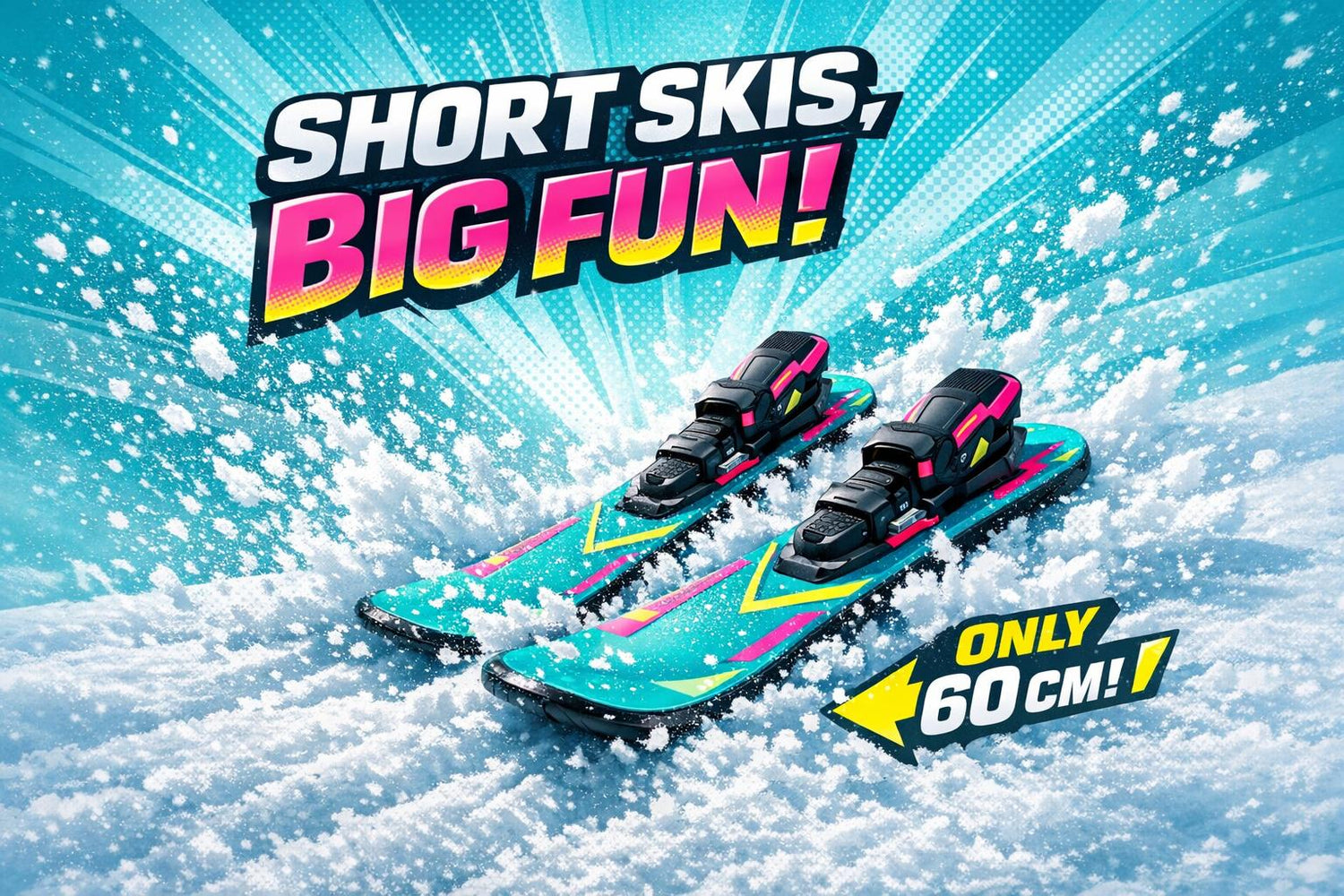
Looking to make skiing easier and less tiring as you age? Short skis, like Snowfeet's models, might be the perfect fit. They’re lightweight, easier to handle, and reduce strain on your knees and joints - ideal for older skiers or anyone wanting a low-effort way to enjoy the slopes. Plus, they’re compact enough to carry in a backpack, cutting down on hassle.
Here’s why short skis are a game-changer for seniors:
- Less Effort: Smaller turn radii mean smoother, easier turns with less strength needed.
- Joint-Friendly: They reduce stress on knees and hips compared to longer skis.
- Beginner-Friendly: Easier to balance and control, making them great for new or returning skiers.
- Convenient: Models range from 44 cm to 120 cm, fitting various needs and skill levels.
Popular options include the 44 cm Skiskates (use regular boots, $575) and 65 cm Skiblades (lightweight and stable, $550). For more stability, try the 99 cm or 120 cm models ($675–$775). With Snowfeet, skiing becomes less about effort and more about fun.
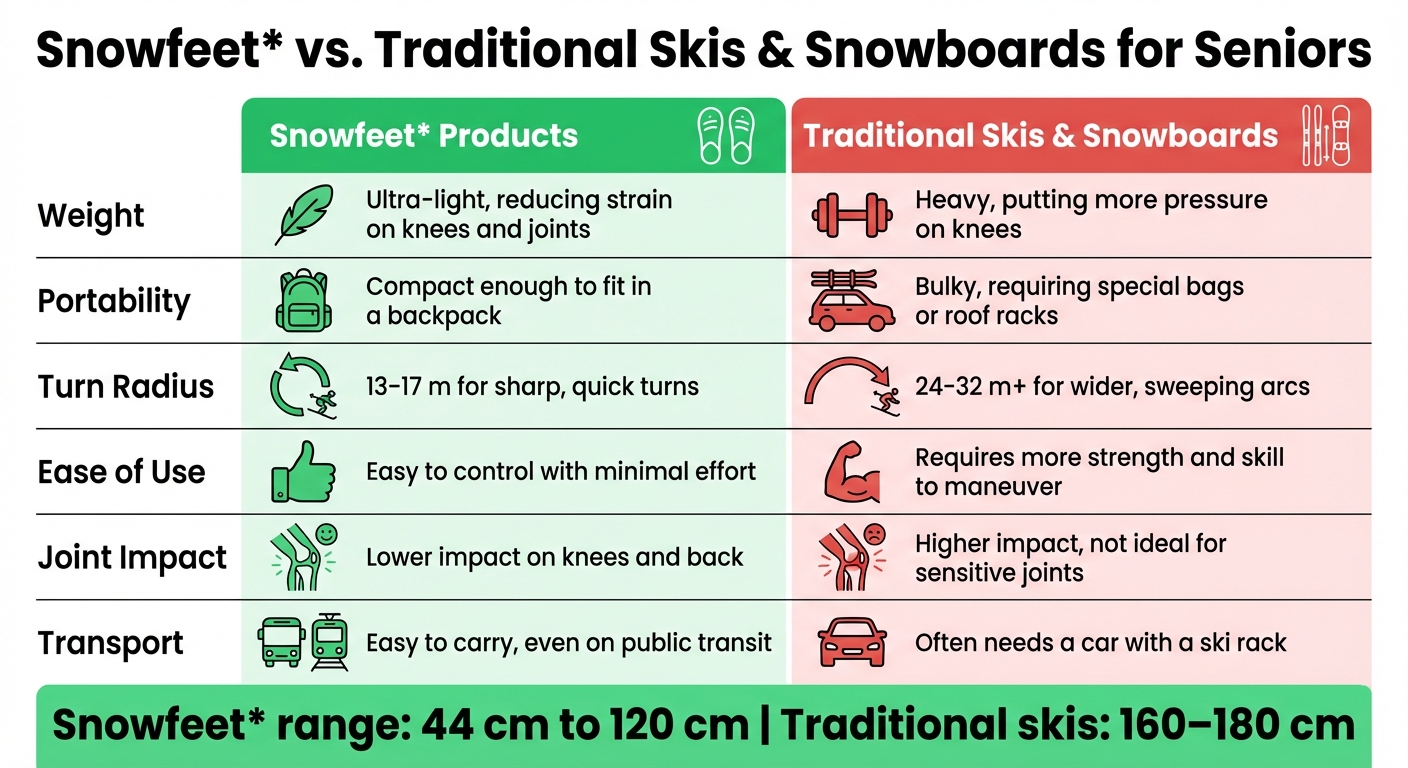
Snowfeet Short Skis vs Traditional Skis Comparison for Seniors
Why Short Skis Work Better for Older Skiers
Lightweight and Easier to Handle
As we get older, dealing with heavy equipment can be a real chore. Traditional skis from well-known brands often feel bulky and unwieldy, which can make skiing more tiring than fun. That’s where Snowfeet* Skiblades and Skiskates come in. They’re designed to be much lighter, making them easier to carry and control. This lightness doesn’t just save your energy - it also lets you spend more time enjoying the slopes without wearing yourself out.
Short skis also make turning and pivoting a breeze. Because they have less edge gripping the snow, you don’t have to fight to make them move. Instead of wrestling with long, awkward skis, you can make quick, smooth turns with minimal effort. For older skiers, who might not have the same strength or reaction speed as before, this translates to better control, more confidence, and a lower chance of falling. Plus, it puts less strain on your body.
Easier on Knees and Joints
Long skis can put a lot of stress on your knees and hips. The longer the ski, the more leverage it creates when you turn or hit bumps, and that extra force gets absorbed by your joints. Snowfeet* short skis, on the other hand, reduce this leverage effect, easing the mechanical strain on your body.
Another bonus? Short skis encourage a more natural, upright stance, so you’re not forced into the aggressive, crouched position that longer skis often demand. This upright posture is a game-changer for anyone dealing with arthritis, past injuries, or general joint discomfort. It helps reduce strain on your lower back, hips, and knees, keeping you comfortable and letting you ski longer without feeling beat up. And when you’re more comfortable, you’re more likely to pick up new skills quickly.
Quicker Learning for Beginners
Let’s face it - long skis can look downright intimidating, especially if you’re new to skiing. Snowfeet* products make things way less scary. They’re easier to balance on and control, which means you can start having fun right away instead of struggling to figure things out.
Their shorter design also helps with balance and quick recovery if you wobble. While traditional skis often have a massive turn radius (sometimes over 80 feet), Snowfeet* short skis offer a much tighter radius - around 40 to 55 feet. This tighter turning ability makes it easier to feel in control, helping you build confidence faster and making skiing more approachable for newcomers.
Best Skis for the Elderly? | Are Short Skis Better for Older Skiers?
Snowfeet* Products for Older Skiers

Snowfeet* has created models designed to suit a variety of needs, making skiing more accessible and enjoyable for older skiers. Each option offers unique perks that set them apart from traditional gear, catering to different preferences and skill levels.
Snowfeet* Skiblades (65 cm): Lightweight and Easy to Handle
The 65 cm Skiblades are perfect for seniors who want the thrill of skiing without dealing with heavy, cumbersome equipment. These blades, just over 2 feet long, are compact enough to fit in a backpack, so you can leave the bulky ski bags at home. Priced at $550 with a 5.0 rating, they feature a softer flex and a wider waist for added stability. This design makes carving on groomed runs a breeze, thanks to their tight turn radius and forgiving feel.
Snowfeet* Skiskates (44 cm): Compact and Effortless Fun
The 44 cm Skiskates are all about simplicity and ease. With an ultralight design, they’re ideal for seniors who want to get back into winter sports without a steep learning curve. Starting at $575, these skates are small enough to toss in a backpack and can be used with regular winter boots. This not only cuts down on fatigue but also saves on extra gear costs, making them a great choice for hassle-free fun on the slopes.
Snowfeet* Longer Models (99–120 cm): Stability Meets Versatility
For seasoned skiers looking for more stability and better performance in varied snow conditions, the longer Snowfeet* models (99 cm and 120 cm) strike a great balance. These models, priced at $675 and $775 respectively, are still much shorter and lighter than traditional skis, which typically range from 160 to 180 cm. Their wider waist and softer flex offer a forgiving ride, while the added length provides enhanced edge control for smoother steering and braking. Plus, they shine in powder, giving experienced skiers the versatility they crave without the bulk of standard skis.
Next up, we’ll dive into how these models stack up against traditional skis and snowboards to give you a clearer picture of their benefits.
sbb-itb-17ade95
Snowfeet* vs. Traditional Skis and Snowboards for Seniors
When it comes to hitting the slopes later in life, the differences between Snowfeet* products and traditional skis or snowboards are hard to miss. Traditional skis are typically 160–180 cm long (about 5 to 6 feet), and snowboards are in a similar size range. This makes them bulky and unwieldy - especially for folks whose knees might not be as strong as they once were. That’s why many seniors are opting for Snowfeet*, which offer a lighter, more manageable alternative.
Comparison: Snowfeet* vs. Traditional Skis and Snowboards
| Feature | Snowfeet* Products | Traditional Skis & Snowboards |
|---|---|---|
| Weight | Ultra-light, reducing strain on knees and joints | Heavy, putting more pressure on knees |
| Portability | Compact enough to fit in a backpack | Bulky, requiring special bags or roof racks |
| Turn Radius | 13–17 m for sharp, quick turns | 24–32 m+ for wider, sweeping arcs |
| Ease of Use | Easy to control with minimal effort | Requires more strength and skill to maneuver |
| Joint Impact | Lower impact on knees and back | Higher impact, not ideal for sensitive joints |
| Transport | Easy to carry, even on public transit | Often needs a car with a ski rack |
Seniors who’ve made the switch often highlight the convenience and ease of Snowfeet*. Take Sophia Kane, for example:
"The Snowfeet I ordered also came with wax and a little note, so adorable. My favorite part about these is that hills are not an issue anymore. I hate getting stuck on a hill in skis because they're so long and bulky. Since these are shorter, you can just skate right up."
Snowfeet* products range from 44 cm to 120 cm, meaning they’re much easier to handle, leaving you less tired at the end of the day. Instead of relying on perfect technique or strong legs, this gear responds to lighter, more natural movements, making the experience far more enjoyable.
The Snowfeet Team sums it up perfectly:
"Long story short, long skis can be a pain in the neck, all the way from the process of selection to the transportation and the skiing itself. With short skis, all of these problems disappear and only the joy of easy and light skiing remains."
For seniors, this translates to less fatigue, more time on the slopes, and the freedom to enjoy skiing without worrying about lugging heavy gear back to the car. Snowfeet* aren’t just equipment - they’re a way to make skiing simpler and more fun.
How to Get Started with Snowfeet* as an Older Skier
Picking the Right Snowfeet* Model
When it comes to choosing the right Snowfeet* model, your weight plays a bigger role than your height. If you're on the heavier side or just starting out, go for the longer options like the 99 cm or 120 cm models. These provide more stability and better float, making them easier to handle. On the other hand, lighter skiers or those looking for more agility will appreciate the shorter 44 cm or 65 cm models, which are easier to control and require less effort for tight turns.
For the simplest and least demanding experience, the 44 cm Skiskates are a great pick. They let you use your regular waterproof winter shoes and have a shorter sidecut (13–17 m), making them super responsive in tight turns - quite different from the wider arcs of traditional skis. Choosing the right model isn't just about fun; it's also about reducing fatigue and skiing safely.
Boot Options and Accessories
If you're going with the 44 cm Skiskates, you can use any waterproof winter shoes or snowboard boots that fit sizes 6–13 US (38–47 EU). Look for shoes with good ankle support. The Pro X bindings are a solid choice for older skiers - they're easy to adjust and work with both winter shoes and snowboard boots, making them a versatile and convenient option.
For Skiblades (65 cm and 99 cm), you have the flexibility to use either ski boots or snowboard boots, depending on what feels most comfortable. However, the 120 cm Short Skis work best with ski boots, as they offer the ankle support needed for longer skis. Many older skiers prefer snowboard bindings because they’re easier to walk in and generally more comfortable than traditional ski boots. Snowfeet* also provides snowboard bindings designed to fit a variety of boot sizes, complete with anti-slip surfaces for added grip.
Don’t forget the extras! Wax is essential for keeping fiberglass models smooth and fast, while safety leashes are a smart addition if you’re using non-release bindings. To ensure a secure fit, it’s worth having your bindings professionally adjusted to match your skill level.
Basic Care Tips for Long-Lasting Equipment
Keeping your gear in top shape is easy with a few simple habits. After each use, wipe off any dirt and snow to prevent damage. If you’re on a trip, wax the bases daily to maintain speed and avoid buildup. Check your bindings regularly to make sure they’re secure, and keep the edges sharp for better control on the slopes. When the season’s over, store your equipment in a cool, dry place to keep it in great condition for years to come.
Conclusion
Snowfeet* short skis offer a mix of easy handling and joint-friendly performance, making them a great choice for skiers who value comfort and control. With options ranging from 44 cm to 120 cm, these skis are perfect for those who prefer smoother, less strenuous skiing. Unlike traditional skis that demand a lot of strength and endurance, Snowfeet* short skis react quickly to your movements and require less effort to turn - especially at slower, more controlled speeds, which many older or casual skiers appreciate.
But it’s not just about performance. Their compact size makes them super convenient. You can toss them in a trunk or backpack - no need for bulky ski bags or roof racks. And once you’re at the slopes, their lightweight design means less hassle lugging your gear from the car to the lift.
These skis are also a fantastic option for beginners or those returning to the sport. They’re easier to learn on, offer stable performance at moderate speeds, and work with either winter shoes or ski boots. Plus, they’re low-maintenance, making skiing more accessible to everyone.
With Snowfeet*, you can enjoy longer days on the slopes with less effort, all while giving your knees and joints a break. More fun, less strain - that’s the Snowfeet* promise.
FAQs
Why are short skis a great choice for older skiers?
Short skis are a great pick for older skiers, and here’s why: they’re lightweight, easy to handle, and don’t demand as much physical effort. Thanks to their smaller size, they put less strain on your joints and muscles, making your time on the slopes more comfortable and enjoyable. This is especially helpful if you’re looking to avoid lugging around heavy, awkward gear.
Another bonus? They’re super beginner-friendly. Short skis make it easier to learn the basics and master smooth turns, so you can focus on having fun instead of struggling to stay upright. Plus, their compact design makes them a breeze to carry around. Some models, like Snowfeet’s skiblades and skiskates, even work with regular winter shoes, which adds a layer of safety and versatility to your skiing adventures. For older skiers looking for a fun, low-impact way to enjoy the snow, short skis are definitely worth considering.
How do I choose the best Snowfeet model for my skiing needs?
To choose the best Snowfeet model for you, think about your skill level and what you want to achieve on the slopes. If you're just starting out or like to keep things simple with easy tricks, the compact Skiskates (17 in) are a solid pick. For those looking for a low-impact, versatile option - especially seniors - the 65 cm Skiblades (26 in) are a great fit. If you're an intermediate skier, the 99 cm Skiblades (39 in) offer a nice mix of balance and stability. And for advanced riders craving speed and precision, the 120 cm Short Skis (47 in) are the way to go.
Shorter models, like the Skiskates and 65 cm Skiblades, are lightweight and easy on your joints, making them especially good for older skiers. Plus, they work with most winter footwear, including ski and snowboard boots, so you won’t need to buy special gear. Their compact size also makes them super easy to carry and store. Pick the model that matches your goals, and get ready for smooth, fun rides on the slopes!
Can I use regular winter boots with Snowfeet short skis instead of ski boots?
Yes, you can! Snowfeet short skis are made to work with regular winter boots, so you don’t need to invest in bulky or pricey ski boots. This makes them super convenient and perfect for anyone, whether you’re new to skiing or a seasoned pro looking for a no-fuss option on the slopes.
Thanks to their clever binding system, they securely fit most standard winter shoes, giving you both comfort and ease of use. Snowfeet short skis are lightweight, easy to carry, and a fun alternative to traditional ski gear - all without sacrificing performance.











Leave a comment
This site is protected by hCaptcha and the hCaptcha Privacy Policy and Terms of Service apply.