



















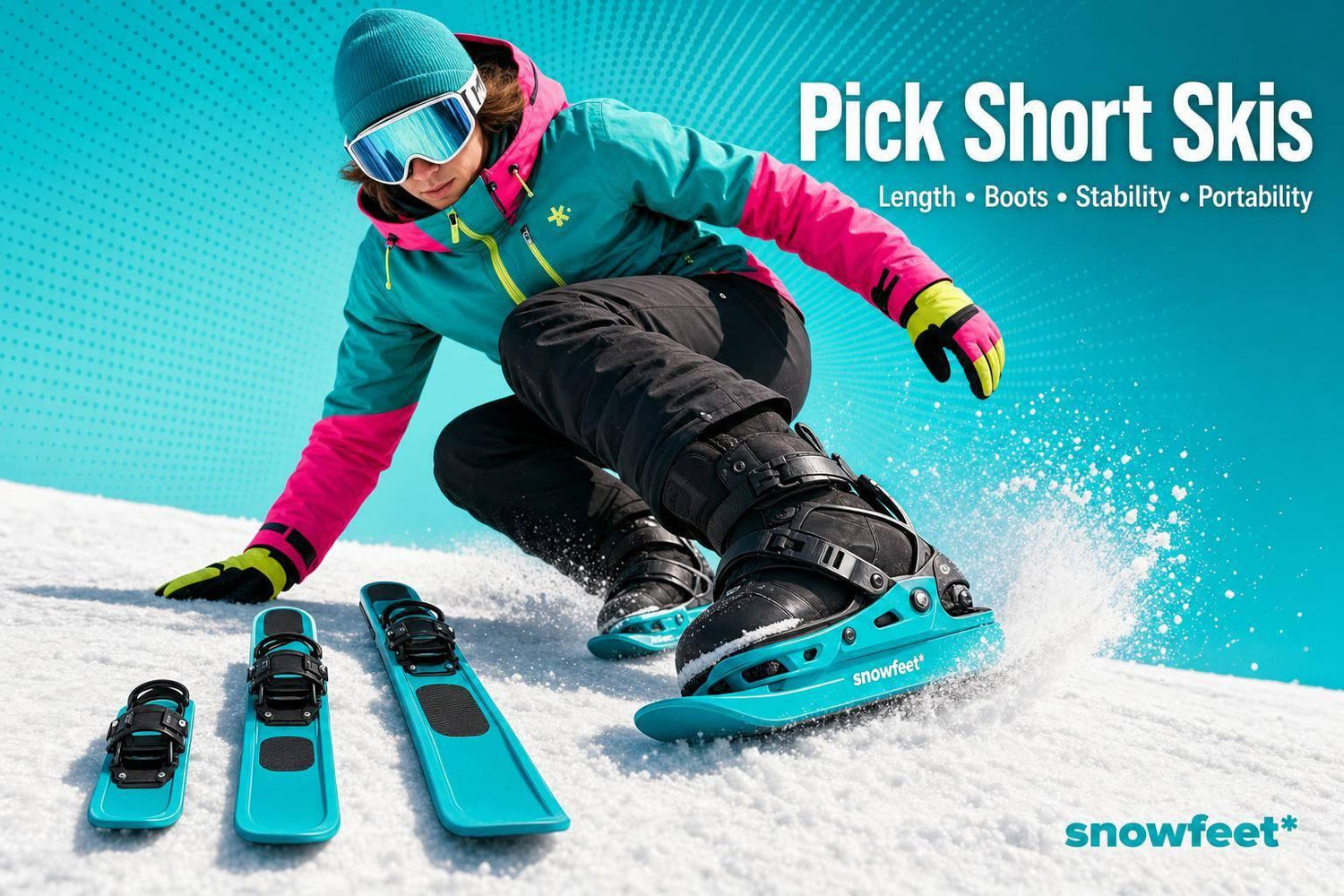
If I had to sum it up fast: pick by length and boots, not by hype.
If you want the smallest setup, go with 44 cm or 50 cm. If you want an easier ride on resort runs, look at 65 cm, 99 cm, or 120 cm. Prices in this lineup run from $299 to $950.
Here’s the short answer:
- 44 cm Skiskates: best for travel, tight turns, and skate-style riding
- 50 cm PRO: best if you want to use winter boots
- 65 cm Skiblades: best starting point for many new skiers
- 99 cm Skiblades: best mix of control and short-ski feel
- 120 cm Skiblades: best if you want the most calm ride in this group
Short skis are easier to carry, easier to turn, and often easier to learn than full-length skis. But there’s a catch: the shorter you go, the less stable they feel when speed climbs. So, if you ski mellow groomers, park laps, or just want less gear drama, short skis make a lot of sense. If you want long, fast carving runs, go longer.
Snowboarder tries Snowfeet* | Which Snowfeet* Short Ski is the Best? | Snowblades 44, 65, 99 Review
Quick Comparison
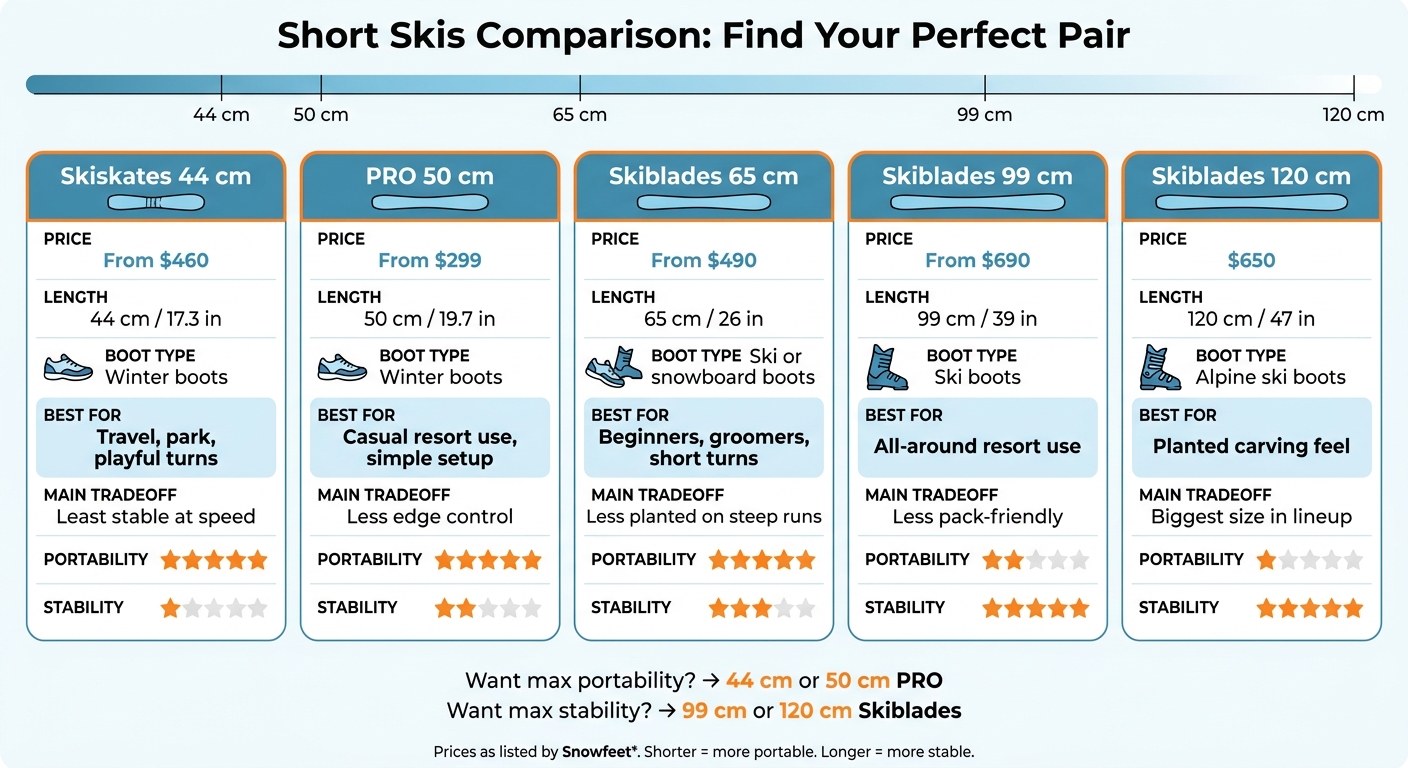
Short Skis Comparison: Find Your Perfect Pair
| Model | Price | Boot Type | Best For | Main Tradeoff |
|---|---|---|---|---|
| 44 cm | From $460 | Winter boots | Travel, park, playful turns | Least stable at speed |
| 50 cm PRO | From $299 | Winter boots | Casual resort use, simple setup | Less control than ski boots |
| 65 cm | From $490 | Ski or snowboard boots | Newer riders, groomers, short turns | Not as planted on steep runs |
| 99 cm | From $690 | Ski boots | All-around resort use | Less pack-friendly |
| 120 cm | $650 | Alpine ski boots | More planted carving feel | Biggest size in the lineup |
What stood out to me most is this: there isn’t one “best” short ski for everyone. The right pick depends on how you ride, what boots you own, and whether you care more about a suitcase-friendly setup or a calmer feel on snow. That’s the filter I’d use first - before anything else :)
If you want, I can also turn this into a product round-up intro, SEO intro, or affiliate-style buyer’s guide intro.
1. Snowfeet* Skiskates 44 cm
Price: From $460 | Length: 17.3 in (44 cm)
Length and Stability
At 17.3 inches, these are short. And you feel that right away.
The 44 cm length makes turns super fast and snappy. You can change direction in a blink. That’s the fun part. The tradeoff is simple: less length means less stability when speed picks up. On a steep, fast groomer, they won’t feel as planted as 99 or 120 cm skiblades.
On mellow resort runs or in the park, though, that short length feels light and playful instead of limiting.
Skill Level Fit
This model works best for riders who already have skating experience or strong balance. If you’re new, start on easy, groomed runs and give yourself a little time to get used to the feel.
They ride more like inline skates or ice skates than alpine skis, which is a big plus for people with that kind of background. If that movement pattern is already in your legs, the learning curve feels a lot less steep.
Pick the 44 cm model if you care more about portability and quick, playful turns than top speed or downhill stability.
Terrain and Riding Style
These do best on groomed resort slopes and in terrain parks.
Their small size makes them great for:
- weaving through crowded slopes
- hitting small rails or boxes
- trying quick spins or 180s
They’re a solid match for short resort laps. They’re not built for all-day big-mountain riding.
Spring slush? Still fun. Deep powder or long, steep groomers? Not their lane. For that kind of terrain, the 99 or 120 cm skiblades make more sense.
Boot Compatibility
Skiskates 44 cm work with regular winter boots, not ski boots.
That’s a big convenience win. You can bring one pair of waterproof insulated boots, clip in on the hill, then walk around the resort in the same pair. No boot shuffle. No stomping through the parking lot in stiff ski boots like a robot :)
For better control, use winter boots that feel firm and supportive. Soft or loose boots can make the ride feel less precise and can tire out your legs faster.
Portability
At 44 cm, these fit inside a standard suitcase or a large backpack.
For U.S. travelers heading to the mountains by plane or car, that can be a huge relief. You skip a lot of the oversize-baggage headache, and you don’t need to play trunk-space Tetris on a road trip.
At home, storage is easy too. They fit in a closet, so there’s no need for a ski rack.
If you like this compact setup but want more support from ski boots, move up to the 50 cm PRO.
2. Snowfeet* PRO 50 cm
Price: From $299 | Length: 19.7 in (50 cm)
Length and Stability
At 50 cm, the PRO gives you a bit more stability than the 44 cm Skiskates, but it still keeps that quick, playful feel. You’re not getting the ride of a full-length ski here, and that’s the point. This setup leans toward control and agility, not all-out speed.
That makes it a nice middle ground between the 44 cm Skiskates and the longer, more planted skiblades.
Skill Level Fit
This one works best for beginners and intermediate riders who want a compact, forgiving setup for resort laps and basic freestyle. It also makes sense for riders who like to mess around a bit in the park and try spins, small jumps, or simple features.
Terrain and Riding Style
The PRO feels most at home on groomed runs and in the terrain park. It handles easy resort laps well and rewards playful, low-speed riding.
It’s not the pick for:
- Deep powder
- Chopped-up snow
- Steep, technical terrain
For those conditions, the 99 cm and 120 cm Skiblades are the better call.
Boot Compatibility
One nice part: the PRO works with regular winter boots, so you don’t need ski boots. The bindings fit US sizes 6–13, though riders near 12–13 should check strap length and mounting position to make sure the fit is snug.
If you want a bit more room to move and more control without going all the way to a full skiblade, the 65 cm version is the next step.
3. Snowfeet* Skiblades 65 cm
Price: From $490 | Length: 26 in (65 cm)
If the PRO 50 feels a bit too short, the 65 cm version gives you more control without killing the fun. It’s a nice middle ground for riders who want more stability than the 44–50 cm models, but still want that quick, snappy feel.
Length and Stability
The 65 cm Skiblades give you more stability and better edge hold, while still keeping that short-ski feel. You get more edge on the snow, so turns feel cleaner and there’s less skidding than on the 44–50 cm models.
That extra length helps a lot when you’re carving on groomers. The ride feels calmer and more planted. That said, once speeds climb or the run gets steep and icy, it won’t feel as locked-in as the 99 cm or 120 cm versions. This model fits best for low- to moderate-speed carving on groomed runs.
Skill Level Fit
This one works well for beginners who want easier control and for intermediate riders who like short, quick turns. Advanced riders can still have a good time on them for casual resort laps, but if you want to ski harder or faster, the 99 cm or 120 cm models will make more sense.
Terrain and Riding Style
The 65 cm model is best on groomed slopes, moguls, and small park features. It has about a 13 ft (4 m) turning radius, which makes quick pivots easy on blue runs and easier black runs.
A good fit for:
- Relaxed resort laps
- Quick, short-radius turns
- Light freestyle
Boot Compatibility
The 65 cm version works with ski boots or snowboard boots, based on the binding you choose. It weighs 3.79 lb with ski bindings or 5.89 lb with snowboard bindings.
If you know you want more speed and a steadier ride, the 99 cm model is the next step up.
sbb-itb-17ade95
4. Snowfeet* Skiblades 99 cm
Price: From $690 | Length: 39 in (99 cm)
If the 65 cm model feels a bit too twitchy, the 99 cm version gives you more calm and control without drifting into full-size ski territory. It’s the natural next step if you want that short-ski feel, just with a steadier ride.
Length and Stability
At 99 cm, you get more edge on the snow. That means better grip on groomers and a smoother feel when the snow gets chopped up. The extra length helps the ski track better, so resort laps at moderate speed feel more planted and less busy.
That said, these are still short skis. On steep or icy runs, and once speed starts climbing, you’ll notice the limit of the shorter platform. If that’s the kind of riding you want to do more of, the 120 cm model is the better fit.
Skill Level Fit
These work best for confident beginners up through advanced riders who want control, fast turns, and an easier feel than full-length skis.
Terrain and Riding Style
The 99 cm does well on:
- Groomed runs
- Chopped snow
- Light park use
It’s short enough to pivot fast in tight spots, which is great when the trail gets busy or narrow. But it also has enough length to feel stable on small to medium park features, so landings don’t feel too sketchy. If you want more speed and a steadier ride on steeper terrain, the 120 cm model is the next move.
Boot Compatibility
The 99 cm Skiblades use ski-boot bindings, which help with edge control on firm snow.
If you’re after more stability and speed, move up to the 120 cm Skiblades.
5. Snowfeet* Skiblades 120 cm
Price: $650 | Length: 47 in (120 cm)
The 120 cm is Snowfeet*’s most stable, most ski-like short ski. It feels calmer at speed than the 99 cm, which makes sense once you get it on snow.
Length and Stability
This model uses a parabolic sidecut, a 3 in (7.8 cm) waist, and tip-and-tail rocker. That combo helps it feel more planted, but it still turns in without much fuss.
Skill Level Fit
If you’re stepping up from the 99 cm, skill level is the big thing to think about. These work best for intermediate to advanced riders.
Beginners can use them, sure, but the 65 cm or 99 cm will usually feel easier and less demanding.
Terrain and Riding Style
If you’re picking based on where you ride, this is the Snowfeet* model for the most planted resort feel.
Use the 120 cm for:
- Groomers
- Mixed snow
- Longer resort runs where you want a more planted carving feel
It gives you more control than the shorter models. But if your top goal is max portability or quick spins, the shorter Snowfeet* options still win there.
Boot Compatibility
Use alpine ski boots with release bindings. That setup fits the speed and force this length is built to handle.
Bindings fit roughly US men’s 4.5–14.5.
If you plan to ride in winter boots or snowboard boots, you’ll want to look at the shorter Snowfeet* models instead.
Next, match each length to your skill level, terrain, and boot setup.
Which Short Ski Is Right for You
Use the model breakdown above, then match it to what matters most to you. The best pick usually comes down to length, terrain, boots, and how easy it is to pack. So, here’s a simple way to sort it out.
| Buyer Type | Skiskates 44 cm | PRO 50 cm | Skiblades 65 cm | Skiblades 99 cm | Skiblades 120 cm |
|---|---|---|---|---|---|
| Beginners and casual resort skiers | Limited | Good | Excellent | Excellent | Excellent |
| Travelers and apartment dwellers | Excellent | Excellent | Good | Limited | Limited |
| Park and freestyle riders | Excellent | Good | Excellent | Good | Limited |
| Kids and families | Excellent | Good | Excellent | Good | Limited |
| Casual resort riders who want simpler gear | Good | Excellent | Good | Good | Limited |
For most beginners, the 65 cm, 99 cm, and 120 cm models tend to be the easiest place to start. They give you a nice mix of stability and control without making things feel awkward or twitchy.
If you travel a lot or live in a small space, lean toward the 44 cm Skiskates or PRO 50 cm. They’re the smallest options here, which makes packing and storage a whole lot less of a pain.
For kids and families, the 44 cm and 65 cm models make the most sense. They’re easier to carry, easier to learn on, and just more fun for a laid-back day on the snow.
Use this chart to narrow things down, then compare the pros and cons of each model.
Pros and Cons of Each Model
After the model-by-model breakdown, this chart puts the trade-offs side by side. It’s the quickest way to see what each model does well, where it falls short, and who it fits best.
| Model | Main Pros | Main Cons | Best Match |
|---|---|---|---|
| Skiskates 44 cm (from $460) | Most portable, fits in a backpack, playful skate-like feel, quick edge-to-edge | Least stable at speed, can feel twitchy on rough terrain, less versatile | Travelers who want the smallest setup |
| PRO 50 cm (from $299) | Works with regular winter boots, compact, easy setup, no ski boots needed | Less edge control than ski-boot setups, not ideal for aggressive or high-speed skiing | Casual riders who want winter boots |
| Skiblades 65 cm (from $590) | Great for beginners, quick turning, more stable than ultra-short models | Less stable on steep runs or at speed, not as planted as longer skis | Beginners who want easy control |
| Skiblades 99 cm (from $690) | Best all-around balance of agility and stability, handles mixed terrain well | Less portable than shorter models, less "skate-like" feel | Riders who want the best balance |
| Skiblades 120 cm ($950) | Most stable and ski-like of the group, better for carving and longer runs | Least compact in the lineup, gives up some of the tight-turn playfulness | Riders who want the most stability |
The short version is pretty simple. 44 cm and 50 cm win on portability, while 99 cm and 120 cm give you steadier speed and better grip.
The PRO 50 cm stands out for one big reason: it works with regular winter boots. That’s a huge convenience perk. You can skip ski boots, keep setup simple, and get on snow with less fuss. The trade-off is less edge control than a ski-boot setup, so it’s not the top pick for hard charging or high-speed runs.
That’s why the PRO 50 cm often feels like the easiest starting point for casual riders. It keeps things simple, compact, and approachable - kind of the grab-and-go option of the bunch.
At the end of the day, this comes down to two things: length and boot setup. Match those to the terrain you ski most, and your choice gets a lot easier.
Conclusion
After looking at all five Snowfeet* models, the choice comes down to one simple thing: stability or portability and boot freedom?
44 cm is the most portable pick. PRO 50 cm is the easiest setup if you want to ride in simple winter boots. 65 cm is the easiest choice for beginners. 99 cm and 120 cm give you the most stability for resort riding.
Traditional long skis still come out on top for high-speed carving and long, hard-charging runs. But short skis fix a different problem. They’re easier to carry, easier to turn, and easier to handle on the mountain.
So, here’s the final filter: go shorter if portability matters most. Go longer within the short-ski range if you want more stability. Match the length to your terrain, boots, and how much gear you want to haul around, and the right model gets pretty clear.
FAQs
Should I choose short skis by my height or how I ski?
Choose short skis based more on how you ski - your riding style, terrain, and skill level - than on your height.
That’s the big shift here.
Unlike standard skis, which are often sized by body measurements, Snowfeet* models are chosen to fit the way you ride.
Here’s the simple breakdown:
- 65 cm: best for tricks and a skating-like feel
- 99 cm: a solid pick for all-mountain use
- 120 cm: gives you more stability and better carving
So, instead of asking, “How tall are you?” it makes more sense to ask, “How do you want to ski?”
Can I use regular winter boots, or do I need ski boots?
You don’t need to buy or rent stiff ski boots to use Snowfeet. Most models work with the regular waterproof winter boots or snowboard boots you may already own. That means more comfort and less money spent. Nice deal :)
Ski boots are optional if you like them for aggressive carving. For the best ride, use waterproof boots with firm ankle support.
Which short ski length feels best for beginners?
For beginners, shorter skis usually feel best. They’re lighter, easier to turn, and less punishing than long skis when you make those first wobbly moves.
A great place to start is the 38 cm Snowfeet Mini Ski Skates. If you want a bit more range, the 65 cm Snowfeet Skiblades give you more stability while still feeling quick, playful, and easy to learn on.











Leave a comment
This site is protected by hCaptcha and the hCaptcha Privacy Policy and Terms of Service apply.