



















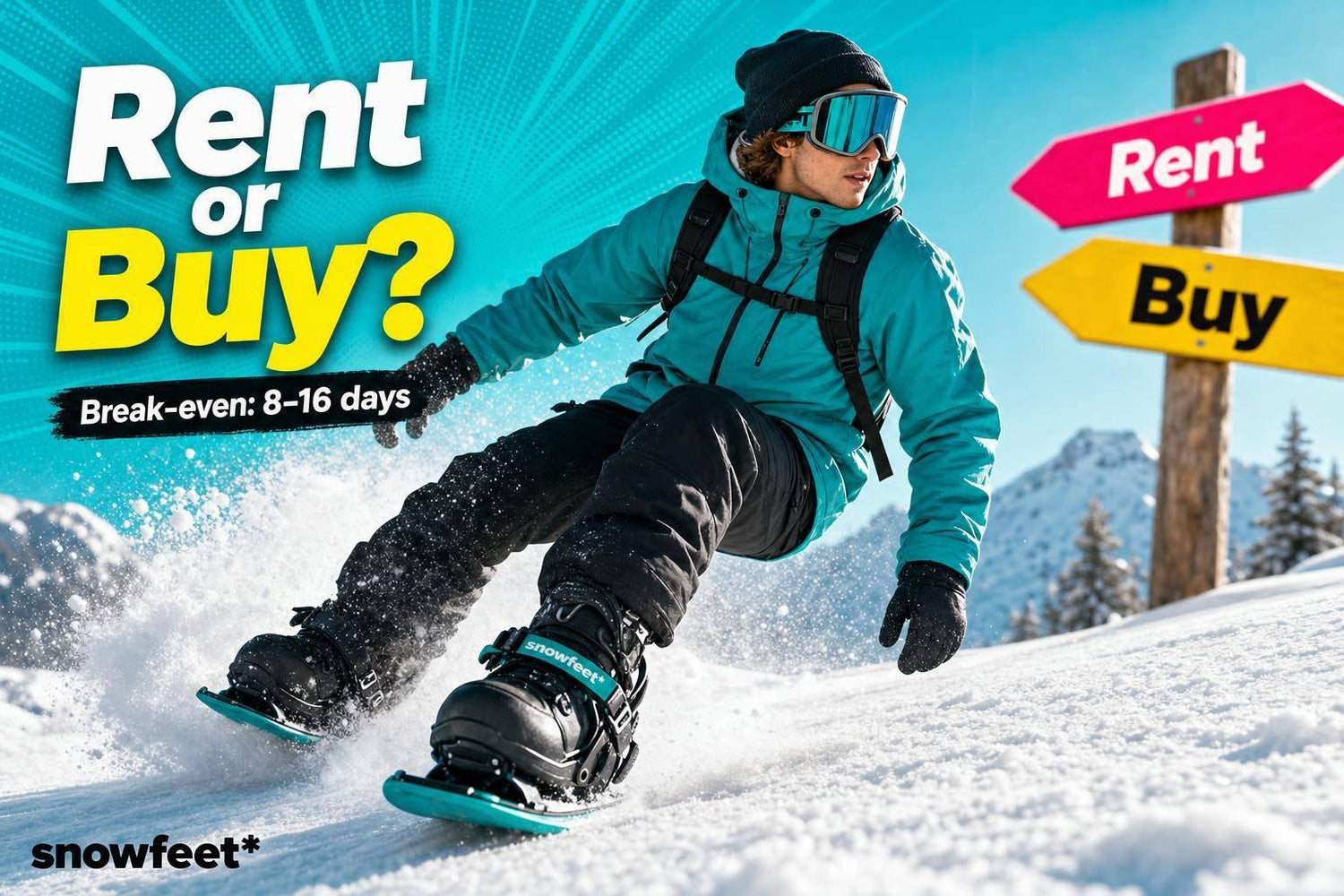
If you ski just once or twice, rent. If you’ll get to about 8 to 16 days of use, buying can cost less. That’s the whole thing in one line.
I’d boil it down like this:
- Rent standard skis for a short trip or a one-off resort visit
- Buy short skis if you want compact gear and plan to ride more often
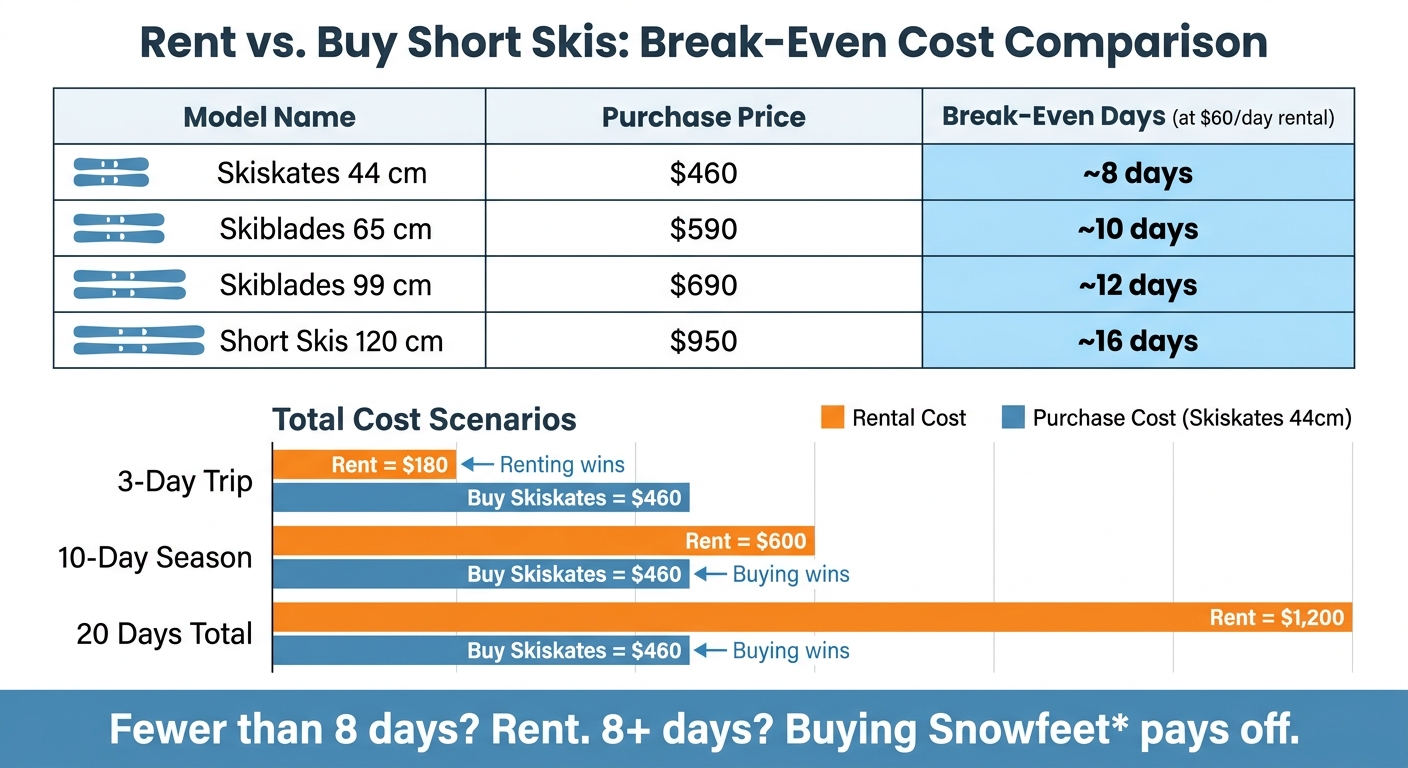
- At about $60/day for rentals, short-ski setups priced around $460 to $950 tend to break even after roughly 8 to 16 days
- For families and weekend riders, rental bills can stack up fast
- For big, steep mountain days, standard rental skis still make more sense
So, if you’re choosing between renting standard skis and buying Snowfeet*, I’d use one simple rule: few days = rent, many days = buy. Pretty simple, and your wallet will notice :)
Rent vs. Buy Short Skis: Break-Even Cost Comparison
Snowboarder tries Snowfeet* | Which Snowfeet* Short Ski is the Best? | Snowblades 44, 65, 99 Review
Quick Comparison
| Option | Upfront Cost | Best For | Main Cost Pattern | Main Tradeoff |
|---|---|---|---|---|
| Rent standard skis | $30–$100/day | First-timers, one-trip riders, steep resort days | You pay each ski day | Costs add up over time |
| Buy Snowfeet* Skiskates 44 cm | About $460 | New riders, short sessions, travel | One-time buy, breaks even near 8 days at $60/day | Higher cost at the start |
| Buy Snowfeet* Skiblades 65 cm | About $590 | Park laps, carving | One-time buy, breaks even near 10 days | Not the top pick for fast alpine runs |
| Buy Snowfeet* Skiblades 99 cm | About $690 | More all-mountain use | One-time buy, breaks even near 12 days | Costs more at the start |
| Buy Snowfeet* Short Skis 120 cm | About $950 | Riders who want more stability | One-time buy, breaks even near 16 days | Highest buy-in |
Here’s the short version: renting wins for short use, buying wins for repeat use, and convenience can tip the scale. If you hate rental lines, like gear you can toss in the car, or want something small enough to travel with, buying starts to look a lot better.
If you want a quick feel for short skis before you spend money, I’d also watch a few ride clips on YouTube first:
- Snowfeet Official - YouTube
- Skiblades basics on YouTube
- Short skis vs long skis on YouTube
That’s the decision in plain English: pay per day now, or pay once and use them again and again.
Rental Fees vs. Snowfeet* Purchase Price: The Core Math
Here’s the simple way to look at it: daily rental cost × number of ski days versus a one-time Snowfeet* purchase.
That’s the cleanest comparison because short-ski rentals are still hard to find in the U.S. So, for most people, the choice isn’t “rent short skis or buy short skis.” It’s rent standard ski gear or buy Snowfeet*.
Snowfeet* Prices and Break-Even Days
Using the $60/day rental baseline above, here’s where each model breaks even:
| Model | Purchase Price | Daily Rental | Break-Even Days |
|---|---|---|---|
| Skiskates 44 cm | $460 | $60 | ~8 days |
| Skiblades 65 cm | $590 | $60 | ~10 days |
| Skiblades 99 cm | $690 | $60 | ~12 days |
| Short Skis 120 cm | $950 | $60 | ~16 days |
Snowfeet* pricing reflects current store prices for the 44 cm, 65 cm, 99 cm, and 120 cm models.
The math is dead simple: break-even = purchase price ÷ daily rental rate.
So if your local shop is closer to $80/day, the payback point comes a lot sooner. The 44 cm Skiskates, for example, break even in about 6 days instead of 8. That’s a pretty quick swing.
Still, this is just the starting line. The better deal comes down to one thing: how often you ski.
Total Cost for a 3-Day Trip, 10-Day Season, and 20 Days Overall
A few sample scenarios make this much easier to picture:
- 3-day trip: Renting costs $180. Buying Skiskates costs $460. Renting is cheaper.
- 10-day season: Renting costs $600. The 44 cm Skiskates at $460 have already paid for themselves, which puts them at an average of $46/day.
- 20 days total: Renting costs $1,200. At that point, owning any Snowfeet* model costs less. The 44 cm Skiskates average $23/day, and even the 120 cm Short Skis at $950 average $47.50/day.
These totals assume boots are handled separately; maintenance is minor.
That’s why the cheapest option shifts based on the kind of rider you are. A once-a-year vacation skier will see this one way. Someone who hits the slopes a lot? Whole different ballgame :)
sbb-itb-17ade95
Which Option Costs Less for Different Types of Riders
Now that the break-even math is on the table, the next step is simple: who gets there fastest?
First-Timers and One-Trip Riders: Renting Usually Wins
If this is your first time skiing, or you're only planning one trip this season, renting is usually the cheaper play. A 1–3 day rental tends to run about $35–$195 per person, based on the shop and package you choose.
By comparison, buying entry-level Snowfeet* Skiskates 44 cm at about $460 doesn't make much sense for one trip.
Some resorts and shops do offer demo packages for Snowfeet*-style gear. That's a smart way to try the format before you spend money on your own setup.
Simple rule: one trip, rent. A few trips, run the numbers again.
For riders who get out more than once or twice a season, the math shifts fast.
Occasional Riders and Families: Buying Starts to Make Sense After a Few Trips
If you ski about 5–10 days per season, owning gear starts to look a lot better, especially for families. Rental costs stack up fast. A family of four can spend about $120–$200 per day just on rentals. Stretch that across a 5-day trip, and you're looking at roughly $600–$1,000 in one season.
That’s where buying can start to hit a sweet spot. Add more people, and the rental bill grows right along with them.
| Scenario | 5-Day Rental Cost | Snowfeet* Gear Package | Avg. Cost/Season (Over 3 Seasons) |
|---|---|---|---|
| 1 adult + 1 child | ~$450 | ~$710 (Skiskates 44 cm + MINI KIDS - the kid-size Snowfeet* option) | ~$237/season |
| 2 adults + 2 children | ~$900 | ~$1,420 (2× Skiskates 44 cm + 2× MINI KIDS) | ~$473/season |
By the second or third season, owning can cut your per-season cost by about half. The one catch: kids grow. If boot sizes change, that can eat into the savings.
If you want something with a longer, more ski-like feel, the 65 cm, 99 cm, and 120 cm models cost more up front. Still, the same basic math applies if you ride often enough.
For weekend skiers, it gets even more one-sided.
Frequent Weekend Skiers and Park Riders: Buying Snowfeet* Often Pays Off
At 10+ days per season, rental costs start to sting. Standard gear at $50–$65 per day adds up to about $500–$650 per season, and that's only year one.
A weekend park rider doing 12 days each winter for two seasons would spend around $1,200–$1,300 on rentals. A pair of Snowfeet* Skiblades 99 cm at $690 can pay for itself in about a season and a half. After that, your cost barely moves.
This is also where Snowfeet* gets fun for casual riders. Instead of being stuck with one big, bulky setup, you can pick from a few formats, from compact Skiskates to longer Short Skis, and choose the length that matches how you like to ride.
Beyond Price: Convenience, Travel, and Use
If the price gap is small, convenience is usually what tips the scale.
Why Owning Snowfeet* Is Easier Day-to-Day Than Owning Standard Skis
Snowfeet* are small enough to stash in a closet, trunk, or gear bin. That sounds simple, but it matters. You can keep them in the car, spot good snow, and head out without making a rental stop. More convenience often means more days on the hill.
If you can ride in winter shoes or snowboard boots you already own, that cuts out another rental cost. For families, that’s one less item to fit, size, and pay for for each person. That’s where compact Snowfeet* gear starts to look like the easy pick.
The upkeep is also light compared with full-size skis.
| Factor | Renting Standard Skis | Owning Snowfeet* |
|---|---|---|
| Boot compatibility | Usually requires rental ski boots, fitted on-site | Many models work with winter shoes or snowboard boots, so you may not need rental boots |
| Maintenance | Handled by the rental shop | Minimal upkeep: fastener checks, cleaning, occasional edge work |
| Terrain use | Better for high-speed runs and steep alpine terrain | Best on groomed slopes, parks, small hills, and light powder up to about 4 in. |
| Spontaneity | Tied to shop hours and resort access | Ride whenever conditions allow, including local hills |
When Renting Standard Skis Still Makes More Sense
Snowfeet* are a strong fit for many casual riders, but rentals still have their place.
Long skis are flat-out better in some settings. If you’re going to a big Western resort with steep groomers, mixed snow, or off-piste terrain, a well-fitted pair of long skis will give you more stability and control at speed than any short ski setup. That’s just the nature of the gear.
Rental shops also help by matching ski length and stiffness to your weight, ability, and the day’s snow conditions. That can be a big plus for beginners and for anyone trying terrain they don’t know well. Some full-season rental programs even include complimentary tuning and size exchanges.
For a once-a-year trip to a large resort with fast, steep terrain, rent long skis. For repeat use, easy travel, and quick sessions on local hills, buy Snowfeet*.
Conclusion: A Simple Rule of Thumb for Renting vs. Buying
Here’s the simple rule:
- Rent if you ski fewer than about 5–7 days per season
- Buy if you expect 10+ days of use or repeat family trips
The math gets pretty clear, pretty fast. Rentals can stack up in a hurry: five days at about $70/day is $350, and that’s before extra fees.
Snowfeet* also have a big edge on convenience. They’re compact, easy to store, and much easier to carry than standard skis. For a lot of casual riders, that combo matters a lot: lower long-term cost and less hassle getting them around.
So the rule of thumb looks like this:
first-timers rent, occasional riders can go either way, families usually save by buying, and frequent weekend skiers get the best value from Snowfeet*.
Rent if this is a one-off trip. Buy Snowfeet* if short skis will be part of your regular winter routine.
FAQs
Do I still need separate boots with Snowfeet*?
No. Snowfeet* work with the regular waterproof winter boots or snowboard boots you already own, so there’s no need to buy separate ski boots.
If you like, you can use ski boots too. But one of the big perks of Snowfeet* is that you can stick with your own boots, spend less, and keep your day simple.
How much can a family actually save by buying instead of renting?
A family can save a lot by picking Snowfeet instead of a standard ski setup. A full setup with skis, bindings, boots, and poles can run past $1,000. By contrast, Snowfeet models start at $150.
That price gap gets even better if you already own winter boots or snowboard boots. Snowfeet work with those, so you can skip the added $200–$400 for ski boots. And let’s be honest: ski boots aren’t cheap, and they’re not much fun to lug around either.
There’s also the travel side of it. Since Snowfeet are small and easy to carry, families may avoid extra costs such as:
- Roof racks
- Oversized baggage fees
- Professional maintenance
So, for families trying to keep winter fun from turning into a money pit, that’s a pretty solid deal :)
Are short skis stable enough for beginners and local hills?
Yes. Short skis are stable enough for beginners and for local hills. Their shorter length and lower center of gravity make them easier to handle than long skis, so new riders can find their balance and learn turns faster.
They’re also light and easy to steer, which can help cut down on leg tangles and knee strain on groomed slopes, trails, and backyard hills. Snowfeet* models are made to give riders that easy, confidence-building control.











Leave a comment
This site is protected by hCaptcha and the hCaptcha Privacy Policy and Terms of Service apply.