



















Short skis, like those from Snowfeet, are changing the game for skiers looking for control and ease without the bulk of traditional long skis. Here's the quick takeaway:
- Short skis are stable at moderate speeds. Modern designs, like Snowfeet Skiblades (65 cm to 120 cm), offer excellent grip, balance, and vibration absorption.
- Easier to handle. Their lightweight and compact size make quick turns, stops, and even uphill movement more manageable.
- Perfect for groomed slopes. Unlike long skis, which can feel sluggish and heavy, short skis let you pivot effortlessly and enjoy a smoother ride.
- Convenient to carry. These fit in a backpack, eliminating the hassle of transporting bulky gear.
- Versatile footwear options. Snowfeet works with winter shoes, snowboard boots, and ski boots.
Whether you're a beginner or an experienced skier, short skis provide a fun, controlled experience on the slopes. Let’s dive into the details!
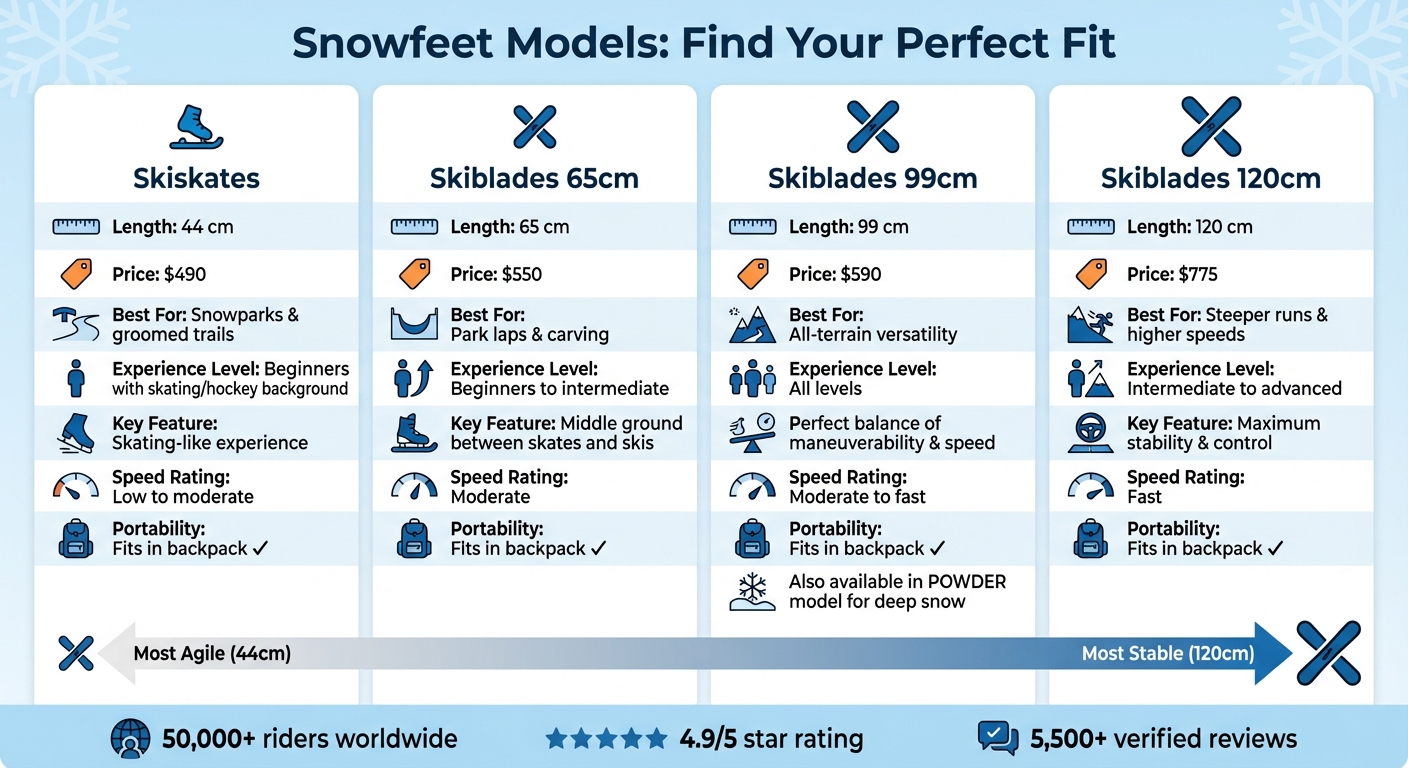
Snowfeet Short Ski Models Comparison: Sizes, Prices, and Best Use Cases
3 types of speed for short turn skiing SLOW MEDIUM and FAST
Problems with Long Skis at Moderate Speeds
Long skis are built for speed, but they can feel like overkill on casual, groomed slopes. Their extended sidecut radii (typically 24–32+ meters, or around 80–105+ feet) make them sluggish when it comes to edge response. Luke Koppa from Blister Review puts it this way:
"The longer the sidecut radius of a ski, the slower it will react when put on edge to arc a turn across the hill, and the longer that turn will be".
Another issue? The weight. Long skis can feel like a chore when you’re trying to make quick, sharp pivots. Many expert skiers praise Super G skis for their high-speed stability, but these same skis often feel less fun and engaging on smaller hills. As the Snowfeet team bluntly states:
"With long skis, making those tight turns would feel cumbersome. But with shorter skis, you can pivot easily and make quick adjustments, turning on a dime."
These limitations become especially noticeable on groomed runs.
Poor Response on Groomed Slopes
Groomed slopes tend to highlight the drawbacks of long skis. Instead of feeling nimble, they can make you feel like you’re wrestling with oversized gear. Their design often leads to a "hunting" sensation - wobbling or feeling unstable unless you keep them perfectly edged. This turns what should be a smooth, relaxing ride into something far more labor-intensive.
It’s worth noting that traditional long skis were designed with a different skiing style in mind. The old rule of thumb - choosing skis that reached anywhere from your chin to the top of your head - originates from fully cambered, non-rockered skis that were popular in the mid-1990s. Today’s groomed slopes and modern skiing techniques demand something more agile.
Weight and Transport Problems
The weight of long skis doesn’t just make them harder to handle on the slopes - it also adds to the hassle off the mountain. Skiers often describe long skis as "heavy burdens on feet", leading to faster fatigue during a day on the hill. Sophia Kane, a fan of Snowfeet short skis, shares her frustration with traditional skis:
"I hate getting stuck on a hill in skis because they're so long and bulky. Since these are shorter, you can just skate right up."
And it’s not just about skiing. Transporting long skis can be a headache. Their size often requires special racks or extra vehicle space. In contrast, short skis are far more convenient - they’re compact enough to fit inside a standard backpack.
How Snowfeet* Short Skis Deliver Better Stability
Snowfeet* is shaking up the ski world by proving that stability doesn’t have to come from ski length. Their premium wood core models - offered in sizes like 44 cm, 65 cm, 99 cm, and 120 cm - are built to absorb vibrations on groomed slopes. Add metal ski edges to the mix, and you’ve got the precision to nail sharp turns and hold steady on icy patches. As Daniel Siouffi puts it:
"Going fast i was in complete control of every move turns and stops."
This thoughtful engineering sets the groundwork for features that take stability to the next level.
Design Features That Improve Stability
Snowfeet* packs a punch with its lightweight construction and stability-focused materials. The wood core not only absorbs vibrations but also reduces leg fatigue, making those long sessions more enjoyable. Its compact design responds instantly to your movements, while rocker profiles make carving feel smooth and natural. To stay firmly planted, keeping your weight slightly forward or evenly distributed is key - something these skis are designed to support.
Better Turning and Edge Control
Short skis like Snowfeet* excel in tight spots. Whether you’re maneuvering through moguls, weaving between trees, or navigating busy slopes, their shorter length allows for quick, precise pivots. According to Blister Review, the rocker profiles combined with effective damping help these skis tackle varied snow conditions without feeling jittery. The 65 cm and 99 cm Skiblades strike a sweet spot, offering just enough surface area for stability while staying nimble enough to dodge obstacles. Andrew B. shares his experience:
"These skiblades are so much fun and easy to control. Never going back to regular skis."
With over 5,500 reviews averaging 4.9 out of 5 stars, it’s clear that riders love the responsive edge control that keeps moderate-speed skiing both fun and secure.
Works with Winter Shoes and Snowboard Boots
Snowfeet* takes versatility seriously with its flexible binding system, which goes beyond traditional ski boots. Unlike rigid ski boots that can feel restrictive, Snowfeet* bindings feature an anti-slip surface that keeps your footwear secure while allowing natural movement. This setup works with a variety of footwear - whether you prefer waterproof winter shoes, snowboard boots, or ski boots - so you can adapt based on the terrain or your comfort. Plus, this design doesn’t just enhance stability on the slopes; it also makes walking off the snow a breeze.
sbb-itb-17ade95
Snowfeet* Models: Stability Comparison
Snowfeet* offers a variety of models that prove stability isn't just about ski length - it's about smart, thoughtful design. Each model is crafted to deliver a unique blend of control and agility, showing that shorter skis can still provide a stable and enjoyable ride, especially at moderate speeds. Here’s a closer look at how the design of each model contributes to stability and performance on the slopes.
Snowfeet* Skiskates (44 CM): Compact and Playful
The 44 cm Skiskates bring a skating-like experience to skiing, making them perfect for riders who enjoy quick, playful turns on groomed trails. Priced at $490, these compact skis require precise weight distribution, making them incredibly responsive. They’re a great choice for beginners with skating or hockey experience who want to pick up the basics quickly. While they’re not built for high-speed descents, they excel in snowparks and on groomed runs where agility is key. Plus, their lightweight design means you can toss them in a backpack - something traditional skis just can’t match.
Snowfeet* Skiblades (65 CM, 99 CM, 120 CM): Versatility for All Terrains
Snowfeet* Skiblades are designed for a range of terrains, offering options to suit different skiing styles.
- 65 cm Skiblades ($550): These are a middle ground between skates and skis, offering excellent carving ability and nimbleness for park laps.
- 99 cm Skiblades ($590): As Evan Cook puts it, these strike “a perfect balance of responsive maneuverability that can also handle steeper runs and faster speeds”. They’re versatile enough to glide effortlessly on groomed slopes and light powder.
- 120 cm Skiblades ($775): Built for riders who crave stability at higher speeds, this model delivers unmatched control. Extensively tested, the 120 cm Skiblades handle steeper runs and faster speeds with ease, making them a top choice for those who want maximum stability.
Each size is tailored for specific terrain challenges, ensuring you get the right mix of responsiveness and control.
Snowfeet* POWDER (99 CM): Designed for Deep Snow
Deep snow can be a challenge for traditional long skis, often making them tiring to control. The Snowfeet* POWDER model ($590) tackles this problem head-on with a wider design that provides excellent flotation while keeping maneuverability intact. At 99 cm, they’re short enough to navigate tight spaces but wide enough to stay stable in deeper snow. While standard short skis handle light powder up to about 10 cm, this model is made for deeper, more variable conditions, making it an excellent choice for powder enthusiasts.
User Experiences: Snowfeet* Stability in Action
Easier to Learn for All Skill Levels
Snowfeet* has been a game-changer for skiers of all levels, making the learning process far less intimidating compared to traditional skis. Michael Hirsch shared his experience:
"In a couple of descents I had them mastered and their short length helped me better control my daughters who were learning to ski".
For many, it’s possible to go from absolute beginner to intermediate in just one day - a pace that traditional skis rarely allow.
Even those returning to skiing after years away find Snowfeet* surprisingly easy to pick up. Paolo Macabenta, a former skier who had switched to snowboarding for nearly two decades, noted:
"I picked it up pretty quickly".
The shorter length and skate-like motion make balancing feel natural, especially for individuals with a background in ice hockey or inline skating. Daniel Siouffi described his experience:
"My first run the skis did shake but soon thereafter by distributing better my weight on your toes - I was flying like never before. Going fast I was in complete control of every move turns and stops".
Robin We echoed this sentiment, adding:
"This short ski is slower than traditional skis, which made it feel safer to use. It was easy to control and make turns".
With over 50,000 riders worldwide and an impressive 4.9/5 star rating from more than 5,500 verified reviews, Snowfeet* has made stability and control more accessible than ever. Plus, they’re not just about performance - they bring unmatched convenience to the table.
Easy to Carry and Store
If you’ve ever struggled to lug around a pair of traditional 6-foot skis, Snowfeet* might feel like a breath of fresh air. Their compact size means they can fit in the trunk of a small car or even a standard backpack. No more awkwardly maneuvering through crowded parking lots or wrestling with ski racks.
One user, eileen007, summed it up perfectly:
"No more heavy legs after skiing".
The lightweight design doesn’t just make transport easier - it also changes how you move on the slopes. Navigating flat sections and gentle inclines feels much more effortless, giving you a sense of freedom that bulky skis just can’t match. Snowfeet* truly makes skiing simpler, from the moment you pack them up to the time you hit the mountain.
Conclusion: Why Snowfeet* Is Changing the Game in Winter Sports
Short skis are no longer just a novelty - they’re redefining control on the slopes. Thanks to optimized metal edges, precise turning capabilities, and balanced weight distribution, Snowfeet* delivers a level of performance that rivals (and often surpasses) traditional long skis. With over 50,000 riders and a stellar 4.9/5 rating backing them up, the numbers speak for themselves: smaller skis are proving to be a smarter choice.
But it’s not just about performance. Snowfeet* tackles the everyday annoyances of skiing head-on. Forget about lugging around bulky gear - these compact skis fit right into a backpack, making transportation a breeze. Whether you go for the 44 cm Skiskates for quick, agile moves or the 99 cm Skiblades for all-mountain versatility, you’re getting lightweight gear that’s easy to handle and perfect for any terrain. Plus, their design promotes safer stops and even makes uphill movement more efficient. And with prices ranging from $190 to $775, there’s an option for everyone, no matter your skill level or budget.
Winter sports don’t have to mean dragging around heavy, uncomfortable, and pricey equipment. Snowfeet* is flipping the script, proving that compact skis can pack a serious punch. Ready to ditch the bulk? It’s time to experience the Snowfeet* revolution. Smaller skis, bigger thrills.
FAQs
Are short skis stable and easy to control compared to traditional skis?
Short skis, like Snowfeet Skiblades (65 cm, 99 cm, 120 cm) and Snowfeet Skiskates (44 cm), are all about control and ease. Thanks to their compact and lightweight design, they’re super easy to maneuver, making quick turns a breeze. This makes them a great choice for beginners or anyone who wants to enjoy a more relaxed, less tiring day on the slopes. The 120 cm model even steps it up a notch, offering extra stability for those with more experience, giving you a smooth and confident ride on groomed trails.
On the flip side, traditional skis - usually over 160 cm long - are built for speed and deep powder. Their larger surface area and longer edges provide solid stability at high speeds and in challenging snow conditions. But that extra length can also make them trickier to control and less agile, especially for beginners. That’s where Snowfeet's short skis shine. They’re designed for responsiveness and ease, making them a fun and user-friendly option for moderate-speed runs - perfect for carving up the slopes without the steep learning curve of traditional skis.
Are short skis good for both beginners and experienced skiers?
Short skis, typically ranging from 38 cm to 120 cm, are a fantastic choice for both newcomers and seasoned skiers. Thanks to their compact and lightweight design, they’re much easier to control, turn, and carry compared to traditional long skis. For beginners, this translates to a quicker learning process, less fatigue, and a confidence boost when navigating groomed trails or icy conditions. Options like Snowfeet’s Mini Ski Skates (38 cm) and 44 cm Skiskates are especially beginner-friendly, offering a forgiving and approachable way to ease into the sport.
For experienced skiers, short skis bring their own set of perks. If agility, quick edge control, or portability are high on your list, these skis deliver. Snowfeet’s 99 cm Skiblades are perfect for all-mountain and intermediate skiers, while the 120 cm model offers more speed and stability for advanced riders. Unlike traditional long skis, which can feel heavy and cumbersome, short skis make sharp turns, freestyle tricks, and smooth maneuvering a breeze. Whether you’re hitting the resort, playing in the park, or exploring off-piste, they’re a versatile option. While they may not excel in high-speed stability or deep powder like their longer counterparts, their ease of use and versatility make them a solid pick for skiers of all skill levels.
What types of footwear are compatible with Snowfeet short skis?
Snowfeet short skis are built to work with a range of footwear, including winter shoes, snowboard boots, and ski boots. This makes them a great option for everyone - whether you're gearing up for your first snowy adventure or you're a seasoned skier looking to mix things up.
The fact that they work with regular winter shoes is a game-changer. Unlike traditional skis that demand specialized boots, Snowfeet let you skip the hassle of extra gear. So, you can spend less time suiting up and more time carving through the snow!











Leave a comment
This site is protected by hCaptcha and the hCaptcha Privacy Policy and Terms of Service apply.