




















Short answer: Yes, short skis can hold an edge, but it depends on the terrain and your technique. While longer skis have traditionally been seen as better for grip and stability, shorter skis - like Snowfeet's Skiblades - are proving they can compete. They offer quick turns, precise control, and are great for groomed runs, terrain parks, and even light powder. However, on icy surfaces or deep powder, longer skis still have the upper hand.
Here’s what you need to know:
- Groomed Runs: Short skis are super responsive and great for carving tight turns.
- Icy Surfaces: Short skis work but need more precise weight distribution; longer skis are more stable.
- Powder: Short skis handle light powder well, but deeper snow favors longer skis.
- Terrain Parks: Short skis are nimble and perfect for tricks and quick pivots.
- Portability: Short skis are lightweight and easy to transport, unlike bulky traditional skis.
If you value agility, portability, and fun over high-speed stability or deep powder performance, short skis could be your new best friend. They're easy to learn, quick to turn, and ideal for casual skiers who want a playful ride without the hassle of heavy gear.
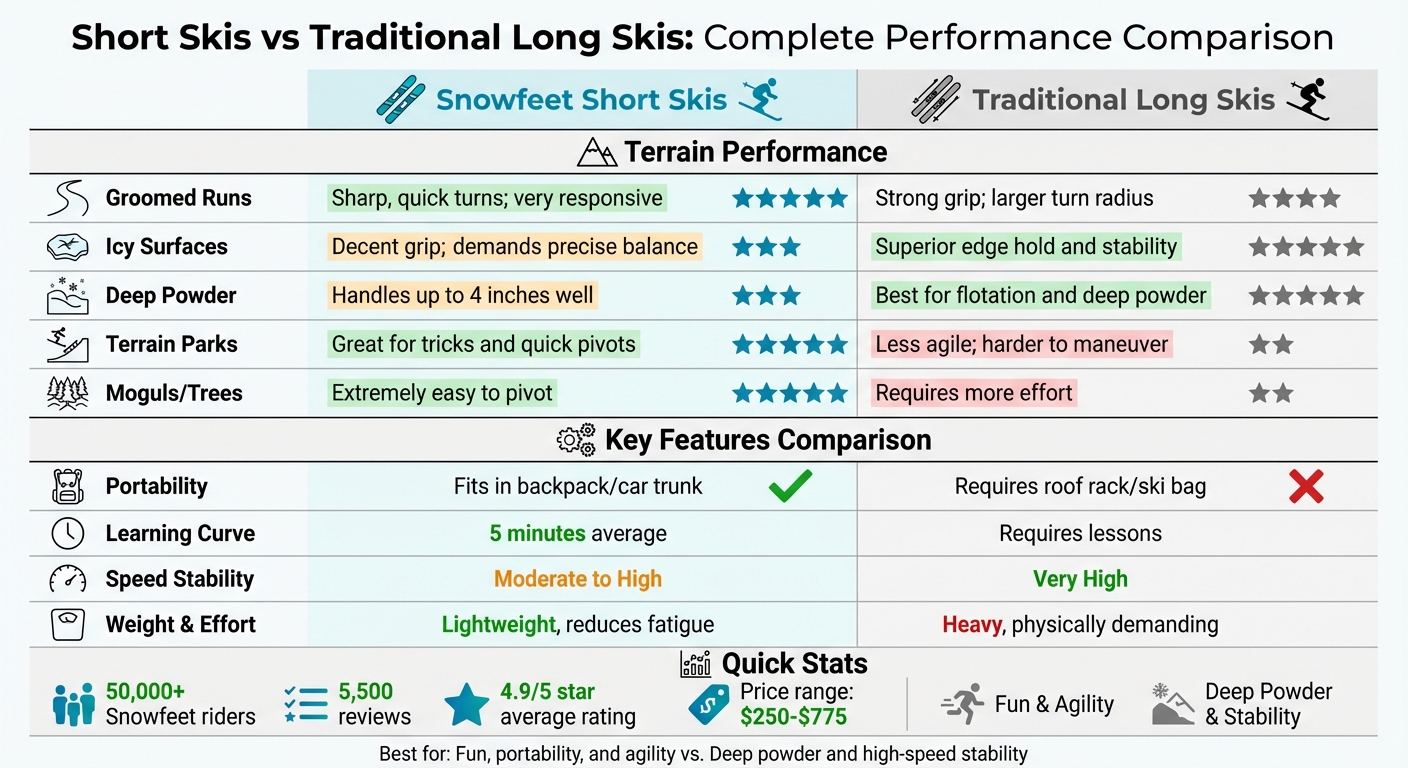
Short Skis vs Traditional Long Skis Performance Comparison Chart
How to Short Turns on Skis | 5 Best Drills & Ski-Off!
Edge Hold Performance on Different Terrains
On groomed runs, Snowfeet* Skiblades are in their element. Both the 65 cm and 99 cm models feature a wood core paired with high-quality metal edges, giving them a solid grip for confident carving. These shorter skis make edge-to-edge transitions feel quick and precise compared to the slower, sweeping turns of a 170 cm ski. The 65 cm version shines with its sharp, almost ice-skating-like turns, while the 99 cm model adds stability at higher speeds, offering a balance of playfulness and control.
When it comes to icy surfaces, things get a bit trickier. Although the metal edges provide decent grip, the shorter length of Snowfeet* Skiblades means you’ll need to be precise with your weight distribution. Traditional long skis have the advantage here, spreading edging forces over a larger surface area, which helps reduce chatter and maintain grip at speed. The 99 cm model, with its greater edge contact, handles icy conditions better than the 65 cm version, but both require you to stay centered and engaged for optimal performance.
Powder introduces a whole new challenge. The 65 cm skiblades can handle light powder up to about 4 inches (10 cm), but anything deeper will push their limits. The 99 cm version, however, is much more capable in these conditions. With the right technique and weight transfer, it offers a playful ride and surprising maneuverability in deeper snow, something traditional long skis often struggle to match in tight or variable terrain.
In terrain parks and mixed conditions, agility becomes the star of the show. Snowfeet* Skiblades thrive here, thanks to their lightweight and nimble design. Whether you’re navigating moguls, weaving through trees, or landing tricks in the park, these skiblades make quick pivots and adjustments feel effortless. By comparison, traditional long skis can feel bulky and require more effort to control, especially in tight spaces. The trade-off here is that while the skiblades prioritize agility, they don’t offer the same high-speed stability as longer skis.
| Terrain Type | Snowfeet* 65 cm Skiblades | Snowfeet* 99 cm Skiblades | Traditional Long Skis (170+ cm) |
|---|---|---|---|
| Groomed Runs | Sharp, quick turns; very responsive | Smooth carving; stable at higher speeds | Strong grip; larger turn radius |
| Icy Surfaces | Decent grip; demands precise balance | Better stability and grip | Superior edge hold and stability |
| Powder (Deep) | Handles light powder (up to 4 inches) | Performs well in deeper snow | Best for flotation and deep powder |
| Terrain Parks | Great for tricks and quick pivots | Solid for jumps and landings | Less agile; harder to maneuver |
| Moguls/Trees | Extremely easy to pivot | Agile in tight spaces | Requires more effort to navigate |
Turning Ability and Control
Snowfeet* products are all about precision and agility, thanks to their exceptional edge grip. Short skis like the Snowfeet* Mini Ski Skates (38 cm) and Skiskates (44 cm) offer a turning experience that's completely different from traditional long skis. Instead of relying on wide arcs, these compact skis pivot smoothly, almost like ice skates. If you've ever been on inline skates or played hockey, you'll find the movement feels second nature. The Mini Ski Skates, at just 38 cm, are known for their "instant" responsiveness, allowing for quick, tight turns. Meanwhile, the 44 cm Skiskates, with their wood core, provide extra stability while still delivering sharp, precise edge control. Compare that to traditional skis, which are typically 150+ cm long and require more deliberate tip engagement and a slower, wider turning arc - less ideal for tight spaces or quick adjustments.
However, this agility does come with a learning curve. Because these short skis are so responsive, maintaining a balanced stance is key, especially during carving. Distribute your weight evenly, and you're golden. But lean too far forward or backward, and you'll quickly notice that the compact design doesn't compensate like a longer ski would, which naturally spreads your weight over a larger area.
| Product | Length | Turn Radius | Response Time | Primary Turning Style |
|---|---|---|---|---|
| Snowfeet Mini Ski Skates* | 38 cm | Tight / Skate-like | Instant responsiveness | Skating / Twisting |
| Snowfeet Skiskates* | 44 cm | Tight / Skate-carving | Instant responsiveness | Carving / Skating |
| Traditional Skis | 150+ cm | Wider arc | Delayed (Requires tip engagement) | Long-radius Carving |
This ability to make quick turns is a game-changer for Snowfeet*, giving riders an edge in agility across a variety of terrains.
Another huge plus? The lightweight design of Snowfeet* products makes stopping a breeze and helps you handle flat sections with ease. In fact, you can even skate up small hills - something that's pretty much impossible with traditional skis. And the best part? The learning curve is super short. Most people get the hang of it in just five minutes, thanks to the familiar skating motion. This combination of quick turning, easy control, and versatility makes Snowfeet* a standout choice for anyone looking for a dynamic and responsive ride.
sbb-itb-17ade95
Speed Stability and Transport Convenience
Snowfeet* models are not just about agility and control - they also bring a solid mix of speed stability and ease of transport to the table.
Traditional long skis use their length and surface area to absorb vibrations, providing a steady ride at high speeds. On the other hand, shorter skis, like the Snowfeet* Mini Ski Skates (38 cm) and Skiskates (44 cm), require a bit more effort to maintain balance, which can feel tricky at first.
Snowfeet* has found a sweet spot with its longer models. The 99 cm and 120 cm Skiblades offer excellent stability at speed while being way easier to handle than your typical 160+ cm skis. Daniel Siouffi shared his experience with the 120 cm model:
My first run the skis did shake but soon after, by better distributing my weight on my toes, I was flying like never before. Going fast, I was in complete control of every move, turn, and stop.
The trick? Lean forward and keep your weight on your toes. This technique helps these shorter skis hold their own, even when you're zipping down the slopes.
When it comes to portability, Snowfeet* products shine. Unlike traditional skis that often require a roof rack or a dedicated ski bag, the 38 cm Mini Ski Skates and 44 cm Skiskates can easily slip into a standard backpack. Even the 99 cm Skiblades can fit snugly in a car trunk. As Uncrate put it:
far more portable and affordable than traditional skis or snowboards.
One user summed it up perfectly:
I hate getting stuck on a hill in skis because they're so long and bulky. Since these are shorter, you can just skate right up.
With Snowfeet*, you can glide effortlessly across flat terrain, navigate crowded lodge areas, and even tackle small uphill sections without breaking a sweat.
| Product | Length | Speed Stability | Fits in Backpack | Transport Method | Price |
|---|---|---|---|---|---|
| Snowfeet* Mini Ski Skates | 38 cm | Moderate (requires balance) | Yes | Small backpack | From $250 |
| Snowfeet* Skiskates | 44 cm | Moderate to High | Yes | Standard backpack | From $575 |
| Snowfeet* Skiblades | 99 cm | High | No | Car trunk / Large bag | From $675 |
| Snowfeet* Short Skis | 120 cm | Very High | No | Most car interiors | $775 |
| Traditional Skis | 160+ cm | Very High | No | Roof rack / Ski bag required | N/A |
Advantages and Drawbacks
Snowfeet* short skis stand out for their incredible maneuverability and portability, especially when stacked against traditional long skis. They make quick turns a breeze and help reduce fatigue, a stark contrast to the more cumbersome experience of handling longer skis.
The compact design of Snowfeet* products, like the 44 cm Skiskates and 65 cm Skiblades, makes them perfect for tight spaces such as moguls or crowded terrain parks. Plus, they’re super easy to transport - no need for bulky ski bags or roof racks.
As the Snowfeet Team puts it:
Short skis are easier to carve and to turn than long skis, since you don't need to put too much pressure on your knees to actually tilt the skis on their edge.
On the flip side, traditional long skis excel in certain areas. They provide better float in deep snow and feel more stable at high speeds thanks to their longer edges. But they come with a trade-off - they’re heavier and demand more physical effort. As the Snowfeet Team notes:
Long skis are for most of skiers too clunky and heavy.
For those looking for a balance, Snowfeet* Skiblades (99 cm and 120 cm) hit the sweet spot. These models are stable enough for speed while still being portable and playful. The 120 cm version, priced at $775, offers excellent stability and can fit into most car trunks - no extra gear needed. While traditional short skis can be up to three times less stable in variable conditions (as shown by Renoun's testing), Snowfeet* Skiblades manage to deliver solid control for everyday skiing.
| Feature | Snowfeet* Short Skis | Traditional Long Skis |
|---|---|---|
| Edge Hold | Great for carving with less knee strain | Superior grip on hard-packed snow due to longer edges |
| Turning Ability | Extremely agile - perfect for tight spaces | Requires wider turns and more effort |
| Stability | Moderate to high (notably in 99–120 cm models) | Very stable at high speeds and in deep powder |
| Portability | Lightweight and compact - fits in a backpack or car trunk | Bulky; needs a roof rack or large ski bag |
| Weight & Effort | Reduces fatigue | Heavy and physically demanding |
| Learning Curve | Quick to pick up - most users improve within minutes | Slower; often requires lessons |
Conclusion
Short skis pack a punch - Snowfeet* products use the same metal ski edge technology as traditional skis, giving you solid carving ability and reliable stopping power.
When it comes to control, ease of use, and a quick learning curve, Snowfeet* short skis outshine traditional long skis. Don’t just take our word for it - over 50,000 riders and 5,500 reviews (averaging an impressive 4.9/5 stars) back it up. Andrew B. summed it up perfectly:
These skiblades are so much fun and easy to control. Never going back to regular skis.
Looking at the lineup, Snowfeet* offers options like the 44 cm Skiskates ($490) and the 120 cm Short Skis ($775), both delivering excellent edge grip on groomed runs, terrain parks, and light powder (up to 4 inches). Sure, traditional long skis might be better for deep powder or high-speed runs, but Snowfeet* stands out for everyday skiing, unmatched maneuverability, and pure fun.
So, if you’re tired of lugging around heavy, clunky gear, Snowfeet* short skis offer a lighter, more portable option. They challenge the old-school belief that longer skis are always better. For most skiers who value fun, portability, and fast progression over extreme high-speed thrills, short skis are exactly what you’ve been waiting for.
FAQs
How well do short skis hold an edge compared to traditional skis on icy slopes?
Short skis, like Snowfeet’s Skiblades and Skiskates, excel when it comes to edge grip on icy or hard-packed snow. Why? Because your weight is concentrated over a smaller surface area, which means you get sharper control and faster reactions on slick terrain.
Take Snowfeet’s 65 cm Skiblades or their 44 cm Skiskates, for example. These compact skis are built for quick turns and steady rides, making them a solid pick for both newbies and seasoned skiers. Their small size isn’t just for convenience - it also boosts edge hold, giving you the confidence to tackle icy runs where longer skis might struggle to keep up.
What makes short skis great for terrain parks?
Short skis turn terrain parks into your personal playground, thanks to their compact size, lightweight feel, and amazing maneuverability. Snowfeet’s ultra-short models, like Skiblades (ranging from 38–65 cm), are perfect for hitting park features. They make spins, jumps, and rail tricks feel less intimidating, offering quick edge changes and smooth control. Plus, their small size means they’re easy to carry - toss them in a backpack for lift rides or quick gear swaps.
Compared to traditional long skis, short skis are faster to pivot and feel way less cumbersome, making tight rotations and precise tricks a breeze. Their lighter weight doesn’t just reduce fatigue during endless runs - it also helps with softer, more stable landings. Unlike snowboards, which can feel a bit clunky in tight spots, short skis give you direct edge control and quicker turns, making you feel more at ease on boxes and jib lines. With Snowfeet’s designs, you can even use your regular winter boots, which adds a whole new level of convenience. In short, Snowfeet’s models bring agility, portability, and pure fun to the park, whether you’re just starting out or already a seasoned shredder.
Can short skis perform well in deep powder snow?
Short skis often struggle in deep powder due to their smaller surface area, which makes it harder for them to float. But Snowfeet’s 99 cm Skiblades are built to manage light powder conditions, handling depths of up to around 4 inches pretty well. If you’re dealing with deeper powder, though, traditional long skis or specialized powder skis are usually the way to go.
On the flip side, short skis like those from Snowfeet shine in other areas. They’re incredibly easy to maneuver and offer great control on packed snow or groomed trails, making them a solid choice for tackling a variety of terrains.













Leave a comment
This site is protected by hCaptcha and the hCaptcha Privacy Policy and Terms of Service apply.