



















When it comes to skiing, shape beats length - hands down. Forget the old “chin-to-forehead” rule for picking skis. Today, elements like sidecut, width, and rocker profile make a much bigger impact on how skis perform. Whether you're carving groomers, floating in powder, or navigating tight spots, the right shape can transform your experience.
Here’s the kicker: short skis, like Snowfeet, are flipping the ski world on its head. These compact skis ditch the bulk of traditional long skis, focusing on smart design for better control and agility. They’re lighter, easier to maneuver, and perfect for quick turns or tricky terrain. Plus, they’re portable enough to fit in a backpack.
Key Takeaways:
- Sidecut: A deeper sidecut = sharper, smoother turns.
- Width: Narrow skis handle hardpack; wider ones float better in powder.
- Rocker Profile: Helps with turn initiation and stability in various snow conditions.
- Snowfeet Short Skis: Shorter length, tighter turns, easier to learn, and great for most resort conditions.
So, if you’re tired of lugging around long skis or struggling in tight spaces, it might be time to rethink what you’re riding. Shape over length - it’s the future of skiing.
Ski Shape, Turn Radius & Dimensions Explained
1. Traditional Long Skis
Traditional long skis rely on carefully engineered shapes to balance their extended length, giving them specific strengths and weaknesses.
Sidecut Radius
The sidecut is what gives skis their hourglass shape when viewed from above. A tighter sidecut radius allows for sharper, quicker turns. For example, race skis typically have a radius of about 13.2–16.5 m, while big-mountain and downhill skis stretch that radius to 35–50 m. This larger radius helps with stability at high speeds but makes quick, tight turns more challenging.
When it comes to the waist width, narrow waists - under 74mm - excel on hardpack and icy conditions, delivering what some call "samurai precision." However, for competitive skiing, FIS regulations require a minimum waist width of 63–65mm to ensure stability during races.
Width
Width plays a huge role in how traditional skis perform. Skis with a waist under 90mm are built for groomed runs and icy terrain. They feel nimble and precise on hard surfaces, but they struggle in powder. On the flip side, skis with waists over 90mm are better suited for deep snow, offering more flotation. The tradeoff? They’re often less responsive on groomed trails.
Race skis generally stick to waists between 60mm and 70mm to maximize edge grip, while powder skis go much wider - 105mm or more - to stay afloat in softer snow.
"If you want to know what a ski is designed to do, look at its waist width first." - Mike Whitaker, Ski Federation
Choosing the right waist width often depends on where you ski. East Coast skiers, who deal with icy conditions, might prefer skis in the 80–90mm range. Meanwhile, West Coast riders, who often encounter powder, lean toward 95–105mm waists. This can lead many skiers to invest in multiple pairs to handle varying conditions.
Rocker Profile
The rocker profile - where the tips and tails are lifted off the snow - makes a big difference in how traditional long skis handle. Tip rocker helps the ski float in powder and makes initiating turns easier, while tail rocker allows for smoother pivots in tight spaces. However, elongated tips can vibrate on hardpack, which can reduce precision.
"The tradeoff is that an elongated shovel riding above the snow surface tends to vibrate. So, precision is compromised in hard snow conditions." - Pete Wagner, Founder, Wagner Custom Skis
Traditional camber, the upward arc underfoot, provides excellent edge grip and a springy feel on groomed trails. But in powder, it can feel like extra work to keep the skis from sinking. To address this, many modern skis blend rocker and camber, creating a rocker/camber/rocker profile that balances flotation in soft snow with edge hold on harder surfaces.
While these features make traditional long skis effective in specific conditions, they also highlight their limitations. This sets the stage for a look at Snowfeet* short skis, a more agile and versatile alternative that we'll dive into next.
2. Snowfeet* Short Skis (Mini Ski Skates, Skiblades, Skiskates)
Snowfeet* short skis have taken a fresh approach to ski design, focusing on shape rather than length. With over 50,000 riders and a stellar 4.9/5 rating from more than 5,500 verified reviews, these compact skis deliver a level of agility and control that traditional long skis just can’t compete with. They’re a game-changer for anyone looking to carve up the slopes in a whole new way.
Sidecut Radius
One of the standout features of Snowfeet* short skis is their tight turning radius. Unlike traditional skis that rely on complex triple-radius sidecuts for varied turns, Snowfeet* Skiblades come in sizes from about 26 inches (65 cm) to 47 inches (120 cm). The 39-inch (99 cm) model, in particular, is a favorite for its carving precision, giving you sharp, controlled turns without the bulk of longer skis. This compact design is all about nimbleness and precision.
Width
Snowfeet* offers models tailored to different riding preferences. The standard Snowfeet and Skiskates feature a narrow profile, perfect for quick, skating-like movements on groomed slopes. On the other hand, the wider Skiblades are designed for added stability, making them a solid choice for snowparks and light powder (up to about 4 inches deep). This versatility means you can tackle a variety of snow conditions with ease.
Effective Edge
The shorter effective edge on Snowfeet* skis makes them incredibly responsive. This design allows for quick turn initiation and advanced maneuvers with minimal effort. Plus, the centered balance - something most skiers pick up quickly - helps maximize performance. It’s all about keeping things fast, fun, and easy to control.
Rocker Profile
Snowfeet* short skis also ditch the annoying shovel bounce you often get with longer skis on hardpack. They maintain precision across different snow conditions. Some models even feature HRZN technology, which increases the tip surface area by 10%. This tweak boosts flotation and makes turns smoother without losing the playful, responsive feel that defines Snowfeet* skis . It’s precision and playfulness rolled into one compact package.
sbb-itb-17ade95
Pros and Cons
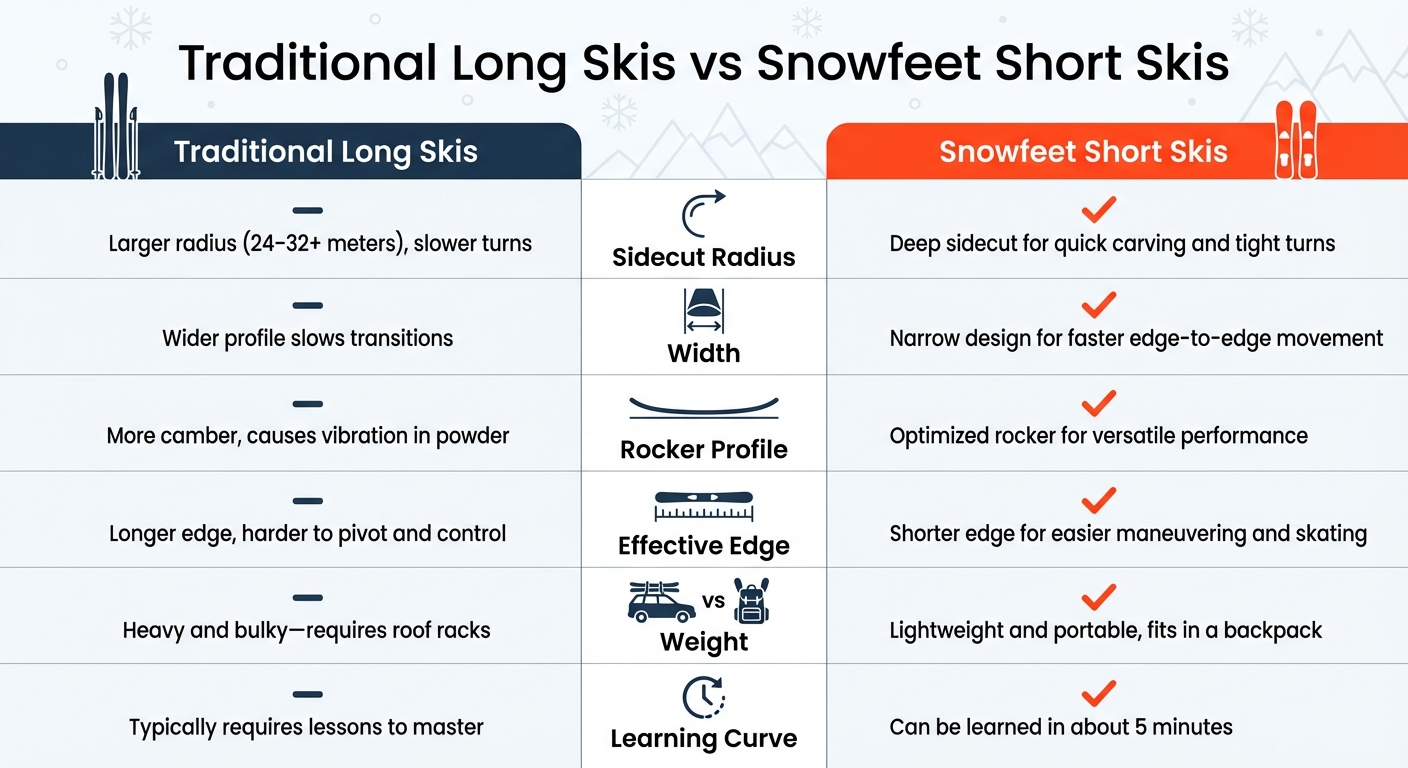
Traditional Long Skis vs Snowfeet Short Skis Performance Comparison
Here's a quick breakdown of how traditional long skis stack up against Snowfeet* short skis:
| Aspect | Traditional Long Skis | Snowfeet* Short Skis |
|---|---|---|
| Sidecut Radius | Larger radius (24–32+ meters), slower turns | Deep sidecut for quick carving and tight turns |
| Width | Wider profile slows transitions | Narrow design for faster edge-to-edge movement |
| Rocker Profile | More camber, which can cause vibration in powder | Optimized rocker for versatile performance |
| Effective Edge | Longer edge, harder to pivot and control | Shorter edge for easier maneuvering and skating |
| Weight | Heavy and bulky - requires roof racks | Lightweight and portable, fits in a backpack |
| Learning Curve | Typically requires lessons to master | Can be learned in about 5 minutes |
This comparison highlights a key takeaway: the shape of a ski has a bigger impact on performance than its length.
Traditional long skis excel in deep snow and at high speeds, thanks to their extended effective edge. But that length comes with a downside - maneuvering them in tight spaces, on flat terrain, or around moguls can be a real hassle. As Sophia Kane, a verified user, put it:
"I hate getting stuck on a hill in skis because they're so long and bulky. Since these are shorter, you can just skate right up."
Snowfeet* short skis, on the other hand, shine when it comes to agility and control. Their compact design and deep sidecut make them perfect for quick, precise movements on groomed slopes or in snowparks. Plus, their lightweight build means no need for roof racks or other bulky gear - just toss them in a backpack and go.
Of course, there’s a trade-off. Snowfeet* short skis perform best on groomed snow or light powder (up to about 4 inches). For deeper powder, longer models like the 39-inch (99 cm) or 47-inch (120 cm) skiblades are a better choice. But for most resort conditions, Snowfeet* short skis offer a playful, responsive ride that's hard to beat for quick transitions and fun on the slopes.
Conclusion
When it comes to skiing, the shape of your skis matters far more than their length. Features like sidecut, width, and rocker profile determine how easily you can carve, float, and initiate turns. Adding extra length? That just means more weight and less maneuverability.
Take Snowfeet* short skis as a prime example. These skis are designed with deep sidecuts for tight, precise turns, rocker profiles that make handling effortless, and wider waists for added stability. They’re lightweight, easy to control, and - get this - they fit in a backpack. Skiers around the world are realizing that shorter skis with smarter designs make for a more enjoyable experience.
Forget the old chin-to-forehead rule. Ski design has evolved. As the Snowfeet Team puts it:
"You cannot outgrow your skis if you never accept the rules of long skis!"
Whether you’re a beginner mastering the basics in just minutes or a seasoned skier chasing fun and agility, Snowfeet* short skis have you covered. From the compact 17-inch (44 cm) Skiskates priced at $490 to the versatile 39-inch (99 cm) Skiblades at $590, these skis combine performance-focused design with unbeatable portability.
Leave the bulky gear behind. Embrace shape over length - and rediscover the pure joy of skiing.
FAQs
How does the maneuverability of Snowfeet short skis compare to traditional long skis?
Snowfeet short skis are all about agility. Thanks to their compact size, lightweight build, and clever sidecut design, they’re much easier to maneuver than traditional long skis. Their shorter length makes quick, sharp turns a breeze, offering precise control that’s perfect for beginners, park riders, or anyone tackling tight spaces or moguls. Imagine this: a 15-inch (38 cm) Snowfeet model can pivot and stop way faster than a 67-inch (170 cm) traditional ski. That means a more nimble, responsive ride every time.
On the flip side, traditional long skis - usually around 59 to 75 inches (150–190 cm) - shine in areas like high-speed stability and deep powder. But they can feel bulky and awkward in crowded spots or on icy slopes. Their added length and weight make turning slower and control trickier, especially for less experienced skiers. Snowfeet, weighing just 1.5 to 4 pounds per pair, cut down on fatigue and boost maneuverability, giving riders a smoother, more fun experience on the slopes.
Why are sidecut and rocker profile more important than ski length?
The sidecut of a ski plays a big role in how sharply it can turn. A deeper sidecut means you can make quick, precise, and nimble moves. Then there’s the rocker profile - that gentle upward curve at the tip and tail - which makes starting turns a breeze and helps you float better in soft snow. Together, these design elements have a huge impact on how skis perform across different terrains. In fact, they matter way more than just making skis longer, which mostly adds stability at high speeds.
Snowfeet* products, like Skiblades and Skiskates, take full advantage of these design features. Their compact size, paired with advanced sidecut and rocker profiles, delivers agility and fun like no other. They’re easier to maneuver and more user-friendly than traditional long skis. Whether you’re weaving through tight turns or cruising through powder, Snowfeet* skis are built to give you a smooth, exciting ride on your winter adventures.
Are Snowfeet short skis good for different snow conditions?
Snowfeet short skis are built to handle a wide range of snow conditions, from hard-packed trails to icy groomers and general all-mountain terrain. Thanks to their compact size and thoughtful design, they’re incredibly easy to control, giving you a smooth, enjoyable ride in most environments.
That said, if you’re planning to tackle deep powder, wider and longer skis might be a better choice. But for most winter sports fans, Snowfeet skis bring a whole new level of convenience and fun, performing well across a variety of conditions.











Leave a comment
This site is protected by hCaptcha and the hCaptcha Privacy Policy and Terms of Service apply.