



















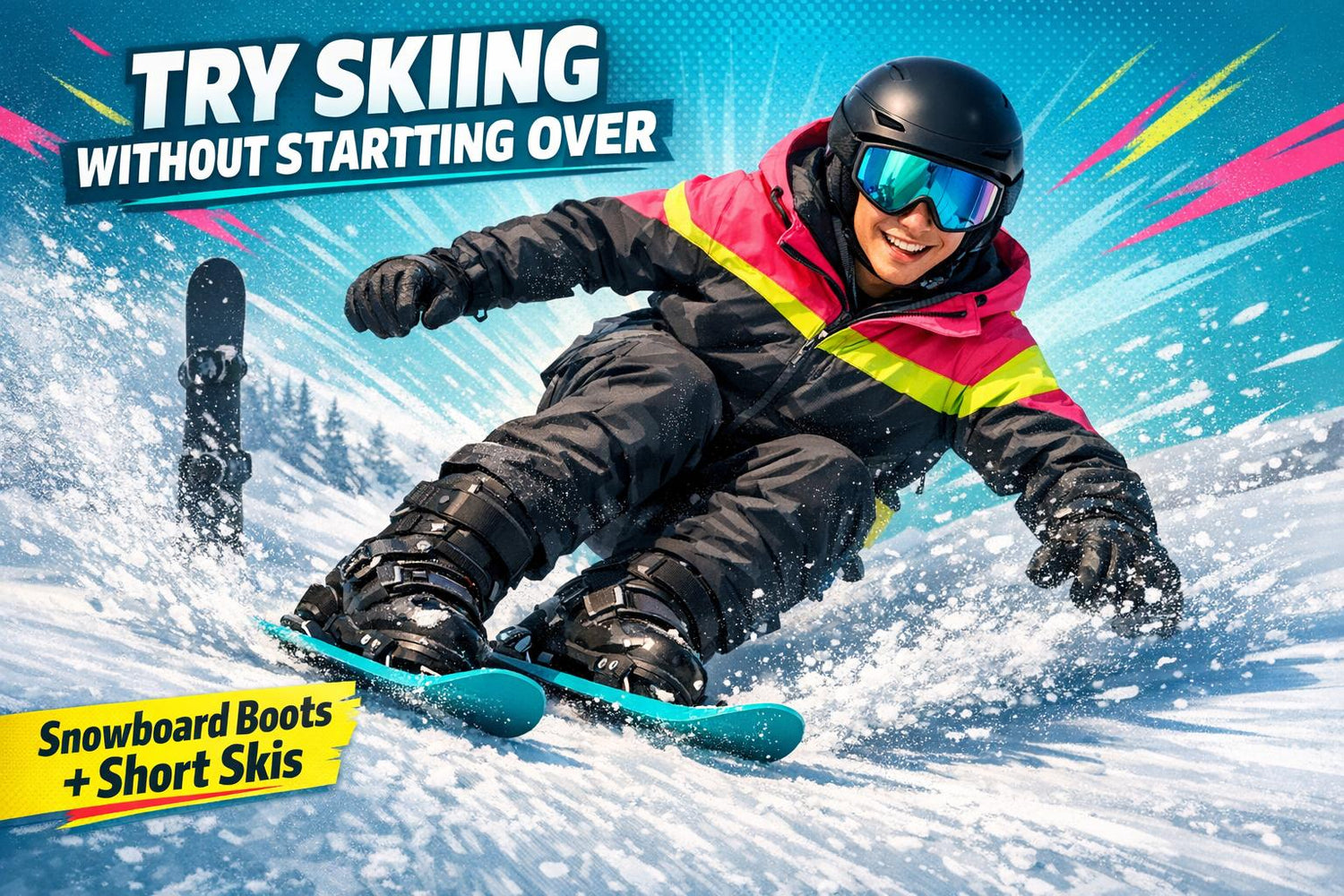
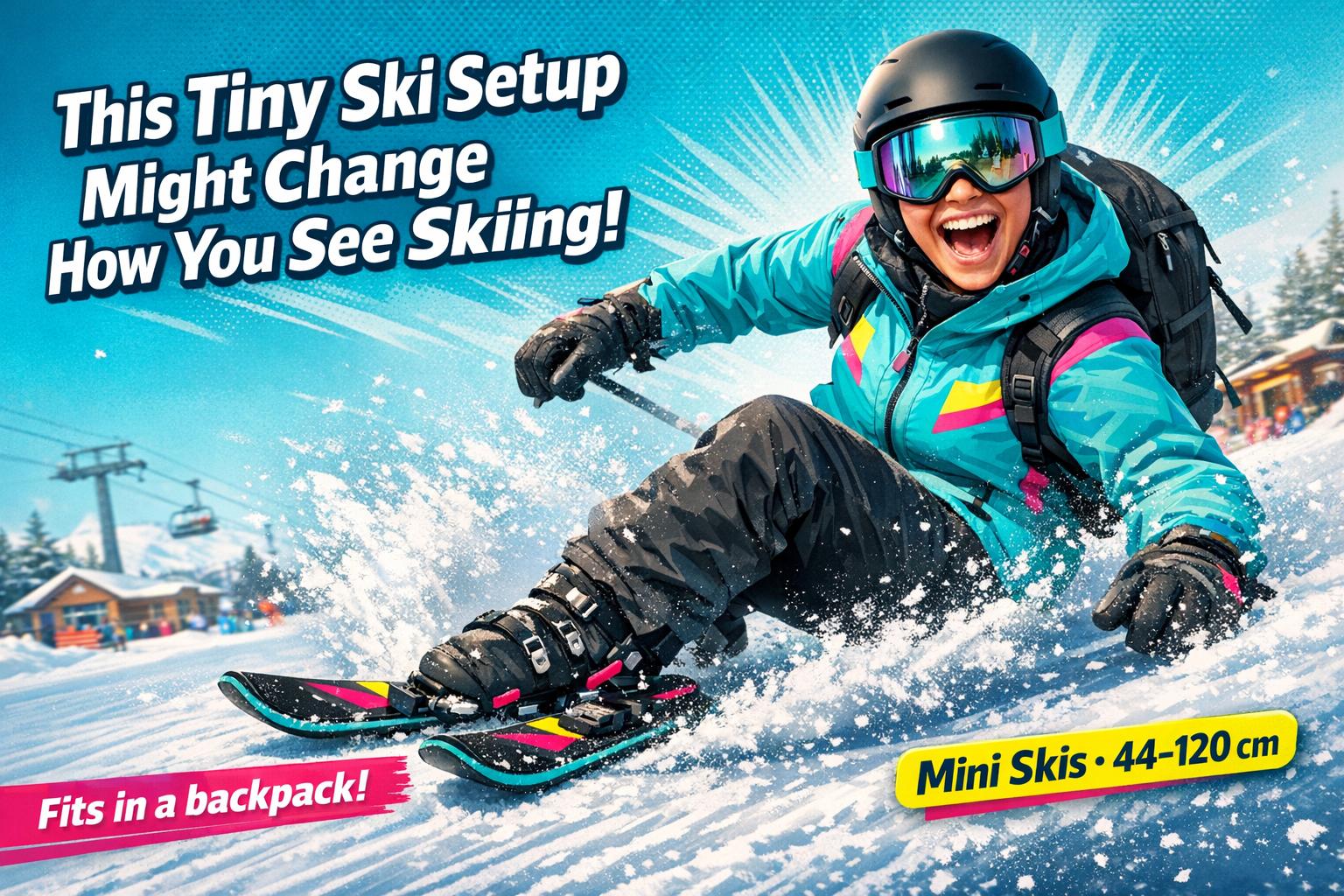
Switching from snowboarding to skiing doesn’t have to mean starting from scratch. Snowfeet* offers short skis, skiblades, and skiskates that work with your snowboard boots, making it easier (and cheaper) to try skiing without committing to bulky gear or a steep learning curve. These shorter skis (44–120 cm) are agile, forgiving, and let you use your existing skills like edge control and balance. Perfect for snowboarders who want to explore skiing without the hassle.
Key Takeaways:
- Gear Compatibility: Some Snowfeet* models work with snowboard boots - no need for stiff ski boots.
- Affordable: Starting around $250, way less than a full ski setup.
- Easy to Learn: Shorter skis make turns easier and falls less intimidating.
- Portable: Fits in a backpack, unlike long skis.
Want to try skiing without the hassle? Snowfeet* could be your perfect crossover gear.
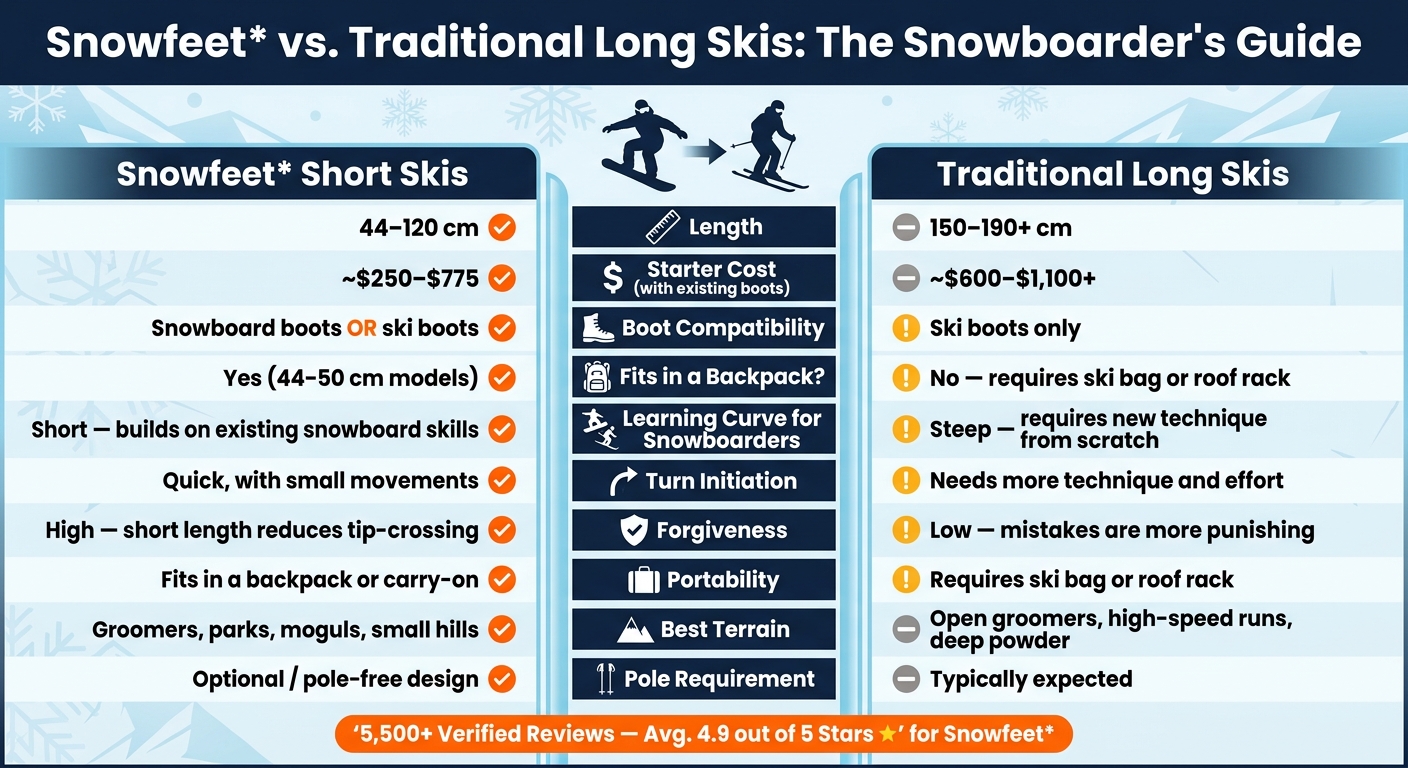
Snowfeet vs. Traditional Long Skis: The Ultimate Snowboarder's Comparison
Snowboarder tries Snowfeet* | Which Snowfeet* Short Ski is the Best? | Snowblades 44, 65, 99 Review
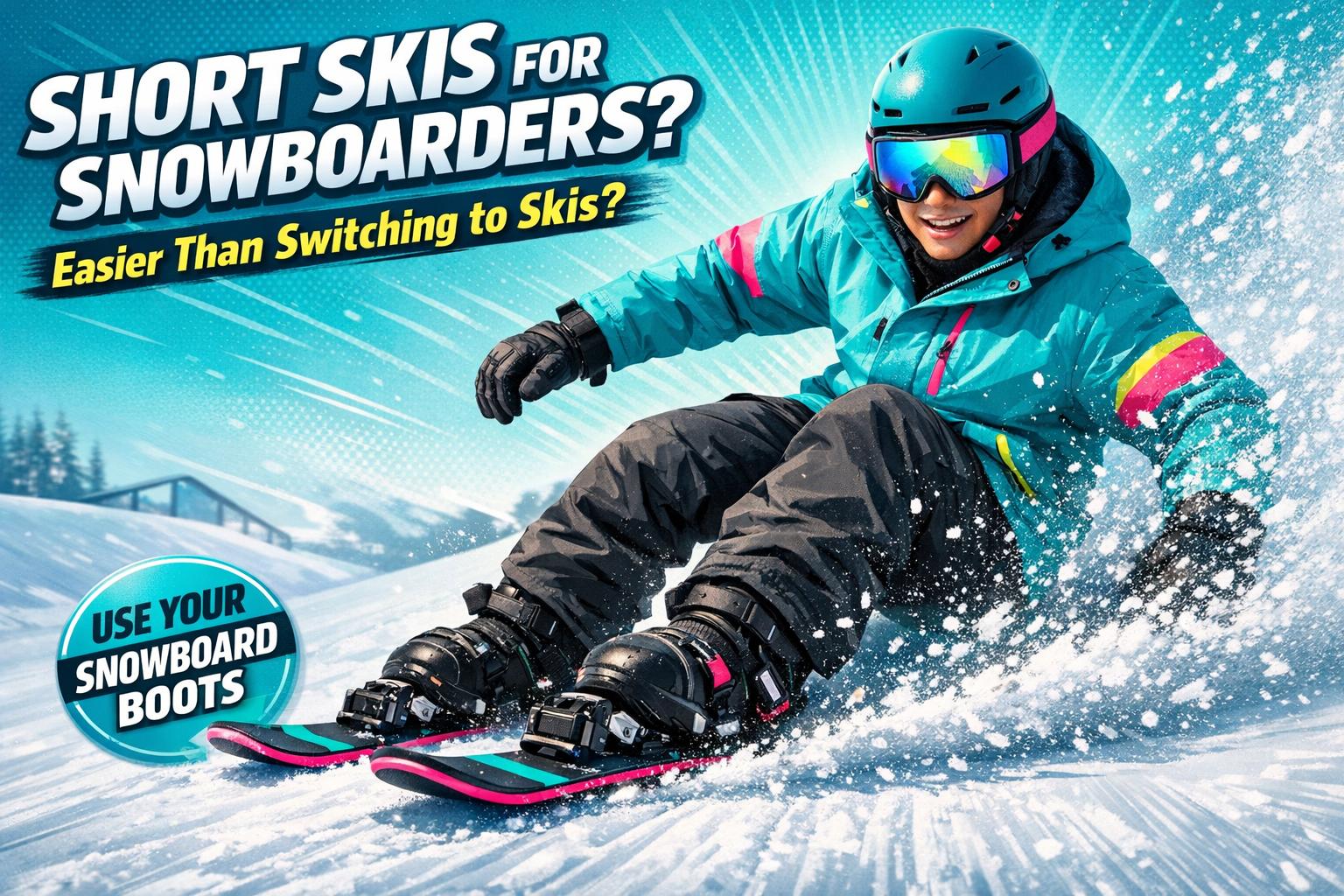
How Snowboarding Skills Carry Over to Snowfeet* Short Skis
Switching from snowboarding to Snowfeet* short skis can feel surprisingly natural. Why? Many of the skills you've honed as a snowboarder translate seamlessly to this innovative gear.
Snowboarding Skills That Transfer Directly
If you're a snowboarder, you're already ahead of the game when it comes to Snowfeet*.
Take edge control, for instance. Snowfeet* short skis come equipped with four edges, doubling your grip compared to a snowboard. This makes carving on hard-packed or icy slopes a breeze.
Then there's balance and terrain reading. Your ability to handle steep pitches, absorb bumps, and adapt to changing snow conditions is just as valuable on Snowfeet* as it is on your board. These skills help you maintain control and confidence, regardless of the terrain.
Another key advantage? You're already used to riding without poles. Snowfeet* gear is designed to be pole-free, so you’ll feel right at home. As randomstriker, a CSIA Level 3 Professional Instructor, notes:
"In skiing, my students often learn wedge turns and stops in one day quite painlessly."
These shared skills mean you’re not starting from scratch. Instead, you're building on a solid foundation that makes the transition smoother.
Key Differences Between Snowfeet* and Long Skis
While your snowboarding background gives you a head start, there are still some differences to consider when transitioning to Snowfeet*.
One of the biggest adjustments is independent leg movement. Unlike snowboarding, where your legs move as one unit, Snowfeet* short skis require coordination between both legs. The good news? Their shorter length makes this much easier to master compared to traditional long skis.
Another major plus is how forgiving Snowfeet* are. A slight backseat lean, which might throw you off balance on long skis, is far less destabilizing with Snowfeet*. This extra forgiveness makes them ideal for snowboarders adjusting to the new setup.
Here’s a quick comparison to highlight the differences between Snowfeet* short skis and traditional long skis:
| Feature | Snowfeet* Short Skis | Traditional Long Skis |
|---|---|---|
| Turn Initiation | Quick and easy | Requires more effort and technique |
| Independent Leg Movement | Easier to learn | Harder to coordinate |
| Backseat Forgiveness | More stable | Can cause chatter or instability |
| Physical Fatigue | Low | Higher demand on legs and core |
| Pole Requirement | Optional | Typically expected |
As The Ski Monster explains:
"Shorter skis are always quicker and easier to initiate a turn on for a given ski."
This quick response and agility make Snowfeet* a perfect match for snowboarders. They're nimble, easy to control, and far less intimidating than long skis, especially on icy or hard-packed slopes. With these differences in mind, you're well on your way to choosing the right Snowfeet* gear for your smooth transition.
Choosing the Right Snowfeet* Gear for Your Crossover
Now that you know your snowboarding skills transfer over, it’s time to pick the right Snowfeet* model for your style. Your choice boils down to three things: the type of boots you’ll use, the terrain you plan to ride, and how adventurous you want to get. Let’s break it down so you can find the perfect fit.
Snowfeet* Product Options at a Glance
Snowfeet* offers three main product types, each designed for a specific kind of rider.
- Skiskates (44 cm): These are the most portable option, small enough to toss in a backpack. They’re compatible with both winter boots and snowboard boots, giving you a skate-like feel that’s great for anyone with a background in skateboarding or ice skating. Priced around $575, they’re perfect for quick sessions at local hills, terrain parks, or resorts.
- Skiblades (65 cm): If you’re looking for a mix of agility and ski-like performance, these are a solid choice. They’re great for intermediate riders who want to explore more of the mountain, offering stability for blue runs while still being playful enough for surfy maneuvers.
- Skiblades (99 cm): These bring you closest to a traditional skiing experience while staying forgiving. The added length allows for deep carving and better edge hold at higher speeds, making them ideal for advanced riders who enjoy black runs and steeper terrain.
"Go for Skiblades if you want short skis - choose Snowfeet or Skiskates if you want skating on snow." - Snowfeet Official
One thing to keep in mind: all three models come with bindings that work with snowboard boots, so you can skip the hassle of renting ski boots. However, if you’re considering 120 cm Short Skis, those require standard ski bindings, which means you’ll need ski boots too.
Snowfeet* vs. Long Skis: A Side-by-Side Look
The difference between Snowfeet* and traditional long skis isn’t just about size - it’s also about how quickly you can learn, how easily you can travel, and how much fun you’ll have right from the start.
| Category | Snowfeet* Short Skis / Skiblades | Traditional Long Skis |
|---|---|---|
| Length | 44–120 cm | Typically 150–190+ cm |
| Learning Curve | Quick; often mastered in a day | Steeper; harder to control at low speeds |
| Boot Options | Works with ski or snowboard boots | Ski boots only |
| Portability | Fits in a backpack or carry-on | Requires a ski bag or roof rack |
| Turn Initiation | Quick, with small movements | Needs more technique and effort |
| Forgiveness | High; short length reduces tip-crossing | Low; mistakes are more punishing |
| Best Terrain | Groomers, parks, moguls, small hills | Open groomers, high-speed runs, deep powder |
As you can see, Snowfeet* models are perfect for riders who value portability, ease of learning, and versatility on different terrains.
"They're lightweight and much easier to carry around than full-size skis." - Brad Tolin
If you’re a snowboarder curious about skiing but not ready to commit to a full ski setup, Skiblades in the 65–99 cm range are a fantastic starting point. They work with your snowboard boots, handle most resort terrain, and make the transition from snowboarding to skiing practically seamless.
sbb-itb-17ade95
How to Get Started: Your First Day on Snowfeet*
Getting Your Gear and Body Ready
Before heading out, make sure your Snowfeet* Skiblades are securely attached to your snowboard boots. The great thing is they clip right onto your existing boots, so there’s no need for extra footwear. After strapping in, give each binding a solid tug to double-check that everything is locked in place.
When it comes to protective gear, safety first! Wear a helmet, wrist guards, and padded shorts. While falling on Snowfeet* is usually less harsh than snowboarding - thanks to the shorter length and reduced leverage - it’s always better to have some extra cushioning, especially on your first day.
If you’re using a fiberglass-reinforced model, waxing your skis beforehand can make a noticeable difference in how smoothly you glide. It’s a small step but worth the effort for better performance.
Once you’re all set with your gear, you’re ready to ease into your first session.
Step-by-Step Progression for Snowboarders
Start your adventure on an easy, beginner-friendly slope. A groomed green run or a wide, flat area works perfectly. Avoid deep powder (anything over 4 inches) and steep slopes until you’re more comfortable.
The biggest adjustment for snowboarders is learning to move each leg independently. On a snowboard, your legs are locked together, but with Snowfeet*, each foot has its own freedom. Spend some time walking and gliding on flat ground to get used to this new sensation.
Here’s how to approach your first runs:
- Find Your Center: Keep your weight evenly distributed between both feet. Because the base of Snowfeet* is short, staying balanced from front to back is even more important than on a snowboard. Think of it like inline skating - it’s all about staying actively balanced.
- Master Stops, Then Link Turns: Start by learning to stop using a wedge. Point your toes inward to slow down, then practice linking gentle turns down the slope. If you already have edge awareness from snowboarding, that’ll give you a big head start as you learn to steer one foot at a time.
- Ditch the Poles: Skip ski poles on your first day. They can throw off your balance as you’re learning to rely on your core for stability.
"In skiing, my students often learn wedge turns and stops in one day quite painlessly." - randomstriker, Professional Instructor, CSIA Level 3/CASI Level 2
A fun tip: Have someone record a video of you. It’s easier to spot things like leaning back too far or dropping a shoulder when you can see yourself in action. Plus, it’s a great way to track your progress!
Why Snowfeet* Works Better for Snowboarders Than Long Skis
Snowfeet* bridges the gap between snowboarding and skiing, offering snowboarders a chance to explore skiing without the hassle of traditional long skis. It’s an easy, fun way for riders to expand their snow sport adventures.
Portable, Flexible, and Fun
Long skis, typically ranging from 155 to 185 cm, come with their own set of challenges - bulky roof racks, ski bags, and awkward transport logistics. Snowfeet*, on the other hand, are compact and lightweight, with lengths between 44 and 120 cm. The smallest model, Skiskates (44 cm), even fits into a standard backpack.
"I loved how easy they are to carry in a backpack with their convenient waterproof bag! Highly recommended for fun for experts and beginners alike!" - Michele, Snowfeet* customer
This portability changes the game. Instead of wrestling with oversized gear, you can pack Snowfeet* in your bag and head to a nearby hill after a fresh snowfall. You can even switch between your snowboard and Snowfeet* during the same day at the resort, hassle-free. Their compact size also makes maneuvering in lift lines and on chairlifts much easier - no more struggling with long skis in tight spaces.
On top of that, Snowfeet* bring a playful vibe to the slopes. Their short length allows for quick turns, sharp pivots, and freestyle tricks, giving them a feel that’s closer to snowboarding in the park than traditional skiing. Riders often describe the experience as “ice skating on the slopes,” blending skiing and skating in a way that feels natural for those with a freestyle mindset. This combination of convenience and fun makes Snowfeet* an appealing choice for snowboarders looking to try something new.
A Quicker, Simpler Transition
For many snowboarders, the biggest hurdle to skiing is the gear. Long skis demand precise edge control, weight shifts, and a steep learning curve - even at moderate speeds. Snowfeet* simplify this process. Their shorter edges make turns easier to initiate, allowing snowboarders to rely on their existing balance and edge control skills right away.
Another advantage? The cost. A full traditional ski setup can run anywhere from $600 to $1,100+, and that’s before factoring in ski boots. Snowfeet* Skiblades, on the other hand, start at around $635 if you already own snowboard boots - no additional boot purchase required.
Here’s a quick comparison:
| Snowfeet* Short Skis | Traditional Long Skis | |
|---|---|---|
| Starter cost (with existing boots) | ~$250–$775 | ~$600–$1,100+ |
| Fits in a backpack | Yes (44–50 cm models) | No |
| Learning curve for snowboarders | Short; builds on existing skills | Steep; requires new technique |
| Best for | Groomed runs, parks, casual fun | High-speed carving, deep powder |
"Super easy to control, quick to turn, and way more forgiving than traditional skis. I felt comfortable on them within just a few runs." - Brad Tolin, Snowfeet* customer
With over 5,500 verified reviews averaging 4.9 out of 5 stars, it’s clear why Snowfeet* is a hit. Snowboarders get the hang of it quickly, skipping the typical frustrations of learning on long skis. It’s skiing made simple, and a whole lot more fun.
Conclusion: Make the Switch with Snowfeet*
If you’ve mastered snowboarding, Snowfeet* opens the door to skiing without the hassle of a full gear overhaul. With your skills in edge control, balance, and reading the terrain, you’ll be linking turns on day one. No ski boots, roof racks, or steep learning curve needed - Snowfeet* makes it simple.
Pick your style: Skiskates for nimble park laps, Skiblades for smooth carving, or mini skis for ultimate portability. Snowfeet* works with your existing snowboard boots, so there’s no need for extra purchases. This consistency helps you improve from the very first run.
"I was nervous about the boots not being stiff enough for skis but it was not an issue at all. SUPER comfortable, easy to control, very agile, easy on the knees and ankles." - Mike E., Verified Customer
Snowfeet* combines cutting-edge design with your current skills to create an easy, exciting skiing experience. Head over to snowfeetstore.com to explore models, check sizing and boot compatibility, and read reviews to find your perfect match.
FAQs
Which Snowfeet* model is best for my riding style?
When it comes to choosing the best Snowfeet* model, it really boils down to what you’re looking for - whether it’s maneuverability, pulling off tricks, or tackling different types of terrain.
- For all-around versatility, the Snowfeet Original Skiboards (44–120 cm) are a solid pick. They’re lightweight, easy to handle, and work great on downhill slopes, in parks, or even on moguls.
- If quick turns and a skating-like vibe are more your thing, the 44 cm Skiskates are a perfect fit.
No matter the model, they’re all portable, simple to use, and compatible with ski or snowboard boots. Snowfeet gear brings a mix of fun and control to riders of all skill levels.
Are Snowfeet* allowed at most ski resorts?
Most ski resorts allow Snowfeet products, such as skiblades and skiskates. These are crafted for simple and enjoyable snow activities and are compatible with ski or snowboard boots. That said, it's smart to double-check the policies of the resort you plan to visit, just to be sure.
Do I need ski poles or lessons to start?
Nope, you don’t need ski poles or lessons to get started with Snowfeet products. These are built to be compact, simple to use, and perfect for beginners - especially snowboarders looking to dip their toes into skiing. While lessons can be helpful for polishing your technique and staying safe, Snowfeet’s user-friendly design makes it easy to give skiing a shot on your own. If you’re already confident moving around on snow, you’re good to go without poles or formal instruction.











Leave a comment
This site is protected by hCaptcha and the hCaptcha Privacy Policy and Terms of Service apply.