



















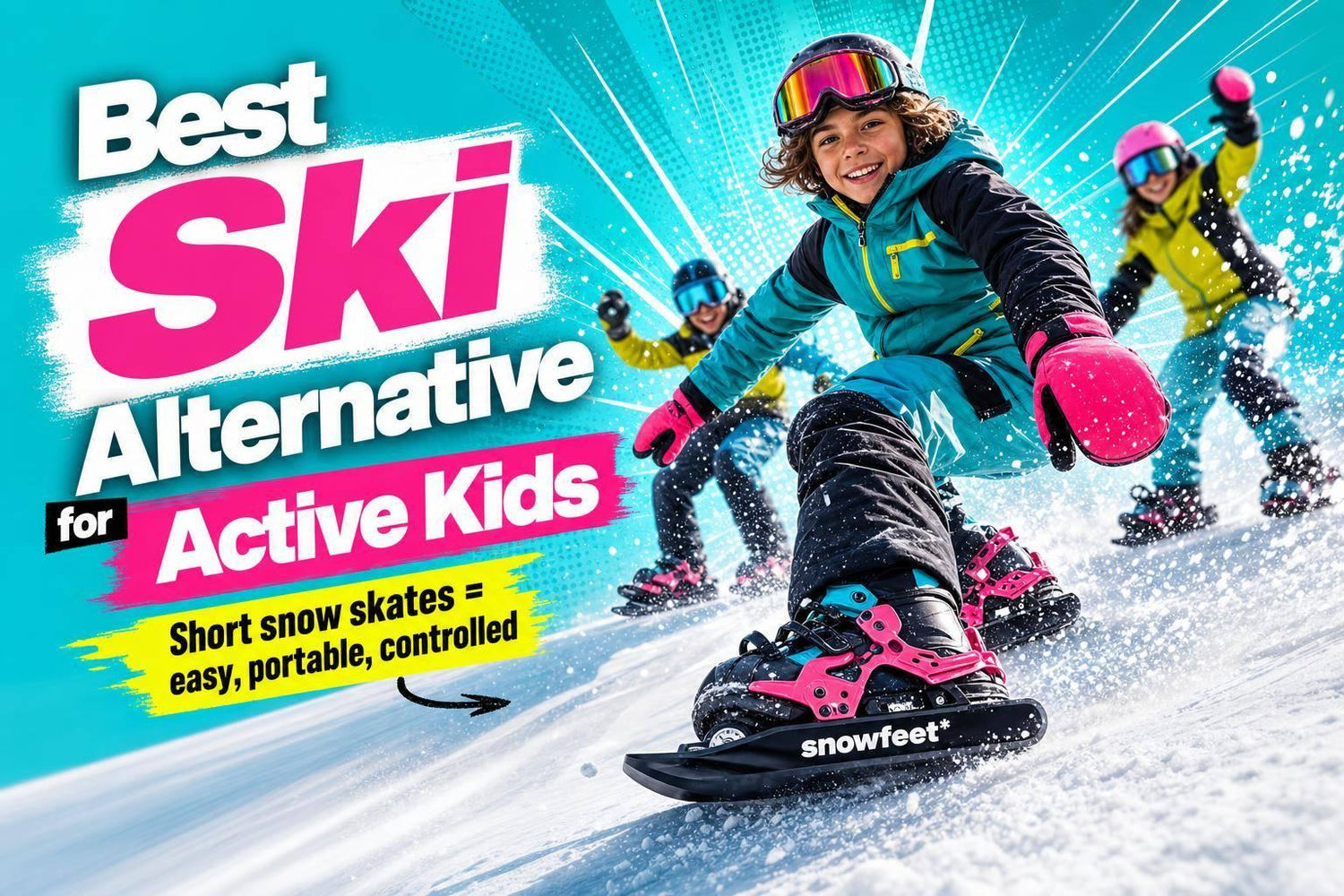
If you want the short answer: most active kids do better with short Snowfeet* gear than with junior skis or kids’ snowboards. Why? It’s lighter, easier to turn, and far less annoying to carry from the car to the hill.
Here’s the simple breakdown:
- Ages 3–6: Snowfeet* MINI KIDS is the easiest first pick.
- Young beginners who want more glide: Mini Ski Skates 38 cm
- School-age kids who want more balance and control: PRO 50 cm
- Kids with a skating or hockey background: Skiskates 44 cm
- Older kids and teens who want more of a ski feel: Skiblades 65 cm
- Formal ski lessons and full mountain progression: Junior skis
- Park-focused tweens and teens: Kids’ snowboards
In other words: the best setup is the one your child will use without a fight. Short gear wins for low-speed control, easy stopping, and travel. Full skis still make sense for ski school. Snowboards fit kids who already want that sideways style and don’t mind a slower start.
A few numbers stand out:
- Snowfeet* prices in this lineup run from about $250 to $635
- The 38 cm model fits about US Kids 10 to Adult 6
- The PRO 50 cm can handle light powder up to about 4 in / 10 cm
- Junior skis often run about 120–130 cm or more for kids, which means more bulk and more gear to haul
Best Ski Gear for Kids: Snowfeet vs Junior Skis vs Snowboards
How to Choose the Best Skis for Kids
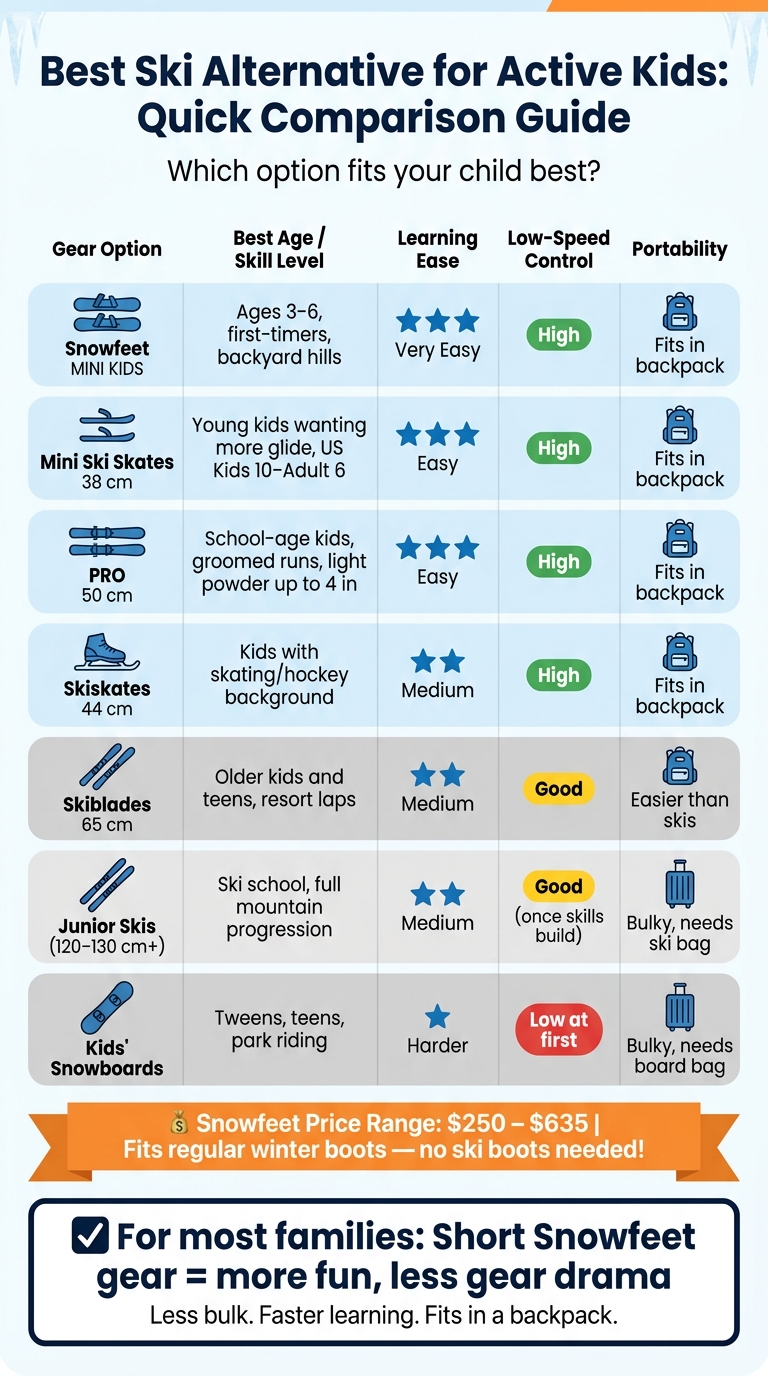
Quick Comparison
| Option | Best For | Learning Ease | Low-Speed Control | Portability |
|---|---|---|---|---|
| Snowfeet* MINI KIDS | First-timers, small kids, backyard hills | Very easy | High | Fits in a backpack |
| Mini Ski Skates 38 cm | Young kids who want more glide | Easy | High | Fits in a backpack |
| PRO 50 cm | School-age kids, groomed runs, light powder | Easy | High | Fits in a backpack |
| Skiskates 44 cm | Kids who skate or play hockey | Medium | High | Fits in a backpack |
| Skiblades 65 cm | Older kids, teens, resort laps | Medium | Good | Easier than skis |
| Junior Skis | Ski school, full mountain learning path | Medium | Good once skills build | Bulky |
| Kids’ Snowboards | Tweens, teens, park riding | Harder | Lower at first | Bulky |
So, if I had to boil the whole thing down into one line, it’d be this: for most families, short Snowfeet* gear gives kids more fun with less gear drama :)
If you want a quick visual before you buy, these videos can help:
1. Snowfeet* MINI KIDS
MINI KIDS are the simplest Snowfeet option for the youngest beginners.
Learning Curve
MINI KIDS are the easiest Snowfeet pick for young beginners. They strap onto regular winter boots, so kids don’t need ski boots. That’s a big win for parents and a nice little relief for kids too.
The forward-facing stance feels natural. Kids already move that way, so the first few minutes on snow tend to feel less awkward than a sideways snowboard stance. In plain English: they can get the idea fast.
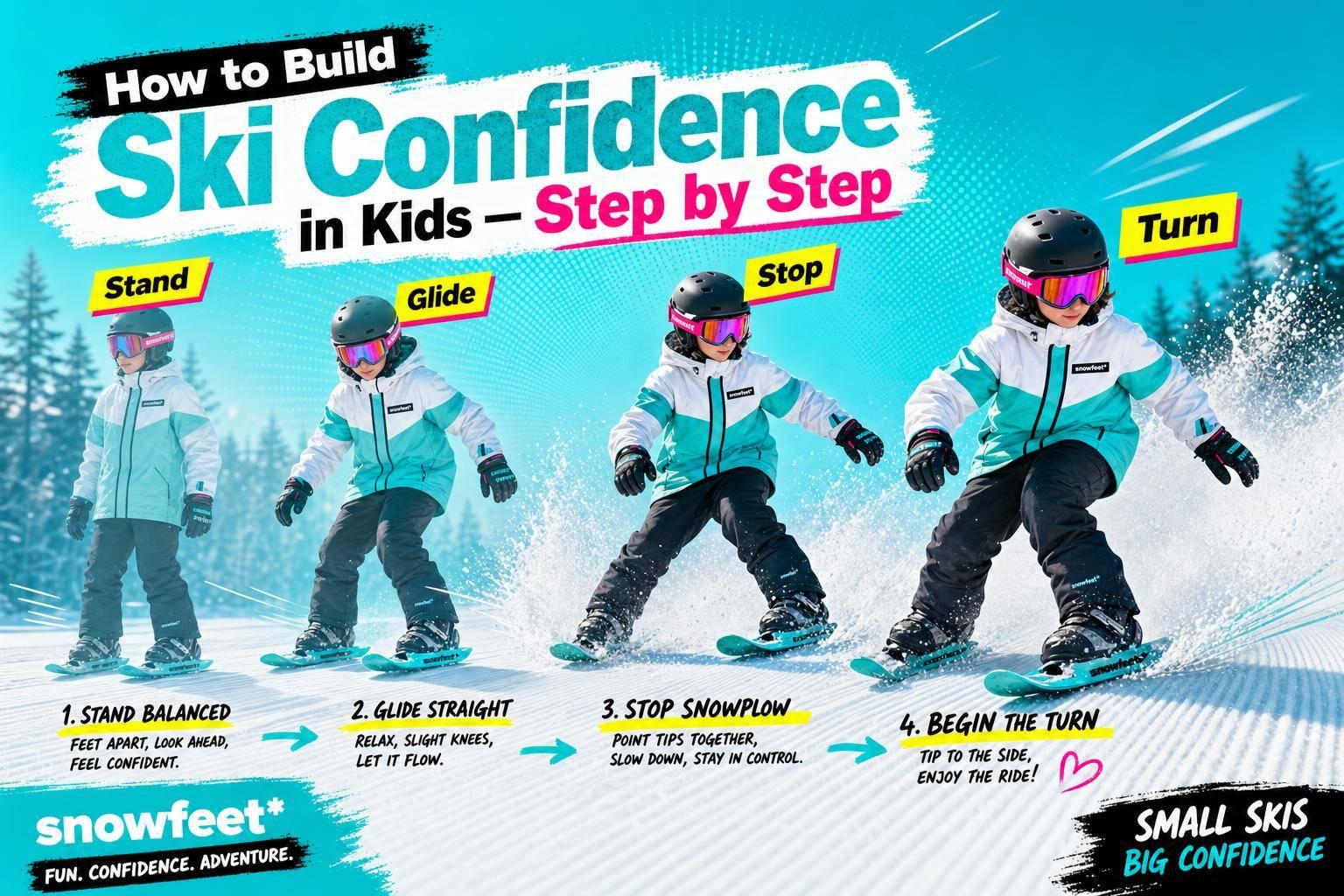
Many kids can slide, stop, and turn within one short session. Parents report kids can start stopping and turning within one short session. Once a child outgrows this first step, the next move is a slightly longer model with more glide.
Speed Control
MINI KIDS use metal ski edges for stopping and a built-in heel brake for extra control. Their short length helps keep speed in check and makes falls feel less harsh. That matters, because a rough first day can kill the mood fast.
Kids can slow down by:
- stepping
- turning uphill
- putting a foot down
That simple control helps kids stay calm, have fun, and want another run. And honestly, that’s half the battle :)
Weight and Portability
Snowfeet* MINI KIDS fit in a backpack. So instead of parents hauling a pile of gear like pack mules, kids can carry them from the car to the hill on their own.
That small detail makes family snow days a lot easier.
Best-Fit Activities
MINI KIDS are a strong fit for backyard hills, bunny slopes, and magic carpets. They’re made for playful fun on gentle terrain, not steep slopes.
They work well as a first snow setup for small riders who need room to grow. They suit kids who want an easy, playful first snow setup.
For kids ready for a bit more glide and speed, the next step up is Mini Ski Skates 38 cm.
2. Snowfeet* Mini Ski Skates 38 cm
Snowfeet* Mini Ski Skates 38 cm are a smart next step for kids who want more glide than MINI KIDS but aren’t ready for full skis. You get more room to move, but without adding a bunch of extra stuff to learn. That’s the sweet spot.
Learning Curve
At just 15 inches long, these skates are easier for kids to handle than longer skis. They’re less likely to cross at the tips or catch an edge when a child turns or stops. That small size also makes a big difference after a fall. Kids can pivot, stop, and stand back up with less fuss.
The short platform keeps turning simple. It also helps kids reset fast and keep going instead of fighting the gear. If a child already ice skates or plays hockey, this can click pretty fast. Parents report that kids can pick up hockey stops and backward movement in one short session.
Speed Control
Mini Ski Skates 38 cm come with full metal ski edges and a built-in heel brake. That gives kids two solid ways to slow down, which is a nice thing to have when the hill starts to feel a bit fast.
Because the platform is short, kids can scrub speed with quick, small turns instead of long carving arcs. On groomed beginner and easy-intermediate runs, that usually means better control and less drama. Always nice, right? :)
On icy snow, though, the shorter edges grip less than longer skis. So these are best kept to groomed, moderate runs.
Weight and Portability
One of the handiest parts: these skates fit inside a standard backpack. That makes them easy to carry, stash, and bring along without feeling like you’re hauling half the garage.
They also fit US Kids 10 - Adult 6 / EU 27-38, which gives them a pretty broad fit range for children. And since regular waterproof winter boots work fine, kids can walk around the lodge without changing shoes. That’s a small win that feels HUGE when you’re dealing with cold hands and restless kids.
Best-Fit Activities
These work best for:
- Groomed resort runs
- Sledding hills
- Packed paths
They’re less suited for deep powder or long, fast runs. For bigger terrain and more speed, a longer Snowfeet* model is the better pick.
For kids who want more speed and a stronger setup, the next step up is PRO 50 cm.
3. Snowfeet* PRO 50 cm
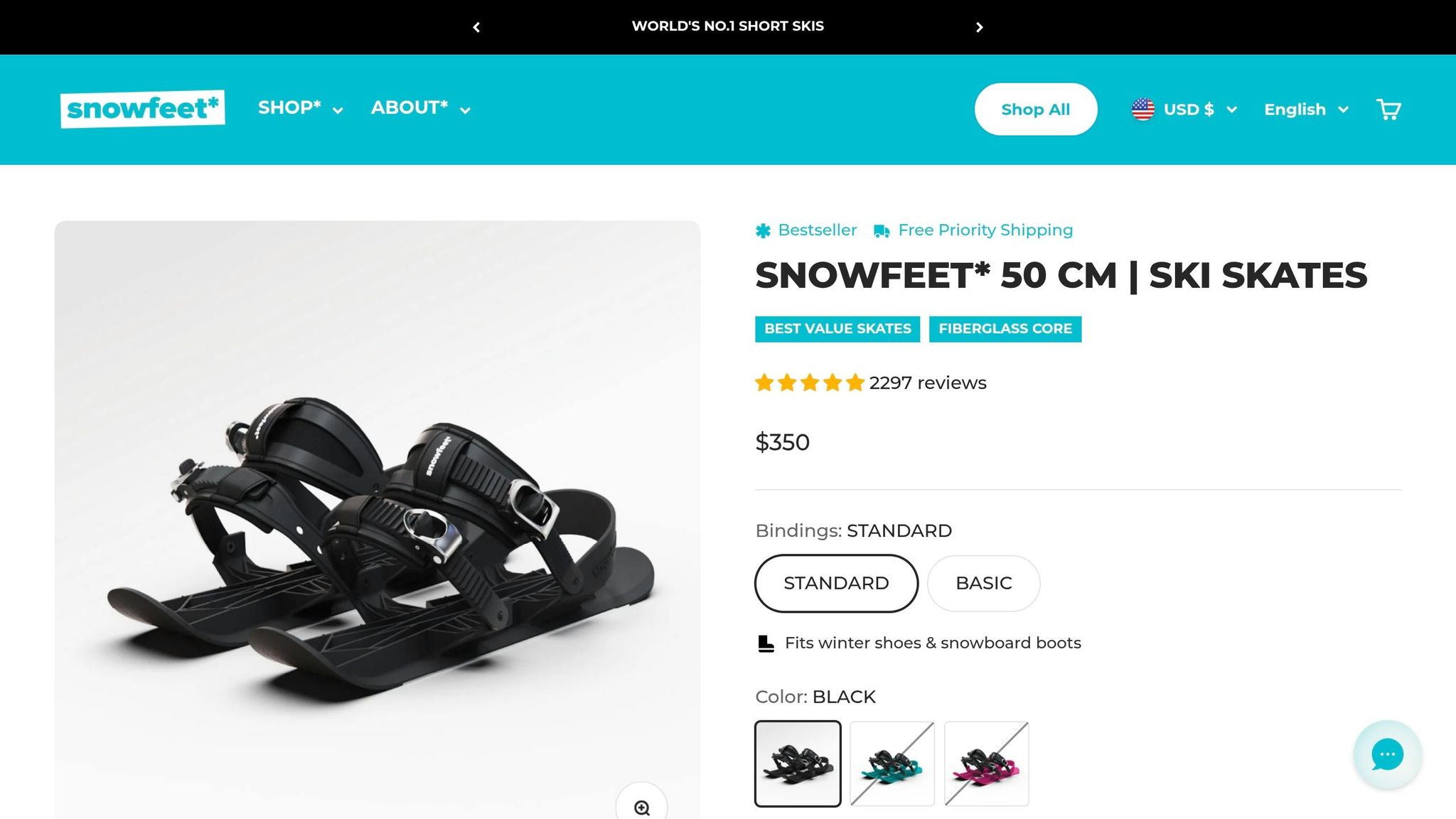
If the 38 cm mini skates seem a bit too tiny, the PRO 50 cm is a nice middle ground. Kids get more stability, but the setup still stays simple. It’s a good pick for kids who’ve outgrown the mini models and want something small, easy to carry, and easy to use. You get more edge contact too, without drifting into full-on ski territory.
Learning Curve
Snowfeet* says many riders can get comfortable on the PRO 50 cm in about 5 minutes. That tracks, especially for kids who already have decent balance from ice skating, rollerblading, or hockey.
The flexible fiberglass core feels more forgiving than stiff, which helps a lot when kids are still figuring things out. And using regular winter boots or snowboard boots cuts out one of the biggest pain points with skiing: ski boots. For most families, that’s a big plus. This model tends to make more sense for school-age kids with solid balance than for preschoolers.
Speed Control
The PRO 50 cm has full metal steel edges and a heel brake, so kids get two simple ways to slow down. That’s a pretty friendly setup.
Because the platform is short, quick turns come naturally. And quick turns mean kids can dump speed without fighting the gear. The flip side? It won’t feel as steady on steep, fast runs. Still, that trade-off works well for active kids. The ride feels easy to handle without feeling dull.
Weight and Portability
Like the smaller models, the PRO 50 cm is easy to carry, which makes family ski days a lot less messy. It still fits in a backpack, unlike typical 120–130 cm junior skis.
Best-Fit Activities
Snowfeet* calls the PRO 50 cm the most versatile compact option. It works well for:
- Groomed resort slopes
- Snow parks
- Hiking trails
- Sledding hills
- Light powder up to about 4 inches (10 cm)
In day-to-day use, it’s best on groomed green runs, easy blue slopes, beginner park features, and packed hills.
For kids who want a firmer, more skate-like ride, the next section covers Skiskates 44 cm.
4. Snowfeet* Skiskates 44 cm
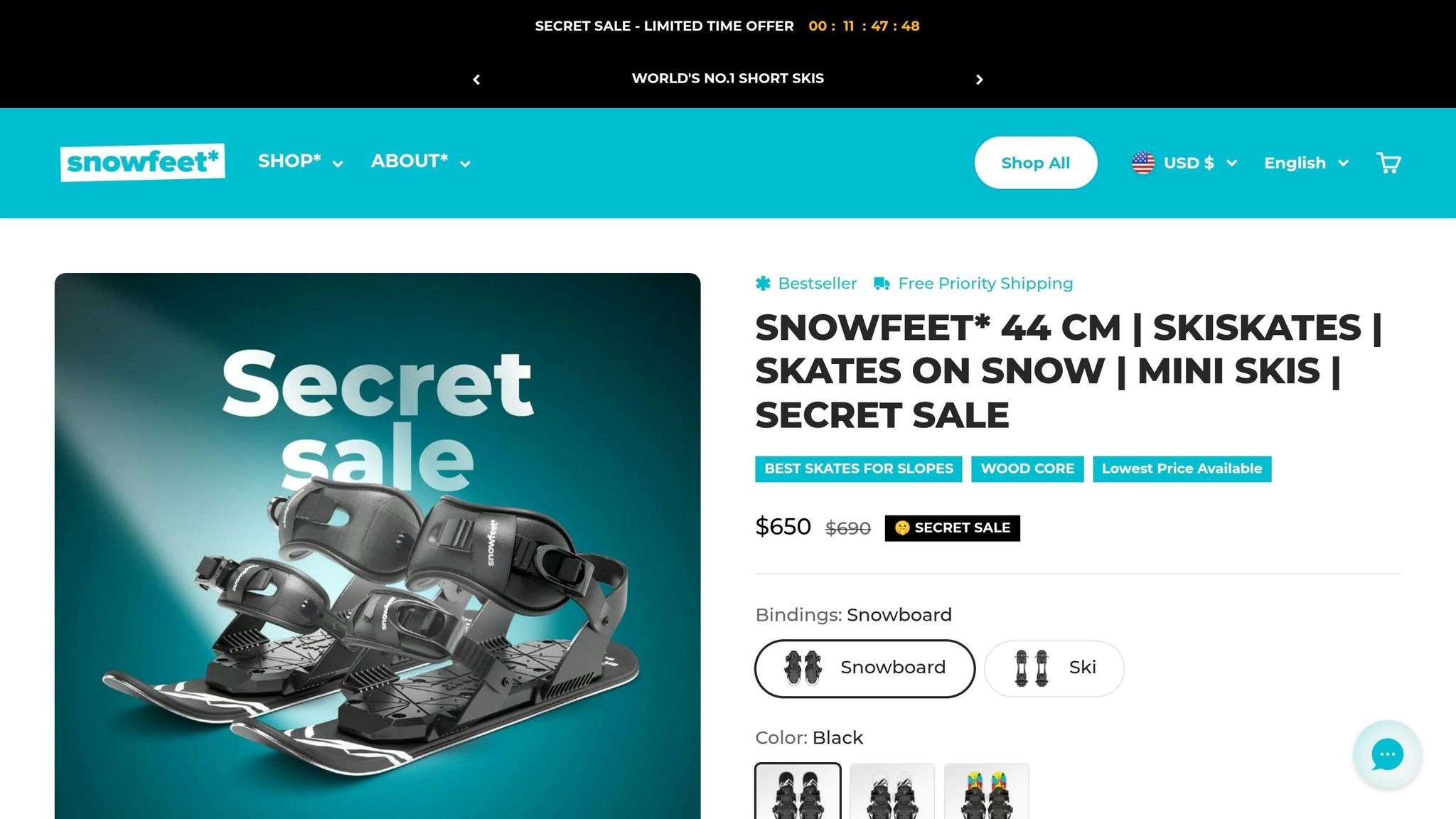
The Skiskates 44 cm are the most skate-like pick in the Snowfeet* lineup. At 44 cm (17 in), they lean hard toward agility and playful riding, not top speed. Snowfeet* calls them its original Skate on Snow.
Learning Curve
This skate-style stance can feel pretty natural for kids who already ice skate, rollerblade, or play hockey. That said, the 44 cm model asks for more balance than the MINI KIDS or 38 cm mini skates. It tends to fit older kids with strong coordination better than those starter picks.
Think of it as the next step up. If a child wants more control and more freedom to move, this model makes sense.
Speed Control
The metal edges and short platform help kids slow down with quick edge-to-edge moves. Another plus: speed stays lower than it does on full-length skis. That can make the ride feel less intimidating.
If your child wants a bit more stability and glide, the 65 cm Skiblades are the next move.
Weight and Portability
At 44 cm, these fit easily into a standard backpack.
Best-Fit Activities
The 44 cm Skiskates work well on groomed green runs and in snow parks. They’re a nice match for kids who want a playful, trick-friendly ride.
This model sits right in the middle:
- More agile than the mini models
- Less long and less stable than skiblades
- A strong fit for kids who want to move around more freely
That middle-ground feel is a big part of the appeal. You get more freedom than the mini options, without jumping straight to the extra length of skiblades.
If your child wants more stability than the 44 cm model, move up to the 65 cm Skiblades.
sbb-itb-17ade95
5. Snowfeet* Skiblades 65 cm
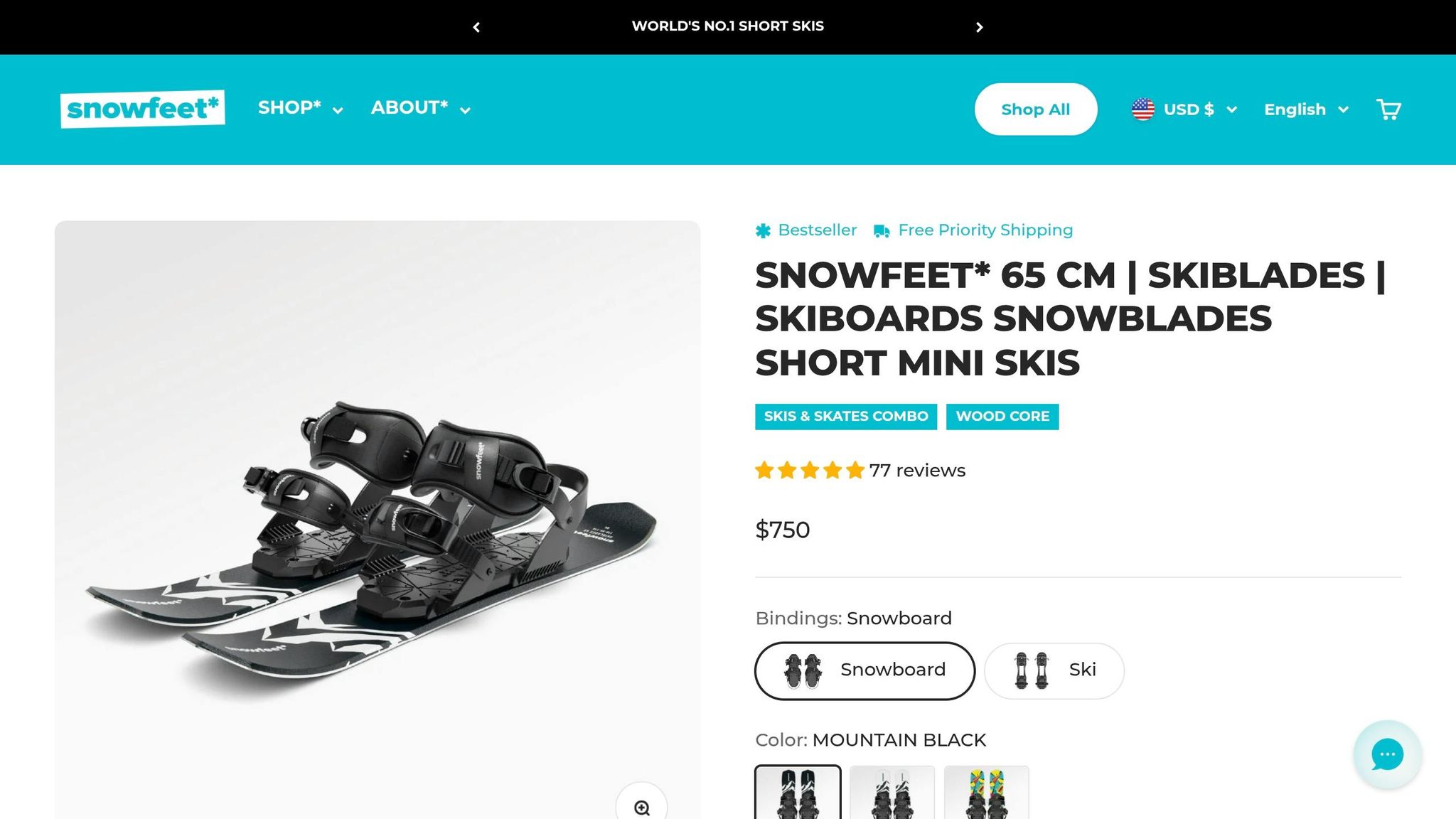
The 65 cm Skiblades are the first Snowfeet* model that starts to feel a lot more like skiing, while still staying small and easy to manage. They sit in that sweet spot between playful short skis and junior skis.
Compared with 100–140 cm junior skis, the shorter length makes it easier for kids to turn, stop, and get back under control. That’s a big deal when a child has outgrown the mini models but still isn’t ready for full-length skis. For a lot of kids, this is the best next step. Beginners will still need a short lesson on edging and stopping.
Learning Curve
The learning curve is a bit steeper than with the 38–50 cm Snowfeet* models. There’s more length underfoot, so kids need a bit more balance and edge control.
That said, the extra length also gives them more stability at moderate speed. And for many kids, that added stability feels nice and less twitchy.
Speed Control
The shaped profile and metal edges help kids turn and slow down with wedge or skid turns. They can make quick turns without wrestling with long skis.
Because the platform is still shorter than a standard junior ski, kids can pivot their feet more easily to scrub speed. That makes these a good match for early ski days on:
- Groomed green runs
- Easy blue runs
That’s the best place to start. Nice, mellow terrain. No drama :)
Weight and Portability
The 65 cm skiblades still fit in a backpack. They’re also much easier to travel with than junior skis, which parents will probably enjoy just as much as the kids.
Best-Fit Activities
These skiblades are a strong match for groomed resort runs, beginner terrain parks, and casual resort laps. They work best on groomed green and easy blue runs.
They’re not the right pick for:
- Deep powder
- Very steep terrain
- Icy slopes
If your child wants more length and a more standard ski feel, junior skis are the next move.
6. Junior Skis
Junior skis are the standard ski-school setup in the U.S. And there’s a reason for that: they give kids a clear path from first-day basics to tougher terrain.
That said, they ask more from the child. More gear. More time. More lessons.
Learning Curve
Junior skis follow the usual ski-school path: balanced stance, wedge, turning, then parallel skiing.
Kids have to learn each step in order. First, they find their stance. Then they use the wedge to slow down and steer. After that, they work toward parallel skiing. It works, but it often takes repeat lessons before a child can move past beginner runs with confidence.
That’s the big trade-off when families compare junior skis with compact Snowfeet gear. Junior skis teach the standard resort method. Snowfeet tends to feel easier at the start.
Speed Control
The wedge gives kids solid speed control on groomed runs. On packed snow, the longer edge helps the ski hold well, which matters once a child starts skiing blue runs with decent form.
Snowfeet gear, by contrast, is easier to pivot and slow on mellow terrain. Junior skis ask for better technique, but they pay off on groomed slopes when that technique starts to click.
Weight and Portability
This is where junior skis can feel like a lot. A pair of junior skis, bindings, and ski boots is bulky and tough for kids to carry.
Travel can turn into its own mini workout too. Flying to U.S. resorts often means checking the gear as oversize sports baggage, and that can bring extra fees. Snowfeet products fit in a standard backpack or duffel, which is a lot nicer on a busy resort morning when everyone’s half-zipped, one glove is missing, and someone has already said, “I’m tired.”
Best-Fit Activities
Junior skis make the most sense for:
- Formal ski school
- Full resort days on chairlift-accessed terrain
- Kids learning through step-by-step instruction
They’re less practical for backyard hills, short outings, and easy family travel.
"Only trade-off is at higher speeds, where longer skis still feel more stable - but for overall fun and maneuverability, these [short skis] are hard to beat." - Brad Tolin
If your child prefers a sideways stance instead of skis, the next option is kids' snowboards.
7. Kids' Snowboards
Snowboarding looks cool. No doubt about it. But for active kids, it usually takes more time to learn than compact Snowfeet gear. That’s a big reason many younger kids get going faster on Snowfeet’s forward-facing, boot-friendly designs.
Learning Curve
Snowboarding asks kids to do a lot at once. They have to stand sideways, keep both feet strapped to one board, and learn balance from square one. For younger children, or kids with no board-sport background, that can make early progress feel slow.
With Snowfeet MINI KIDS or PRO 50 cm, it’s a different story. The forward stance feels more natural, so kids can often start sliding within minutes. That’s a huge plus when attention spans are short and everyone just wants to have fun :) Beginner snowboarders should wear a helmet and wrist guards. For active kids who want quick fun instead of a long setup phase, that gap matters.
Speed Control
A snowboard doesn’t give kids a wedge option. To slow down, they need edge control and basic turning. And yeah, that takes practice.
With the PRO 50 cm or MINI KIDS, kids can use simple pivots and a heel brake to slow down on gentle terrain right away. That makes those first runs feel less intimidating. A snowboard can feel less forgiving until those core skills finally click. That’s where Snowfeet still has the edge on beginner terrain.
Weight and Portability
A full snowboard setup means more stuff to carry:
- Board
- Bindings
- Boots
That kit is bulkier than compact Snowfeet gear and less fun to haul across a parking lot with snacks, gloves, and one kid saying they’re cold every five minutes.
Snowfeet products fit in a standard backpack and strap onto regular winter boots. For a family day, that makes packing and carrying much simpler.
Best-Fit Activities
Kids' snowboards make the most sense on groomed resort runs and lift-served slopes. They’re a better match for tweens and teens who are willing to push through a steeper learning curve.
They’re less suited to backyard hills, quick outings, or families who want flexible, low-setup winter fun. For most younger kids, a compact Snowfeet setup gets them moving faster with less frustration. That tradeoff becomes clear in the head-to-head comparison below.
Head-to-Head Comparison for Parents
Here’s the short version: parents care most about confidence, control, portability, and how the gear works on a normal family day.
So, instead of thinking only about skiing style, it helps to look at what matters in the moment: how fast a kid gets the hang of it, how easy it is to stop, and whether you’ll be stuck hauling a bunch of gear through the parking lot.
How Kids Build Confidence Faster
Compact Snowfeet gear helps beginners get moving faster than junior skis. The short platform feels less intimidating, so kids can start sliding without feeling like they’re wrestling long equipment.
That matters more than people think. When gear feels simple, kids tend to relax. And when they relax, they learn faster.
Control and Stopping Across Options
Short Snowfeet models are easier to pivot and stop at low speed. That gives kids a better sense of control early on.
Junior skis and snowboards usually take more technique before that same feeling clicks. In plain English: the learning curve is steeper, and some kids need more time before they feel steady.
Carrying, Packing, and Travel
Snowfeet stay compact across the whole lineup, which makes them much easier to carry, pack, and stash in the car.
Junior skis and snowboard setups take up more room and often need more adult help. That’s fine for full resort days, but it can feel like overkill for a short outing or a quick trip to a local hill.
Which Option Fits Which Activity
The quick snapshot below makes the differences easier to scan.
| Gear Type | Learning Speed | Low-Speed Control | Portability | Best For |
|---|---|---|---|---|
| Snowfeet* models | Very Fast | High | Excellent - fits in a backpack or regular luggage | Backyard, travel, resort fun, short sessions |
| Junior Skis | Moderate | Moderate | Difficult - needs ski bag, adult help | Traditional resort skiing, race training |
| Kids' Snowboards | Slow | Low until skills develop | Moderate - snowboard bag often needed | Freestyle, park riding, older kids and teens |
The MINI KIDS and Mini Ski Skates 38 cm are the go-to pick for backyard hills, sledding areas, and short outings. They’re easy to bring along, easy to set up, and a lot less fuss.
The PRO 50 cm and Skiskates 44 cm work well on resort green and blue runs for kids who want more glide and speed. They give a bit more ride without jumping all the way to full-size skis.
The Skiblades 65 cm fit older kids and teens who are ready for longer resort runs and want a more ski-like feel without committing to full-length equipment.
Junior skis make the most sense for kids who are training for traditional alpine skiing. Kids' snowboards are a better match for tweens and teens who are pulled toward freestyle and park riding and don’t mind spending more time on the learning curve.
In the end, the better choice often comes down to one simple thing: which gear your child will use more often.
The pros and cons below show where each option wins and where it gives up ground.
Pros and Cons
For most active kids, Snowfeet wins on ease, control, and portability. Junior skis and snowboards can still make sense, but in tighter situations.
If you're a parent, the big three are pretty simple:
- Control
- Learning curve
- Portability
And, honestly, the best winter gear is often the gear a kid can use fast without bulky boots, heavy skis, or a long, frustrating learning phase.
| Item | Main Pro | Main Con | Best For |
|---|---|---|---|
| Snowfeet* MINI KIDS | Lightweight; very easy to control | Limited to gentle slopes | Ages 5–15; true first-timers; backyard hills |
| Snowfeet* Mini Ski Skates 38 cm | Smallest and lightest; fits in a backpack | Not for powder | Younger kids with decent balance; energetic beginners |
| Snowfeet* PRO 50 cm | Metal edges and heel brake; better balance than shorter models | Not ideal for deep powder | Older elementary kids; beginners wanting more control |
| Snowfeet* Skiskates 44 cm | Agile and responsive; very portable | Less forgiving for total beginners | Kids with skating backgrounds; groomed resort runs |
| Snowfeet* Skiblades 65 cm | Closest feel to real skis; stable enough to carve | Less portable than shorter Snowfeet models | Older kids and teens; confident beginners at resorts |
| Junior Skis | High-speed stability; strong edge control on groomed runs | Heavy; requires stiff ski boots; harder to carry | Kids in formal lessons; traditional ski progression |
| Kids' Snowboards | Good for surf/skate style | Hardest to learn; bulky to pack | Tweens and teens drawn to terrain parks |
The table lays out the tradeoffs. The short version? Different gear fits different kids.
MINI KIDS is the best first-contact option. It’s the easy on-ramp. When a child starts wanting more glide, Mini Ski Skates 38 cm usually take over. That’s why younger kids often start with the shortest Snowfeet models and move up from there.
PRO 50 cm is the best next-step pick for kids who’ve outgrown the tiniest models. It gives them more balance and control without jumping straight into full ski territory. Skiskates 44 cm work best for kids who already feel at home on blades. If a child skates well, the learning curve often drops fast. Skiblades 65 cm come closest to the feel of real skis, so they’re a smart fit for older kids and teens who want that ski-like ride without going full-length.
This is where Snowfeet pulls ahead for most families: less gear, less effort, faster fun. That matters more than people think. Hauling stiff boots and long skis across a parking lot with a tired kid? Yeah, not exactly a dream morning :)
Junior skis are still a good match for kids in structured ski school or those heading down the path of alpine skiing. Kids' snowboards fit a much narrower group. They make sense when a kid already knows they want to snowboard and doesn’t mind a steeper start.
The final verdict below turns these tradeoffs into a clear pick by age and use case.
Final Verdict
After looking at the learning curve, control, and how easy each option is to carry around, the pick mostly comes down to age and confidence.
For most active kids, compact Snowfeet* models are the best fit. The main job is simple: match the model to the child’s age and comfort level.
For kids ages 3–6, Snowfeet* MINI KIDS is the clearest place to start. It’s simple, light, and less intimidating for little ones. As kids get bigger and more sure of themselves, Mini Ski Skates 38 cm and Skiskates 44 cm make sense as the next move. A lot of kids can even start learning hockey stops and backward movement in one short session.
For kids in the 8–12 range who want more edge hold and a steadier feel, PRO 50 cm and Skiblades 65 cm are the better match. They have enough length for carving on groomed resort runs and for full chairlift days without feeling like too much gear.
Junior skis and snowboards still make sense for kids who want formal lessons and the usual path on the mountain. But outside of lessons, they tend to feel heavier, bulkier, and slower to pick up than Snowfeet*. That’s the big reason compact Snowfeet* models come out on top for most active kids.
For the majority of active kids, compact Snowfeet* models offer a shorter learning curve, better low-speed control, and a lot less hassle, whether it’s a full resort day or a spontaneous afternoon in the backyard. Less gear. Less hassle. More time sliding.
FAQs
Are Snowfeet* easier to learn than skis?
Yes. Snowfeet* products are easier and faster to learn than long skis.
Here’s why: they’re small, light, and far less awkward on your feet. Kids can move in a way that feels more natural, kind of like skating or even walking, instead of wrestling with long, heavy skis.
That makes a big difference on snow. Most families and first-timers can pick up the basics in under 30 minutes. With long skis, it often takes hours of lessons and a few sessions before kids feel that same level of confidence.
Which Snowfeet* model fits my child’s age?
The right model comes down to three things: your child’s age, confidence, and skill level.
Here’s the simple breakdown:
- Ages 3–6: 38 cm MINI KIDS is the best pick for beginners
- Ages 6–10: 44 cm Skiskates or 50 cm PRO works well as the next step
- Older kids: 65 cm Skiblades offer more stability and better performance on tougher terrain
Think of it like moving from training wheels to a mountain bike. You want gear that matches where your kid is now, not where you hope they’ll be by lunch :)
Can kids use Snowfeet* with regular winter boots?
Yes. Most Snowfeet* models, including MINI KIDS, Skiskates, and the PRO series, use adjustable strap bindings that attach to regular insulated winter boots or snowboard boots.
So kids can use the winter boots they already own. No need for specialized ski boots like you get with old-school skis.











Leave a comment
This site is protected by hCaptcha and the hCaptcha Privacy Policy and Terms of Service apply.