



















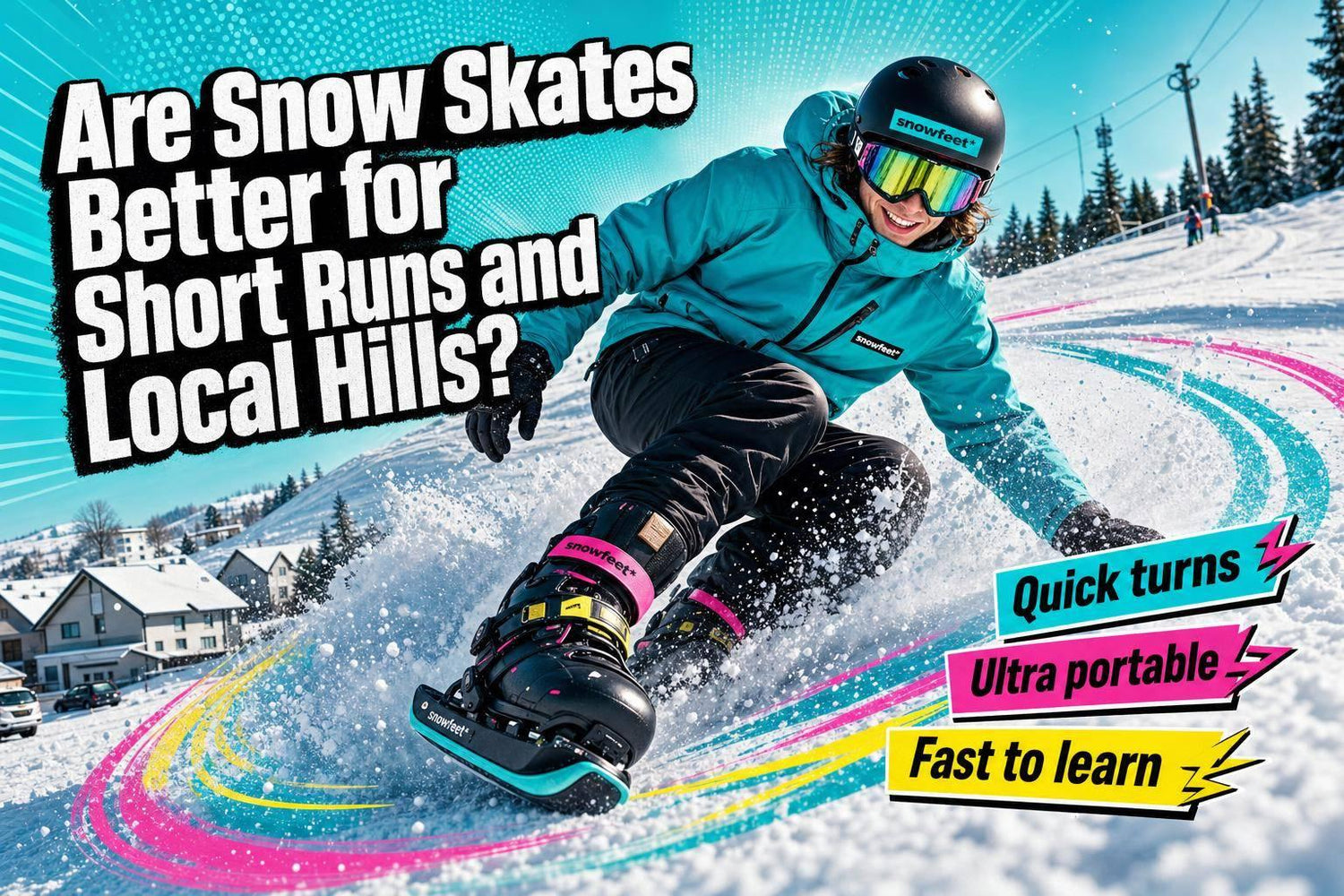
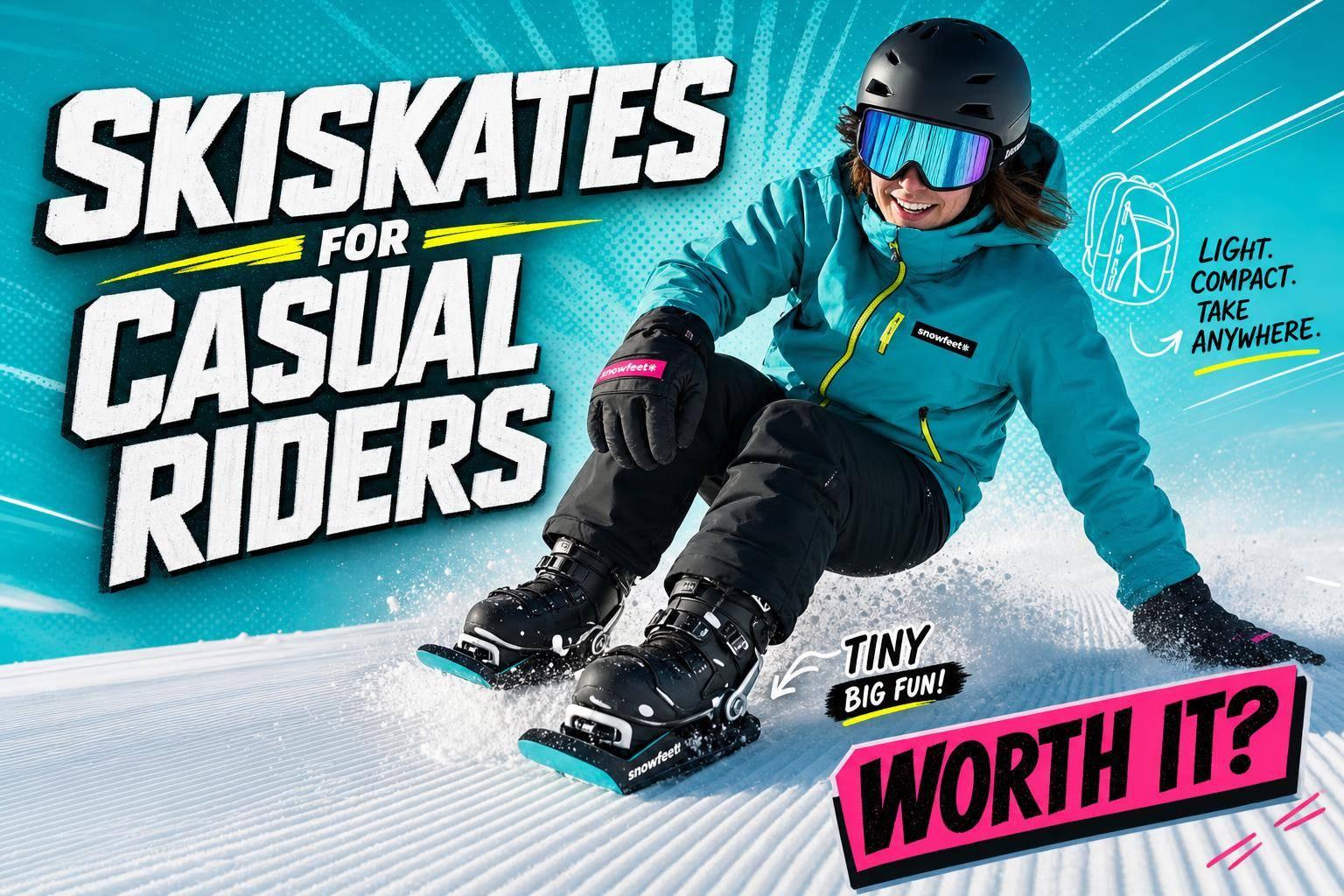
Yes - for short runs, small local hills, and quick laps, I’d pick snow skates over long skis or a snowboard most of the time.
If you ride on groomed snow and don’t need high-speed stability, compact Snowfeet* gear is often the better match. It’s lighter, easier to carry, easier to turn in tight spaces, and simpler for many new riders to get started with. The main tradeoff? Once snow gets deep, chopped up, or the run gets long, full-size gear starts to make more sense.
Here’s the short version:
- Best for local hills: Snowfeet* 38 cm, 44 cm, 50 cm, and 65 cm
- Best for backpack carry: 38 cm and 44 cm
- Best for first-timers: 38 cm and 50 cm
- Best if you want more support: 65 cm
- Best for long, fast, or soft-snow days: skis or snowboards
A few takeaways stood out to me:
- The shortest models work well for low-speed control
- Compact gear is a lot easier to haul for a 30-minute hill session
- Models that use winter shoes keep setup simple
- The 65 cm option gives more stability than the shorter pairs
- Long skis and boards still win in powder, rough snow, and longer descents
The Best Skates for Slopes: Snowfeet* 44 CM
Quick Comparison
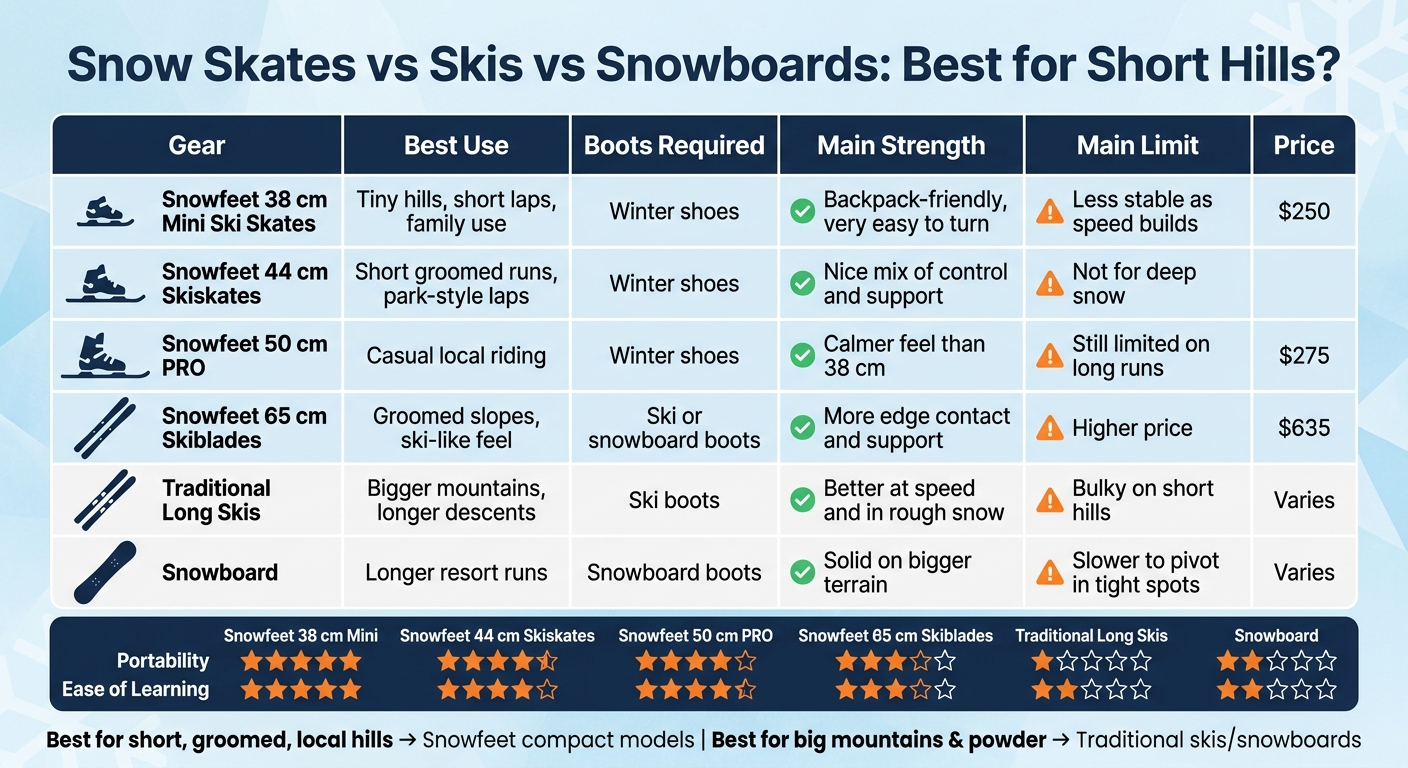
Snow Skates vs Skis vs Snowboards: Which Is Best for Short Hills?
| Gear | Best Use | Boots | Main Strength | Main Limit |
|---|---|---|---|---|
| Snowfeet* 38 cm | Tiny hills, short laps, family use | Winter shoes | Very easy to carry and turn | Less stable as speed builds |
| Snowfeet* 44 cm | Short groomed runs, park-style laps | Winter shoes | Nice mix of control and support | Not for deep snow |
| Snowfeet* 50 cm | Casual local riding | Winter shoes | Calmer feel than 38 cm | Still limited on long runs |
| Snowfeet* 65 cm | Groomed slopes, riders who want more ski-like feel | Ski or snowboard boots | More edge contact and support | Higher price at $635 |
| Long skis | Bigger mountains, longer descents | Ski boots | Better at speed and in rough snow | Bulkier on short hills |
| Snowboard | Longer resort runs | Snowboard boots | Solid on bigger terrain | Slower to pivot in tight spots |
So, if your hill is short, packed, and close to home, compact snow skates are often the smart pick. They’re a lot like grabbing a BMX for the neighborhood instead of hauling out a downhill bike for the driveway :)
1. Snowfeet* Mini Ski Skates 38 cm
The 38 cm model shows where snow skates shine: short hills, easy laps, and laid-back sessions. At just 38 cm long, the Snowfeet* Mini Ski Skates are built for a neighborhood hill or a short beginner run at a local ski area. They start at $250 and clip onto regular winter boots with adjustable bindings. So, you can skip the ski boots. Nice bonus.
Low-Speed Control
Because they're so short, these skates react fast at low to moderate speeds. You turn with small hip and knee movements, which feels closer to skating than skiing.
That makes a big difference on busy or narrow slopes. It's easier to:
- weave around people
- stop fast
- change direction without a lot of effort
The metal edges give you enough bite on packed snow to stay in control, especially if you keep your knees a bit bent and your weight centered. The whole thing feels playful, not like you're studying for a ski exam. That said, this kind of control works best on packed snow, so where you ride matters.
Carry-and-Go Portability
These fit in a backpack. That's the big win.
You can carry them to a local hill, bring them on transit, or toss them in the car without playing trunk Tetris. Among all Snowfeet* models, the 38 cm version is the smallest and lightest. It's easier to haul around than the 50 cm PRO or the 65 cm Skiblades.
For families, that's a pretty sweet deal. Carrying several pairs doesn't turn into a workout before the fun starts. For short outings, this grab-and-go feel is hard to beat compared with skis or a snowboard.
Terrain Fit
These work best on groomed, packed snow. Think beginner and intermediate runs at smaller U.S. ski areas, short rope-tow hills, and local park slopes.
They're not built for deep powder or steep terrain. A small community hill or a city sledding spot is much more their speed. On short runs and local hills, this compact setup often makes more sense than full-length skis or a snowboard.
Learning Curve
Snowfeet* says most riders can learn fast, and on gentle terrain, that checks out. The movement feels familiar for skaters and approachable for beginners, so first-timers can usually slide, slow down, and make basic turns within a few runs.
The 38 cm size is the easiest starting point for new riders on mellow slopes. Start on gentle terrain and get comfortable with stopping before you let speed build.
If you want a bit more stability and still want something easy to carry, the 50 cm PRO is the next step.
2. Snowfeet* PRO 50 cm
If the 38 cm version feels a bit twitchy, the Snowfeet* PRO 50 cm gives you more balance without losing that small, easy-to-carry shape. At $275, it sits right in the middle between the 38 cm Mini Ski Skates and the 65 cm Skiblades.
Low-Speed Control
That extra length gives you more edge on the snow. In plain English, that means better grip and a steadier feel when you're moving slow. You can still pivot, skid, and change direction fast, but the PRO 50 cm feels calmer than the shorter skates, especially on hard-packed snow or icy patches.
That steadier ride is a nice plus for beginners and casual riders on green runs. It doesn't feel sluggish. It just feels less jumpy.
Carry-and-Go Portability
The PRO 50 cm stays compact, so it's easy to toss in most car trunks or carry over one shoulder. That's a big deal on short hills where you're hiking back up after each run. You can keep them strapped to your boots the whole time, which makes lap-after-lap riding a lot less of a hassle than messing with full-size skis.
Terrain Fit
These work best on groomed or packed snow at local hills and beginner areas. On longer, steeper, or icier runs, they give up some stability, and that's where full-size skis and snowboards still have the edge.
For short sessions on mellow terrain, though, the PRO 50 cm does its job well:
- Easy to carry
- Fast to set up
- Stable enough for quick laps on neighborhood hills and small ski areas
Learning Curve
The PRO 50 cm is a good starting point if the 38 cm model felt too reactive. The longer running length gives you more fore-aft stability, so beginners tend to feel more planted. You still get that playful ride, but with a bit more control. Kind of like going from a super twitchy go-kart to one that tracks straighter.
If you come from ice skating, inline skating, or hockey, there's a good chance you'll get the hang of it fast. It also straps onto regular winter boots, which keeps setup simple and quick. And if you want a more locked-in feel while staying in this compact lane, the 44 cm Skiskates are the next step over.
3. Snowfeet* Skiskates 44 cm
The Snowfeet* Skiskates 44 cm sit right in the middle. They give you more stability than the 38 cm Mini Ski Skates, but they’re still small enough for fast laps on local hills. If the 38 cm model feels a bit too twitchy and full-length skis feel like too much gear, this is the happy middle ground.
Low-Speed Control
The 44 cm length, parabolic shape, narrow waist, and metal edges help them react fast at low speeds. So, turns come quicker, stops feel easier, and tight terrain is less of a hassle than it is on long skis or a snowboard. That’s a big deal when you’re making short, playful laps and don’t want to fight your gear.
Carry-and-Go Portability
At 44 cm, they slide into a backpack with little fuss and are much easier to carry than full-length skis. Within the compact Snowfeet* lineup, this model lands in a nice middle zone: more packable than the 65 cm Skiblades, but with more running length than the 38 cm Mini Ski Skates.
Terrain Fit
These work best on groomed slopes, snow parks, moguls, and narrow trails. That’s where their short length and quick feel shine. Deep powder and long, fast runs are still better territory for skis or snowboards. Different tool, different job.
Learning Curve
If you’ve skated or rollerbladed before, you may get the hang of them pretty fast. The smaller size also feels less intimidating than full-size skis, which helps a lot on day one. That makes them a good pick for beginners, casual riders, and families sticking to shorter terrain.
If you want a bit more support and speed, the 65 cm Skiblades are the next step up.
sbb-itb-17ade95
4. Snowfeet* Skiblades 65 cm
The Snowfeet* Skiblades 65 cm are the most stable compact pick in the Snowfeet* lineup. That extra length gives you more edge contact and a steadier feel than the 38–50 cm models. So if you want something that feels a bit more like a ski, but you’re not ready to jump to full-size gear, this is the one to look at.
At $635, they sit at the top of the compact range. You’re paying for more stability while still keeping that quick, playful Snowfeet* feel. Think of them as the step-up option for riders who want more control without hauling around full-length skis.
Low-Speed Control
The 65 cm length gives you better edge grip and more stability at low speeds than the 38–50 cm models, which makes tight turns easier than on full-length skis. On short hills and crowded beginner areas, you can make quick, short-radius turns and change direction without much fuss.
One big plus: each foot moves on its own. That means you can skid, step, and pivot in ways a snowboard just can’t. On busy slopes, that feels pretty handy.
Carry-and-Go Portability
Even at 65 cm, they’re still short enough to toss in a car trunk, carry with one hand, or strap to a backpack without the awkward overhang you get with full skis. That makes quick laps at a nearby hill a lot easier.
Families hauling gear for a few kids will notice this right away. And for kids or older adults, the lighter setup is simply easier to carry and handle. Less wrestling with gear, more time on snow. Hard to argue with that :)
Terrain Fit
These work best on short, groomed runs, small resort slopes, and neighborhood hills with moderate inclines. That’s where they feel fun, quick, and easy to manage.
They’re not the top pick for very icy, deeply rutted, or ungroomed terrain. Since they’re shorter, they can sink more than full-length skis in rougher snow. In other words, smooth and mellow terrain is their happy place.
Learning Curve
The 65 cm length is beginner-friendly, but it still has enough stability for riders who want to push a bit more. If you’ve ever ice skated or rollerbladed, the stance and movement will feel familiar pretty fast. That first run may feel a little odd, then it tends to click.
Casual riders and older adults may also like that a shorter setup takes less effort to control on local hills. For longer and faster runs, though, skis and snowboards still do a different job.
5. Traditional Long Skis and Snowboards
Compared with the compact Snowfeet* models above, traditional skis and snowboards make more sense when speed, stability, and bigger terrain are the main goal. But there’s a catch: they give up convenience for that extra speed. On short neighborhood hills and small local slopes, that trade can feel pretty hard to justify.
Low-Speed Control
On short, tight runs, long skis and snowboards don’t turn as fast as Snowfeet* gear, so they feel less nimble when space is tight. That’s a plain downside when you’re doing quick laps on a neighborhood hill or moving through a crowded beginner slope.
In that kind of setup, the 38 cm, 44 cm, or 50 cm Snowfeet* models can simply get out of the way faster. Less gear. Less fuss. More room to react.
Carry-and-Go Portability
Traditional gear is also more of a hassle to move around. Compared with compact Snowfeet* products, long skis are harder to carry and take up more space in the car. And yeah, you feel that before the session even starts.
For a quick trip to a local hill, that bulk can be annoying:
- More awkward to carry from the parking lot
- Harder to fit in small cars
- Less convenient for short, casual sessions
Terrain Fit
Traditional skis and snowboards still do better in soft, deep, or chopped snow and on flat exits, where short gear can lose momentum. So if your local hill gets rough or has a long flat section at the bottom, traditional gear can still be the better pick.
That’s the trade in a nutshell. On short hills, the gap shows up most in control, carrying ease, and day-to-day simplicity.
Learning Curve
Once learned, traditional skis and snowboards feel stable and less leg-intensive. But on a short local hill, that same length can make quick direction changes and easygoing practice feel less convenient than compact Snowfeet* gear like the 44 cm Skiskates or 65 cm Skiblades.
So, on short terrain, the big deciding points are pretty simple: control, portability, and how easy the gear feels while you learn.
Control, Portability, and Learning on Short Terrain
After you line up each model side by side, the takeaway is pretty simple: short Snowfeet* comes out ahead on control, portability, and ease of use for short terrain. On short downhill runs, neighborhood hills, and small local ski areas, that’s where Snowfeet* shines.
Short Snowfeet* models turn fast at low speed. That makes them easier to steer on narrow or crowded hills than long skis or boards. On a small slope, that matters a lot. You don’t want gear that feels like a bus in a grocery store parking lot.
Portability is another big win. The 38 cm model fits in a backpack, and the 44 cm and 65 cm versions are still much easier to carry than full-size skis.
There’s also the learning side of it. Shorter gear is easier to balance, turn, and recover on day one. That helps beginners, older adults, and families who want to get moving without a long adjustment period.
Here’s how the options compare across the four key points:
| Criteria | Snowfeet* 38/50 cm | Snowfeet* 44/65 cm | Traditional Skis/Boards |
|---|---|---|---|
| Low-Speed Control | Exceptional; easy to stop and steer | High; very maneuverable | Moderate; needs more space to turn |
| Portability | Fits in a backpack | Easy to carry | Bulky; requires roof rack or large bag |
| Learning Curve | Very fast; intuitive for skaters | Fast; forgiving | Moderate to steep |
| Best Terrain Fit | Local hills, parks, groomed trails | Groomed slopes, snow parks | Big mountains, deep powder |
The tradeoff is pretty clear too: short gear does best on packed snow, while long skis still have the edge in soft or deep snow. Those upsides and limits set up the pros and cons section next.
Pros and Cons
Here’s the trade-off in plain English: compact Snowfeet* shines on short local terrain, while traditional gear starts to win when runs get longer and speeds climb.
On short downhill runs, neighborhood sledding hills, and small local ski areas, the 38 cm, 44 cm, 50 cm, and 65 cm Snowfeet* models are usually the better match. If your plan is quick laps close to home, the shorter Snowfeet* options make a lot of sense.
The 38 cm Mini Ski Skates strap onto regular winter boots and fit in a backpack. That’s a big deal. You can toss them in the car, hike up a small hill, and get a session in without turning it into an all-day mission. For beginners, families, and older adults, that kind of ease can make snow days feel a lot more doable.
Traditional skis and snowboards do better once speed and distance go up. They’re built for longer, faster days on bigger mountains. So the split is pretty simple: compact gear feels more playful and convenient on short terrain, while traditional gear is made for bigger runs and more speed.
The table below sums up the main differences.
| Gear | Stability | Maneuverability | Portability | Quick-Session Use | Fit for Local U.S. Hills |
|---|---|---|---|---|---|
| Snowfeet* Mini Ski Skates 38 cm | Comfortable at low-to-moderate speeds | Excellent; quick pivots and short turns | Backpack-friendly | Excellent | Excellent |
| Snowfeet* PRO 50 cm | Stable for short runs and casual riding | Very nimble | Easy to carry | Strong | Excellent |
| Snowfeet* Skiskates 44 cm | Good on short, lower-speed terrain | Highly maneuverable | Easy to carry | Best for short, frequent sessions | Strong |
| Snowfeet* Skiblades 65 cm | More stable than shorter models; less than long skis at speed | Easy to turn and carve | Compact | Good for repeat laps | Very good |
| Traditional long skis | Superior straight-line stability on long, fast, or steep runs | Good, but need more space to turn | Bulky | Better for planned full-day trips | Better for larger resorts |
| Traditional snowboards | Better on bigger terrain and longer descents | Good once moving; less quick to pivot | Bulky | Better for planned resort days | Better for larger hills |
That leaves one question: which setup is the best overall pick for your kind of local terrain?
Conclusion: Are Snow Skates the Right Call for Short Runs and Local Hills?
For neighborhood sledding hills, short downhill runs, or small local ski areas, Snowfeet* products make more sense. They’re easier to carry, easier to control, and easier to learn on when the terrain is short and compact.
Here’s the simple way to pick the right one.
| Rider Type | Best Snowfeet* Pick | Why |
|---|---|---|
| Beginners and families | 38 cm Mini Ski Skates | Easy setup, works with regular winter boots |
| Casual adults | 50 cm PRO | More glide, still easy to carry |
| Frequent short-hill riders | 44 cm Skiskates | Fast turns, skate-style feel |
| Riders wanting to carve | 65 cm Skiblades | More carve feel on groomed snow |
Long skis and snowboards still have their place on longer, faster, or softer runs. But on short terrain, all that extra length can feel like bringing a ladder to a snowball fight.
On short runs, control and portability matter more than top speed. If your local hill is short, close to home, and groomed, Snowfeet* is the better fit.
FAQs
Are snow skates safe for beginners?
Yes - snow skates are generally safe for beginners if you take the right precautions.
A helmet, wrist guards, knee pads, and elbow pads can help lower the risk of injury. That stuff isn’t just for kids or first-timers, either. Falling happens, and a bit of padding can save you from a rough day.
Good fit matters too. Well-fitting skates are easier to control, which can help you feel steadier from the start. Lessons can help, and so can practicing how to fall safely before you pick up speed. It also helps to stay aware of your surroundings so you don’t get caught off guard by other riders, icy patches, or uneven snow.
Snowfeet also puts a lot of focus on ease of use and control. For beginners, that can make the learning curve feel a lot less steep and a lot more fun :)
Which Snowfeet* size should I choose?
Choose based on your boot size. Snowfeet 44 cm* fits ski boots in EU 36–49 (US 4.5–14.5) and snowboard boots in EU 38–49 (US 6–14.5), so it works for most riders.
If your boots are outside that range, Snowfeet 50 cm* or 65 cm might be a better match. For most people, though, 44 cm hits the sweet spot between control, portability, and ease of use.
Can I use snow skates in powder?
The search results you provided don’t answer this question.
They do not include information about using snow skates in powder.











Leave a comment
This site is protected by hCaptcha and the hCaptcha Privacy Policy and Terms of Service apply.