



















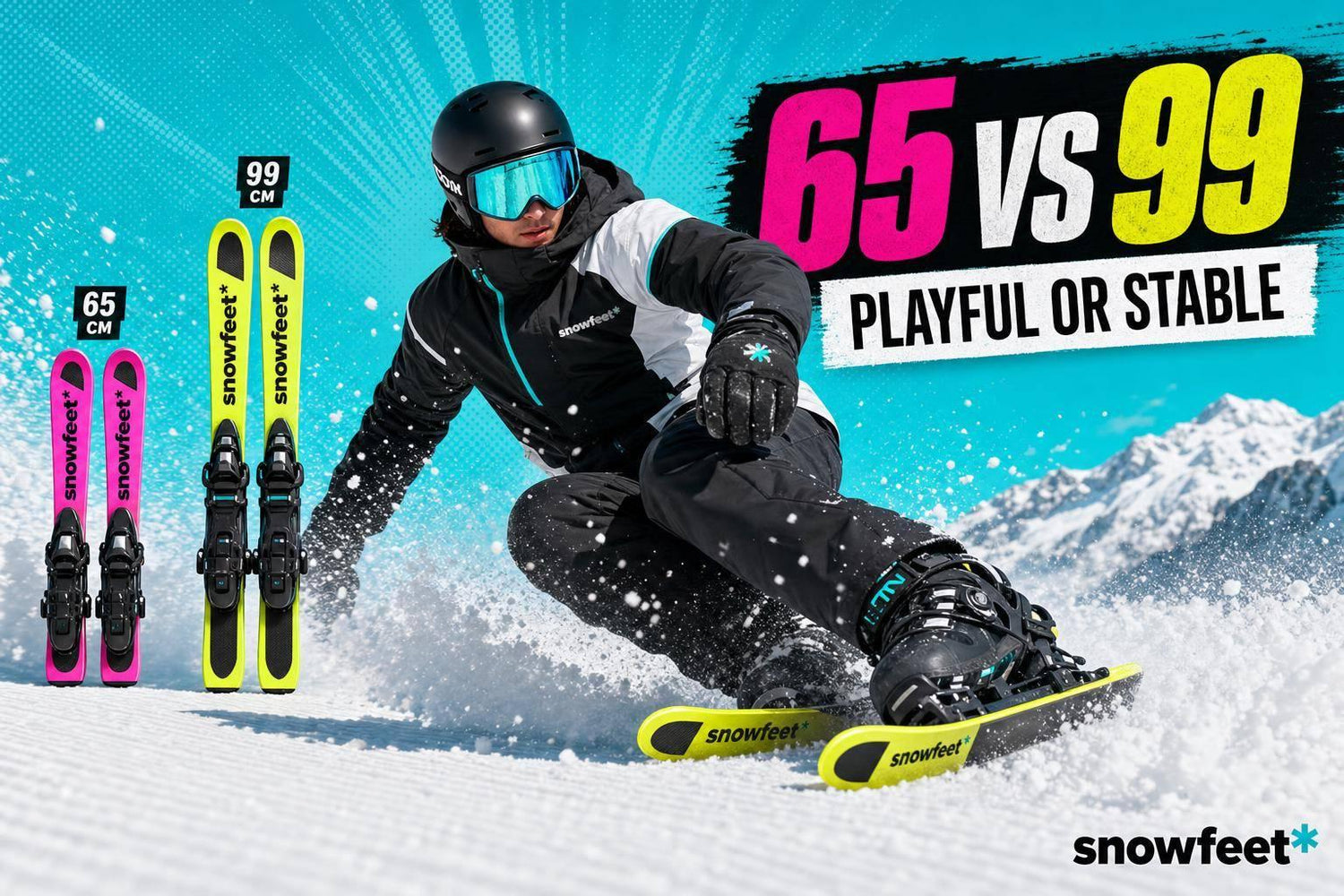
If you want the short answer, here it is: I’d pick 65 cm for easy learning, tight turns, park laps, and travel. I’d pick 99 cm for calmer resort runs, better grip, and more comfort once speed builds.
That’s the whole call in one line. The gap is only 34 cm, but on snow it changes a lot.
Here’s how I’d break it down:
-
Choose 65 cm if you want:
- the easiest first day
- a skate-like feel
- tight, snappy turns
- lighter carry weight
- the lower price at $590
-
Choose 99 cm if you want:
- more stability on groomers
- smoother carving
- better feel on longer runs
- more support for taller or heavier riders
- more range for resort days at $690
One stat jumps out fast: the 65 cm has a 4 m turn radius. That means it wants to pivot fast and play around. On the flip side, the article notes the 65 cm can start to feel chattery around 20–25 mph. That’s where the 99 cm starts to make more sense.
So, if you ski short local hills or spend time in the park, I’d lean 65 cm. If you ski full resort days in places like Colorado or Utah, I’d lean 99 cm. Simple stuff. No ski-shop poetry needed :)
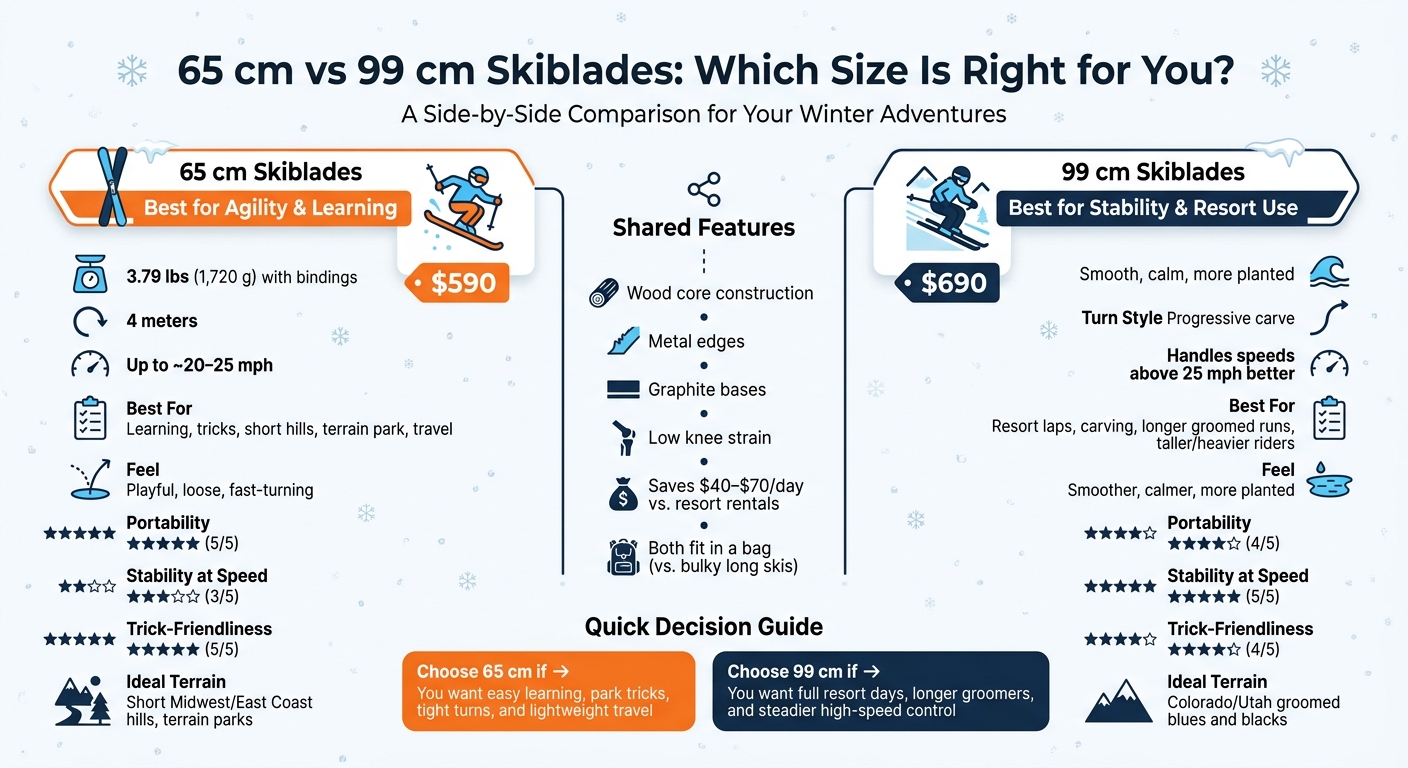
65 cm vs 99 cm Skiblades: Side-by-Side Comparison
ULTIMATE SHORT SKIS 🔥 Snowfeet Skiblades 99 cm | Unboxing & First Look
Quick Comparison
| Criteria | 65 cm Skiblades | 99 cm Skiblades |
|---|---|---|
| Best for | Learning, tricks, short hills | Resort laps, carving, longer runs |
| Feel | Playful, loose, fast-turning | Smoother, calmer, more planted |
| Turning | Very tight | More gradual |
| Stability | Lower at higher speed | Better at higher speed |
| Park use | Best pick | Solid, but less nimble |
| Portability | Best | Still easy to carry |
| Price | $590 | $690 |
If I were helping a friend in the shop, I’d say this: 65 cm is more fun for messing around; 99 cm is better if you want a short ski that feels closer to a full resort tool.
How 65 cm and 99 cm Skiblades Ride Differently
What Snowfeet* Skiblades Are
Snowfeet* Skiblades are short, compact skis with a wood core, metal edges, and a curved sidecut. The 65 cm pair weighs 3.79 lbs with bindings, or about 1,720 g. You feel that low weight right away on lifts, in parking lots, and any time you have to carry them around.
That small build isn’t just nice off the snow. It also changes how they ride. And that’s where the gap between the 65 cm and 99 cm starts to show.
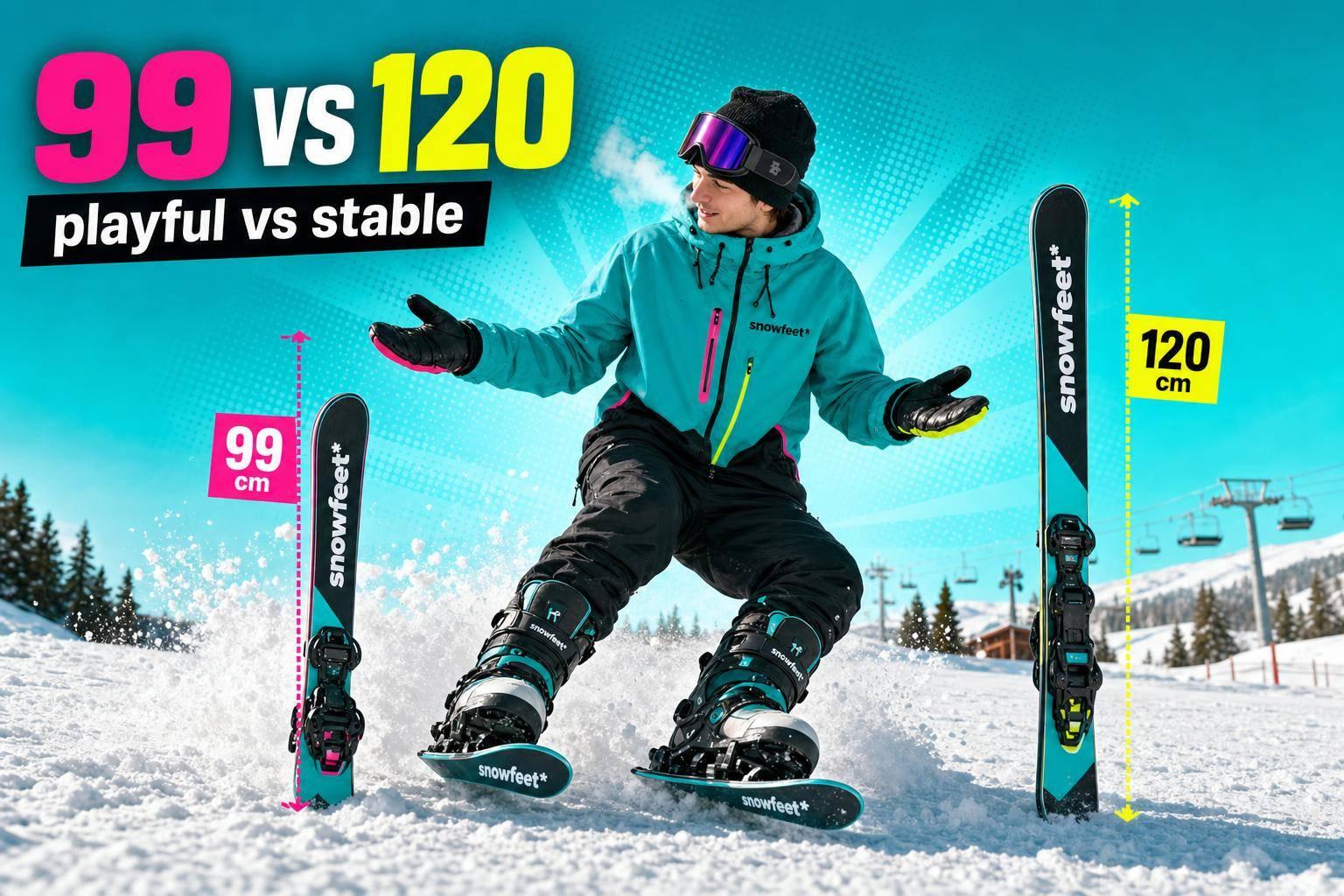
The 65 cm is the most agile option. The 99 cm still feels short and easy to handle, but it adds more calm and more stability when speed picks up.
How Length Affects Turning, Speed, and Control
This is the part most buyers notice first on snow: fast pivots versus a calmer ride at speed. Ski length changes how fast the ski hooks into a turn and how steady it feels once you start moving faster.
The 65 cm has a 4-meter turning radius, so it snaps into turns fast and feels quick in tight spots, crowded areas, or narrow terrain. It reacts almost right now. That’s a big part of the fun.
The 99 cm gives up some of that instant response. In return, you get a longer platform underfoot, which helps the ski feel steadier in a straight line. On longer groomed runs, it tracks more smoothly and feels less twitchy. It’s still easy to turn. Just a bit more measured. For a lot of riders, that’s a good thing once they move past slow first runs and start skiing with more speed.
As Brad Tolin, a customer, noted:
"Only trade-off is at higher speeds, where longer skis still feel more stable - but for overall fun and maneuverability, these are hard to beat."
So, the split is pretty simple. The 65 cm leans toward tight, playful riding. The 99 cm leans toward longer, faster resort laps without giving up that short-ski feel.
sbb-itb-17ade95
65 cm vs 99 cm Skiblades: Compared by Riding Situation
Here’s how each length tends to feel in the situations most buyers care about.
65 cm: Best for Fast Learning, Tight Turns, and Tricks
The 65 cm is the smart pick if you’re new to skiing, ride shorter local hills, or want to spend time in the park. It pivots fast, feels a bit like skating, and makes short hills and tight spots feel less intimidating.
As Tripp said:
"I purchased the snowfeet 65cm... They maneuver as easily as skates, but are surprisingly fast down the mountain. The most fun was weaving through the woods." - Tripp
In the park, the lighter swing makes 180s and 360s easier to start and land. Side hits, small jumps, and switch transitions also feel a bit more forgiving.
There is a trade-off, though. Once you get above about 20–25 mph, the 65 cm can start to feel chattery on chopped-up snow. On icy New England blues or firmer Rocky Mountain groomers, the tails may wash out if you push too hard. This size is built for fun, control, and quick moves, not long, fast descents.
If your runs start getting longer and your speed creeps up, the 99 cm usually becomes the better fit.
99 cm: Best for Stability, Carving, and Longer Resort Runs
The 99 cm is the better match for longer resort laps, smoother carving, and more speed. The added length gives you more edge contact underfoot, which helps the ski feel calmer in a carve and steadier when the snow gets chopped up later in the day.
"I had a lot of fun with the 99s. They are easier to turn than skis." - MindySue
On longer groomed blue runs at places in Colorado or Utah, the 99 cm handles speed shifts and rough patches with more calm. It still turns fast enough for quick line changes, but it feels better on longer groomers than the 65 cm. It likes smoother, more deliberate turns instead of constant snap-pivot moves. For taller or heavier riders, the extra length spreads weight more evenly and feels more planted when speed picks up.
It’s still a short ski, by the way. You’re not losing the fun factor or the easy packing. You’re just getting a bit more range.
Side-by-Side Decision Tables for Common U.S. Riding Scenarios
Use this table to match each size to how you ride.
Feature Comparison
| Feature | 65 cm | 99 cm |
|---|---|---|
| Ease of learning | Fastest - skate-like feel from the start | Easy, but needs slightly more edge commitment |
| Turning | Ultra-tight, instant pivot | Smooth, progressive carve |
| Stability at speed | Lower - can feel chattery above about 20–25 mph | Higher - more planted on long runs |
| Terrain park & tricks | Best choice - low swing weight, easy spins | Good - more stable on landings, less nimble |
| Portability | Most compact - 3.79 lbs per pair with ski bindings | Still very portable, just a bit longer |
| Choppy/variable snow | Manageable at moderate speeds | Handles it more smoothly |
Real-World U.S. Riding Scenarios
| Scenario | Better Size | Why |
|---|---|---|
| Short Midwest or East Coast community hills | 65 cm | Slower terrain, tight turns, easy to carry |
| All-day resort skiing (blue/black runs) | 99 cm | More stable at speed and less tiring on long runs |
| Family trip with mixed abilities | Both - 65 cm for cautious riders, 99 cm for confident ones | Each size fits a different comfort level |
| Dedicated terrain park day | 65 cm | Lightest, easiest for spins and freestyle play |
| Flying with limited luggage space | 65 cm | Easier to pack and less bulk in checked bags |
| Groomed Western resort runs (e.g., Colorado, Utah) | 99 cm | Better edge grip and composure on longer pitches |
Price, Value, and How Snowfeet* Compares to Long Skis
Current Pricing: $590 for 65 cm vs $690 for 99 cm
In the U.S., the 65 cm starts at $590 and the 99 cm starts at $690. The final price can change based on the binding setup and the time of year. That $100 gap matters most when you line it up with how often you ride.
Which Size Gives Better Value for Your Riding Style
Value comes down to two simple things: how often you ski and where you ski.
If you mostly ride casual sessions on local hills, the 65 cm tends to make more sense. If you ski resorts often, the 99 cm usually gives you more for your money. And if you spend a lot of time on longer blue and black runs, that extra $100 for the 99 cm is much easier to justify.
There’s also a practical angle here. Either size can help you skip U.S. resort rental costs, which often run $40 to $70 per day. So if you ride a lot, the upfront cost may pay for itself over time.
The table below shows how that value stacks up next to long skis and other short-ski options.
Markdown Table: Snowfeet* vs Long Skis and Other Short-Ski Options
| Feature | Snowfeet* 65 cm | Snowfeet* 99 cm | Long Skis | Budget Snowblades |
|---|---|---|---|---|
| Portability | Excellent - fits in a backpack | Very good - still far more compact than long skis | Poor - bulky and harder to transport | Good to very good |
| Learning curve | Fastest - skate-like feel from the start | Quick | Moderate to slow for beginners | Varies widely |
| Trick-friendliness | Best - light, easy spins and jumps | Good - more stable landings | Difficult for new park riders | Varies |
| All-day resort use | Good on small to mid-size hills | Very good on most groomed runs | Excellent for old-school all-mountain use | Varies |
| Stability at speed | Moderate - best at lower speeds | High - handles longer, faster runs well | Very high | Varies |
| Knee strain | Low | Low | Higher than skiblades | Low to moderate |
| Best user type | Casual/local hill rider, park-focused rider | Progressing resort rider | Expert, speed-focused skier | Depends on brand and length |
Long skis still win in a few clear spots: very high speeds, deep powder, and hard carving. No surprise there. That’s their home turf.
But a full long-ski setup can cost a lot more once you add skis, bindings, and boots. Snowfeet* gives casual riders a simpler setup with less hassle. Less stuff to carry. Less stuff to deal with. That matters more than people think.
As Brad Tolin put it:
"Only trade-off is at higher speeds, where longer skis still feel more stable - but for overall fun and maneuverability, these are hard to beat." - Brad Tolin
Compared with budget snowblades, Snowfeet* sits at the higher end on price. Still, that price makes sense when you look at the build: wood cores, metal edges, and graphite bases instead of the cheaper materials often used on lower-cost options.
Conclusion: Which Size Should You Choose
After looking at learning, speed, and stability, the pick is pretty simple: 65 cm is built for agility, while 99 cm leans toward stability.
"The learning curve was quick. They maneuver as easily as skates, but are surprisingly fast down the mountain." - Tripp, Manitou Springs, US
Go with 65 cm if you want something for short local hills, easy carrying, and a more playful ride. Go with 99 cm if you want full resort days, longer groomers, and a steadier feel when you pick up speed.
Both are much easier to carry and turn than regular skis. And no, neither one boxes you in as you improve. The 65 cm can grow with you as you start making quicker carves and trying small park features. The 99 cm gives you more space to lean into steeper terrain and longer days on the mountain.
So, yeah, this one’s not too hard. Choose 65 cm ($590) for portability and play. Choose 99 cm ($690) for stability and resort use.
FAQs
Which skiblade size is better for beginners?
For absolute beginners, 65 cm Snowfeet Skiblades* are the best pick. At about 26 inches long, they feel light and much easier to handle than bulky, full-size skis. That means turns come easier, and stopping feels more natural from the start.
The 99 cm model works well for beginners too. It gives you more stability on groomed runs and in light powder. But if you're just learning the basics, the 65 cm version feels more nimble and easier to control.
Are 99 cm skiblades too much for small local hills?
No. 99 cm skiblades are not too much for small local hills. They hit a nice middle ground: quick enough for tight spots, but steady when you pick up more speed.
Compared with 65 cm models, 99 cm Snowfeet* Skiblades give you better control and a smoother ride on groomed slopes, bumps, and light powder. At the same time, they still feel nimble on local terrain, which is great as your confidence starts to build.
How do I choose between park riding and all-day resort use?
It comes down to agility vs. range.
Snowfeet Skiblades 65 cm* are the better pick for terrain park laps, quick freestyle tricks, and tight, skate-like moves. They feel nimble, playful, and easy to flick around.
For all-day resort use, Snowfeet Skiblades 99 cm* are the better fit. They give you more stability and control on groomed runs, mixed terrain, and light powder. The 65 cm model shines in the park, while the 99 cm gives you more support for longer all-mountain days.











Leave a comment
This site is protected by hCaptcha and the hCaptcha Privacy Policy and Terms of Service apply.