




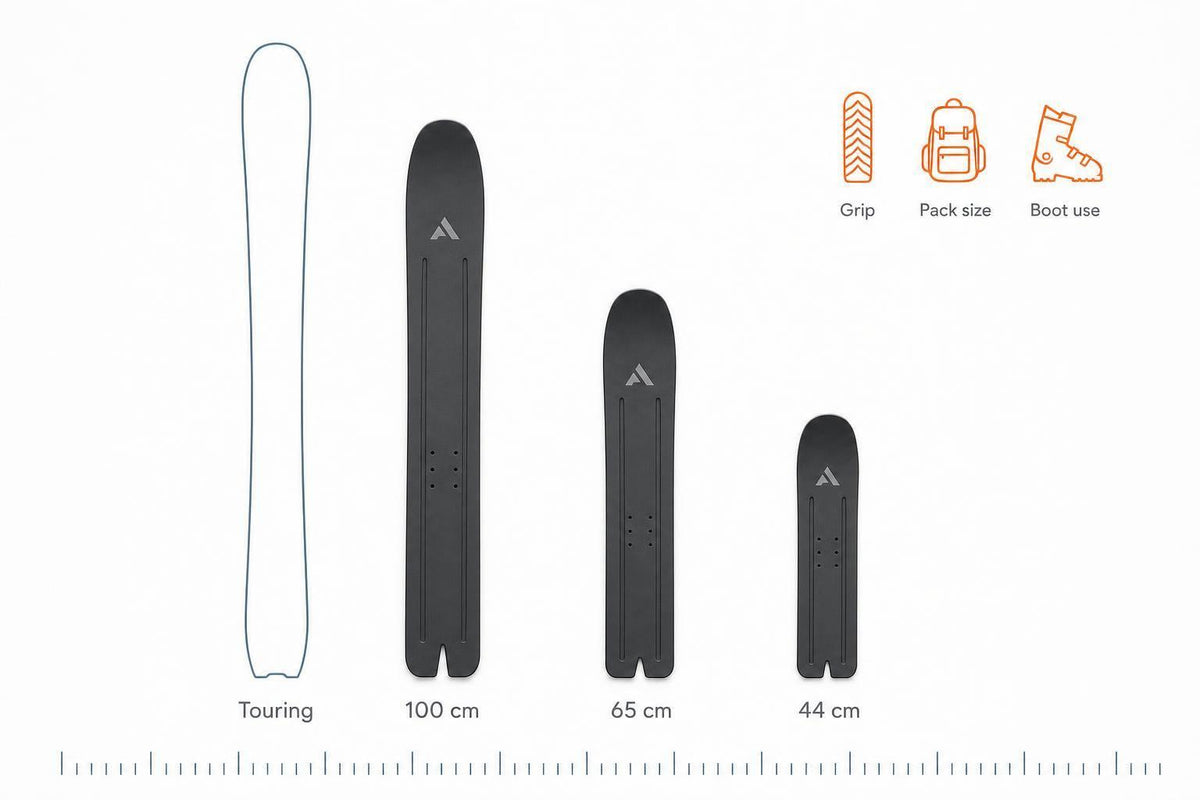
If I want the short answer: the 100 cm WALKSKI is the best fit for most splitboard approach days. It gives me the best mix of uphill help, small pack size, and snowboard-boot use. If I care more about cutting bulk, I’d look at the 65 cm Skiblades. If I want the tiniest setup possible for short, flat access, I’d pick the 44 cm Skiskates.
Here’s the whole thing in plain English:
- WALKSKI 100 cm: best all-around pick for most riders
- Skiblades 65 cm: smaller and lighter on the pack, but less grip uphill
- Skiskates 44 cm: tiny, fun, and easy to stash, but only for short, mellow access
- Standard touring skis: best for long climbs, deep snow, and firm skin tracks, but they need a second boot setup
The main tradeoff is simple:
- More uphill help = more ski on your pack
- Smaller gear = less grip, float, and stability
A few numbers tell the story fast:
- 100 cm WALKSKI: 6.9 lb per pair
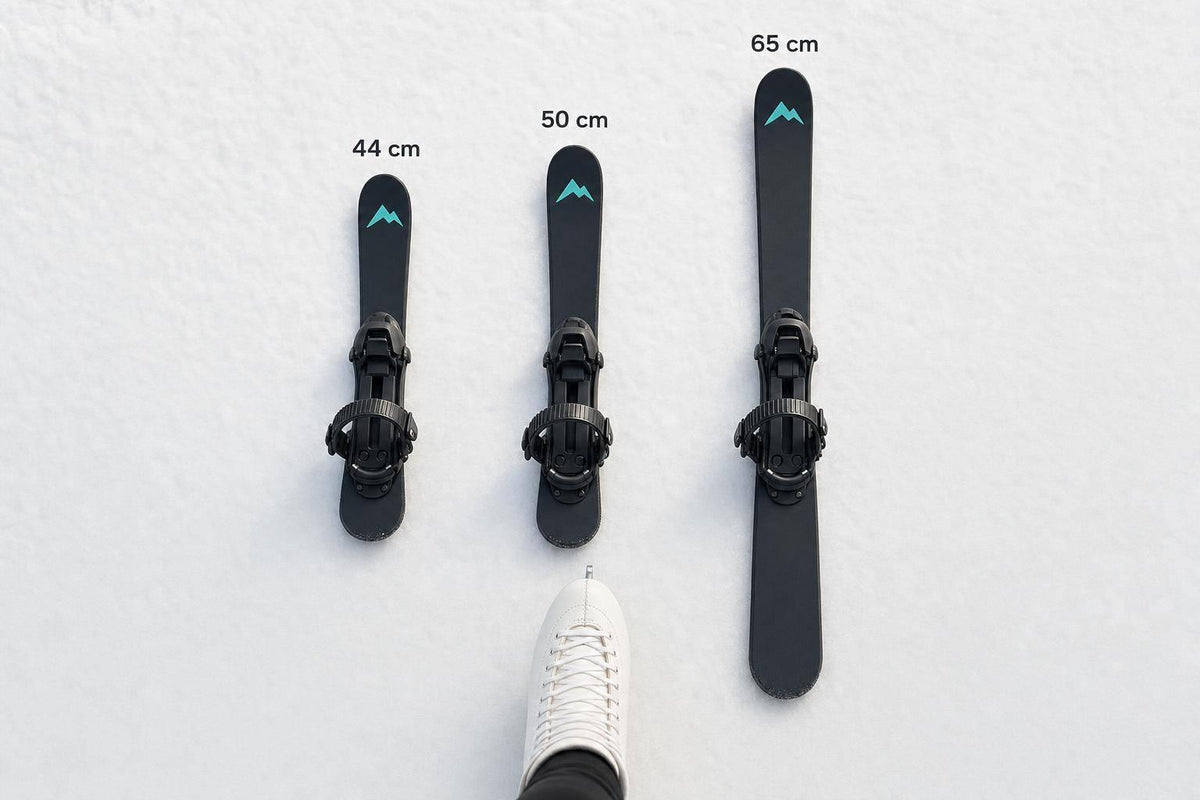
- 65 cm Skiblades: much shorter at 25.6 in
- 44 cm Skiskates: just 17.3 in
- Standard touring skis: usually 59 in+ and often 6–10 lb per pair
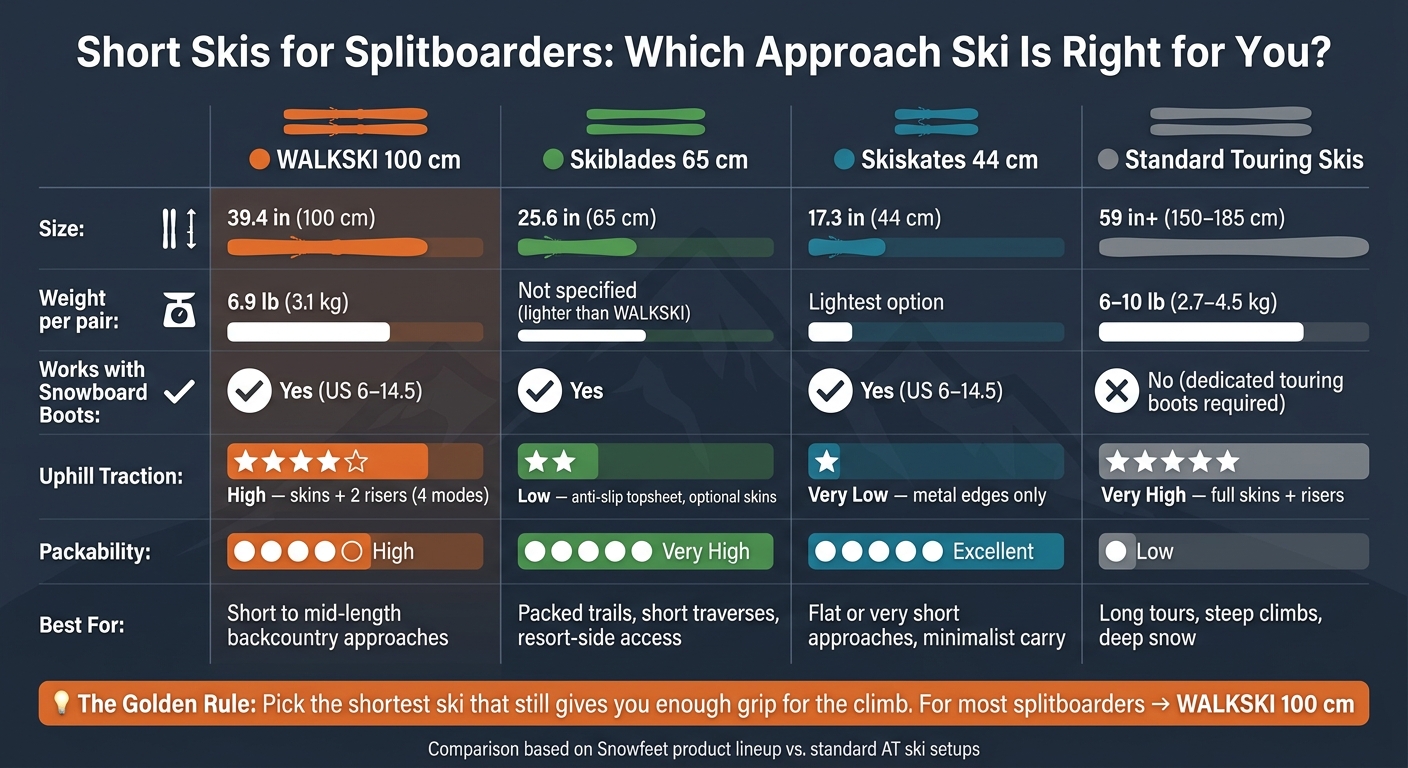
Short Skis for Splitboarders: Side-by-Side Comparison
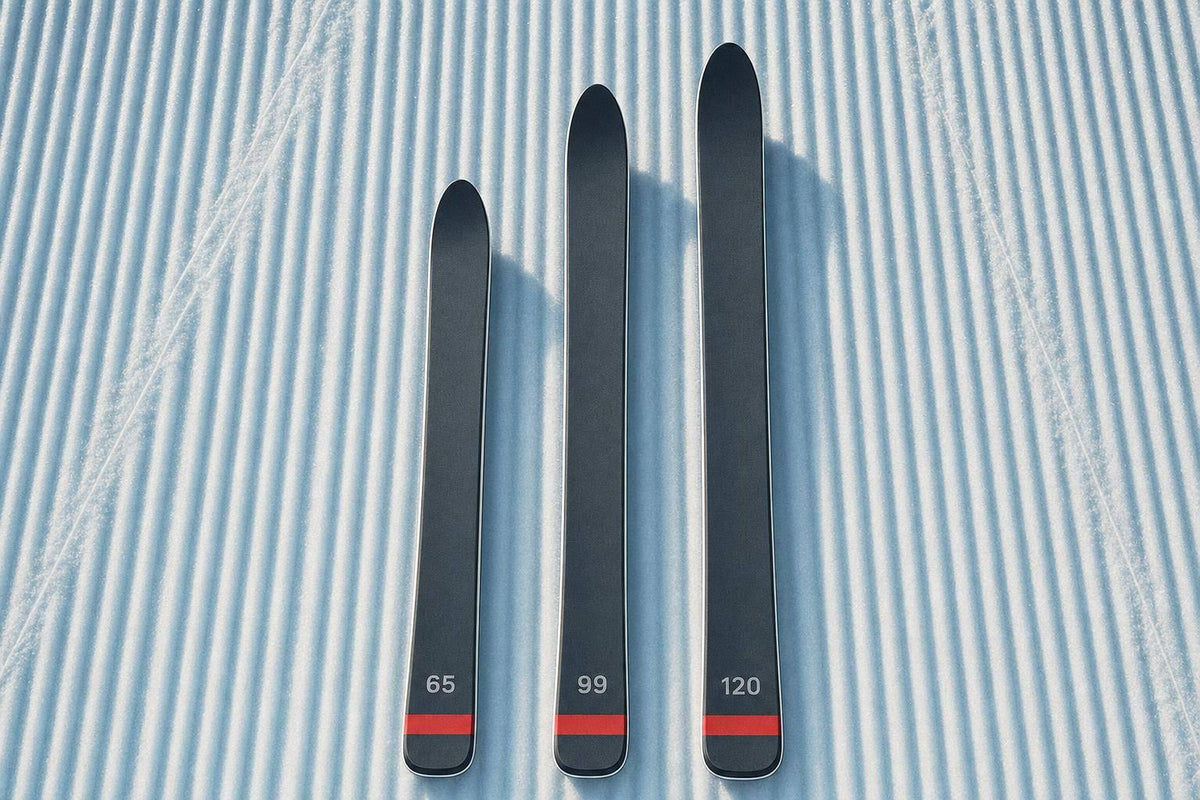
Snowboarder tries Snowfeet* | Which Snowfeet* Short Ski is the Best? | Snowblades 44, 65, 99 Review
Quick Comparison
| Option | Size | Works with snowboard boots | Uphill help | Best for |
|---|---|---|---|---|
| WALKSKI 100 cm | 39.4 in | Yes | High | Short to mid-length backcountry approaches |
| Skiblades 65 cm | 25.6 in | Yes | Low | Packed trails, short traverses, resort-side access |
| Skiskates 44 cm | 17.3 in | Yes | Very low | Flat or very short approaches |
| Touring skis | 59 in+ | No | Very high | Long tours, steep climbs, deep snow |
So, if I’m a splitboarder who wants one clean answer, it’s this: pick the shortest tool that still gives me enough grip for the climb. For most people, that lands on the WALKSKI 100 cm. It’s the middle ground that makes the most sense - without turning my pack into a yard sale :)
For a quick look at short-ski travel and uphill use, these YouTube links may help:
- Short skis / skiblades videos on YouTube
- Splitboard approach gear videos on YouTube
- Backcountry short ski skinning videos on YouTube
1. Snowfeet* WALKSKI Backcountry Touring 100 cm
At 100 cm (39.4 in), the WALKSKI hits a sweet spot for splitboarders. You get a nice mix of climbing ease, glide, and pack size in the Snowfeet lineup. Out of the three Snowfeet* options covered here, this one is the most capable. It’s a strong pick if you want solid approach-day use without hauling a full touring setup. If pack size matters more than uphill ease, the next option drops to 65 cm.
Packability
For splitboarders, the WALKSKI stays compact without losing real skinning function. The wood-core version weighs 6.9 lb (3.1 kg) per pair and comes in at about 40–50% shorter than a standard backcountry ski. That smaller size makes a big difference when you’re strapping gear to a pack.
It rides well on a splitboard pack and stays pretty easy to manage on forest roads, low-angle glades, and ridgelines. In steep bootpack terrain, though, the fixed length can snag on branches or rocks. It’s one of those little mountain annoyances that shows up fast. Keep the load centered and tight to your back, and you’ll have better balance on kick turns and steep skin tracks.
Boot Compatibility
The WALKSKI works with snowboard boots in US sizes 6–14.5. That means you can skin up and ride down in the same boots. No swapping. No extra footwear hanging off your pack. For long approaches, that can make the day a lot more comfortable and cut down on the gear you need to carry.
Traction & Skin Use
The removable skins and four modes - Walk, Ski, Climb 1, and Climb 2 - help the WALKSKI move well on firm, moderate snow. The shorter length does ask a bit more from you on icy skin tracks and in deep powder. You’ve got to pick your line with more care.
For splitboarders, this is the part that makes the WALKSKI make sense. The skin-and-riser setup gives you the uphill help you need, then you switch back to your board for the ride down.
Uphill/Downhill Balance
The WALKSKI is made for the approach first. On the downhill, it does fine on low-angle runouts, but full touring skis feel steadier once speed picks up. For splitboarders, that tradeoff usually isn’t a big deal, since the actual descent happens on the board anyway.
As Jan from Snowfeet* puts it:
"The 100cm are a great middle ground between freedom of movement and hard stability."
That tradeoff tends to matter less for splitboarders than for skiers. And that’s part of why the shorter 65 cm option exists. If you want something smaller on your pack, the 65 cm Skiblades give you that, though you give up some uphill ease in return.
2. Snowfeet* Skiblades 65 cm
At 65 cm (25.6 in), the Skiblades sit in a nice middle spot. They’re more useful than a tiny emergency option, but they’re still much easier to carry than a full setup. If the 100 cm WALKSKI feels like too much ski for your needs, this version trims things down for shorter approach days.
Packability
These strap onto most splitboard packs without much fuss. They also carry a lot smaller than the WALKSKI, which is a big plus when you want something low-bulk for short, low-commitment approaches.
Boot Compatibility
The Skiblades work with snowboard boots, winter boots, and ski boots. For splitboarders, though, snowboard boots make the most sense. And unlike the 44 cm Skiskates, the 65 cm Skiblades stay usable with a broader mix of boots.
Traction & Skin Use
The binding surface has an anti-slip topsheet that gives light grip on flat terrain. You can also add short or cut-to-fit skins. That said, the 65 cm running length limits traction on steep or icy climbs.
They do best on:
- packed snow
- flat traverses
- short climbs
For long climbs or icy ascents, skins or bootpacking are the better call. On steep, icy skin tracks, traction falls off fast because the running length is shorter.
Uphill/Downhill Balance
Kick turns and tight switchbacks feel easier here than on the 100 cm WALKSKI. That’s the trade: you give up some uphill efficiency, but you get easier carrying and better movement in tight spots.
Compared with the 44 cm Skiskates, the 65 cm Skiblades give you more control on the way down. They make the most sense for short traverses and resort-adjacent approaches.
If you care less about approach performance and more about pure portability, the 44 cm Skiskates trim even more bulk.
3. Snowfeet* Skiskates 44 cm
At 44 cm (17.3 in), the Skiskates are the smallest Snowfeet option and work best for short, low-commitment approaches.
Packability
This is the most compact Snowfeet model. At 44 cm, they can fit in a daypack with avalanche gear like a probe, shovel, skins, and extra layers without hogging space. That makes them a nice match for resort-side laps, drive-up terrain, and short sidecountry ski-ins.
Of course, there’s no free lunch. That short platform gives up uphill grip and stability.
Boot Compatibility
The Skiskates come in two binding versions: one for ski boots and one for snowboard boots. If you want to stay in your ride boots, go with the snowboard boot version. It fits US 6–14.5 (EU 38–49) and adjusts without tools.
Traction & Skin Use
The 44 cm length puts a clear cap on uphill traction. Skiskates do best on flat traverses, groomed access routes, and short, low-angle approaches. They’re not a good pick for icy skin tracks, firm morning approaches, or sidehills. That’s the tradeoff for going this small.
Uphill/Downhill Balance
On the way up, they’re fine for short, flat approaches, but not for long climbs or steady vertical gain. On the way down, they can feel playful and easy to turn in tight terrain. Still, they have less edge stability and less float than the 65 cm Skiblades or the 100 cm WALKSKI.
So, think of Skiskates as a small-footprint approach tool, not a touring setup.
When the approach gets longer or the snow gets firmer, standard touring skis still do the job better. For longer climbs, firmer skin tracks, and more stable descents, standard touring skis still set the mark.
sbb-itb-17ade95
4. Standard Approach and Touring Skis
Standard AT skis are the top pick for long, snowy approaches with steady climbing. Their edge comes from a longer platform, full-length skins, touring boots, and better control on the way down. Not from being easy to carry or fast to set up.
Packability
This is the weak spot for touring skis if you're a splitboarder. Most models run 150–185 cm, so they can be a pain to strap to a pack, more so during hiking sections or when you're picking through rocky, mixed terrain. They’re made for moving on snow, not for easy carry.
That’s where short skis feel like a breath of fresh air. Compact options - even the 100 cm WALKSKI - are much easier to deal with when the approach gets technical.
Boot Compatibility
Standard AT setups need touring boots and tech bindings. So now you’ve got a second boot system in the mix. That takes away the single-boot setup Snowfeet keeps.
For splitboarders, that extra boot system is the biggest downside. Plain and simple.
Traction & Skin Use
This is where touring skis flat-out shine. Full-length skins give you the best grip and glide on steep, icy skin tracks and long traverses. On long approaches with mixed snow, that full-length contact can make a big difference in security and fatigue.
If the skin track gets firm and spicy, this is the setup you want under your feet.
Uphill/Downhill Balance
Modern touring skis in the 85–95 mm waist range often weigh about 1,000–1,500 g per ski, and many efficient setups come in under about 2.8 kg (6 lb 2 oz) per pair. That’s good for long tours, where steady uphill travel and solid descent performance matter more than quick transitions.
For splitboarders, that only starts to pay off when the approach is long enough to make a full touring setup worth the hassle.
The next section shows how those differences play out on the mountain.
How Each Option Performs on the Mountain
Now that each option is defined, here’s the short version of how they stack up on snow.
Packability is the big win for short skis. And for splitboarders, that’s a huge deal. Your board, avy gear, and boots already eat up pack space. The Skiskates 44 cm are the easiest to stash or strap on. The Skiblades 65 cm are still easy to carry and won’t catch on branches or mess with your balance. Even the WALKSKI 100 cm is much easier to haul than a full touring setup.
Boot compatibility is another clear win for Snowfeet*. This is the part many splitboarders will care about most. All three Snowfeet* models use a universal boot-compatible binding system that works with snowboard boots and winter boots, so you can stay in the same boots all day. That’s simple. That’s nice. Standard AT setups still need touring boots and tech bindings.
Traction is where the tradeoff shows up. The WALKSKI 100 cm comes with removable climbing skins and two riser levels, low and high. That makes it the strongest Snowfeet* option for moderate skin tracks and firm traverses. The Skiblades 65 cm and Skiskates 44 cm lean more on their short length and edge control. That works well on packed snow and mellow approaches. But when the climb gets steep or icy, full-length skins still give standard touring skis the best grip.
Uphill and downhill balance depends on what kind of day you have in mind. For a short to moderate approach on moderate terrain, the WALKSKI hits the sweet spot. Its four integrated modes, Walk, Ski, Climb 1, and Climb 2, make transitions easy without swapping gear. That keeps things smooth when you just want to move and not fiddle with setup in the cold. Touring skis still pull ahead on long, steep, or mixed descents.
| Skiskates 44 cm | Skiblades 65 cm | WALKSKI 100 cm | Standard Touring Skis | |
|---|---|---|---|---|
| Packability | Excellent | Very High | High | Low |
| Boot Compatibility | Snowboard, winter, and ski boots | Snowboard, winter, and ski boots | Snowboard, winter, and ski boots | Dedicated Touring Boots |
| Uphill Traction | Metal edges | Metal edges | Skins + 2 risers | Full skins + risers |
| Best Terrain | Short approaches | Mellow traverses | Moderate backcountry approaches | Long tours and steep climbs |
| Downhill Stability | Playful, limited speed | Moderate | Good for short runs | Best at speed and in deeper snow |
For splitboarders, it comes down to one simple thing: how much uphill help you want versus how small you want the setup to be. Some riders will want the tiniest option possible. Others will take a bit more length if it means better grip on the climb. The next section breaks that out into straight pros and cons.
Pros and Cons of Each Option
Each option gives you something good, and each asks you to give something up. That’s the deal.
The WALKSKI 100 cm is the best all-around pick for most splitboard approach days. It has a four-mode binding system, removable climbing skins, and two riser levels, so it handles mixed terrain better than the smaller setups. It’s not just for flat approaches. The catch is weight. The wood-core version comes in at 6.9 lb per pair, and it still won’t keep up with full-length skis in deep snow or on long approaches.
The Skiblades 65 cm are all about portability. If you want less bulk on your back, this is the easy call. But that compact size comes with a cost: less climbing efficiency and less stability in soft or chopped-up snow. They make the most sense for short approaches on packed terrain.
The Skiskates 44 cm are the smallest setup of the bunch, plain and simple. On firm snow, that can be great. In soft snow, on long traverses, or in mixed conditions, their weak spots show up fast.
Standard touring skis give you the best float and the most stability at speed. No surprise there. But they also ask for dedicated boots and bindings, and they’re the toughest option to carry when your main goal is to snowboard the descent. For most splitboarders, that extra boot system is the big reason Snowfeet feels like the simpler approach-day option.
The table below sums up the tradeoffs.
| Option | Best Advantages | Biggest Drawbacks | Ideal Rider Profile |
|---|---|---|---|
| WALKSKI 100 cm | Four-mode binding; skins and risers included; works with snowboard boots | Heavier than shorter options; less float than full skis in deep snow | Splitboarders wanting reliable, versatile approach-day performance |
| Skiblades 65 cm | Very portable; quick transitions | No climbing risers; reduced stability on steep or soft terrain | Short-mission riders on packed or rolling terrain |
| Skiskates 44 cm | Most compact; lightest; easy to pack | Poor in soft snow; no skins or risers; least forgiving | Minimalists on firm, short approaches only |
| Standard Touring Skis | Best flotation; highest stability at speed | Expensive; bulky; requires specialized boots | Long tours and deep backcountry expeditions |
Conclusion
The Snowfeet* WALKSKI Backcountry Touring 100 cm is the best pick for most splitboard approach days. It hits the sweet spot between uphill use, small pack size, and snowboard boot fit. You also get climbing skins included, and you don’t need to switch out of your snowboard boots.
If you want something with less bulk than the WALKSKI, the Skiblades 65 cm are the next move. They make more sense for short approaches and resort-accessed laps.
If pack size is your top concern, go with the Skiskates 44 cm. They’re the smallest of the bunch, fit into a daypack, and work best for short carries from the car to the trailhead on travel days when space is tight.
Standard touring skis still come out ahead on long climbs, deep snow, and icy skin tracks. That’s the tradeoff. Short skis lean toward convenience. Full touring skis give you better backcountry performance.
So, pick short skis if you want compact, low-commitment access and want to stay in the same boots while carrying less gear. Pick touring skis for big backcountry missions and long, tough days out.
FAQs
How do I choose between 100 cm, 65 cm, and 44 cm?
Choose based on what you want to do that day.
- 100 cm WALKSKI: best if you want to hike up and ski down. It’s the only option with climbing skins and a four-mode touring binding system.
- 65 cm Skiblades: best if you want a balance of easy turning and solid edge hold for carving or park laps.
- 44 cm Skiskates: best if small size matters most, especially for quick, playful runs on groomed terrain.
Are short skis enough for steep or icy approaches?
Generally, no. Short skis aren’t the best pick for steep, icy approaches.
The Snowfeet WALKSKI 100 cm comes with dual-height risers and climbing skins, so it can handle moderate slopes just fine. But once the terrain gets steeper, it starts to lose grip and uphill efficiency. That’s the trade-off with shorter skis: they’re light and handy, but they don’t hang on as well when things get firm and slick.
On icy sections, trimming the skins so they expose 5 to 7 mm of metal edge can help with traction. It gives the edge more bite, which can make a rough patch feel a bit less sketchy.
For long stretches of steep, icy, or technical backcountry terrain, traditional long-touring skis or snowshoes are still the more stable choice.
Can I use these with my snowboard boots all day?
Yes - Snowfeet products work with standard snowboard boots all day.
The WALKSKI 100 cm, Skiblades 65 cm, and Skiskates 44 cm come with universal, free-heel bindings that fit snowboard boots in US sizes 6 to 14.5.
That means you can use the same boots for the approach and the ride down. No need to switch into specialized alpine touring boots. Nice and simple :)











留下評論
此網站已受到 hCaptcha 保護,且適用 hCaptcha 隱私政策以及服務條款。