




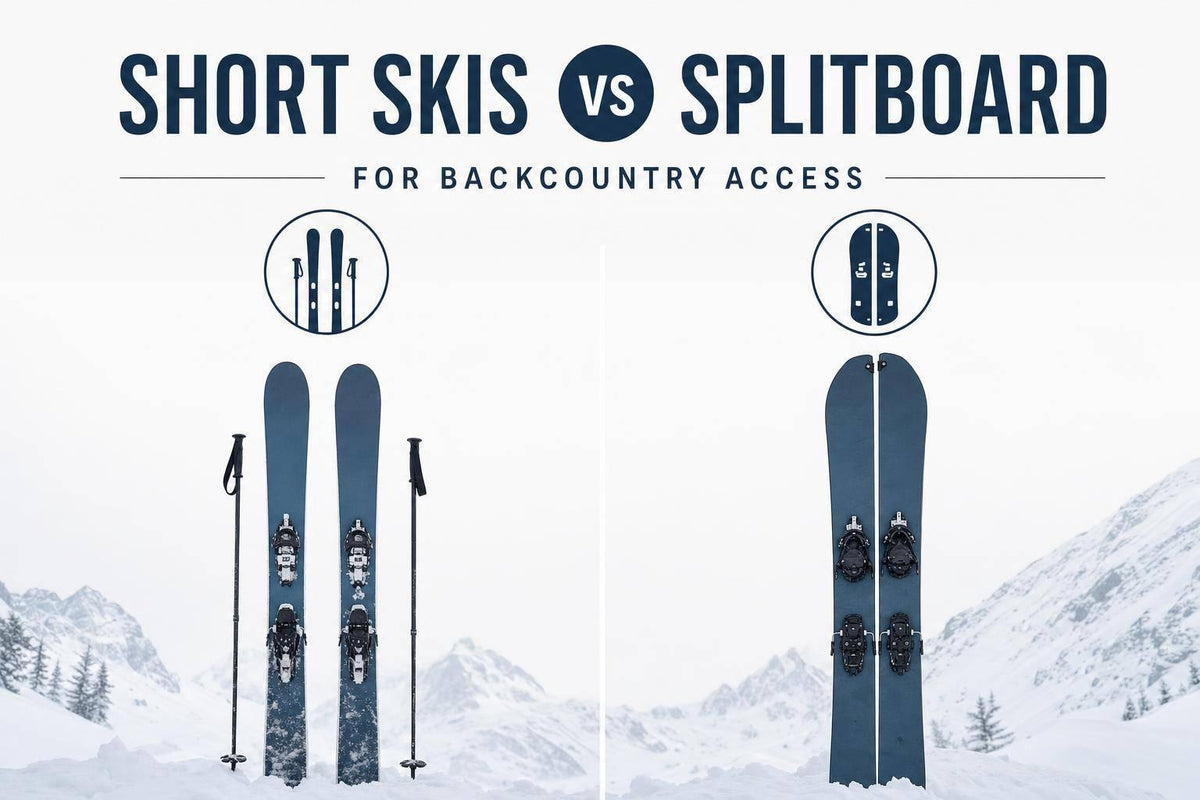
If you want short sidecountry laps, gate-access runs, or quick hikes, I’d pick short skis. If you want full touring days with 3,000+ vertical feet, I’d pick a splitboard.
Here’s the short version: Snowfeet* short skis cost less, pack smaller, and take less fuss to use. A setup can start at $595, and the WALKSKI 100 cm weighs 2.79 lb per ski with binding. Splitboards make more sense when your day is longer, your skin track is longer, and you care more about glide than pack size.
What matters most in this comparison:
- Uphill travel: splitboards do better on long climbs and traverses
- Transitions: short skis take less time and less messing around
- Boots: short skis fit more boot types
- Weight and packing: short skis fit in a 25–35 L pack
- Learning curve: short skis are easier for casual riders
- Cost: splitboard setups often land around $1,500–$2,200
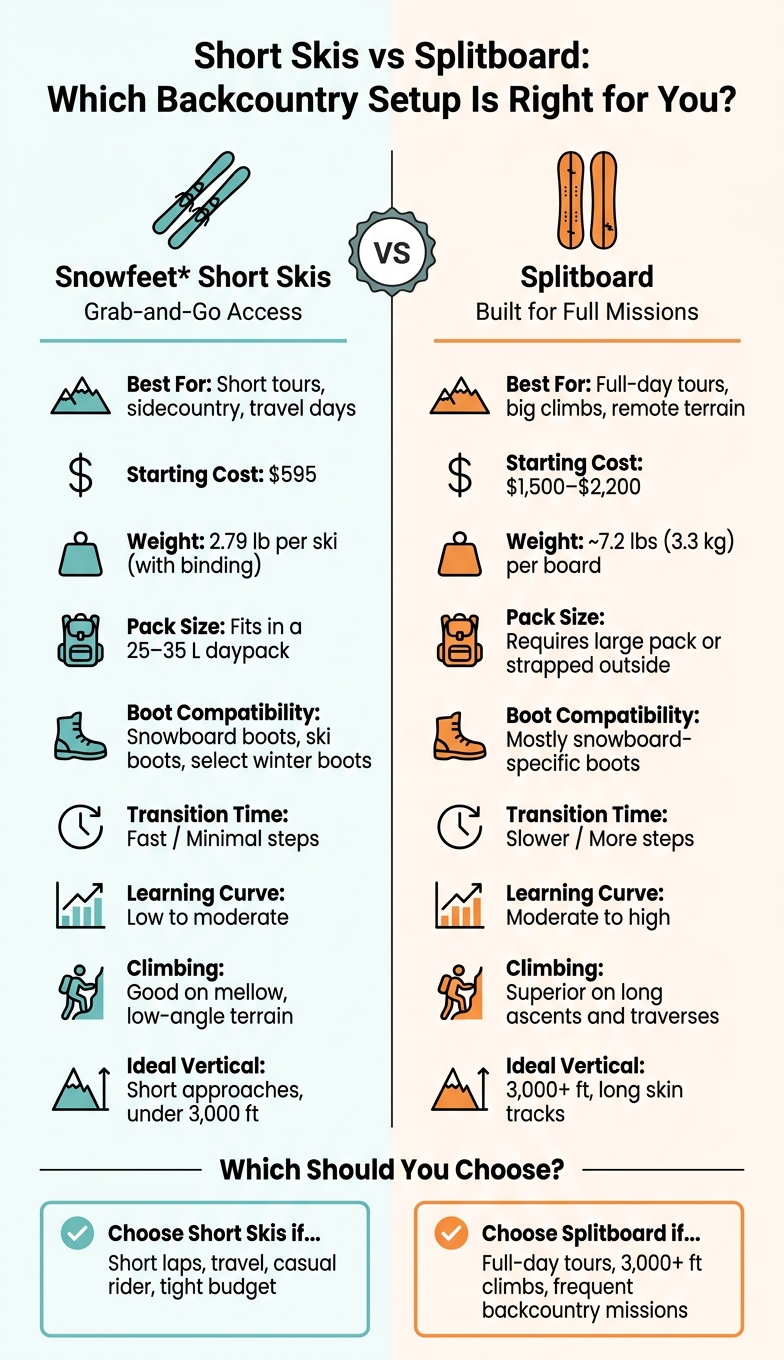
Short Skis vs Splitboard: Backcountry Access Comparison
Snowfeet* Snowblades | Skiboards | Skiblades | Short Skis - Complete Guide | All you need to know
Quick Comparison
| Criteria | Snowfeet* Short Skis | Splitboard |
|---|---|---|
| Best for | Short tours, sidecountry, travel | Long tours, big climbs, remote terrain |
| Climbing | Good on mellow skin tracks | Better on long ascents |
| Traverses | Okay for short distance | Better for long distance |
| Transition time | Short | Longer |
| Pack size | Smaller | Larger |
| Boot options | Snowboard, ski, some winter boots | Mostly snowboard boots |
| First setup cost | From $595 | About $1,500–$2,200 |
| Learning curve | Lower | Higher |
So, if you want the simple answer: short skis win for short access days; splitboards win for full missions. Think of it like this - one is a grab-and-go tool, the other is a full touring setup. Both work. It just depends on how big your day is.
How Short Skis and Splitboards Work for Backcountry Access
Short Skis: Compact and Low-Hassle Access
Snowfeet* short skis in the 99–120 cm range are made for fast backcountry access, short tours, and easy descents. You slap skins on the base, use free-heel touring bindings, and get moving without a bunch of fiddling. That’s a big plus for short approaches, stop-and-go terrain, and riders who don’t want to burn time on setup.
The Snowfeet* WALKSKI Backcountry Touring 100 cm works well on mixed terrain - rolling ground, short steeps, and variable snow. The setup stays lighter and easier to handle than most full-size touring skis. And on short approaches, that simple, grab-and-go feel often matters more than top-end uphill speed.
The Snowfeet* Skiblades in 99 cm and 120 cm lean toward quick, playful touring instead of long uphill grinds. The 99 cm gives you the most agility. The 120 cm adds more glide and a bit more stability for slightly longer traverses.
Splitboards: Built for Full Touring Days
A splitboard breaks into two ski-like halves for the climb, then locks back together for the ride down. That setup suits long tours and big descents. But there’s a catch: every transition takes extra time and effort. A board like the Korua Transition Finder 157 cm weighs about 7.2 lbs (3.3 kg), and that extra weight can drag on the climb. On short-access days, you tend to feel that more.
Next, the real gap shows up in the uphill, transitions, weight, and packability.
sbb-itb-17ade95
Short Skis vs Splitboard: Uphill, Transitions, Weight, and Packability
Once you’ve got the setup straight, the next thing that hits you is simple: how much work does each option ask from you on the climb? That’s where short skis and splitboards start to feel very different.
For short-access backcountry days, the big things are pretty simple:
- how well they climb
- how fast you can transition
- how easy they are to carry and pack
| Factor | Short Skis (Snowfeet*) | Splitboard |
|---|---|---|
| Skin-track traction | Good on low-angle terrain with skins | Strong on long skin tracks |
| Long-track efficiency | Limited on long climbs | Better on long traverses |
| Transition time | Fast, minimal steps | Slower, more steps |
| On-foot weight | Light | Heavier |
| Pack weight | Very light | Heavier |
| Packability | Fits in a 25–35 L daypack | Requires a larger pack or strapped outside the pack |
| Best use | Short tours, sidecountry, travel | Full-day tours, larger elevation gains, remote terrain |
Uphill Travel and Traverses
The Snowfeet* WALKSKI 100 cm and Skiblades 99 cm or 120 cm do well on short approaches, low-angle skin tracks, and mixed terrain. That shorter platform is nice when the route is mellow and the day is simple.
But on long, steady climbs, you start to feel the limit. There’s less glide, so covering distance takes more effort.
A splitboard still wins on long skin tracks, bigger elevation gains, and long traverses where glide makes a big difference. If you’re out for the full haul, that matters a lot.
Transitions and Day Flow
This is one of the clearest day-to-day differences.
Splitboard transitions take more steps. You switch modes, put the board back together, and reset for the descent. It works fine, but it takes longer.
With short skis, the changeover is faster and more direct. That helps keep laps moving on short tours and resort-side access. Less fiddling, more riding. Hard to complain about that :)
Weight, Pack Size, and Travel Convenience
The Snowfeet* WALKSKI touring model weighs 1,266 g (2.79 lb) per ski with binding. A pair fits into a 25–35 L daypack. A splitboard, on the other hand, usually needs a bigger pack or has to be strapped to the outside.
That smaller size pays off in all the boring but real parts of life:
- road trips
- tiny car trunks
- apartment storage
- flying with gear
Short skis are easier to pack, store, and travel with. And if you’ve ever tried stuffing bulky gear into a packed car at 6:00 a.m., you know that stuff matters.
After size and weight, boot and binding compatibility decide how simple the setup feels on snow.
Boot Compatibility, Learning Curve, and Ease of Use
After uphill speed and pack size, the next big checkpoints are boot compatibility and how much setup hassle you're willing to deal with.
| Factor | Short Skis (Snowfeet*) | Splitboard |
|---|---|---|
| Boot options | Snowboard boots, ski boots, and select winter boots | Mostly snowboard boots; some hard-boot systems use specialized boots |
| Binding complexity | Simple | Complex |
| Skill required | Low to moderate | Moderate to high |
| Setup cost (USD) | From $595 | About $1,500–$2,200 for a complete first setup |
| Beginner friendly | Yes, especially for mellow terrain | Less so |
Boots, Bindings, and Gear Complexity
Snowfeet* short skis work with snowboard boots, ski boots, and select winter boots depending on the model. That’s a big plus. The WALKSKI 100 cm uses a simple touring binding that fits a wide range of adult boot sizes, so many riders can start touring with gear they already own.
Splitboard systems usually need snowboard-specific boots and more complex bindings. And yeah, that means more cost and more steps. Splitboard bindings include touring and ride modes, pin systems, heel risers, and sometimes crampon compatibility. Each part has its own little quirks, which can get annoying when your hands are cold and the wind is doing its thing.
That simple setup is a big reason Snowfeet* feels easier for casual riders and travelers.
Learning Curve for Casual Riders
Fewer parts means fewer things to mess with during cold, windy transitions. That alone makes a difference.
Most casual snowboarders get comfortable on Snowfeet* short skis in a few sessions. The shorter length makes kick turns and transitions easier. That matters a lot on short tours, sidecountry laps, and travel days, where you want to move - not stand around fiddling with gear.
Splitboards take more practice. New tourers usually need several dedicated outings before skinning and the switch from touring to riding starts to feel natural. It’s also smart to start on low-angle routes before stepping up to steeper terrain or longer tours. Splitboards make more sense once you want the full splitboard routine.
Which Setup Is Right for You
If the climb, transition time, and pack size already made this feel close, here’s the simple call: pick based on tour length. For short, easy-access days, go with Snowfeet*. For long, committed tours, go with a splitboard.
| Your situation | Best pick |
|---|---|
| Short approaches, sidecountry laps | Snowfeet* WALKSKI 100 cm or Skiblades 99/120 cm |
| Occasional tours, travel days, limited luggage space | Snowfeet* short skis |
| Full-day tours, 3,000+ feet of climbing, remote terrain | Splitboard |
| Frequent full-day tours | Splitboard |
Use the table for the fast answer. Then check the two setup summaries below.
Choose Snowfeet* Short Skis for Short Tours, Travel, and Simple Access
For short access days, the compact setup is hard to beat. The Snowfeet* WALKSKI Backcountry Touring 100 cm is made for compact touring days and keeps things simple. It starts at $595. The short length is easy to pack, which makes travel a lot less annoying.
The Snowfeet* Skiblades 99 cm (from $690) or 120 cm ($950) work well on mellow terrain and short climbs. They’re easy to turn, forgiving for newer riders, and fun on low-angle slopes where a full splitboard can feel like overkill.
Choose a Splitboard for Longer and More Committed Tours
When the objective gets bigger, the splitboard starts to earn its keep. If you’re planning full-day tours on a regular basis, aiming for 3,000+ feet of climbing, or heading into remote terrain, the better climbing efficiency on long ascents, better traction on traverses, and full snowboard feel on the way down make the added cost and setup hassle worth it.
It also comes down to volume. The more tours you do each season, the more that extra cost starts to make sense.
For most casual riders, Snowfeet* is the simpler pick. Splitboards fit better when touring turns into a bigger part of how you ride.
FAQs
Can I use my regular snowboard boots with Snowfeet* short skis?
Yes. Most Snowfeet* short skis, including the WALKSKI 100 cm, come with universal, tool-free bindings that fit regular snowboard boots, plus winter boots and hiking boots.
For the 99 cm and 120 cm models, make sure you pick the version with snowboard-boot bindings, since some setups use ski-boot bindings instead. These bindings usually fit US men’s sizes 6–14.5.
Are short skis enough for beginner backcountry touring?
Yes. Short skis like the Snowfeet WALKSKI 100 cm are a smart pick for beginner backcountry touring.
Their short length feels less intimidating than standard touring skis. That makes them easier to turn, easier to handle, and a lot less awkward when you're still getting your ski legs under you. For new riders, that often means more confidence, faster.
They also work with standard winter boots, hiking boots, or snowboard boots. So you can skip the cost and hassle of buying special touring boots and bindings right away. That’s a big win if you want to try backcountry touring without dropping a pile of cash on day one.
And the learning curve? It’s pretty friendly. Many new users pick up the basics in minutes to two hours.
When does a splitboard make more sense than short skis?
A splitboard makes more sense if your main goal is a full-day backcountry mission with long approaches, steady climbs, and deep powder.
Short skis like the Snowfeet WALKSKI 100 cm are great when you want convenience, easy carry, and nimble movement on short tours with mixed terrain. But a splitboard gives you better glide, more float, and a steadier ride for serious alpine days. If you’re a dedicated snowboarder and want that classic snowboard feel on the way down, it’s still the go-to pick.











留下評論
此網站已受到 hCaptcha 保護,且適用 hCaptcha 隱私政策以及服務條款。