




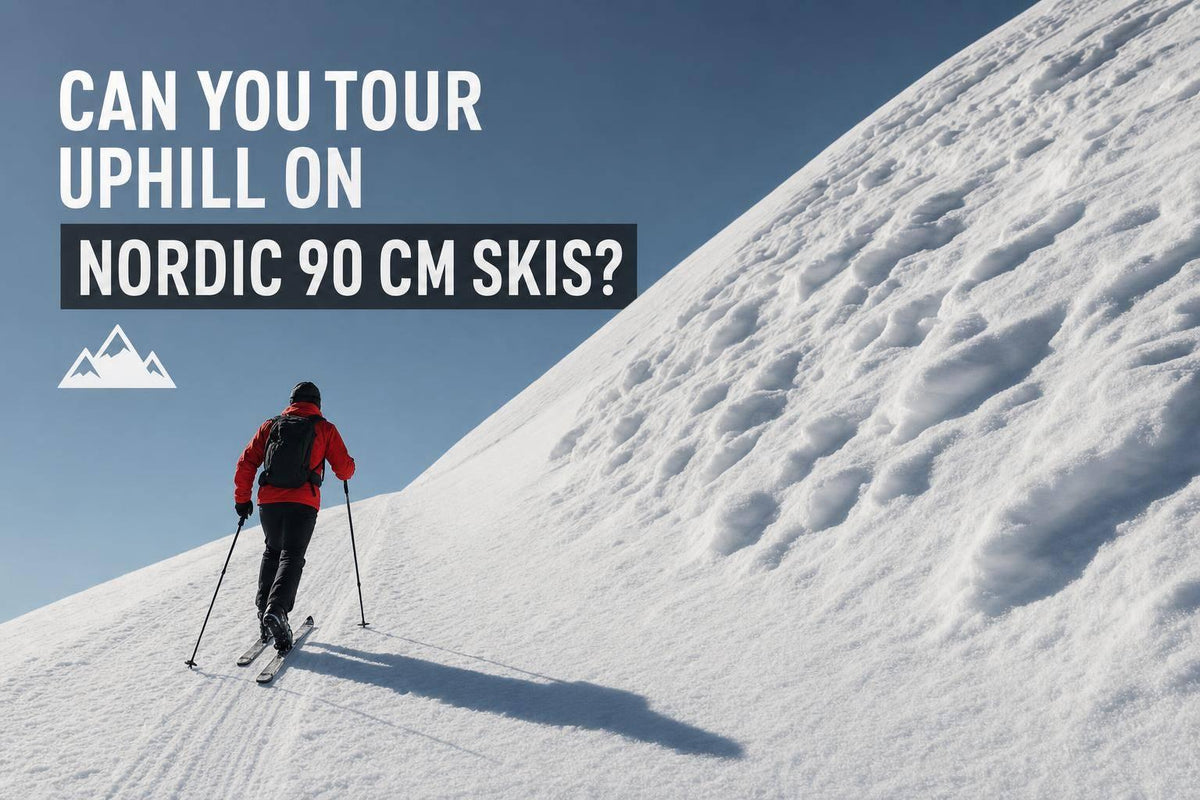
Yes - but only in the right snow and on short climbs.
If I had to give you the short answer: NORDIC 90 cm skis work uphill on firm, packed snow, mellow grades, and short routes. They do not make much sense for deep powder, steep skin tracks, or long touring days.
Here’s the whole thing in plain English:
- Best use: groomed trails, packed paths, rolling terrain, short uphill sections
- Hardest conditions: deep snow, ice, steep climbs, long elevation gain
- Main limit: at 90 cm (about 35 in.), they have less surface area, so they sink more in soft snow
- What helps most: fish-scale grip, snug boots, poles, short steps, and herringbone on steeper bits
- Better pick for longer climbs: WALKSKI 100 cm
- Right tool for steep or remote terrain: full touring gear, plus avy gear where needed
A simple way to think about it: these skis are for short uphill travel, not full backcountry touring. If your route looks more like a fitness loop than a hut trip, you’re in the right lane :)
One stat says a lot: full touring skis often run about 150–195 cm, while these are just 90 cm. That short length makes them easy to carry and turn, but it also means less float in soft snow and less calm on rough descents.
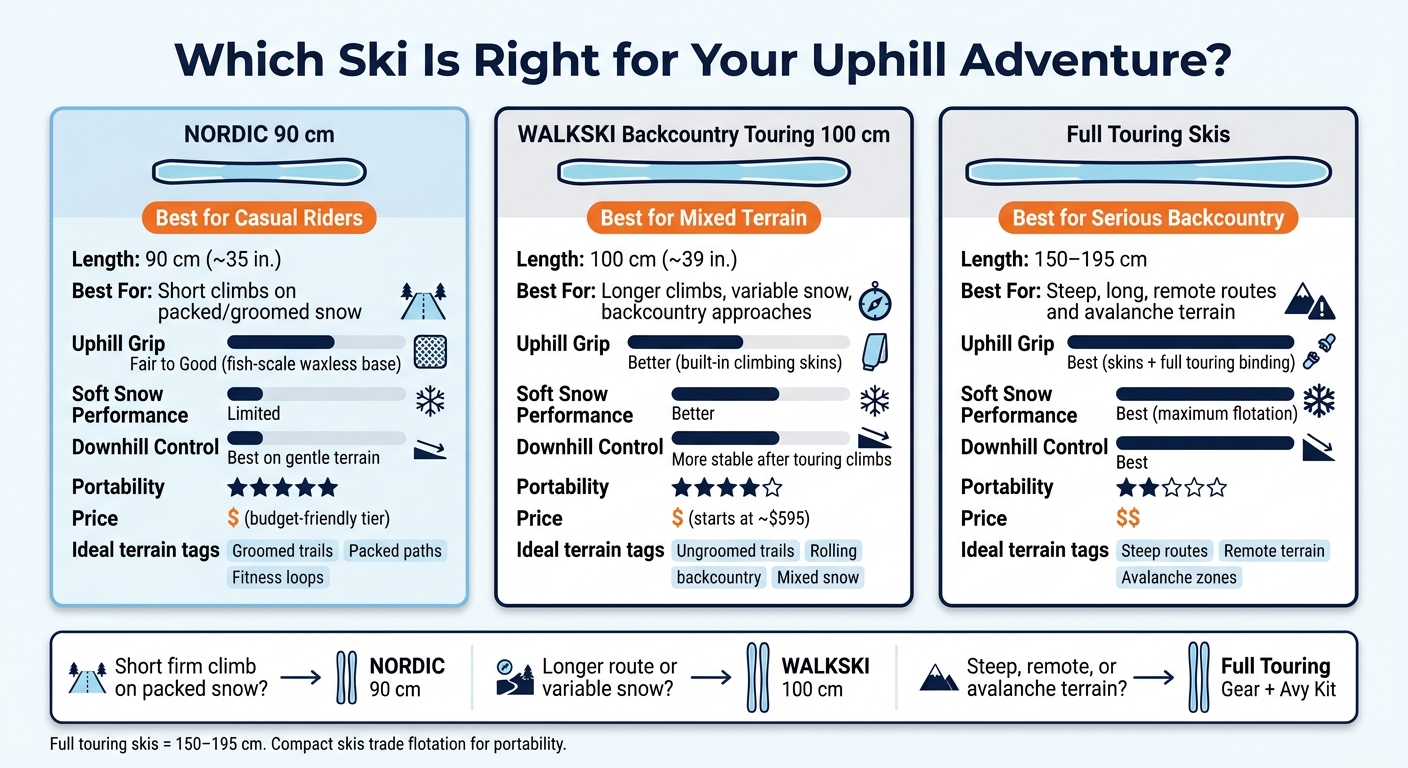
NORDIC 90 cm vs WALKSKI 100 cm vs Full Touring Skis: Which Should You Choose?
Snowfeet* WALKSKI Backcountry Touring Skis | 100 CM
Quick Comparison
| Option | Best for | Uphill grip | Soft snow | Portability |
|---|---|---|---|---|
| NORDIC 90 cm | Short climbs on packed snow | Fair to good | Limited | High |
| WALKSKI 100 cm | Longer climbs and mixed snow | Better | Better | High |
| Full touring skis | Steep, long, remote routes | Best for that job | Best | Lowest |
So, if you want a small, simple ski for short uphill sections, NORDIC 90 cm can work well. If your day includes deep snow, long climbs, or rough backcountry terrain, I’d move up to touring gear and skip the suffering.
Where NORDIC 90 cm Skis Work Well Uphill
Best terrain: groomed trails, packed snow, short approaches
The NORDIC 90 cm skis do best on groomed Nordic trails, packed access paths, and short rolling climbs.
That’s their sweet spot.
At 90 cm, they’re also easier to manage on tight connectors and short carry sections. You can move through awkward little trail links without feeling like you’re wrestling a pair of long boards.
Where do they start to struggle? On long climbs, deep powder, and icy pitches. That’s where the short length stops helping and starts asking more from you.
Once the route gets steeper, technique matters more than ski length.
Best technique: herringbone steps, edging, and pole use
On steeper pitches, use herringbone. Point the skis into a V, lean your ankles and knees inward so the inside edges bite, take short steps, and plant your poles behind you for support.
A few simple cues help:
- Stay centered over the bindings
- Keep your steps short
- Widen the V as the slope gets steeper
It’s not fancy, but it works. Think of it like walking uphill in ski form: stable, steady, no drama.
For short uphill travel, the right boots, poles, and traction accessories matter next.
Uphill performance by snow condition: firm, loose, icy, powder
The table below gives a quick, practical read on uphill performance by snow condition.
| Snow condition | Uphill grip | Control | Overall suitability | What to do |
|---|---|---|---|---|
| Firm packed or groomed snow | Good | Good | Best use case | Use parallel stride on gentle sections; herringbone on steeper pitches |
| Shallow loose snow | Fair | Fair | OK for short climbs | Stick to consolidated tracks, shorten your steps, expect more effort |
| Icy or very hard snow | Limited to fair | Fair to limited | Use cautiously | Edge deliberately, pick the least steep line, take small steps |
| Deep powder | Poor | Limited | Major limitation | Expect sinking and fatigue; choose longer touring equipment instead |
That balance changes again with your gear setup.
sbb-itb-17ade95
Gear Setup for Short Uphill Travel
Core gear: skis, boots, poles, and winter layers
For short climbs, keep the setup simple. The NORDIC 90 cm needs just the skis, compatible bindings, supportive winter boots, adjustable poles, and layered clothing. If you're heading into remote terrain or any area with avalanche risk, switch to full backcountry gear.
Your boots matter a lot here. They should lock into the binding with no slop, stay warm, and give you enough grip for walking across thin snow or bare patches. The regular-shoe binding fits about U.S. sizes 6–13, but check the exact fit before you buy. Go with snug winter boots. Soft or oversized boots can feel sketchy fast.
A simple setup checklist:
- Adjustable poles with snow baskets
- Moisture-wicking base layers
- Insulating mid-layers
- Windproof shell
- Gloves
- Warm socks
- Eye protection
Set your poles so your elbows stay slightly bent when the tips touch the snow. If you're on mixed terrain or in a busy area, wear a helmet. No drama there - your head will thank you.
Traction options and compatibility limits
Most of your grip comes from the ski base and your technique, not extra climbing hardware.
The Fishscales base has built-in grip, so you don't need kick wax. If you want more glide, you can add glide wax. For short climbs, that built-in grip is usually enough. If the skis start sliding backward, or your boot shifts in the binding, stop right away and take an easier line. That's the ski telling you, "Nope."
Also, don’t assume standard climbing skins will fit these skis. Use only traction accessories Snowfeet* approves for this model. If traction still isn't enough, the route is too steep or the snow is too soft for this ski.
NORDIC 90 cm vs WALKSKI Backcountry Touring 100 cm
With the setup covered, this choice comes down to one simple tradeoff: easy short climbs vs. touring-focused traction.
Why NORDIC 90 cm suits most casual riders
The NORDIC 90 cm is all about keeping things simple. At 90 cm, or about 35 inches, it’s easy to toss in the car, carry to the trail, and turn in tight spots.
For short climbs on packed snow, NORDIC does the job without much fuss. It fits casual Nordic outings well, especially if you want something light, small, and easy to use. That’s the sweet spot.
Why WALKSKI 100 cm is better for longer climbs and variable snow
The WALKSKI Backcountry Touring 100 cm is built for a different kind of day. Its big edge comes from the touring setup: built-in climbing skins, a free-heel binding, and climbing/descent positions made for uphill travel.
If you plan to leave groomed trails, carry a small pack, or want more control on the way down, WALKSKI starts to make a lot more sense. It starts at $595, though the final price can change by retailer, package, and promotion.
Side-by-side comparison: intended use, traction, soft-snow performance, portability
The easiest way to see the gap is to put them next to each other.
| Feature | NORDIC 90 cm | WALKSKI Backcountry Touring 100 cm |
|---|---|---|
| Intended use | Casual Nordic outings, fitness loops, and short packed-snow approaches | Short backcountry tours, repeated climbs, and mixed terrain |
| Ideal terrain | Groomed Nordic trails, packed snow, and moderate grades | Ungroomed trails, rolling backcountry terrain, and longer or steeper climbs |
| Uphill traction | Waxless/fish-scale grip and technique-dependent traction | Built-in climbing skins designed for touring ascents |
| Soft-snow performance | Limited flotation; best in shallow or packed snow | Better handling in loose snow, but still limited compared with full-length touring skis |
| Downhill control | Best on gentle terrain and controlled speeds | More stable for descents after touring climbs |
| Portability | Highest; 90 cm / about 35 inches | Very portable; 100 cm / about 39 inches |
For context, adult touring skis usually land in the 150–195 cm range. Those longer skis give you more flotation and glide than compact skis.
But for most casual riders, that’s not the whole story. If your goal is a fun, portable, low-fuss option for groomed trails and short climbs, Snowfeet* hits the part that matters most.
Conclusion: When NORDIC 90 cm Skis Are Enough - and When They Are Not
How to choose: NORDIC 90 cm, WALKSKI 100 cm, or full touring gear
After looking at terrain, traction, and gear, the call is pretty simple: the Snowfeet* NORDIC 90 cm makes sense for short, firm, predictable climbs.
If the day looks tougher, go with the WALKSKI Backcountry Touring 100 cm. It gives you more flotation and more control on longer approaches and rougher snow. That’s what this choice comes down to: how much the route is asking from you.
Here’s the simple version:
- Use NORDIC 90 cm for short, firm climbs
- Use WALKSKI 100 cm for longer or rougher routes
- Use full touring gear for steep, remote, or avalanche terrain
Once you move past mellow, predictable ground, it’s time to step up your setup. Full touring gear is the right call for steep or remote routes, especially in avalanche terrain. And if avalanche terrain is part of the plan, carry a transceiver, probe, and shovel - and know how to use them.
The NORDIC 90 cm is a capable, portable ski in the right conditions. Be honest about where it works best, and it’ll do the job without any drama.
FAQs
Can beginners climb on NORDIC 90 cm skis?
Yes - beginners can climb on Snowfeet NORDIC 90 cm skis.
That said, they work best on groomed, flat, or gently rolling terrain. They’re not the right pick for steep backcountry climbs.
Here’s the simple reason: they don’t have climbing skins or heel risers. So they’re made more for glide on packed snow than for strong uphill grip.
If you plan to ride on mixed terrain, tackle steeper climbs, or head onto light backcountry routes, Snowfeet WALKSKI 100 cm is the better beginner choice.
How steep is too steep for NORDIC 90 cm skis?
Snowfeet NORDIC 90 cm skis are at their best on groomed trails, packed snow, and flat to gently rolling terrain.
They can handle mellow grades just fine for casual fitness outings. But steep climbs? That’s not what they’re made for.
Here’s the main issue: they don’t have climbing skins or heel risers. So once the slope gets steeper, uphill travel starts to feel slow, awkward, and kind of like pushing a shopping cart up a hill in ski boots.
If your route includes significant climbing or steep terrain, go with the Snowfeet WALKSKI 100 cm instead.
Do I need skins for uphill use?
It depends on the model and the terrain.
The Snowfeet NORDIC 90 cm* is built for groomed trails and packed snow. So, it doesn’t use skins. Instead, it leans on a light, stiff build that works well for casual uphill travel on mellow, packed routes.
If you’re heading into steeper climbs, rolling backcountry, or mixed snow, go with the Snowfeet WALKSKI 100 cm*. It comes with removable climbing skins and a 4-mode binding system, which gives you better traction and makes uphill touring easier.
Pretty simple: packed and mellow? NORDIC 90 cm. More varied terrain? WALKSKI 100 cm.












Zostaw komentarz
Ta strona jest chroniona przez hCaptcha i obowiązują na niej Polityka prywatności i Warunki korzystania z usługi serwisu hCaptcha.