



















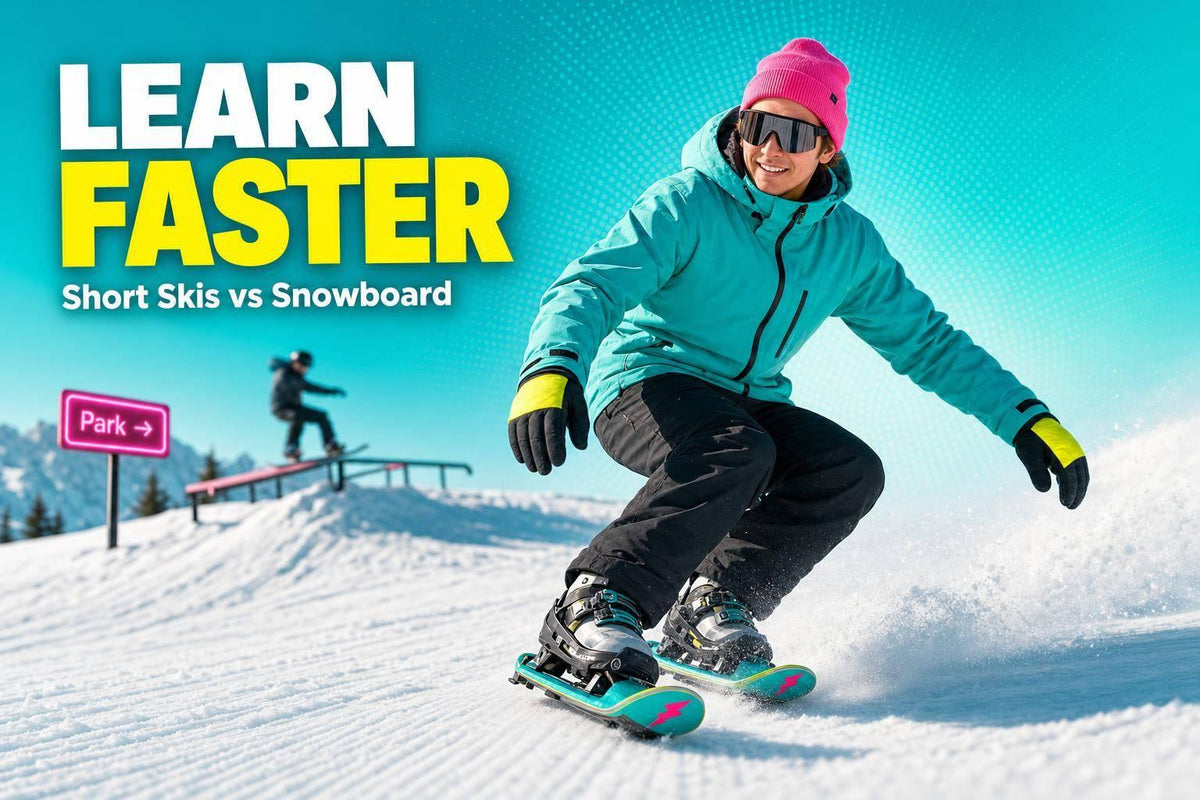
If I only had one weekend to get a beginner on snow, I’d put most people on short skis first. They usually feel easier on day one, need less time to learn basic turns and stops, and cause fewer hard falls than a snowboard.
Here’s the short version:
- Short skis win for most first-timers
- Snowboards often take longer to feel normal
- Many beginners feel okay on skis in 2–3 days
- Many snowboard beginners need closer to 3–4 days
- Short skis are easier for standing, turning, slowing down, lift rides, and carrying gear
- Snowboarding still makes sense if your main goal is park riding or you already love a sideways board stance
So, if your goal is fun this weekend, I’d lean short skis.
If your goal is learning snowboarding on purpose, pick the board and give it time.
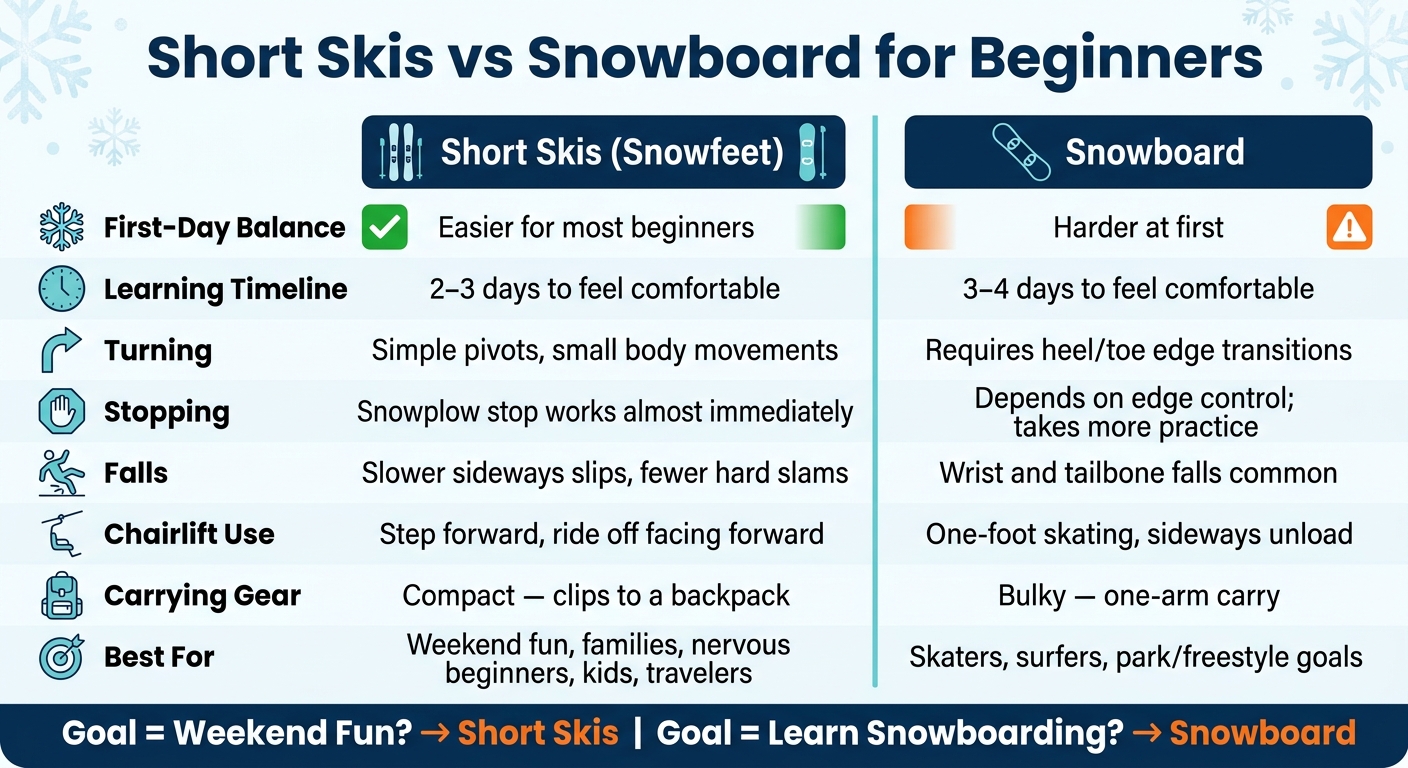
Short Skis vs Snowboard for Beginners: Side-by-Side Comparison
Snowboarder tries Snowfeet* | Which Snowfeet* Short Ski is the Best? | Snowblades 44, 65, 99 Review
Quick Comparison
| Factor | Short Skis | Snowboard |
|---|---|---|
| First-day balance | Easier for most people | Harder at first |
| Turning | Simpler to start | Takes more practice |
| Stopping | Often easier early on | Needs edge control |
| Falls | Often less harsh | More wrist/tailbone falls |
| Lift use | Easier | More awkward at first |
| Carrying gear | Smaller, lighter feel | Bigger and bulkier |
| Best for | Weekend beginners, kids, casual riders | Skate/surf types, park goals |
From what I see, the best beginner fits look like this:
- Nervous beginner: go with a more stable short ski
- Casual weekend rider: short skis
- Kid or family trip: short skis
- Skater or hockey player: very short ski models can feel natural
- Park-focused skateboarder or surfer: snowboard
I like this choice because it’s simple: pick the setup that gives you the most time riding and the least time sitting in the snow wondering what went wrong :)
For a quick visual explainer, these videos can help:
- Beginner skiing basics on YouTube
- Beginner snowboarding basics on YouTube
- Short skis / skiblades beginner guide on YouTube
2. How short skis and snowboards feel on the first day
Short skis: faster confidence and less bulk
Short skis tend to feel easier on day one. The big reason is simple: the forward stance feels more natural for most beginners. Your feet move on their own, and if you get a little shaky, you can step out to catch yourself, kind of like walking. That instinct kicks in right away, which is a nice win early on.
With Snowfeet* models like the Skiblades 65 cm or the Snowfeet PRO 50 cm, there’s less bulk to deal with. They’re short, easy to move, and less awkward when you need to reposition. Small body movements can help you pivot, gentle direction changes can help you slow down, and on beginner terrain, a snowplow stop is often within reach without a ton of technique.
Snowboarding: appealing style, harder first day
Here’s the trade-off: snowboarding has a cool look, but the first day is often tougher. The sideways stance throws a lot of people off at first because both feet are fixed to one board. That’s not how most people naturally balance, so there’s a learning bump right out of the gate.
Edge catches are one of the most common early headaches. That’s when the board suddenly grabs the snow and, well, down you go. Falling, standing back up, and trying again is just part of the deal. Snowboarders also have to manage skating with one foot near lifts and across flat areas, and that can feel pretty clunky when you’re new.
Comparison table: learning curve, balance, stopping, and turning
Here’s how they stack up on the stuff that matters most on day one.
| Day-One Factor | Short Skis (Snowfeet*) | Snowboard |
|---|---|---|
| Standing up | Easier - forward stance, feet independent | Harder - sideways stance, both feet locked |
| Natural balance | More intuitive for most beginners | Less intuitive; requires adjustment |
| First turns | Simple pivots with small body movements | Requires heel-side/toe-side edge transitions |
| Stopping | Snowplow stop works almost immediately | Depends on edge control; takes more practice |
| Speed control | Multiple easy options on green runs | Less forgiving until edge skills develop |
| Confidence on day one | Builds quickly for most riders | Often takes longer to feel in control |
sbb-itb-17ade95
3. Lifts, falls, and carrying gear: what beginners actually deal with
Chairlifts, walking, and carrying convenience
Day one isn’t just about riding. It’s also about hauling gear, standing in lift lines, and doing that clunky walk from the parking lot to the snow.
That part gets ignored a lot, but for beginners, it matters. A lot.
A full snowboard is big and awkward to carry. Snowfeet* Skiskates (44 cm) and Snowfeet PRO (50 cm) are small enough to strap to a backpack or carry in one hand. Even Snowfeet* Skiblades at 65 cm or 99 cm are much easier to handle than a full snowboard. So you spend less time wrestling with your gear and save more energy for the part you came for: learning on snow.
Chairlifts are easier on short skis too. You step forward on both feet, ride off facing forward, and skip the one-foot skating and sideways unload that snowboarders have to deal with. It’s a small thing, sure, but on a first day, small things can feel HUGE.
Less hassle at the lift usually means less stress before each run. And that helps beginners relax and focus.
Falls, body strain, and speed control on green runs
Those little in-between moments matter even more once the falling starts.
Beginner snowboard falls often land on wrists or tailbones, especially after an edge catch. Wrist guards and padded shorts can help. Early snowboard turning and stopping also depend on edge control and body rotation, which can tire out the legs, hips, and back.
Short skis often lead to slower sideways slips instead of wrist-first or tailbone-first crashes. The shorter platform also cuts down on twisting force, though gentle terrain still matters. That means fewer hard slams and more time spent practicing turns and stops, which is what helps beginners improve on day one.
On green runs, speed control is the big test. Which setup helps a beginner slow down without that full-on panic moment?
With Snowfeet*, beginners can widen their stance into a basic wedge or use a skid to slow down, all while facing downhill in a stance that feels natural. Snowboard beginners often spend their first hours sliding sideways to keep speed in check. That works, but it also takes up more mental space, so there’s less room left for learning turns. With short skis, most beginners spend more time gliding and less time parked on the snow trying to reset.
Comparison table: comfort and control on beginner terrain
| Beginner Factor | Snowfeet* / Short Skis | Snowboard |
|---|---|---|
| Lift line movement | Natural stepping with both feet | Awkward one-foot skating push |
| Carrying size | Compact - clips to a backpack | Bulky - one-arm carry, hard to maneuver |
| Braking confidence | High - wedge and skid work early | Lower - edge control takes more practice |
| Control on green runs | Intuitive for most beginners | Requires more time to feel stable |
4. Which Snowfeet* model or snowboard setup fits your beginner profile
Best Snowfeet* picks for most first-timers
If short skis already sound like the easier path, the next move is picking the model that fits your comfort level. Two things matter most here: how much wobble you're okay with and how small you want the setup to be.
Snowfeet PRO 50 cm is the easiest starting point for most first-timers. It feels the closest to skating, so you can start sliding on snow without a big learning curve. It’s also the least intimidating option, which matters a lot when you’re new and just trying to stay upright.
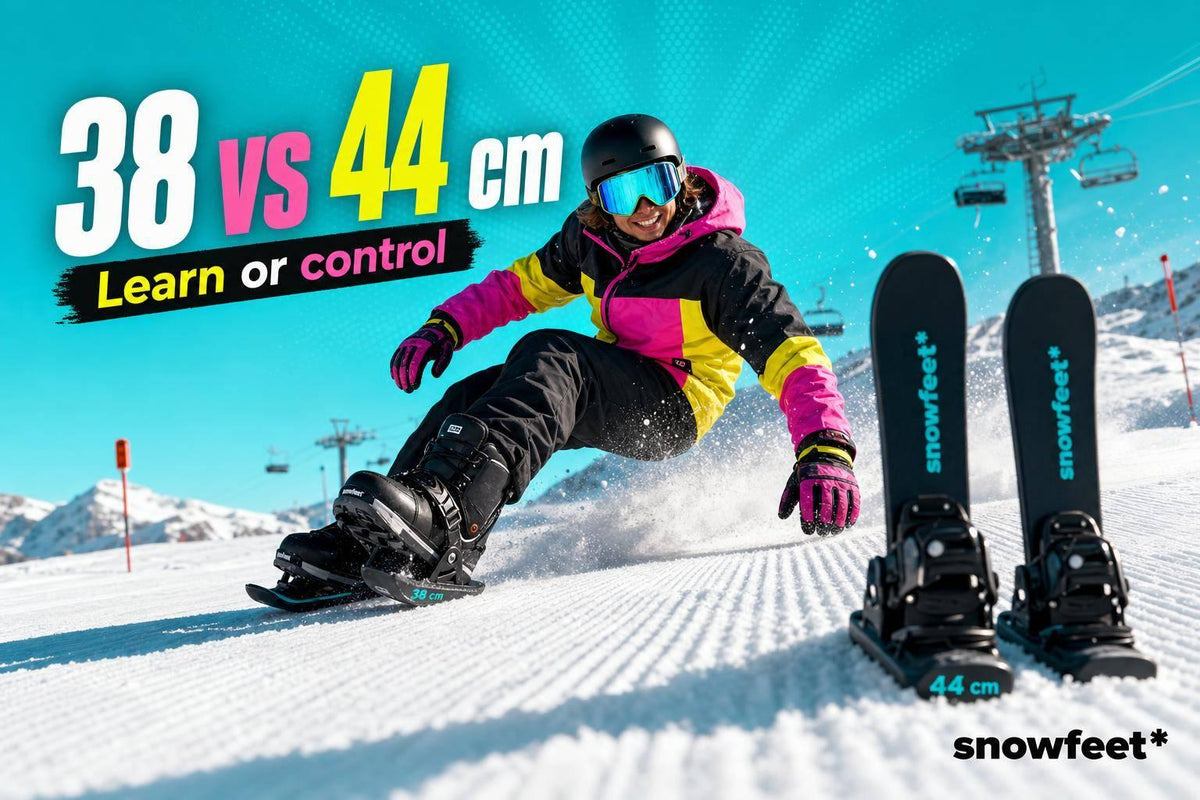
Skiskates 44 cm make the most sense for people who already skate, whether that’s ice hockey, inline, or roller. The movement carries over well to snow. If you don’t have that background, though, they can feel a bit less natural at first.
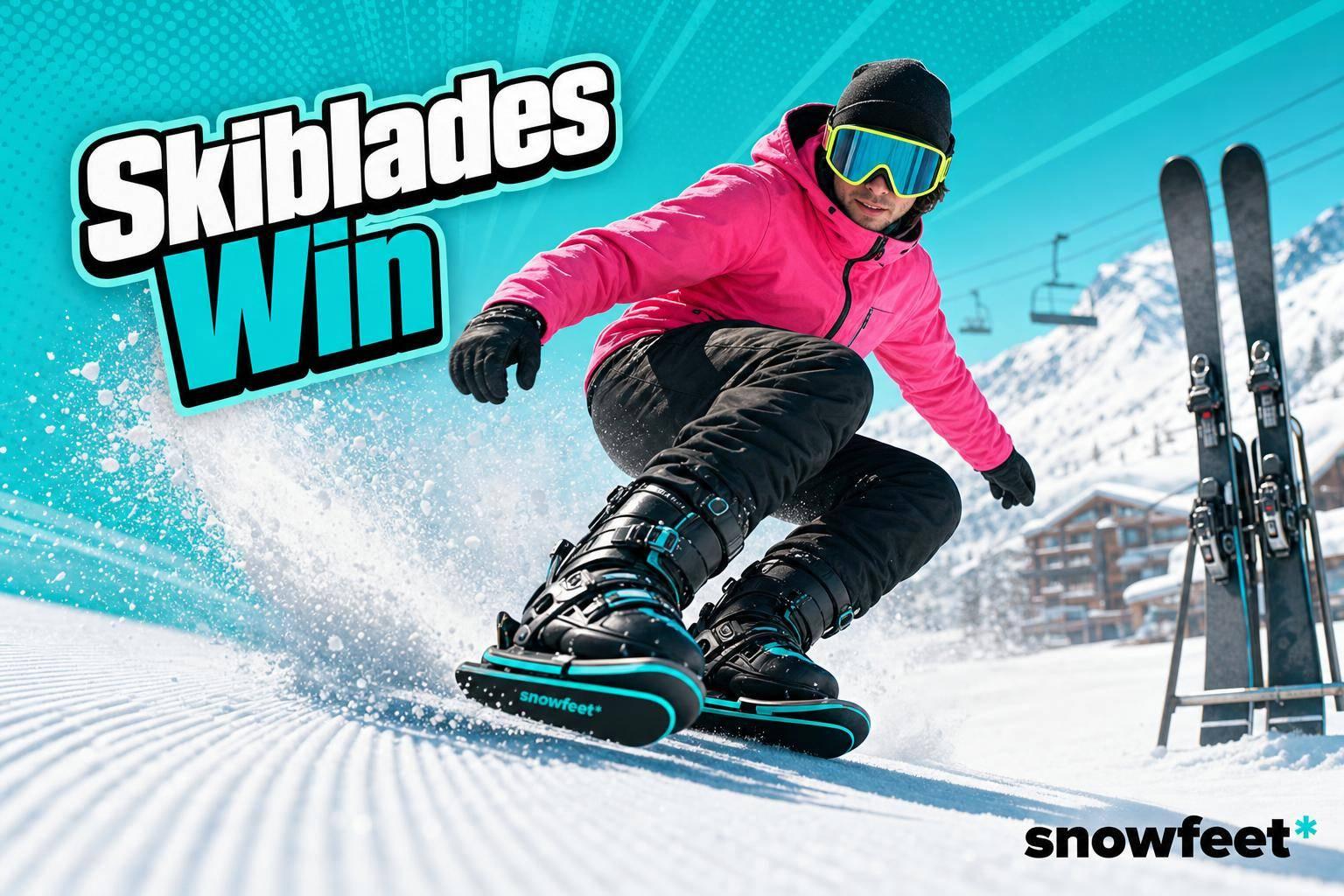
Skiblades 65 cm hit a sweet spot between stability and easy turning. They glide more smoothly than the shorter models, grip better on green runs, and still feel playful for short, fun laps. If you want something that works for day one and still feels good after a few sessions, this is a strong pick.
Skiblades 99 cm are the best match for riders who want the most stable short-ski option. That extra length helps with front-to-back balance and makes things feel calmer, while still being easier to manage than full-length skis.
Who should still choose a snowboard first
A snowboard makes sense in one clear case: you already want the sideways stance and you like the idea of freestyle progression.
If you’re a dedicated skateboarder or surfer and you’re drawn to spins, park laps, and that whole terrain park vibe, go with a snowboard. Just don’t bail after a few hours. Give it at least 3 consecutive days so you can get through the awkward early stage and start linking turns.
For most other people, Snowfeet* is the simpler way in. Casual riders, families, travelers, and anyone who just wants to have fun on snow this weekend will usually get moving faster and with less frustration.
Comparison table: best option by rider profile
Use this table for the quick-match version.
| Rider Profile | Best Setup | Why |
|---|---|---|
| Kids | Snowfeet PRO 50 cm | Easier to handle than full-size skis or a snowboard |
| Casual riders | Skiblades 65 cm or Snowfeet PRO 50 cm | Fun and forgiving without complex technique |
| Travelers | Snowfeet PRO 50 cm or Skiskates 44 cm | Fits in a bag; pairs with regular boots |
| Inline / ice skaters | Skiskates 44 cm | Skating movement translates directly to snow |
| Snowboard-curious learners | Skiblades 65 cm or Snowfeet PRO 50 cm | Faster progress on green runs first |
| Nervous beginners | Skiblades 99 cm | Most stable short-ski option |
| Families | Skiblades 65 cm or Snowfeet PRO 50 cm | Shared learning curve with simpler logistics |
| Skateboarders / surfers (park-focused) | Beginner snowboard | Sideways stance and freestyle culture are the goal |
5. Final call: the easier first choice for fun on snow
A simple decision rule for beginners
After looking at the learning curve, lifts, falls, and gear, the call is pretty simple: Snowfeet* gets most first-timers moving, stopping, and turning faster. Choose a snowboard only if learning snowboard style is the point of the trip.
Ask yourself one thing: Is the goal to learn snowboarding, or do you just want to have fun at the resort?
If snowboarding is the goal - maybe you love the style, want to hit the park, or plan to ride with friends who snowboard - then go for it.
For almost everyone else, Snowfeet* is the faster path to feeling in control on snow. Less struggle. More riding. That’s a good trade :)
Here’s a quick match by rider type:
| Your situation | Best first choice | Why |
|---|---|---|
| Snowboard as the goal | Beginner snowboard + lessons | Sideways stance and freestyle culture are the point |
| Weekend fun | Snowfeet PRO 50 cm or Skiblades 65 cm | Faster confidence on green runs |
| Kids | Snowfeet PRO 50 cm or Skiblades 65 cm | Easier to manage than a snowboard |
| Skater background | Skiskates 44 cm or Snowfeet PRO 50 cm | Skating movement carries over directly |
| Nervous beginner | Skiblades 99 cm | Most stable short-ski option |
| Travel light | Skiskates 44 cm or Snowfeet PRO 50 cm | Fits in a bag; pairs with regular boots |
Pick the Snowfeet* model that fits your comfort level, strap in, and go ride.
FAQs
Are short skis safer than a snowboard for beginners?
Yes. Snowfeet short skis are often a safer, easier pick for beginners than a snowboard.
A snowboard can be tough at first. Your feet are locked into one board, and you ride sideways. For a lot of new riders, that stance feels awkward right away. It can slow down the learning curve and lead to more falls. And, well, falling a lot isn’t most people’s idea of a fun first day on the mountain :)
Snowfeet works differently. The design is forward-facing and independent, so it feels more natural from the start. That makes balance easier for beginners. It also helps you recover when you make a mistake, which everyone does in the beginning.
Their short length helps too. Because they’re compact, beginners are less likely to run into common problems like crossing ski tips. That can make those first runs feel less chaotic and a lot more manageable.
Can I use regular winter boots with Snowfeet*?
Yes - that’s one of the best things about Snowfeet*. They work with regular winter boots, so you don’t need ski boots.
For the best ride, go with waterproof winter boots that have good ankle support. That gives you more stability and better control.
Want a bit more hold? Snowboard boots work well with Snowfeet* bindings too.
Should I still take a lesson if I choose short skis?
Yes. Snowfeet short skis are made to feel easy from the start, so they work well for beginners. But if you’re brand new to winter sports, taking a lesson can still be a smart move.
A lot of people pick up the basics, like turning and stopping, in a few minutes or within a day. That said, an instructor can help you get there with more control and less guesswork. You’ll get direct feedback on your posture, how to shift your weight, and how to stay safe on the snow.
That kind of one-on-one help can make a big difference early on. It often helps you feel more confident, more relaxed, and more in control right away.











コメントを残す
このサイトはhCaptchaによって保護されており、hCaptchaプライバシーポリシーおよび利用規約が適用されます。