



















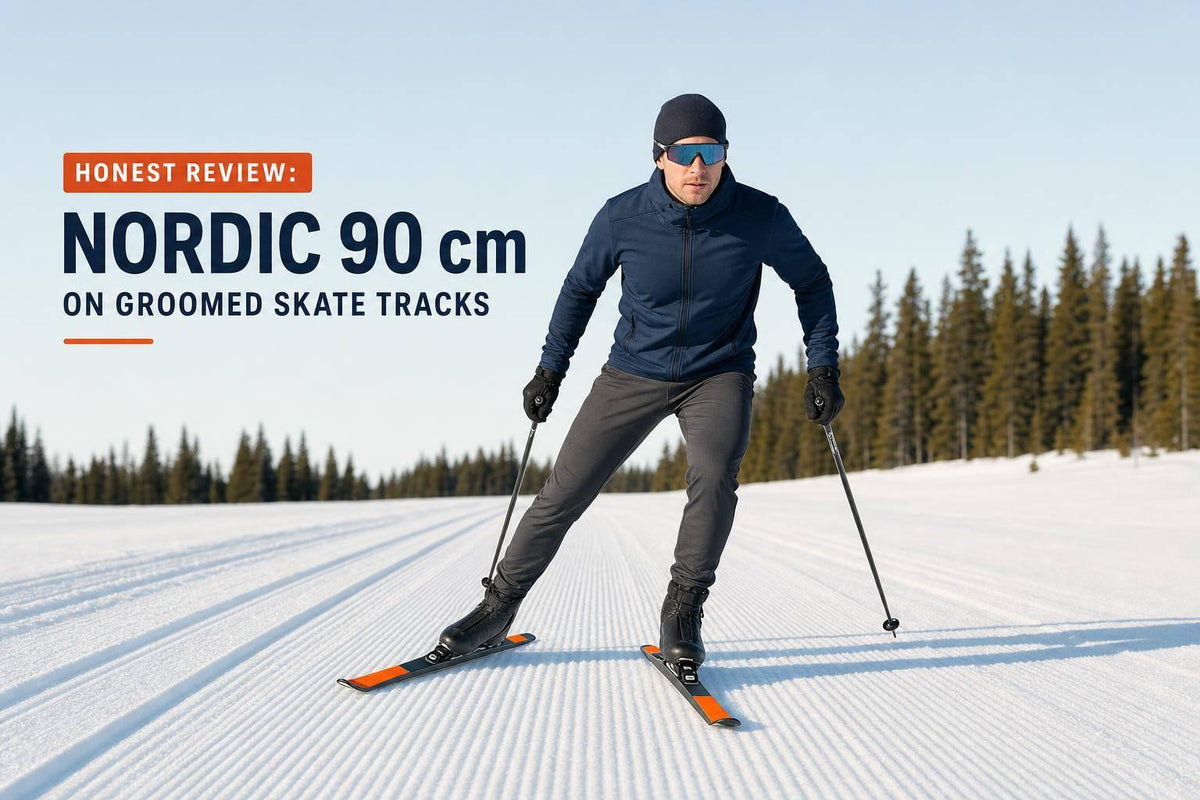
Short answer: I’d pick the NORDIC 90 cm if you want an easy, fun day on groomed skate tracks - not if you want long, fast laps.
I found the big sell here pretty simple: 90 cm skis are less scary, easier to turn, and easier to pack than full-length skate skis. At 3.84 lb per pair, with bindings that fit U.S. shoe sizes 6–13, they’re built for casual riders, families, and travel. The tradeoff? Less glide per push, lower speed, and less calm feel once you start moving fast.
If you’re deciding in 30 seconds, here’s my take:
- Best for: beginners, casual riders, skaters, travelers, families
- Works best on: groomed, firm, packed snow
- Main upside: easy control, easy setup, easy storage
- Main downside: shorter glide and less stability at pace
- Price: starts at $450+
Here’s the quick version:
| What I looked at | My take |
|---|---|
| Glide | Fine for short sessions, but not built for long cruising |
| Control | Very easy to steer and stop |
| Learning curve | Much easier than 170–190+ cm skis for most first-timers |
| Comfort | Better with stiffer winter boots |
| Portability | One of the biggest reasons to buy it |
So, if you want snow gear that feels closer to skating than full Nordic skiing, this makes a lot of sense. If your goal is distance, speed, and workout output, I’d still go with longer skate skis. And yep, that’s the whole story in one shot :)
Snowfeet* Review: Are Skiskates Worth It? | Mini Ski | Skates for Snow | Skating Ski | Short Ski
First Impressions: Setup, Feel, and On-Snow Confidence
Pick up the Snowfeet* NORDIC 90 cm, and the first thing you notice is pretty obvious: they look small next to full-length skate skis. And that’s part of the appeal. The shorter size makes the whole setup feel less intimidating right from the start.
Boot Compatibility and Setup
This is one of the biggest ways it differs from standard Nordic skis. Snowfeet* skips dedicated XC boots and uses a universal winter-shoe binding that fits US shoe sizes 6–13 (38–47 EU). There’s also a Pro XC version with Rottefella NNN bindings that work with NNN, Prolink, and Turnamic systems.
In plain English, that means setup is much simpler. You don’t have to jump straight into a full XC boot system unless you want to. Supportive winter boots or snowboard boots tend to feel steadier, while softer boots can tire your ankles out faster.
That ease matters most once you hit the snow, because the big win here is how fast these skis help you feel in control.
How the 90 cm Length Feels on Snow
The 90 cm length makes the first few minutes on snow feel easy to settle into. The short platform feels quick underfoot and simple to steer. Turns come with less effort, and stopping takes less room. Metal edges help with grip on packed groomed snow, which helps confidence build fast.
"It didn't take long to get used to these shorter skis, much easier than the original longer XC skis I used to own a long time ago! The best part is we can use any shoe and anyone who wants to try them can!" - Martina MacLean
Of course, there’s a trade-off. You get more maneuverability, but less top-end stability than full-length skate skis.
That quick, forgiving feel leads straight into the next part: glide, speed, and control on groomed skate tracks.
Performance on Groomed Skate Tracks: Glide, Speed, and Control
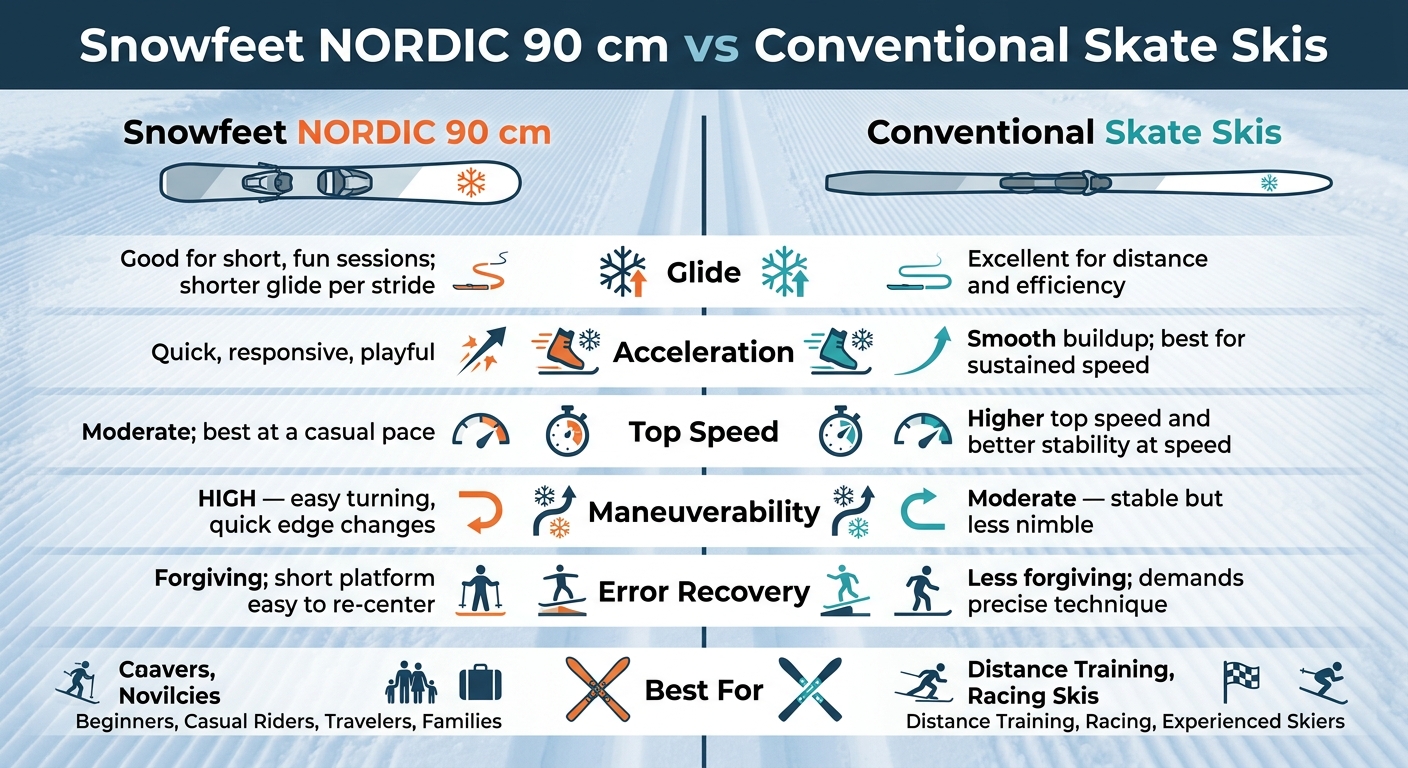
Snowfeet NORDIC 90 cm vs Conventional Skate Skis: Side-by-Side Comparison
Glide and Speed in Casual Use
Once the setup feels dialed in, the next thing that matters is simple: how does the 90 cm length feel when the track opens up?
On groomed skate tracks, the NORDIC 90 cm has enough glide and cruising speed for fun, casual sessions. It works best on firm, packed snow. When the track turns soft or slushy, the short length starts to show its limits sooner than longer skate skis. That’s the deal with short skis: you get less glide from each push, so you’ll need more strides on flat sections.
But there’s a flip side, and it’s a fun one. The lighter swing feel makes the ski feel quick off the line. For short sprints, playful laps, and just messing around on the track, it has a snappy feel that’s easy to like.
Stability, Turning, and Error Recovery
On groomed tracks, the short platform makes quick edge changes and tight turns much easier. Step turns feel simpler. Fast direction changes take less work. And, maybe best of all, there’s far less chance of crossing tips. That alone can save you from a few awkward moments.
The ski is also forgiving when your timing is off. If your weight drifts or you change edges a bit late, the shorter platform is easier to balance on and bring back under control. The metal edges also help when you need to brake or change direction in a hurry. At higher speeds, though, longer skate skis still feel steadier. That’s the main tradeoff.
"Super easy to control, quick to turn, and way more forgiving than traditional skis." - Brad Tolin, Customer
That mix of quick control and modest top-end stability also affects how the ski feels once you’ve been out for a while.
Comparison Table: Snowfeet* NORDIC 90 cm vs Conventional Skate Skis
| Feature | Snowfeet* NORDIC 90 cm | Conventional Skate Skis |
|---|---|---|
| Glide | Good for short, fun sessions; shorter glide per stride | Excellent for distance and efficiency |
| Acceleration | Quick, responsive, playful | Smooth buildup; best for sustained speed |
| Top Speed | Moderate; best at a casual pace | Higher top speed and better stability at speed |
| Maneuverability | High - easy turning, quick edge changes | Moderate - stable but less nimble |
| Error Recovery | Forgiving; short platform is easy to re-center | Less forgiving; demands more precise technique |
For casual riders, that balance starts to matter more as the session goes on. After a while, comfort and ease can matter just as much as speed.
sbb-itb-17ade95
Learning Curve, Comfort, and Day-to-Day Use
Quick handling matters most when you want skis to feel easy right away - and still feel easy after a full session.
How Easy It Is to Learn Skate Stride
At 90 cm, these skis feel far less intimidating than 170–190+ cm skis. There’s just less ski to manage under your feet, so the side-to-side skate motion tends to click faster for first-timers.
That early win matters. One user, makinola from Manchester, US, said they were gliding along in the tracks within 45 minutes of their first outing. That’s the kind of start that helps casual riders stick with it instead of calling it a day too soon.
There is one fair warning, though. If you already have years of XC habits built on full-length race skis, the 90 cm format can feel a bit odd at first. On groomed tracks, the shorter platform changes the feel of classic stride and faster skating. So, experienced XC skiers may need a short reset. Beginners, on the other hand, usually get an easier on-ramp.
Once the motion starts to feel normal, the next thing people notice is simple: how tired - or not tired - they feel.
Comfort, Fatigue, and Ride Feel Over Time
Short skis are easier to lift, pivot, and steer, which can cut down on fatigue during casual rides.
The wood core and waxless base also help keep things simple. You get a smooth ride without much upkeep. That’s nice, because nobody wants to spend more time fussing with gear than skiing.
Boots play a big part too. The universal bindings fit standard winter boots in US sizes 6–13. If comfort is the goal, stiffer winter boots or snowboard boots usually do a better job of limiting foot fatigue than softer boots.
Portability and Storage
At 3.84 lb (1.74 kg) per pair and only 90 cm long, the NORDIC 90 cm is easy to carry, pack, and stash away. You can slide it into a closet, keep it in the car, or pack it in a travel bag. Full-length skate skis? Not so much.
That makes the NORDIC a smart pick for:
- Apartment storage
- Family use
- Travel
So, yeah, the easy learning curve is nice. The easy transport is nice too. And together, they lead to the next point: who gets the most out of the NORDIC 90 cm?
Verdict: Who Should Buy the NORDIC 90 cm
After testing glide, control, and the learning curve, the choice is pretty simple: easy use and easy travel versus the glide and speed of longer skis.
The Snowfeet* NORDIC 90 cm works well for casual skating on groomed tracks. But it’s not for everyone.
Long story short: if you want something fun, compact, and easy to get into, this ski makes a lot of sense. If you care most about speed, distance, and workout output, longer skate skis still have the edge.
Pros and Cons at a Glance
| ✅ Easy to store and travel with | ❌ Less glide per stride than long skate skis |
| ✅ Fast learning curve for beginners | ❌ Lower top speed on groomed tracks |
| ✅ Playful and confidence-building | ❌ Less stable at higher pace |
| ✅ Not suited for distance training or racing |
Best Fit: Beginners, Travelers, Casual Riders, and Skaters
This ski is a good match for beginners, casual riders, travelers, and skaters who want simple groomed-track skating. It’s not built for long-distance efficiency or race-style performance.
If you’re a serious XC skier and care most about pace or workout efficiency, conventional skate skis in the 170–190+ cm range are the better tool for the job. So, yeah, the NORDIC 90 cm sits in a smaller lane. But in that lane, it does its job well.
Final Takeaways
At $450+, the NORDIC 90 cm sits in premium niche territory. You’re paying for portability, easy setup, and comfort on groomed tracks.
That tradeoff only makes sense if those things matter more to you than long-distance glide. For most casual riders, Snowfeet* is the better fit on groomed skate tracks.
FAQs
Can I use these for a full workout?
Yes - but the NORDIC 90 cm works better for short, casual fitness sessions than hard, long-distance training.
Because it gives you less glide and less efficiency than full-length gear, the workout feels more like a brisk winter walk than a full-on ski session. That makes it a good pick for quick, low-stress laps or a bit of after-work movement.
If you're training for speed, following a set workout plan, or going long on endurance, traditional full-length skate skis are still the better tool.
Do I need special boots?
No. With universal bindings, you can use regular waterproof winter boots or snowboard boots. Snowfeet recommends boots with firm ankle support for better stability.
If you want a more familiar feel, the Pro XC version uses Rottefella NNN bindings and needs dedicated cross-country ski boots. For most casual riders, the universal binding is the simpler, more comfortable pick.
How do they handle soft snow?
The Snowfeet NORDIC 90 cm skis work best on firm, packed, and groomed surfaces, where the edges can bite without sinking.
They’re not made for deep, soft snow. The reason is pretty simple: their short length gives you less flotation than longer, wider skis.
Their nimble shape can help cut down on tip-diving in some spots, which is nice. But even then, it’s smart to avoid powder deeper than 4 inches.
For the best ride, stick to:
- groomed skate lanes
- packed park paths
- firm, mellow terrain











コメントを残す
このサイトはhCaptchaによって保護されており、hCaptchaプライバシーポリシーおよび利用規約が適用されます。