



















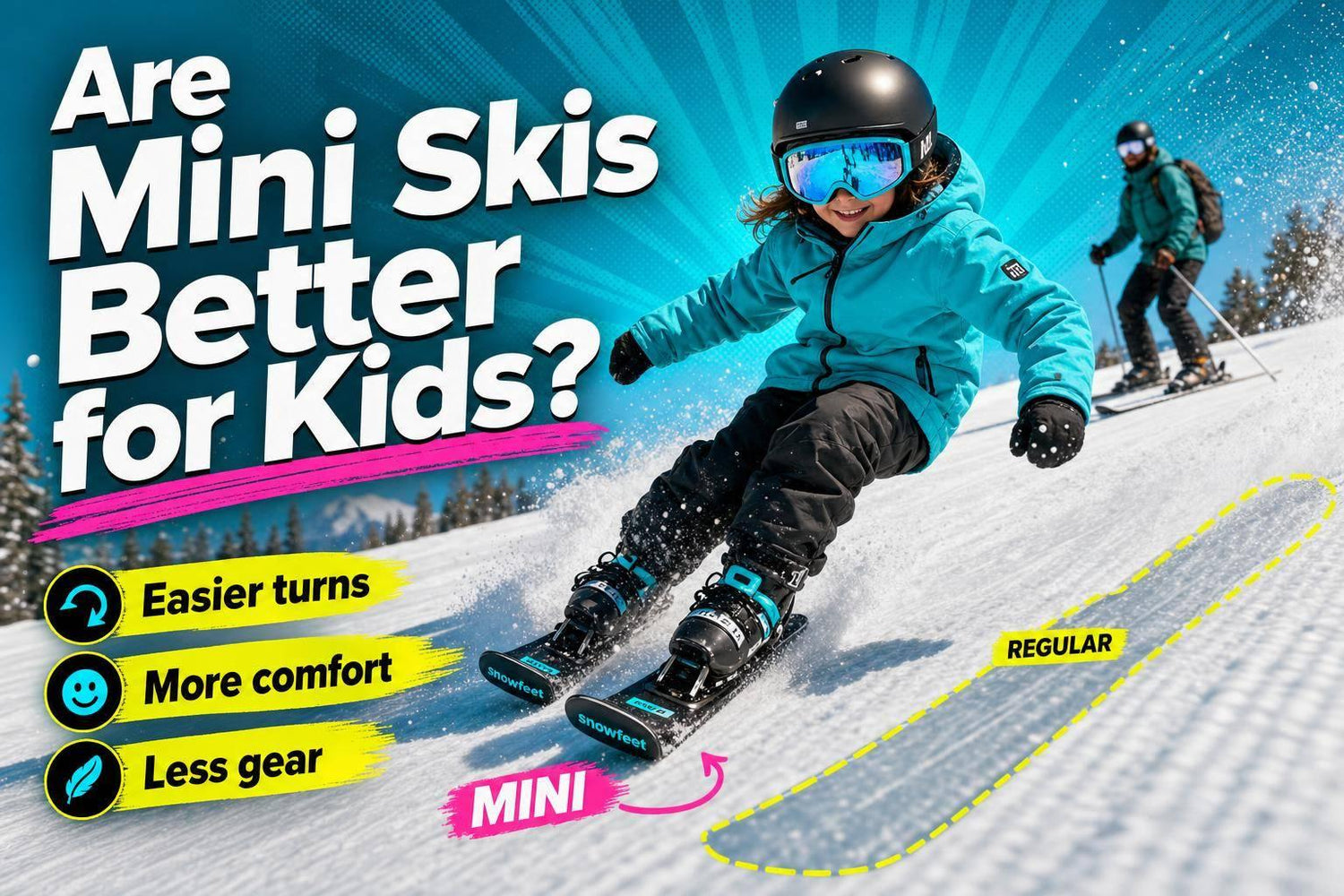
Yes - for most kids, mini skis are the easier start. If your child is young, new to snow, or just wants to turn, stop, and smile without fighting long gear, mini skis usually make more sense than regular skis.
Here’s the short version:
- Mini skis are often 15 to 26 inches (38 to 65 cm) long
- They’re easier to turn at low speeds
- They can feel less awkward for small kids
- Many models work with regular winter boots, so you may skip boot rentals
- Regular skis still make more sense for kids who ski fast, carve hard, or race
I’d look at six things first:
- Control
- Learning speed
- Safety feel
- Comfort
- Portability
- Fun
A simple rule: if your kid is skiing mellow hills, green runs, or backyard snow, shorter skis usually win. If they’re charging blue or black runs and want more stability at speed, regular skis may fit better.
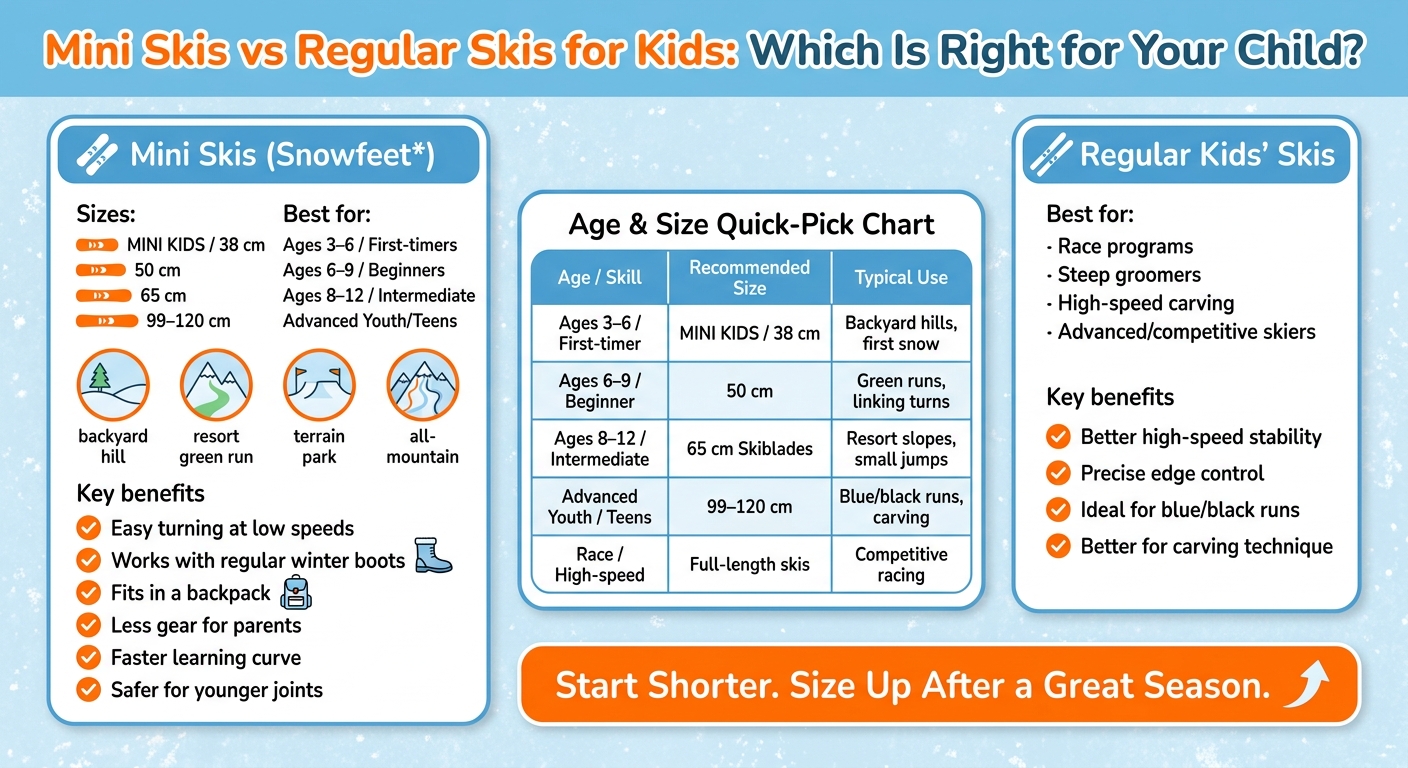
Mini Skis vs Regular Skis for Kids: Quick Comparison Guide by Age & Skill
How to Choose the Best Skis for Kids
Quick Comparison
| Option | Best for | Main upside | Main downside |
|---|---|---|---|
| Mini skis | Young kids, first-timers, casual family snow days | Easy turning, light weight, less gear | Less stable at higher speeds |
| Regular skis | Advanced kids, carving, race track use | Better stability on steeper groomers | Harder for small beginners to handle |
A few size picks from the article:
- Ages 3–6: MINI KIDS or 38 cm / 15 in
- Ages 6–9: 50 cm / 19.7 in
- Ages 8–12: 65 cm / 25.6 in
- Advanced youth: 99 to 120 cm / 39 to 47 in
So, if you want the plain answer: mini skis are often the better pick for most beginner kids because they make the first days on snow simpler and more fun. Long skis still have their place. But for many families, less gear and easier turns are hard to beat :)
How Mini Skis and Regular Skis Compare for Kids
Control, Turning, and How Fast Kids Learn
Mini skis are easier to turn, and that helps kids learn sooner. Snowfeet* MINI KIDS, 50 cm, and 65 cm Skiblades are shorter, so kids can steer with less effort and make tight turns without fighting the ski. There’s also less chance of tips crossing, since there’s simply less ski in front of them. That can save a lot of stop-and-start moments on the slope.
Full-length kids' skis do better once speeds go up, especially on steeper groomed runs.
| Mini Skis (Snowfeet*) | Full-Length Kids' Skis | Best For | |
|---|---|---|---|
| Turning ease | Very easy to steer at low to moderate speeds | Requires more technique and edge use | Mini skis: younger kids, beginners, and playful resort/backyard riding |
| Low-speed stability | Stable on green runs and backyard hills, with quick recovery from wobbles | Good on smooth, gentle slopes, but can feel bulky for small kids | Mini skis: first-timers |
| High-speed stability | Best for moderate speeds, not faster carving | Better for carving, steeper groomed runs, and longer groomed runs | Standard ski setups: advanced kids |
This gap shows up most with beginners. On easy terrain, quick wins matter a lot. A kid who can turn early and stay upright tends to have way more fun. And yeah, fun is half the battle :)
Safety, Comfort, and Kid-Friendliness
Mini skis can feel safer because kids usually stay slower and more in control. When falls happen, shorter skis also bring less chance of twisting during a fall. That’s a big deal for younger children, since their joints are still developing. For most young riders, that matters more than going fast.
Comfort is another spot where Snowfeet* stands out in day-to-day use. Many models, including MINI KIDS and 50 cm options, work with winter boots or snowboard boots. So you can skip the stiff, heavy ski boots that a lot of kids start whining about after the first hour outside. Familiar boots can mean fewer pressure points, less leg fatigue, and more time spent skiing instead of sitting in the lodge. Full-length skis do give better power transfer and more precise control, but that edge matters most when a child already skis with confidence at speed.
Portability and Fun on Snow
Anyone who’s dragged full-length kids' skis across a parking lot knows the deal. It’s awkward. Then add stairs, a lodge, gloves, helmets, snacks... and it turns into a whole production. Snowfeet* mini skis are light and short enough to can fit in a backpack. Less gear means less hassle for parents and more time on snow. Kids can also carry their own setup more easily, which gives them a nice little boost of freedom on the mountain.
Mini skis also bring a more playful feel. They ride a bit more like skating, and most kids pick that up fast. Quick turns, little games, and follow-the-leader laps on a gentle slope feel natural on shorter skis.
| Mini Skis (Snowfeet*) | Full-Length Kids' Skis | |
|---|---|---|
| Weight | Light; kids can carry them independently | Heavier; often requires adult help |
| Length | 15–26 in (38–65 cm); can fit in a backpack | Varies by child height; bulkier to transport |
| Storage | Minimal space at home or in a car trunk | Takes up more space at home and in the car |
| Ease for kids to carry | Easy, even for many younger children | Awkward and tiring for most younger kids |
Once you know how they compare on snow, the next step is matching length to your child's age, size, and where they'll ride.
sbb-itb-17ade95
Choosing the Right Snowfeet* Size for Your Child
After control and comfort, the next thing to sort out is fit.
By Age, Height, and Skill Level
Start with height, then adjust based on skill. For most kids, shorter skis are easier to learn on. So if you’re stuck between two sizes, go shorter first.
Here’s the simple version:
- Ages 3–6: MINI KIDS or 38 cm. These strap right onto winter boots. The short length helps keep the tips from crossing and makes it easier for kids to stand back up after a fall.
- Ages 6–9: 50 cm. This is the next step up. It gives kids more glide and a bit more stability, but still turns fast.
- Ages 8–12: 65 cm Skiblades. A good match for kids who can already link turns and try small jumps. They carve better and feel closer to full-size skis, but still keep that fun short-ski feel.
- Advanced youth: 99 cm or 120 cm. For kids who already ski with confidence and like speed, these give more stability before the move to full-length skis.
If age and height don’t line up, pick based on height and skill first. A strong, athletic kid can often manage the longer option in their height range. A kid who’s still building confidence will usually do better on the shorter size and can move up after a season.
By Use Case: Backyard, Resort, or Terrain Park
Once you’ve picked the size, match it to where your child will use it most.
Backyard hills and local sledding spots: MINI KIDS or 38 cm is the easy pick. They’re fast to put on, fit regular winter boots, and make it simple for kids to start, stop, and turn on uneven snow.
Resort green runs and family ski days: The 50 cm works well for younger kids or beginners. The 65 cm is a better fit for older children who ride lifts and spend more time on longer slopes. That extra length helps on resort runs.
Terrain park laps - small jumps, boxes, playful riding: The 65 cm Skiblades are the go-to. Short enough to stay playful, long enough to feel steady on landings. Teens who are more serious about park riding may like the 99 cm for extra landing support.
Traditional skis are still a better fit for race programs and high-speed carving. But for most casual family use, Snowfeet* mini skis are the cleaner pick.
Quick Guide: What to Pick for Your Child
Use this chart for a fast pick.
| Age / Skill Level | Recommended Snowfeet* Length | Mini Skis vs. Regular Skis | Typical Use |
|---|---|---|---|
| Ages 3–6 / First-timer | MINI KIDS / 38 cm | Mini Skis | Backyard hills, sledding areas, first snow experience |
| Ages 6–9 / Beginner | 50 cm | Mini Skis | Local hills, resort green runs, learning to link turns |
| Ages 8–12 / Intermediate | 65 cm Skiblades | Mini Skis | Resort slopes, terrain parks, small jumps and tricks |
| Advanced Youth / Teens | 99 cm – 120 cm | Short Skis | Blue/black runs, carving, all-mountain resort days |
| Race program / High-speed carving | Full-length kids' skis | Regular Skis | Competitive racing, steep groomers |
Start shorter. It’s a lot easier to size up after a good season than to spend the whole winter watching your kid fight gear that feels too big.
Snowfeet* vs Traditional Ski Brands: Why Shorter Often Wins
Once you’ve got the right length dialed in, the next step is simple: which setup will make skiing easier for your kid?
Most kid ski setups come with longer skis, hard-shell boots, and, well, a pile of gear. That can be a lot. Snowfeet* cuts down that hassle, which is a big reason it works so well for many families.
Where Full-Length Kids' Skis Still Make Sense
Full-length kids' skis still have their place.
They make sense for:
- race training
- steep groomers
- kids who already ski fast and feel at ease on the mountain
For everyone else, the simpler setup tends to win.
Why Snowfeet* Works Better for Most Families
For most families, the trade-off looks different. Snowfeet* mini skis and short skiblades work with regular winter boots. So kids skip the stiff ski boots, and parents skip hauling extra gear around. That alone is a pretty big deal :)
Snowfeet* also fits in a backpack. Traditional kids' skis usually don’t.
And here’s where short skis shine: they’re easier to pivot and easier to stop at beginner speeds. That can make a huge difference when a child is just starting out. Less fighting the gear. More of that “I can do this” feeling.
So, if you want the short version, Snowfeet* makes things simpler:
- regular winter boots
- backpack-friendly transport
- faster learning
- less hassle for parents and kids
That’s why the choice often comes down to this: pick the setup that gets your child skiing sooner, with less frustration, and with more fun.
Conclusion: When Mini Skis Beat Regular Skis for Kids
After looking at control, learning, safety, comfort, and portability, the answer is pretty clear: for most younger kids and beginners, Snowfeet* mini skis in the 38–65 cm range are the better pick than full-length kids' skis. They’re easier to turn, easier to stop, and a lot less scary on mellow slopes.
Here’s the simple breakdown:
- MINI KIDS / 38 cm: best for very young children
- 50 cm: a good fit for most early beginners
- 65 cm: best for older kids who want more glide but still want easy control
Full-length skis still have a place for a smaller group of kids. If a child is already skiing faster blue and black runs, wants more speed, or is headed toward a race program, then full-length kids' skis can make sense. That’s where they start to offer more speed and better stability.
But for most families, Snowfeet* comes out on top for simplicity, control, portability, and plain old fun. And for most kids, that means getting on snow sooner and smiling more while they do it :)
FAQs
Can mini skis be used at ski resorts?
Yes. Mini skis like Snowfeet* Skiblades can be used at ski resorts, mainly on slopes for beginner and intermediate skiers.
They’re built for easy turns and solid control, which makes them a good fit for the right runs.
Do kids need lessons to start on mini skis?
Not always. Kids can often start on mini skis without lessons because the shorter length and forgiving design, like Snowfeet*, make them easier to control and easier to learn on, especially for beginners.
How do I know when my child is ready for regular skis?
A good sign is when your child can control shorter, more forgiving skis with ease, like Snowfeet* mini skis or Skiblades. They’re lighter, simpler to turn, and great for building balance, confidence, and smooth turns.
Once that feels comfortable, your child is likely ready for regular skis. Regular skis give them more stability at higher speeds and on mixed terrain, but they also take more skill to handle.











コメントを残す
このサイトはhCaptchaによって保護されており、hCaptchaプライバシーポリシーおよび利用規約が適用されます。