




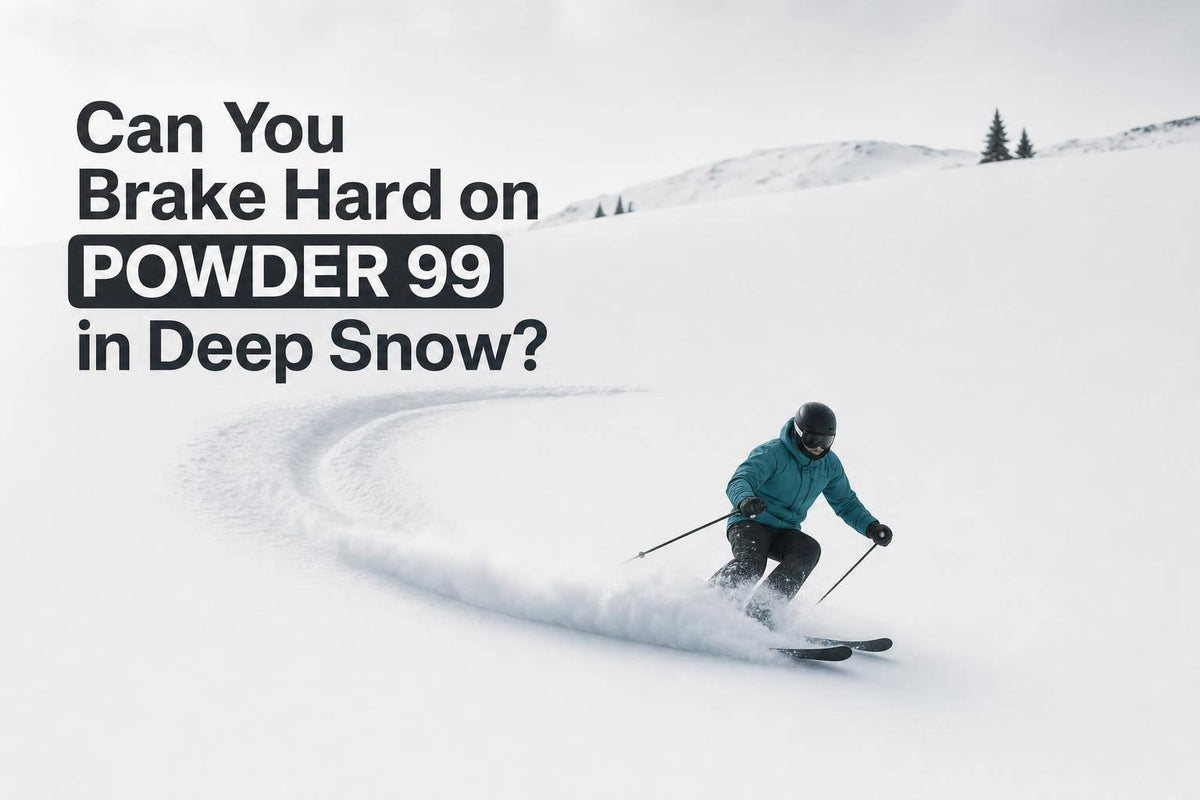
Short answer: yes, but not like on a groomer. On the Snowfeet* POWDER 99, deep snow slows you down best through turns, skids, and uphill finishes - not one sharp slam-stop.
Here’s the simple version:
- In deep powder, braking takes more space
- Rounded turns do most of the speed control
- A hockey stop may work in shallow or tracked powder
- In loose, deep snow, expect a gradual slowdown
- The 99 cm length makes the ski easy to pivot, but less planted than a long powder ski
So, if you’re asking, “Can I stop on these in powder?” the answer is yes - if I start early and use the right move. If I wait until the last second and try to brake like I’m on hardpack... yeah, powder may just laugh at me a little :)
A few numbers help frame it:
- Length: 99 cm
- Best casual terrain: about 10–15° slopes
- Best stopping style in deep snow: J-turns, skidded turns, and broad turns across the hill
Quick Comparison
| Situation | What works best on POWDER 99 | What it feels like |
|---|---|---|
| Groomed snow | Hockey stop or firm skid | Fast, sharp stop |
| Shallow powder | Skidded turn or hockey stop | Good slowdown, some spray |
| Tracked powder | Two-footed skid | Mixed grip, mixed response |
| Deep loose powder | Rounded turn or J-turn | Slow, gradual stop |
My take: POWDER 99 is a fun pick if you want a ski that feels light, turns fast, and handles soft snow well on mellow to mid-grade terrain. Just don’t expect instant-stop braking in deep powder. That’s not a ski issue as much as a snow issue.
Why Braking on POWDER 99 Feels Different Than on Groomed Snow
POWDER 99 is short, quick, and easy to pivot. But it also has less running surface than a full-length powder ski. In deep snow, that tradeoff changes how the ski slows down. Braking feels more gradual, less like a sharp stop. So on POWDER 99, slowing down depends more on turn shape than on trying to slam on the brakes.
How Deep Powder Affects Edge Grip and Stopping Response
Powder doesn't give you the same firm edge bite as groomed snow. That means braking is more progressive. You slow down with turn shape, skids, and short speed checks instead of expecting an instant sideways stop
That’s the big shift. In powder, speed control and turn shape do most of the work.
POWDER 99 vs Long Powder Skis vs Groomed-Snow Skis: A Quick Comparison
Long powder skis still have the edge for high-speed stability. But for most casual riders, the stuff that matters day to day comes down to three things:
- Flotation: Long powder skis spread your weight across more surface area, so they float better in very deep snow. POWDER 99 does fine in moderate powder, but in the deepest snow it can sink a bit and slow down less evenly
- Pivoting: POWDER 99 is easier to redirect and simpler to handle in tight terrain. Long skis feel steadier at speed, but they take more work to swivel
- Braking feel: On groomers, narrow skis stop with the sharpest feel. In powder, every ski moves to a more gradual kind of deceleration. POWDER 99 works best with speed checks and rounded turns, while long skis feel more planted over a longer braking arc
Long skis still feel more planted in steep, open powder. But in tighter terrain, and for most casual riders, POWDER 99 is easier to turn, easier to handle, and usually the better match.
With that in mind, the next step is simple: which braking moves work best in powder.
Braking Methods That Work Best on POWDER 99
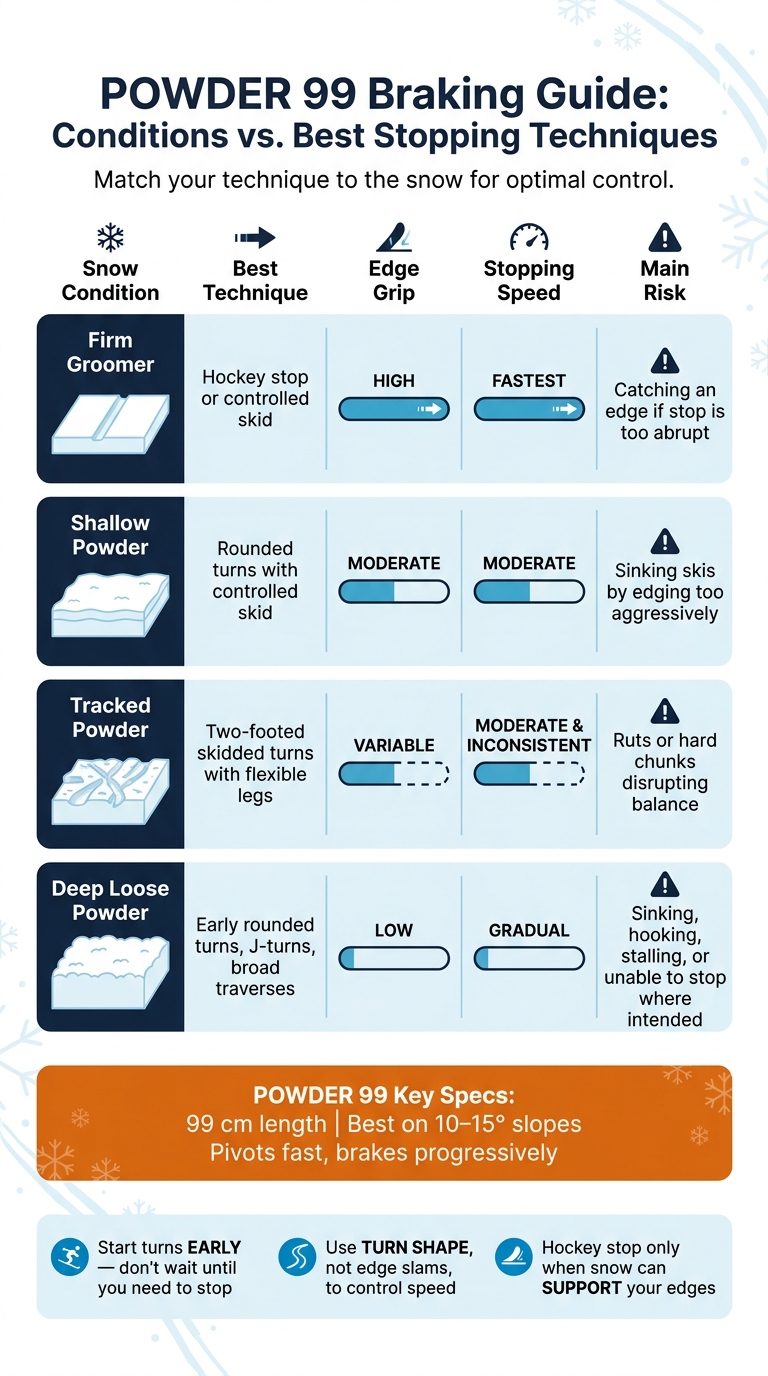
POWDER 99 Braking Guide: Snow Conditions vs. Best Stopping Techniques
In powder, slow down early. On POWDER 99, the best braking usually comes from your turn shape, not a last-second hard stop. So, speed control starts before things feel fast.
Control Speed Early With Rounded Turns
On POWDER 99, the simplest way to stay in control is to finish each turn farther across the slope. Skis pick up speed most when they point straight downhill. That means the less time your POWDER 99 spends in the fall line, the less speed builds.
Link smooth, rounded turns. Make them shorter on steeper slopes. Let them run longer on open terrain. Stay centered over your feet the whole time - ankles flexed, shins lightly touching the front of your boots. If you lean back, you load the tails too much. That makes the skis tougher to steer and can make the next turn feel messy.
Use a Skidded Turn to Bleed Off Speed
If a rounded turn isn’t cutting enough speed, go to a skidded turn. Turn the skis farther across the hill, flatten them a bit, and let them drift sideways to scrub speed.
Steer with both legs. Add pressure as the skis move more across the hill. Then release that pressure before you start the next turn. Don’t jam the tails sideways. On short skis, that can make them sink unevenly or knock you off balance.
When a Hockey-Style Stop Works and When It Does Not
A full hockey-style stop works best in shallow powder, tracked powder, or denser snow where the edges can find support. It can also work at moderate speed if the snow is firm enough for the edges to bite.
In bottomless or very loose powder, treat it as unreliable, not impossible. The skis may sink, dive, or only slow you partway, especially once speed builds. In those conditions, the safer bet is to expect a strong speed check, then finish with a rounded turn, an uphill finish, or a controlled traverse to a safe place to stop.
| Snow condition | Most realistic braking approach | Expected feel |
|---|---|---|
| Shallow powder | Skidded turn, J-turn, or hockey stop when a firmer layer is reachable | Moderate braking with some spray and sink |
| Tracked or denser powder | Skidded turn or hockey stop | More support and more predictable resistance |
| Bottomless or very loose powder | Rounded turns and progressive J-turns; emergency stopping is less reliable, so control must begin earlier | Gradual slowdown, not a sharp stop |
From here, snow depth and slope angle decide how much stopping power you’ll get.
sbb-itb-17ade95
How Braking Changes by Snow Type, Terrain, and Speed
Braking Feel Across Different Snow Conditions
On POWDER 99, snow texture matters just as much as technique. Firm snow helps you stop faster. Deep powder? That’s more about slowing down early than snapping into a hard stop.
Because POWDER 99 is only 99 cm, it reacts fast. Small pressure shifts show up right away, and that becomes even more noticeable as snow gets softer or the pitch gets steeper. In plain terms: this ski doesn’t wait around.
| Snow condition | Ease of initiating a skid | Edge grip | How fast it slows | Best technique | Main risk |
|---|---|---|---|---|---|
| Firm groomer | High | High when edges are engaged | Fastest | Progressive edge set, hockey stop, or controlled skid | Catching an edge if the stop is too abrupt |
| Shallow powder | Moderate to high | Moderate; avoid excessive edging | Moderate | Rounded turns with a controlled skid | Sinking the skis by edging too aggressively |
| Tracked powder | Moderate | Variable but often supportive | Moderate and inconsistent | Two-footed skidded turns with flexible legs | Ruts or hard chunks disrupting balance |
| Deep loose powder | Low to moderate | Low compared with packed snow | Gradual rather than immediate; maintain minimum comfortable speed, then gradually turn across the slope to stop | Early rounded turns, broad traverses, J-turns, and speed control before hazards | Sinking, hooking, stalling, or being unable to stop where intended |
So, speed control has to begin before the slope gets steeper or the snow gets deeper. In deep snow, stopping depends less on a hard edge set and more on your line choice. That’s the big shift.
Where Casual Riders Will Enjoy POWDER 99 Most
This is where POWDER 99 starts to make a lot of sense. Its short, quick feel helps casual riders manage speed without wrestling a long ski.
POWDER 99 works best on low-angle powder laps, especially gentle pitches in the 10–15° range where you can link smooth, rounded turns without needing to slam on the brakes mid-run. At 99 cm, it feels quick and light when changing direction, especially next to a full-length powder ski. That helps in spaced trees or on a soft shoulder beside a groomer, where quick little adjustments can save you from that “uh, too much speed” moment.
On a mixed resort day - firm groomers in the morning, softer snow later - POWDER 99 handles the change well. You get a firmer edge feel on packed snow, then a looser, more skidded feel as the surface softens. Riders who bounce between conditions will like how easy it is to pivot and reset. For most people, that makes POWDER 99 better at controlled speed checks than last-second hard stops.
You also don’t need race-level carving skills to stay in control here. A centered stance, weight on both feet, and relaxed turns do a lot of the work on moderate terrain.
When Long Skis Still Brake More Predictably
Long skis still have the edge when you need a later, stronger speed check in open powder. They brake more predictably in steep, open terrain because the extra surface area keeps you riding higher in deep snow and gives you a longer platform underfoot.
That matters on steep open faces, faster descents, or long flat runouts where you need to carry speed and then shut it down with purpose. In those spots, the extra float and length make big, shaped braking turns feel calmer and less rushed.
If you spend a lot of time on steep lines, heavy powder, or mixed snow where a late stop could turn into a bad day, longer skis give you more room for error. That’s the trade-off, plain and simple.
Still, most casual resort riders are skiing moderate terrain, mixing groomers with soft snow, and looking for something easy to handle. For that rider, POWDER 99 is often the more fun choice because of its quick feel and compact size - even if it asks you to think about speed control a bit sooner than a longer ski would.
Conclusion: Is POWDER 99 the Right Choice if You Need to Stop in Powder?
Bottom line: go with POWDER 99 if you want easy control in powder, not instant-stop braking. This ski slows down best with rounded turns and smooth, progressive skids. It’s not built for hard, groomer-style braking. That’s the honest braking profile.
At 99 cm with a short turn radius, POWDER 99 pivots fast. That makes speed checks easier in soft snow and tight terrain. It feels quick underfoot, which is a big plus. But here’s the part that matters most: snow depth still calls the shots when it comes to braking.
A full hockey stop can work in packed or tracked powder. In deep, loose snow, though, a wide uphill turn or J-turn is the safer bet. Think of it like trying to stop a bike on sand versus pavement. Same rider, same move, very different result.
For casual riders who split time between groomers and soft snow, POWDER 99 gives the best mix of control, maneuverability, and powder performance. Longer skis still slow down in a more steady way on steep, fast, open lines. But for most casual riders, that tradeoff leans in POWDER 99’s favor.
Key Points Before You Buy
- Deep snow softens braking response. Plan to slow down in stages, not all at once.
- POWDER 99 is easy to maneuver. Its short length and tight turn radius help with fast pivots and direction changes.
- Control speed early. Start the turn before you need to stop, not after.
- Use a hockey stop only when the snow can support the edges. In deep, loose powder, a progressive skid or uphill turn works better.
- Leave extra space around hazards in powder. Edge engagement takes longer than it does on a groomer.
FAQs
How much room do I need to stop in deep powder?
Because the Snowfeet POWDER 99 cm is made for agility and quick pivots, you usually need less space to slow down than you would on long skis. In soft resort powder, short, rhythmic turns and quick skidded stops help bleed off speed well.
For a quick stop, a hockey stop can work: turn the skis 90 degrees across the slope, stay centered, and engage the edges. That wide, responsive platform also makes it easier to manage speed in tight trees and side stashes.
Are POWDER 99 skiblades good for beginners in soft snow?
Yes - the Snowfeet POWDER 99 cm is a solid pick for beginners who want to try deep snow.
Compared with long powder skis, it feels lighter, less bulky, and easier to control. That matters a lot when you’re still getting used to soft snow and don’t want your gear to feel like a wrestling match.
Its short length helps in a few big ways:
- It cuts down on fatigue
- It helps you stay more centered
- It makes turns easier
The wider shape also gives you enough float for resort powder. So you can build confidence and enjoy the snow without that “steering a bus” feeling that long powder skis can bring.
When should I use a hockey stop instead of a J-turn?
Use a hockey stop when you need a fast, controlled stop, like on steep runs or when something pops up in front of you. Turn your skis sideways across the slope, bend your knees, stay centered, and press into the edges.
For day-to-day speed control, use J-turns and short, steady turns. They help you slow down with better flow and less jolt. On the Snowfeet POWDER 99, these turn-based moves scrub speed in a smooth, natural way instead of slamming you into a full stop.











コメントを残す
このサイトはhCaptchaによって保護されており、hCaptchaプライバシーポリシーおよび利用規約が適用されます。