



















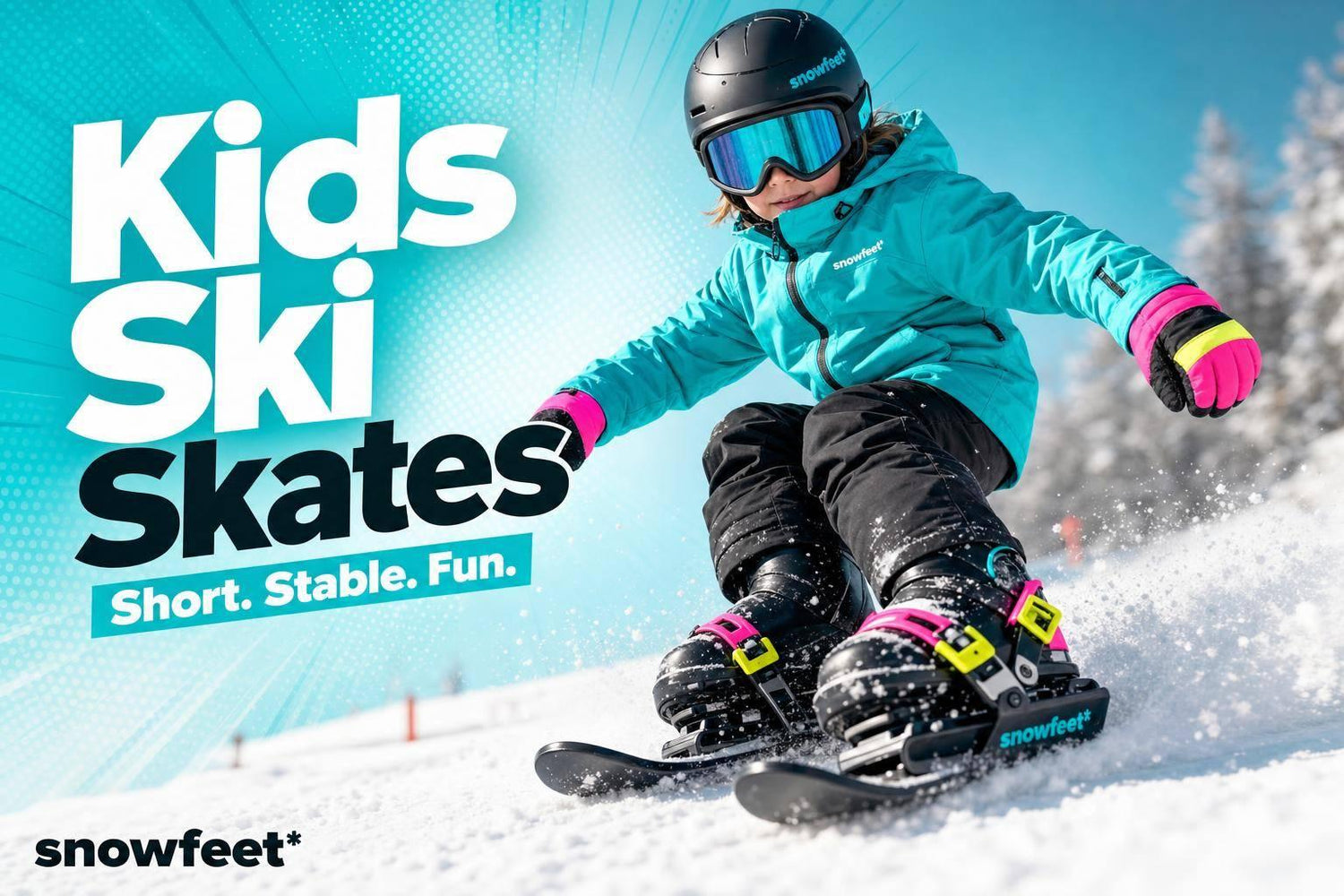
Most kids learn faster on less ski. If full junior skis at 80–120 cm feel like too much, I’d look at shorter options first: MINI KIDS (38 cm), Skiskates 44 cm, PRO 50 cm, and Skiblades 65 cm.
Here’s the short version:
- Ages 3–6: go with MINI KIDS
- Ages 6–10: look at Skiskates 44 cm
- Ages 8–12: check PRO 50 cm
- Tweens and teens: consider Skiblades 65 cm
- Regular winter boots? MINI KIDS or PRO 50 cm make life easier
- More support at speed? The 65 cm option gives the calmest ride
- Best rule: pick the shortest model your child can control
About 75% to 80% of the choice comes down to just two things:
- What boots your child will wear
- How steady they already are on snow
That’s it. Don’t buy by age alone. A bold 7-year-old with skating skills may do fine on 44 cm. A cautious 10-year-old may have more fun on 50 cm.
The ultimate fun skis for kids. 🎿
Quick Comparison
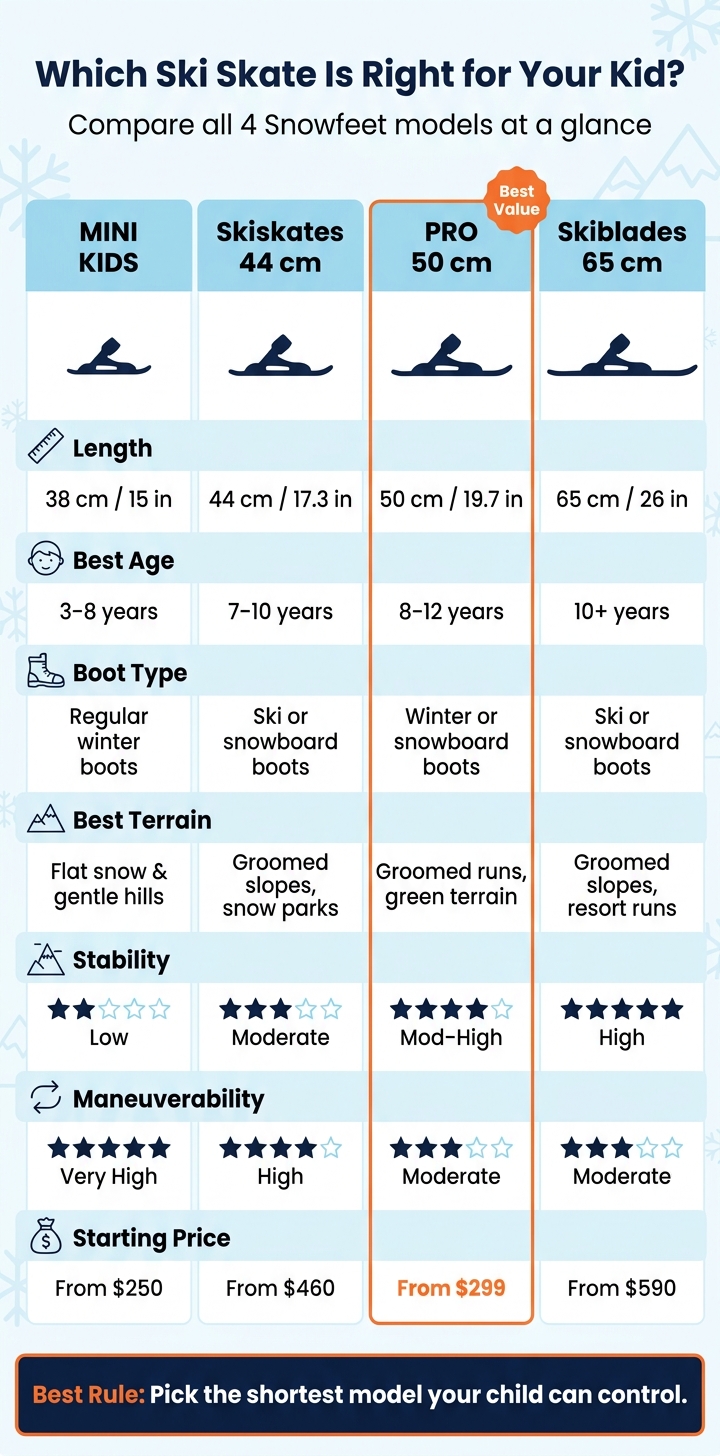
Kids Ski Skates Comparison Chart: Which Model Is Right for Your Child?
| Model | Length | Best for | Boots | Price |
|---|---|---|---|---|
| MINI KIDS | 15 in / 38 cm | First days on snow, small kids | Winter boots | $250+ |
| Skiskates | 17.3 in / 44 cm | Kids who already balance well | Ski or snowboard boots | $460+ |
| PRO | 19.7 in / 50 cm | Kids who want more support without going too long | Winter or snowboard boots | $299+ |
| Skiblades | 26 in / 65 cm | Older kids who want more ski feel | Ski or snowboard boots | $590+ |
My take: MINI KIDS is the easy start, 44 cm is the playful step-up, 50 cm is the best middle pick, and 65 cm is for kids who want more glide and a more ski-like ride.
And yeah, one more thing: check your local resort rules before you go. Some U.S. ski areas don’t allow very short skis or skiskates. That’s a rough thing to learn at the ticket window :)
Below, I break down which model fits which kid, where each one works best, and where each one starts to feel like too much - or not enough.
1. Snowfeet* MINI KIDS
Age Fit
Snowfeet* MINI KIDS is a good match for kids around 3–8 years old. At 15 in (38 cm) long, it feels small and less scary than full skis. That matters a lot with little kids. Long gear can make them freeze up before they even start.
The short platform also makes balance easier to learn. Kids don’t feel boxed in, and they can shuffle, stand, and slide without fighting the equipment. If a child can already stand on snow, scoot around a bit, and glide a short distance, they’re usually ready for these.
Boot Compatibility
This is the big selling point: they work with normal winter boots.
They fit regular winter boots in sizes US Kids 10 to US Adult 6 (EU 27–38). Go with waterproof boots that have:
- firm soles
- decent ankle support
- a snug fit
Try to skip bulky snowboard boots. They can be too wide and awkward for the binding.
Stability vs. Maneuverability
At 15 in, MINI KIDS is built more for easy turning and balance than for speed. That’s a good thing for first-timers. Kids can make small moves, turn fast, and get a feel for sliding without dealing with a lot of ski.
The trade-off is simple: high-speed stability is limited. On steep hills or icy snow, grip won’t match longer Snowfeet models. MINI KIDS does come with metal edges and a heel brake to help with stopping, which gives kids and parents a bit more peace of mind. Still, these work best at low, controlled speeds.
Best Terrain
Use MINI KIDS on gentle, groomed snow with plenty of space at the bottom. That’s the sweet spot.
Skip terrain like this:
- icy patches
- steep slopes
- rough snow
Think of it as a kid’s first step into sliding sports. Once they can turn and stop on their own, it makes sense to move up to Skiskates 44 cm.
2. Snowfeet* Skiskates 44 cm
Age Fit
Skiskates 44 cm are the next step for kids who’ve outgrown MINI KIDS and want more of a skate-like ride. They’re usually a good match for kids around 7–10 years old, but boot size matters more than age.
Here’s the fit range:
- Ski-boot version: US 4.5–14.5 (EU 36–49)
- Snowboard-boot version: US 6–14.5 (EU 38–49)
Kids who already skate on ice or use inline skates often pick these up faster. The movement feels familiar, so the learning curve can be a bit less steep.
Boot Compatibility
Pick the ski-boot version or the snowboard-boot version based on the gear your child already has. Simple as that.
Stability vs. Maneuverability
At 44 cm (17.3 in), these are some of the shortest skis you can buy. That short length is a big part of the fun. They turn fast, feel playful, and don’t take much effort to move around.
The flip side? They give less front-to-back support than longer skis. So if a kid leans back or starts bombing downhill, things can get wobbly in a hurry.
A few basics help a lot:
- Keep knees bent
- Keep hips centered
- Keep hands forward
These work best on groomed, hard-packed snow. At moderate speeds, they feel lively and fun. Push too fast, though, and they’re less forgiving than longer skis.
Best Terrain
Gentle green runs are the sweet spot. Once a child feels at ease, easy blue runs can work well too. Beginner zones and magic carpet lifts are a nice match for first days out.
Skip icy hardpack and deep powder when possible. On ice, they can feel twitchy. In deeper snow, they can sink more than a longer ski.
If your child starts wanting more support and a more classic ski feel, PRO 50 cm is the next move.
3. Snowfeet* PRO 50 cm
Age Fit
If 44 cm feels a bit too short, the PRO 50 cm is the next step. It’s a good match for bigger kids who’ve outgrown the 44 cm model and want a bit more stability underfoot. It fits US shoe sizes 5–13 (EU 37–47), so it works well for kids with bigger feet and better balance.
Boot Compatibility
You can use it with standard waterproof winter boots or snowboard boots. No ski boots needed. That’s a big plus for families, because you can skip the whole ski-boot setup and keep things simple. And, let’s be honest, fewer gear battles in the parking lot is always a win :)
Stability vs. Maneuverability
At 50 cm (19.7 in), the PRO lands right between the 44 cm Skiskates and the 65 cm Skiblades. That extra length gives kids more front-to-back balance and a steadier ride, but it still keeps that quick, skate-like feel.
Kids who already skate or rollerblade often get the hang of it fast. That’s what makes this model such a sweet spot: more control than the 44 cm, but less ski-like than the 65 cm.
Best Terrain
It works best on:
- Groomed slopes
- Snow parks
- Easy downhill runs
That’s the kind of terrain most kids see on lesson days or family ski trips. If a kid wants even more stability and more of a ski feel, the 65 cm Skiblades are the next move.
sbb-itb-17ade95
4. Snowfeet* Skiblades 65 cm
Age Fit
If the 50 cm PRO feels a bit too short, the 65 cm Skiblades are the next step up. This is the most ski-like option in the Snowfeet lineup.
They’re a good match for kids 10 and up who want more of a downhill ski feel than the shorter models give. Think of them as a smart middle ground: more like skis, but without the bulk of full-length skis. They give kids more support than the 44 cm and 50 cm models, and they feel less like skates on snow.
Boot Compatibility
The 65 cm Skiblades come with either ski-boot bindings or snowboard-boot bindings. The ski-boot version fits US 4.5–14.5 (EU 36–49).
If your family already has ski boots, that setup is the easiest path. No extra gear puzzle. Just click in and go.
Stability vs. Maneuverability
At 65 cm, these feel more steady front to back and less twitchy than the 44 cm or 50 cm models. They still turn fast, but the ride feels more controlled and less like skating.
Compared with the 50 cm PRO, the 65 cm trades a bit of snap for a calmer feel. That’s often a good deal for kids who need more planted balance and a little less “whoa, that moved fast.”
Best Terrain
They work best on:
- Packed snow
- Groomed slopes
- Downhill runs
- Snow parks
Next, compare all four models side by side for learning speed, control, and family use.
Side-by-Side Comparison: Learning, Control, and Family Use
After the model-by-model breakdown, this is the fastest way to compare the four options.
MINI KIDS work best for the youngest first-timers. Skiskates 44 cm fit kids who already feel okay on snow. PRO 50 cm adds more stability for older kids with basic balance. And Skiblades 65 cm give the most ski-like ride of the bunch.
Set next to longer junior skis, all four are easier to turn at low speed. That’s the good news. The tradeoff? They sink sooner in powder, and they feel less steady as speed picks up.
The boot setup is often the quickest way to narrow it down. MINI KIDS and PRO 50 cm keep things simple. Skiskates 44 cm and Skiblades 65 cm are a better fit for families who are ready to deal with ski boots.
Here’s the direct comparison:
| Model | Best Age / Stage | Boot Compatibility | Best Terrain | Stability | Maneuverability | Starting Price |
|---|---|---|---|---|---|---|
| MINI KIDS | Young children, first-timers | Regular winter boots | Flat snow and gentle hills | Low | Very High | From $250 |
| Skiskates 44 cm | Beginner–intermediate kids | Ski boots or snowboard boots | Groomed slopes, snow parks | Moderate | High | From $460 |
| PRO 50 cm | Older kids and teens with basic balance | Winter boots or snowboard boots | Groomed runs, green terrain | Moderate to High | Moderate | From $299 |
| Skiblades 65 cm | Older kids and teens ready for a more ski-like ride | Ski boots or snowboard boots | Groomed slopes, resort runs | High | Moderate | From $590 |
If you're choosing for your family, here’s the plain-English version:
- MINI KIDS are the best fit for the youngest beginners.
- The 44 cm and 50 cm models suit kids who already have decent balance and want more glide.
- The 65 cm Skiblades make sense as a step-up for older kids who want more stability and a more classic skiing feel.
Next: pros and cons of each model.
Pros and Cons of Each Model
Use this quick comparison to narrow your pick before the final recommendation.
| Model | Best Advantages | Main Drawbacks | Best For |
|---|---|---|---|
| Snowfeet MINI KIDS* | Fits regular winter boots; less intimidating for first-timers; lightweight and easy to move in | No metal edges; limited control on steep or icy terrain | Young children on gentle backyard hills or beginner resort areas |
| Skiskates 44 cm | Highly maneuverable; metal edges for turning and stopping; best for kids who already skate | Can feel twitchy at speed; requires solid front-to-back balance | Kids comfortable with basic balancing and gliding, ready for simple turns and stops |
| PRO 50 cm | Good balance of stability and control; works with winter or snowboard boots | Can move faster than a beginner can control; less forgiving for very young kids | Confident kids ready to practice smoother turns on green and easy blue runs |
| Skiblades 65 cm | Best stability of the four; closest to a traditional ski feel; strong edge grip | Bulkier than shorter models; demands more balance; usually needs ski or snowboard boots | Older kids and early teens with some snow experience who want a more stable, more ski-like ride |
The MINI KIDS are the easiest way to get started. Kids can wear regular winter boots, which means less gear, less hassle, and fewer battles in the parking lot :). The catch is simple: with no metal edges, stopping gets much less dependable on steeper slopes or icy snow.
The middle two are where most families pause and think. The 44 cm Skiskates feel faster, looser, and more reactive. That makes them a nice match for kids who already know how to skate and can keep their balance front to back. The PRO 50 cm gives a bit more steadiness while still feeling light and easy to turn. It’s a better pick for kids who are ready to work on clean turns, not just straight gliding and stopping.
The 65 cm Skiblades give the most control and edge grip in this group. They also feel the closest to regular skis, which can help older kids who want that ski-like ride. But there’s no free lunch here. They’re bigger, ask more from a child’s balance right away, and usually work best with proper ski or snowboard boots.
So the choice is pretty simple: match the model to the kid’s age, balance, and boot setup. Get that part right, and the rest gets a whole lot easier.
Final Recommendation
The choice here is pretty simple: start with the boot type, then pick the model that fits your child’s confidence level and the kind of terrain they’ll ride.
If your child is a first-time rider and will be using regular winter boots, Snowfeet MINI KIDS is the safest and easiest place to start.
If your child already uses ski or snowboard boots and wants something more playful, go with Skiskates 44 cm.
Pick the PRO 50 cm for a confident child who needs a bit more stability without jumping to a bigger, ski-like setup. It’s the best middle option when the 44 cm feels too small, but the 65 cm is still too much.
Don’t move up to the 65 cm just because your child is older or bigger. Choose the 65 cm Skiblades only if your child wants the most ski-like feel and already has the balance to handle a longer platform.
Go with the shortest model your child can control. In most cases, that’s the safer, easier, and more fun pick.
FAQs
How do I know if my child is ready to size up?
Your child is probably ready to move up once they’ve got the basics down on their current Snowfeet model. That means they can turn, stop, and stay balanced without a ton of wobble.
Shorter options, like the 44 cm Skiskates, are great when kids are still building confidence. They feel less intimidating and are easier to handle.
When skills start to click, moving up to the 65 cm Skiblades or a longer model can help a lot. You get better edge control, a more stable feel, and smoother carving as your child grows and improves.
Can my child use these at any ski resort?
Yes - Snowfeet can be used at most ski resorts in the United States. They have standard metal ski edges, so they’re usually allowed anywhere regular skis and snowboards are allowed.
That said, it’s still smart to check each resort’s equipment policy before you go. Rules can vary, and a quick look can save you a headache at the lift.
Are ski skates easier to learn on than regular skis?
Yes. Ski skates and other short-ski products like Snowfeet* are usually easier to learn on than long skis.
They’re lighter, shorter, and feel more natural right away. That means turning and stopping tend to feel easier, which is a big deal when you’re just starting out.
Their small size also helps you avoid crossed tips. If you’ve ever watched a beginner get tangled up on long skis, you know how fast that can go sideways :) On top of that, they work with regular winter boots or snowboard boots, so the setup feels simpler and less intimidating for first-timers.











コメントを残す
このサイトはhCaptchaによって保護されており、hCaptchaプライバシーポリシーおよび利用規約が適用されます。