



















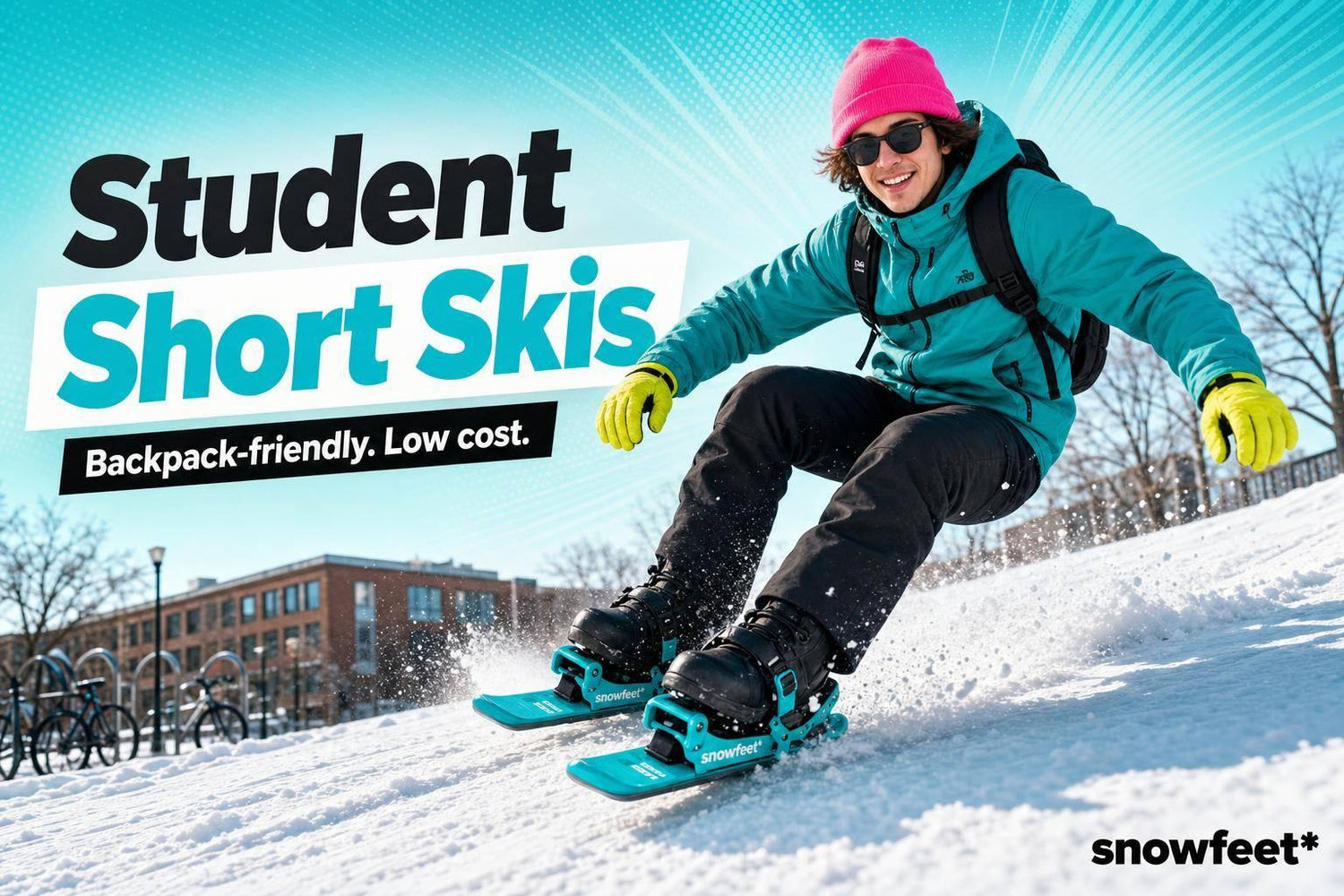
If I were buying short skis on a student budget today, I’d start with the 50 cm option. It has the lowest entry price at $299, works with regular winter boots, and is small enough to stash in a backpack. That matters when a single beginner ski day in the U.S. can cost $200 to $400+, and new full ski setups often land around $500 to $800.
Here’s the short version:
- Best low-cost pick: Snowfeet* PRO Ski Skates 50 cm - from $299
- Most playful pick: Snowfeet* Skiskates 44 cm - from $460
- Most ski-like short option: Snowfeet* Skiblades 65 cm - from $590
- Best for full-mountain use: entry-level full skis - $500 to $800+
- Cheapest used option: legacy snowblades - often $70 to $150, but usually need ski boots and may need shop work
For most students, the big question isn’t just price. It’s total setup cost. If you need to buy boots too, a “cheap” pair of skis can stop looking cheap fast. That’s why I’d look at boot fit, storage space, and how often you’ll ski before anything else.
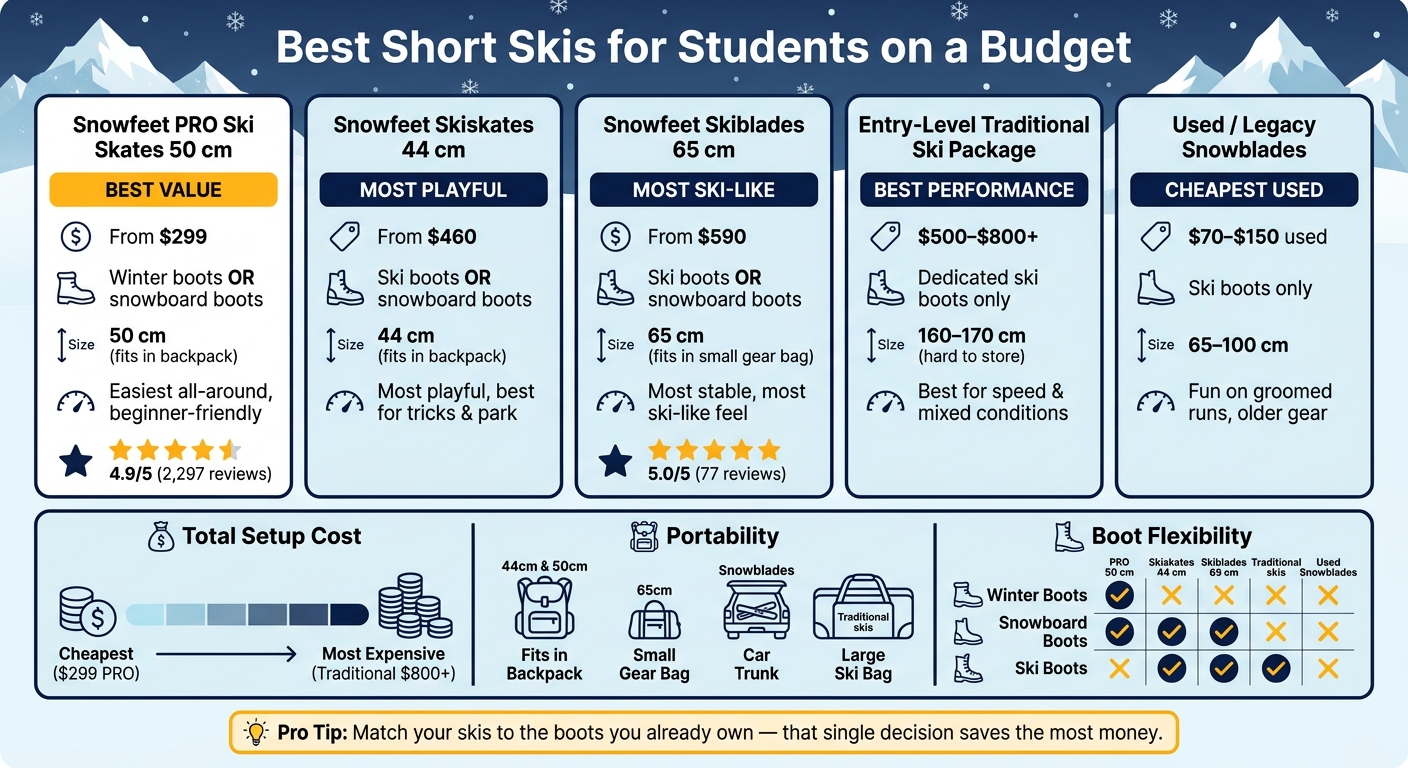
Short Skis for Students: Price, Portability & Performance Compared
Snowboarder tries Snowfeet* | Which Snowfeet* Short Ski is the Best? | Snowblades 44, 65, 99 Review
Quick Comparison
| Option | Price | Works With | Carry/Storage | Best For |
|---|---|---|---|---|
| Snowfeet* Skiskates 44 cm | $460 | Ski boots or snowboard boots | Backpack-sized | Tricks, park laps, groomers |
| Snowfeet* PRO Ski Skates 50 cm | $299–$350 | Winter boots or snowboard boots | Backpack-sized | Lowest-cost setup, casual resort use |
| Snowfeet* Skiblades 65 cm | $590–$750 | Ski boots or snowboard boots | Small gear bag | More control, more ski feel |
| Full ski package | $500–$800+ | Ski boots only | Hardest to store | Faster runs, mixed conditions |
| Used snowblades | $25–$180 | Ski boots only | Easy trunk carry | Lowest used price |
My take? Go with the setup that matches the boots you already own. That one move can save you the most money, the most hassle, and maybe one awkward dorm-room argument with your roommate about why your skis are on the couch again :)
If you want a quick look before you buy, these video searches can help:
- Short skis / skiblades reviews on YouTube
- Snowfeet PRO Ski Skates reviews on YouTube
- Used snowblades buying tips on YouTube
So, if your goal is low cost + easy storage + fun on local hills, short skis make a lot of sense. If your goal is speed, long runs, and full mountain use, full skis still make more sense.
1. Snowfeet* Skiskates 44 cm
Upfront Cost
At $460, the Skiskates 44 cm sit in the compact short-ski camp. They come with a wood core and metal edges.
Boot Compatibility
These Skiskates don’t work with winter boots. At checkout, you pick one of two binding versions:
- Ski boots: sizes 4.5–14.5 US
- Snowboard boots: sizes 6–14.5 US
That detail matters more than it may seem. Your boot setup can change the total price fast. If you already own snowboard boots, you can skip buying or renting ski boots, which is a nice little win for your wallet.
Portability and Storage
At 17.3 inches (44 cm) long, these are small enough to fit in a backpack. That makes them WAY easier to haul to class, carry on public transit, or toss into the car for a weekend trip than full skis. If you live in a dorm or a small apartment, storage is simple too. You can slide them into a closet, tuck them under a bed, or stash them in a corner without playing gear Tetris.
Performance on Local Slopes
The Skiskates are built for groomed runs, snow parks, and small local hills. Their parabolic shape and narrow waist help them turn fast and feel snappy at low to moderate speeds. Snowfeet says many riders can pick up the basics in about 5 minutes.
For students, that means a fun, quick-turning ride that feels playful, but with less stability than longer skis.
Next, the 50 cm PRO version cuts the entry price and works with regular winter boots.
2. Snowfeet* PRO Ski Skates 50 cm
Upfront Cost
At $299 to about $350, the PRO 50 cm is Snowfeet*'s lowest-cost way in. That’s a big drop from the $460 Skiskates 44 cm - $161 less at the starting price. The catch is simple: you get a fiberglass-reinforced core instead of the wood core used in the pricier Skiskates and Skiblades.
Boot Compatibility
One of the best parts here is the boot setup. The PRO works with regular winter boots or snowboard boots, so you may not need to buy anything extra. That cuts the total spend and gives it more flexibility than the 44 cm Skiskates.
For students who already own winter boots, that matters a lot. You give up some precision compared with the 44 cm Skiskates, but the lower total cost is hard to ignore. Sizing fits US 6–13 (EU 38–47), though bulky boots in US 12–13 might need longer straps.
Portability and Storage
At 20 inches (50 cm), these are easy to toss in a standard backpack. Snowfeet* also includes a waterproof bag, which is a nice touch for wet gear days.
Performance for Casual Resort and Local-Hill Use
The PRO 50 cm adds 6 cm over the 44 cm Skiskates, and that extra length gives new riders a bit more balance and stability. Turns and stops feel easier, which is kind of the whole game when you're starting out.
It also comes with metal edges and a built-in heel brake. That gives beginners more stopping control than the 44 cm Skiskates. With 2,297 reviews and a 4.9/5 average rating, this is the most practical Snowfeet* option for students trying to keep costs down.
Next, the 65 cm Skiblades trade some portability for a more ski-like carve.
3. Snowfeet* Skiblades 65 cm
Upfront Cost
At $710–$750, the 65 cm Skiblades are the most expensive Snowfeet* model in the lineup. A Secret Sale can knock about $40 off that price. For students, that puts the spotlight on one thing: does the extra cost bring enough on-snow feel to make it worth it?
That’s the big call here. And, well, boots can change the math fast.
Boot Compatibility
These don’t work with regular winter boots. You’ll need bindings for either ski boots or snowboard boots instead. The supported sizes are US 4.5–14.5 for ski boot bindings and US 6–14.5 for snowboard boot bindings.
If you already own one of those boot types, great. That can save you a chunk of money. If not, the total cost climbs, and that matters when you’re on a student budget.
Portability and Storage
The 65 cm Skiblades are still way easier to stash than full-length skis. At 65 cm, they fit better in small cars, closets, and even backpacks.
Weight depends on the binding setup:
- 3.79 lbs with ski bindings
- 5.89 lbs with snowboard bindings
So yes, they’re still compact. Not toss-in-your-lunch-bag compact, but close enough to make travel and storage a lot less annoying.
Performance on Local Slopes
This is where the 65 cm model starts to stand out. It costs more than the PRO 50 cm, but it also gives you the closest feel to regular skis. If you want something that feels more like actual skiing without going all the way to full-length skis, this is the one to look at.
With a 4-meter turning radius, the 65 cm Skiblades carve with a smooth, ski-like feel while still staying nimble on groomers, in trees, and during short resort laps. They also stay beginner-friendly, which is a nice bonus. You’re not buying a setup that feels twitchy or hard to control.
The model holds a 5.0/5 rating from 77 reviews.
That ski-like ride is the main thing to weigh against a normal beginner ski package. The next step is to stack that feel and price against a standard entry-level ski setup.
sbb-itb-17ade95
4. Entry-Level Traditional Ski Package (Benchmark)
Traditional skis are the baseline here. They work well, no doubt about it, but they cost more and need more gear.
Upfront Cost
A new entry-level traditional ski package in the U.S. usually lands around $600–$800. If you shop past-season sales, you can sometimes find deals in the $450–$650 range. That’s still a much bigger upfront buy than any of the Snowfeet* options covered earlier.
Boot Compatibility
Traditional ski packages need dedicated ski boots plus standard alpine bindings. Regular winter boots won’t work. Snowboard boots won’t work either.
For students, that’s a big catch. You’re not just buying skis. You’re buying into a full setup.
Portability and Storage
Beginner skis are usually 160–170 cm long, which is kind of a pain in small spaces. They’re awkward in cars, annoying in dorm rooms, and not much fun on public transit. By contrast, the 44–65 cm Snowfeet* models are much easier to carry and stash away.
Performance on Local Slopes
This is where traditional skis still have a clear edge. Entry-level all-mountain skis are more stable at higher speeds and handle icy or mixed snow better. They’re also a better fit if you want to move into carving or start skiing more advanced terrain.
So, if you care most about speed, icy snow, or formal lessons, traditional skis are still the stronger pick. The trade-off is simple: more performance, more cost, more space, more upkeep.
If full-price traditional skis are out of reach, the next route is used or legacy snowblades.
5. Used or Legacy Snowblades and Skiboards (Budget Alternative)
Used snowblades and skiboards - sometimes listed as Salomon Snowblades, Bigfoot, or plain old "skiboards" - are the cheapest way to get into short skis. If you're up for some digging on Facebook Marketplace, Craigslist, or at a local ski swap, you can often find a usable setup for $25–$180. Most branded pairs in decent shape land around $70–$150.
Upfront Cost
The sticker price can look great. The catch? Used gear can come with a few extra bills.
An older pair of Salomon snowblades in rideable shape often sells for $80–$115. That’s a low-cost way in. But old bindings may need a shop check, edges may need sharpening, and bases can be dry or slow. So it’s smart to set aside some cash for:
- a tune-up
- edge work
- a binding inspection
That’s why used snowblades are cheap to buy, but not always cheap to get mountain-ready.
Boot Compatibility
Most older snowblades use alpine bindings, which means you need ski boots - not snowboard boots and not regular winter boots.
For a student, that can be a pain. If you don’t already own ski boots, the low price starts to look less sweet. Snowfeet* is easier on that front because its models work with snowboard boots or everyday winter footwear, so you can use them right away.
Portability and Storage
Legacy snowblades are usually 65–100 cm long. That’s short for skis, sure, but they still won’t slide into a backpack like Snowfeet* models will.
And yeah, that matters. If you're hauling gear from a dorm, apartment, or campus parking lot to the hill, smaller gear is just easier to live with.
Performance on Local Slopes
On groomed runs and small local hills, used snowblades are a blast. Their short length makes turning easy, which helps beginners feel at home fast. Older Salomon models, in particular, can feel playful and smooth on packed snow.
There are limits, though. They’re not made for high speeds or icy days, and very old bindings can turn into a safety issue. In fact, many ski shops won’t service bindings that are more than 10 years old.
So, used snowblades make sense as a backup budget pick for students who already own ski boots. If that’s you, they can be a fun little score.
Cost, Portability, and Performance: How They Compare
For students, total cost matters more than the price tag on day one. The big swing factor? Boot compatibility.
The PRO 50 cm is the lowest-cost way in, and it works with regular winter boots or snowboard boots. That makes life a lot easier. The 44 cm Skiskates and 65 cm Skiblades need ski or snowboard boots, so your setup cost can jump fast if you don’t own the right pair already.
A basic entry-level ski package usually lands around $500–$800+ once boots are part of the deal. Used snowblades can look cheap at $70–$150, but that only helps if you already have boots that fit them.
Here’s the quick side-by-side view:
| Product | Starting Price | Setup Cost Notes | Portability | Slope Performance | Best Student Use Case |
|---|---|---|---|---|---|
| Skiskates 44 cm | From $460 | Needs ski or snowboard boots | Fits in backpack | Most playful, best for tricks | Park laps, local hills |
| PRO Ski Skates 50 cm | From $299 | Works with winter boots or snowboard boots | Fits in backpack | Easiest all-around | Best low-cost entry point |
| Skiblades 65 cm | From $590 | Needs ski or snowboard boots | Fits in a small gear bag | Most stable, most ski-like | Groomed runs, more control |
| Traditional Ski Package | $500–$800+ | Higher once boots are included | Least portable | Best for high-speed progression | Serious mountain skiing |
| Used Snowblades | $70–$150 | Only cheap if compatible boots are already owned | Easy trunk carry | Fun but older gear | Ultra-budget backup |
Portability is where Snowfeet* pulls ahead. The 44 cm and 50 cm models fit in a backpack, and the 65 cm Skiblades fit in a small gear bag. That’s a whole different world from hauling full-length skis around campus, stuffing them in a dorm corner, or trying to wedge them into a small car.
On snow, each option has its own feel. The 44 cm is the most playful. The 50 cm is the easiest all-around pick. The 65 cm gives you the most stability. Full-length skis still win if your goal is fast downhill runs and more mountain-focused skiing. But for students riding local hills and keeping things fun, the short-ski trade-off often makes a lot of sense.
Next: the pros and cons of each option.
Pros and Cons
This chart makes the trade-offs easy to see: total cost, boot setup, portability, and ski feel. For most students, Snowfeet* comes out ahead on total cost, storage, and ease of use. The big split is boot compatibility. That one detail can change your total price in a hurry.
So, start with the setup that fits the boots you already own. That’s usually the smartest move.
| Item | Main Pros | Main Cons | Best For |
|---|---|---|---|
| Snowfeet Skiskates 44 cm* | Backpack-portable; needs ski or snowboard boots; best for tricks and groomers | Requires ski or snowboard boots, which raises total cost if you don't own them; less capable on mixed terrain than full skis | Campus riders who want park-style fun |
| Snowfeet PRO Ski Skates 50 cm* | Lowest upfront cost; works with winter boots; easiest low-budget entry | Fiberglass core instead of wood; less capable on mixed terrain than full skis | Students buying the least gear possible |
| Snowfeet Skiblades 65 cm* | Most stable short option; best for carving; highest price | Requires ski or snowboard boots; highest starting price of the three short options | Students who want the closest ski feel in a compact size |
| Entry-Level Traditional Ski Package | Best for varied terrain; handles speed, powder, and mixed conditions | About $500–$800+ for a complete setup; least portable; highest total setup cost | Students planning frequent all-mountain skiing |
| Used/Legacy Snowblades | Cheapest if you already own ski boots; condition and binding safety vary | Older binding tech may not meet current safety standards; may need tuning or a binding check | Students hunting the absolute lowest secondhand price |
Here’s the simple version:
- If you want the lowest-cost setup without buying ski boots, Snowfeet PRO Ski Skates 50 cm* is the easy pick.
- If you want the most ski-like feel in a small package, Snowfeet Skiblades 65 cm* makes more sense.
- If you already own ski boots and don’t mind shopping used, Used/Legacy Snowblades may give you the lowest secondhand price.
The choice mostly comes down to this: do you want the cheapest boot-free way to get on snow, or do you want a compact setup that feels more like skiing? From there, pick the model that fits your budget, your boot setup, and how often you’ll get out and ride.
Conclusion
The boots you already own matter more than anything else. That one detail can change your total cost fast. So if you're trying to set a budget, start there.
The Snowfeet PRO 50 cm is the best value pick. It keeps the total cost down, stays easy to carry around campus, and works well for campus hills and casual riding. It also has a 4.9/5 rating across 2,297 reviews. You don’t need ski boots, either. That’s a big deal if you want the cheapest real ride-on-snow setup without making life harder.
Want more control and something closer to the feel of skis? Go longer. The 44 cm Skiskates make sense for students who already have ski or snowboard boots and want a skate-like ride for groomed runs and tricks. The 65 cm Skiblades are a smart step up if you want something that feels more like skiing but still stays compact. Traditional skis still have their place, but mostly if speed and mountain performance matter more to you than easy carry and small size.
Traditional skis still win for speed and powder. For most students, though, the simple breakdown is this: 44 cm for fun and tricks, 50 cm for the best budget value, and 65 cm for the most ski-like feel.
FAQs
Do I need ski boots?
It depends on the Snowfeet* model.
With Snowfeet PRO 50 cm* and 38 cm Mini Ski Skates, you can use regular waterproof winter shoes or snowboard boots. So, you don’t need ski boots.
For 44 cm Skiskates and 65 cm Skiblades, you can pick bindings for either ski boots or snowboard boots. That gives you more choice and can help you skip the extra cost and hassle of old-school ski boots.
Are short skis good for beginners?
Yes. Short skis are a great pick for beginners because they’re compact, lightweight, and much easier to control than standard skis.
Models like the Snowfeet Skiblades 65 cm feel stable and forgiving, which helps a lot when you’re still getting the hang of turns and balance. The 44 cm Skiskates and 50 cm PRO are also beginner-friendly and easy to manage.
Overall, Snowfeet products have a shorter learning curve and better maneuverability, which makes them a solid fit for casual riders who want to have fun without a big learning hump.
Can I use short skis all over the mountain?
Yes - short skis can work across most of the mountain, most of all on groomed slopes, terrain parks, moguls, and narrow trails.
Longer skis still have the edge in deep powder, steep black diamond runs, and fast carving. But for most casual riders and students, Snowfeet* gives you a more playful, portable, and easier-to-learn option that’s accepted at most ski resorts.











コメントを残す
このサイトはhCaptchaによって保護されており、hCaptchaプライバシーポリシーおよび利用規約が適用されます。