



















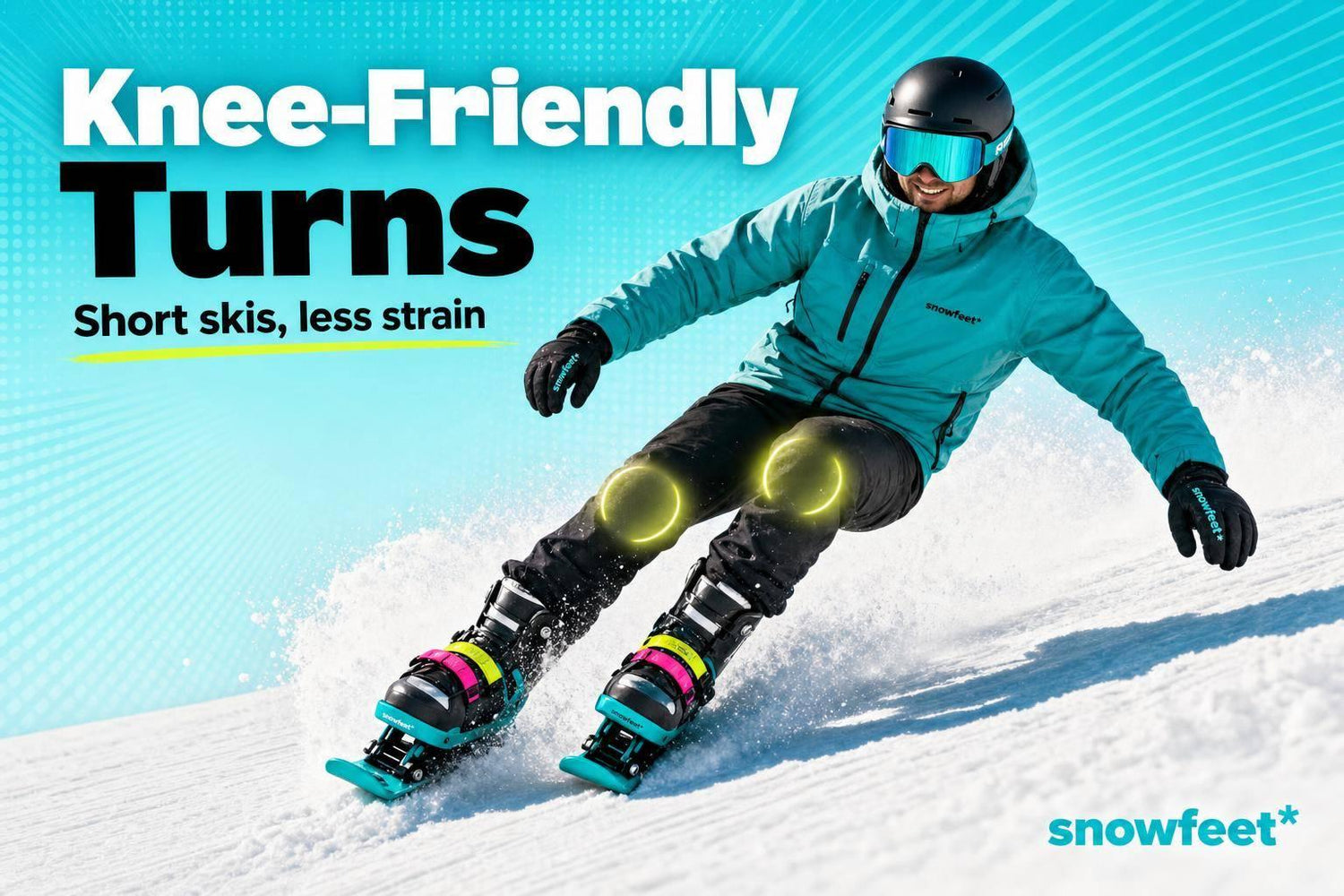
If your knees hurt, shorter skis are often the safer bet. In this lineup, I’d point most skiers to the 99 cm Snowfeet* Skiblades first, with the 120 cm Short Skis close behind if you want more calm on groomers.
Here’s the short version:
- 44 cm Skiskates: lowest swing weight, most playful, least stable
- 65 cm Skiblades: easy turns, light feel, good for mellow resort laps
- 99 cm Skiblades: best mix of knee comfort, control, and stability
- 120 cm Short Skis: closest to full skis, but still easier on the body
- 160–180 cm alpine skis: best at high speed, hardest on sore knees
- Salomon Snowblades / Bigfoot / Figl / ODR: fun old short-ski picks, but less flexible for boot choice and setup
The big idea is simple: less ski in front of and behind you means less leverage in turns. That can help if you ski at mellow to mid speeds and want a fun day without your knees barking by noon.
Best Skis for the Elderly? | Are Short Skis Better for Older Skiers?
Quick Comparison
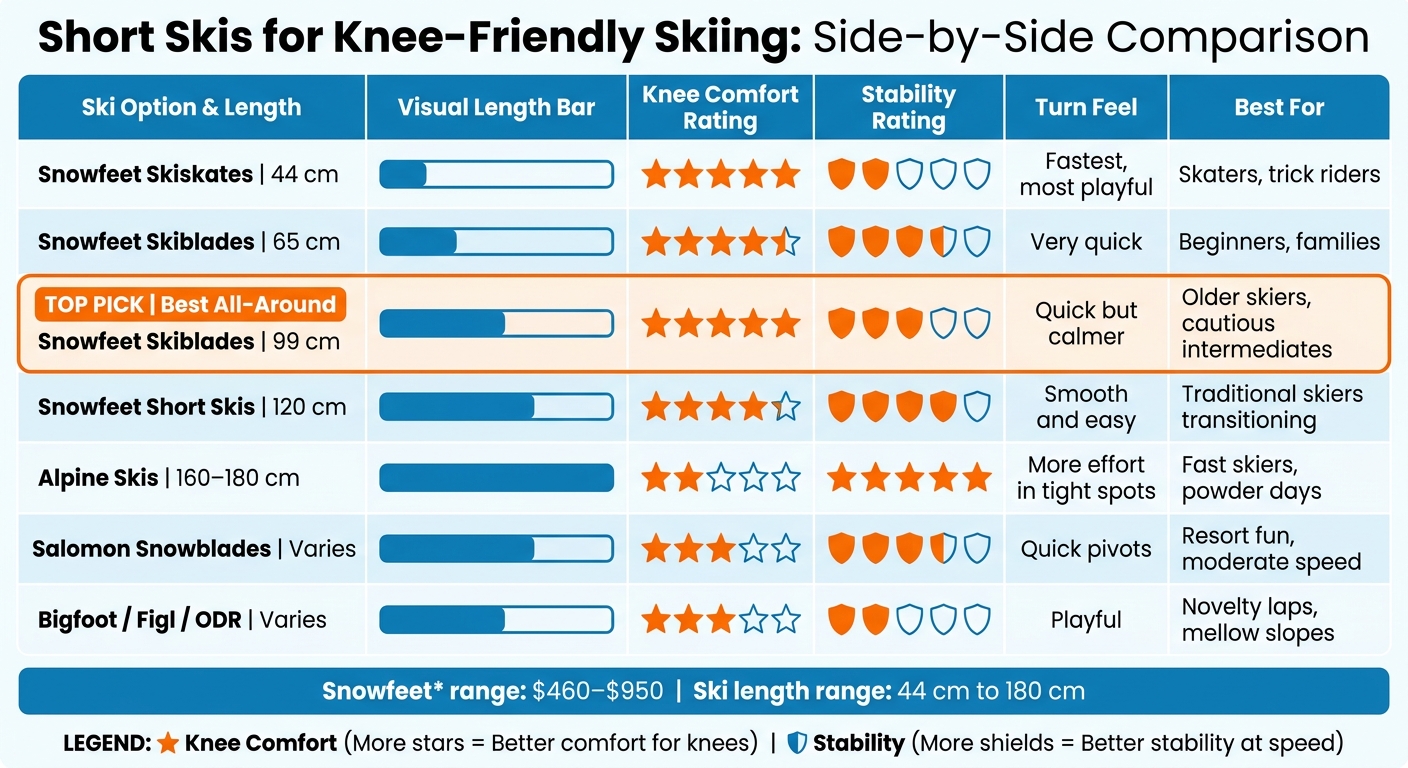
Short Skis for Knee-Friendly Skiing: Side-by-Side Comparison
| Option | Length | Knee Feel | Stability | Turn Feel | Best For |
|---|---|---|---|---|---|
| Snowfeet* Skiskates | 17 in (44 cm) | Lightest feel | Low | Fastest, most playful | Skaters, trick riders, short groomer laps |
| Snowfeet* Skiblades | 25.6 in (65 cm) | Very easy on legs | Medium-low | Very quick | Beginners, casual riders, families |
| Snowfeet* Skiblades | 39 in (99 cm) | Best balance | Medium | Quick but calmer | Older skiers, cautious intermediates |
| Snowfeet* Short Skis | 47 in (120 cm) | Good | Medium-high | Smooth and easy | Skiers who want more calm |
| Alpine skis | 63–71 in (160–180 cm) | Hardest on knees | High | More work in tight spots | Fast skiers, powder days |
| Salomon Snowblades | Varies | Fair | Medium-low | Quick | Resort fun at controlled speed |
| Bigfoot / Figl / ODR | Varies | Fair | Low-medium | Playful | Novelty laps, mellow slopes |
If I had to boil it down to one line, it’s this: pick the shortest ski that still feels stable enough for how you ski. That’s usually the sweet spot for comfort, control, and less knee stress :)
A few quick facts from the article stand out:
- Full alpine skis in this comparison are 160–180 cm (63–71 in)
- The Snowfeet* range here runs from 44 cm to 120 cm
- The 65 cm model has a 4-meter turn radius
- The 44 cm model handles light powder up to about 4 in (10 cm)
- Prices run from $460 to $950
If you want a quick watch before you buy, I’d also check a few short-ski videos on YouTube:
So, my short take is:
- Best all-around: 99 cm Skiblades
- Best for max agility: 44 cm Skiskates
- Best for beginners: 65 cm or 99 cm
- Best if you want more ski under you: 120 cm
- Worst for touchy knees: long alpine skis
That’s the whole story in plain English. Now let’s get into which one fits your knees, your speed, and your boots.
1. Snowfeet* Skiskates 44 cm
At 44 cm, the Skiskates are the shortest option from Snowfeet*. They feel the closest to skating on snow. That short size makes them super agile, but it also means they’re the least forgiving pick in this group.
Knee Load
Because they’re short, there’s less leverage in turns. That can help reduce knee strain. For skiers who want less pull on the knees and less fatigue, this smaller platform can feel easier on the body.
Stability
Here’s the catch: you give up some stability. At 44 cm, these demand good fore-aft balance and work best on groomed or packed snow. They can handle light powder up to about 4 in (10 cm), but they’re not built for deep snow or rough terrain.
Turn Control
This is where they shine. They trade stability for quick, precise steering. They turn fast and feel lively, with a short learning curve for riders who already have some skiing or skating experience.
Boot Fit
The 44 cm Skiskates come in both ski-boot and snowboard-boot versions. They use tool-free adjustable bindings that fit a wide range of sizes.
- Ski boot bindings: EU 36–49 (US 4.5–14.5)
- Snowboard boot bindings: EU 38–49 (US 6–14.5)
Snowboard boots tend to feel more comfortable. Ski boots give you sharper control.
If you want more stability but still want that easy-turn feel, the 65 cm Skiblades are the next step up.
2. Snowfeet* Skiblades 65 cm
The 65 cm Skiblades are Snowfeet*'s best do-it-all short ski. They’re light, quick, and a bit more settled than the 44 cm Skiskates. You still get that easy, snappy feel people like about short skis, but the ride feels calmer and less twitchy.
Knee Load
At 3.79 lbs (1,720 g) per pair with ski bindings, they’re light enough to ease leg fatigue and take some stress off your knees compared with long alpine skis. That makes them a smart pick for mellow days on the mountain, not hard charging.
Stability
The 65 cm length feels steady on groomed runs and in moguls at moderate speeds. It doesn’t feel as planted as the 99 cm or 120 cm models, but that’s part of the appeal. You get a nice middle ground: enough stability to feel in control, with the easygoing comfort casual skiers tend to want most.
Turn Control
A 4-meter turning radius and deep sidecut make these skis fast to start a turn and easy to snake through trees and moguls. They also handle a broader mix of terrain than the 44 cm model, so you can move from groomers to tighter spots without feeling like the ski is out of its lane.
Boot Fit
Like the 44 cm Skiskates, these use tool-free adjustable bindings that work with ski boots or snowboard boots. The snowboard boot setup feels softer and more forgiving. The ski boot setup feels firmer and gives you more direct control. If comfort matters most, the snowboard-boot version has a gentler feel on the knees and ankles.
The 65 cm Skiblades start at $590. If you want more speed and a more planted ride, but still want that short-ski feel, the 99 cm Skiblades are the next move.
3. Snowfeet* Skiblades 99 cm
If the 65 cm Skiblades feel a bit too twitchy, the 99 cm version settles things down without losing that short-ski vibe. It carves clean lines and feels more planted than the shorter models. The wood core and metal edges also make it stiffer and steadier than the 65 cm and 44 cm versions. Starting at $690, it’s the most ski-like option in the Snowfeet* lineup, but it’s still lighter and easier to learn on than full-length alpine skis.
Knee Load
Because these skiblades are lighter, turns take less effort to start and speed feels easier to manage. That lower swing weight can mean less strain when you tip into a turn, which matters a lot if your knees are already grumbling by lunch. Snowfeet* recommends this length for older skiers whose strength and reflex speed may have changed over time.
Stability
At 99 cm (39 inches), these skiblades hit a nice middle ground between quick handling and added stability. They feel steadier than the 44 cm and 65 cm models, but they still turn with less effort than 160–180 cm alpine skis. Push the speed way up, though, and long skis still feel calmer. That’s the plain truth.
Turn Control
The 99 cm model has a short sidecut and a narrow waist, so it starts turns with little fuss and feels snappy on groomed slopes. If you want smooth, low-stress turns instead of wrestling your skis, this setup makes a lot of sense.
"I had a lot of fun with the 99s. They are easier to turn than skis."
Boot Fit
The 99 cm Skiblades come with ski boot, pro ski boot, or snowboard boot bindings. Ski boot bindings fit US men’s sizes 4.5–14.5, and snowboard boot bindings fit sizes 6–14.5. Snowboard boots feel softer and more forgiving. Ski boots give you sharper edge control.
Next, the 120 cm Short Skis bring more speed and stability while still being easier on the knees than full-length alpine skis.
4. Snowfeet* Short Skis 120 cm
If the 99 cm model feels a bit too playful, the 120 cm version gives you more calm without losing that short-ski feel. At $950, these are Snowfeet*'s most stable short skis. They feel more planted than the 99 cm model, but they're still much shorter - and a lot easier to handle - than 160–180 cm alpine skis.
Knee Load
At 120 cm, you get less leverage in turns. That means you can steer with less twist through the knees. For older skiers, cautious intermediates, and anyone with touchy knees, that's a nice plus. Once speeds climb, though, that knee-friendly edge gets smaller.
Stability
These feel planted on groomers and do better in light chopped snow than sub-100 cm models. Still, let's be honest: they won't feel as calm as full-length skis when the snow gets rough. That's the trade-off here - more ease and control, less top-end calm.
Turn Control
The shape makes turns easy to start, which is handy on tight trails and in crowded spots. Compared with the 99 cm Skiblades, the 120 cm version feels a bit less twitchy. Turns still come fast, but edge engagement feels more predictable. That's often a better match for beginners and cautious intermediates.
Boot Fit
Unlike the smaller Snowfeet* models, this size stays closer to a standard ski setup. The 120 cm Short Skis use standard alpine ski boots and fit US men's sizes 4.5–14.5 (EU 36–49). Most riders use regular alpine ski boots with them. The bindings also have DIN-adjustable releases, which can help in twisting falls.
Next: how this length stacks up against full alpine skis, where stability goes up but knee load can also rise.
sbb-itb-17ade95
5. Alpine Skis (160–180 cm)
Traditional alpine skis are the stability benchmark. They shine on fast, open groomers, but they’re also the least knee-friendly pick in this comparison. So, they work well as the baseline for judging how much easier the shorter Snowfeet* models feel.
Knee Load
Long skis add more leverage and swing weight. On sore or touchy knees, that can feel harsher than shorter skis.
Stability
This is where alpine skis win. At higher speeds, 160–180 cm skis feel calmer and more planted on open groomers.
Turn Control
In tight spots, moguls, and busy slopes, old-school skis take more work to pivot and stop. They make the most sense when speed matters more than quick, easy turns.
Boot Fit
Traditional alpine skis usually need rigid ski boots and standard alpine bindings. Snowfeet* short skis, on the other hand, also come with snowboard-boot options.
Next, Salomon Snowblades show the old-school short-ski middle ground.
6. Salomon Snowblades
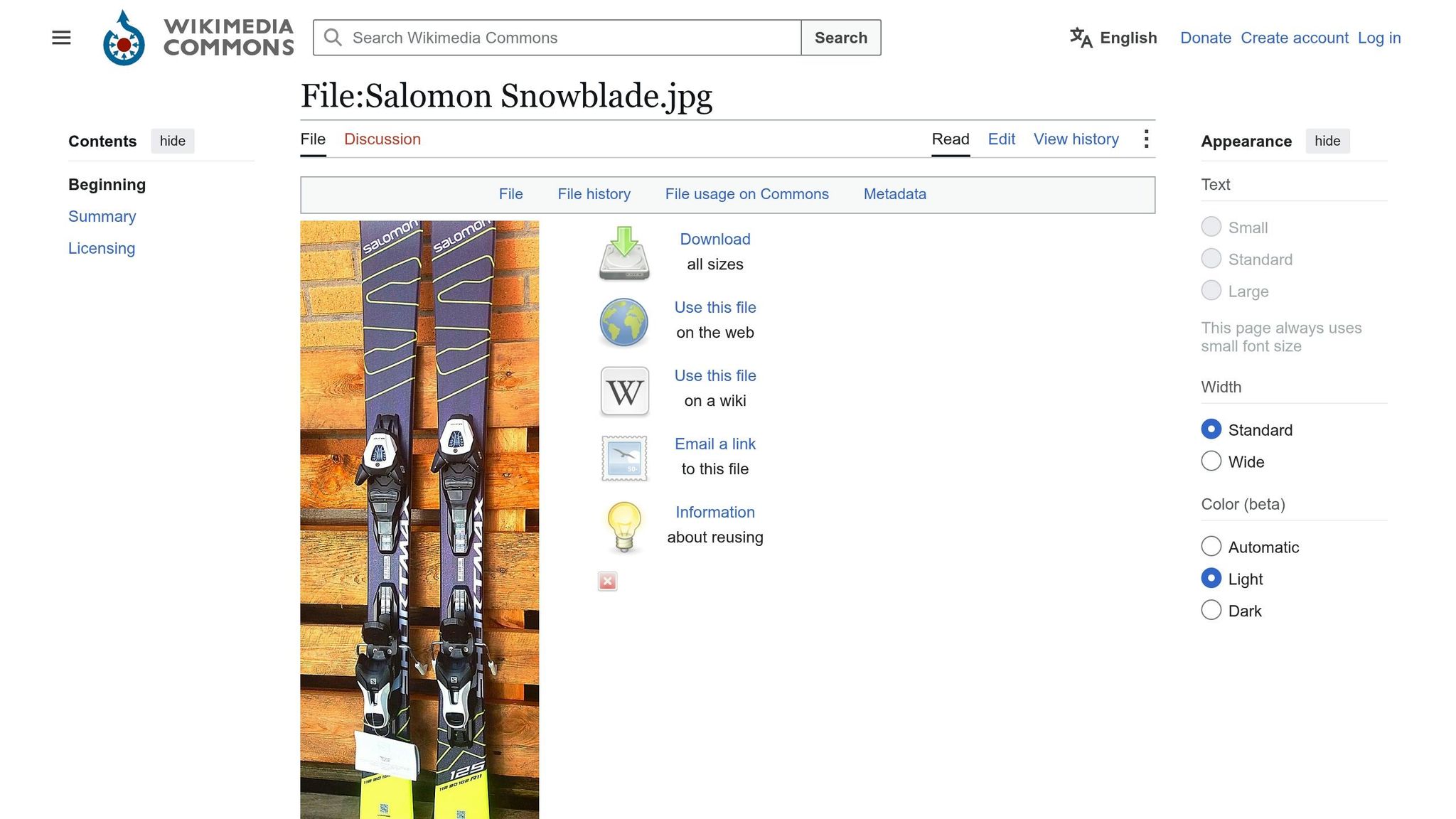
Before the newer Snowfeet* models showed up, Salomon Snowblades were the short-ski option a lot of people knew. They come from an older short-ski style that came before most of today’s short-ski designs.
Because they’re shorter, Snowblades cut down on leverage and swing weight. In plain English: they usually feel easier on your knees than long skis. On groomed runs, they stay fairly steady at moderate speeds. But their sweet spot is simple - fast pivots and easy stops on crowded or tight slopes.
Boot Fit
Snowblades usually use rigid ski boots with standard bindings. Snowfeet* takes a more flexible route. It adds snowboard-boot options and tool-free adjustable bindings across a wide size range, so setup feels less like a chore.
That also makes fit less fussy for casual riders. And for beginners or older skiers, easier boot options can remove a big chunk of the hassle. So, yeah, Snowfeet* is the better pick for most casual riders.
| Feature | Salomon Snowblades | Snowfeet* Skiblades (99–120 cm) |
|---|---|---|
| Boot Compatibility | Primarily ski boots | Ski boots or snowboard boots |
| Binding Setup | Standard alpine bindings | Tool-free, adjustable across a wide size range |
Next, compare these older short-ski designs with Bigfoot, Figl, and other ODR-style options.
7. Bigfoot, Figl, and ODR-Style Short Skis
Bigfoot, Figl, and ODR-style skis are older short-ski options that sit in the same lane as Snowfeet* Skiblades. The draw is pretty simple: they feel light, turn fast, and put less strain on your knees than full-length alpine skis. The big thing now is how they stack up against Snowfeet* in comfort, control, and boot fit.
Knee Load
Their short, light shape cuts down knee leverage in turns. That’s the main reason they tend to feel easier on the knees than long alpine skis.
Stability
This is where the gap shows up most. These skis stay quick and fun in moguls and rough snow, but they can feel twitchy once speed picks up. Snowfeet* 99 cm Skiblades feel more settled on groomers, thanks to their stiffer wood-core build.
Turn Control
Bigfoot- and ODR-style skis are quick to turn. No doubt about it. But Snowfeet* 99 cm and 120 cm Skiblades give you that same easy pivot with better control on groomed runs.
Boot Fit
Snowfeet* also gives most riders a nice bonus: the choice of ski boots or snowboard boots. The bindings adjust across a broad size range, which makes fit a lot easier for many people.
Next, compare these options side by side for knee comfort, stability, turn control, and boot fit.
How Each Option Stacks Up: Knee Comfort, Stability, Turn Control, and Boot Fit
Let’s line these up by the stuff people actually care about: knee comfort, stability, turn control, and boot fit.
Here’s the short version. 44 cm and 65 cm are the most agile. 99 cm and 120 cm give you a nice middle ground between comfort and control. Long skis mostly pull ahead when you’re chasing top-speed stability. For casual riders and skiers with touchy knees, the best pick is often the shortest ski that still feels stable enough.
Knee comfort: Shorter skis put less leverage on your knees, so they usually feel easier on sore or sensitive joints than 160–180 cm alpine skis. The 99 cm and 120 cm models tend to hit the sweet spot for cautious skiers or people coming back after an injury. They’re light enough to ease joint strain, but long enough to feel planted and confidence-building.
Stability: The 44 cm Skiskates ask for more active balance. The 99 cm and 120 cm models feel more planted on groomers. Full-length alpine skis are still the most stable at speed, but you pay for that with more leverage and more effort. For most recreational skiers, Snowfeet’s shorter models land in the best zone for control, comfort, and ease of use.
Turn control: The 44 cm and 65 cm models pivot the fastest. The 99 cm and 120 cm models give up a bit of that snap for cleaner, more controlled turns. That’s a big reason shorter skis feel less intimidating for beginners and casual riders. It’s also why Snowfeet’s 99 cm and 120 cm models often beat full-length skis for most non-racers.
Boot comfort: Snowboard-boot bindings add comfort and a more natural range of movement, which can cut leg fatigue for many riders.
The table below gives you the quick read on who each length fits best.
| Criterion | Strongest Option | Weakest Option | Best For |
|---|---|---|---|
| Knee Comfort | 99–120 cm short skis | Alpine Skis (160–180 cm) | Best balance for older skiers and post-injury riders. |
| Stability on Groomers | 120 cm Short Skis | 44 cm Skiskates | 99–120 cm feel most planted; 44 cm is the least stable. |
| Turn Control (Slow Speed) | 44–65 cm short skis | Alpine Skis (160–180 cm) | Fastest pivot, easiest to learn. |
| Boot Comfort | Snowboard Boot Bindings | Traditional Ski Boots | More natural movement, less fatigue. |
| Confidence for Beginners | 99 cm Skiblades | 44 cm Skiskates | Easiest all-around choice. |
Pros and Cons
Now that the lengths are clear, here’s the short version of the trade-offs. Shorter skis put less leverage on your knees, which can make a long day feel easier. The catch? You give up some speed stability and deep-snow float.
The Skiskates 44 cm are tiny, easy to pack, and built for fast, skate-like turns. They’re also the least stable once you start picking up speed. The 65 cm Skiblades give you a bit more edge contact and a steadier ride, while still turning on a dime. The 99 cm Skiblades hit the sweet spot for most skiers: easier on the knees, steady on groomers, and simple to learn. The 120 cm Short Skis feel the closest to regular skis, with better edge hold and more trust in mixed snow.
Long skis still rule when speed is the goal, but they ask more from your knees over a full day. Older short-ski options land somewhere in the middle. Salomon Snowblades, Bigfoot, Figl, and ODR-style skis are fun and easy to turn at moderate speeds, but Snowfeet* gives you better boot options and more control on groomers. For most casual riders, that tips the scales.
Here’s the quick read:
| Item | Top Pros | Main Cons | Best Rider Match |
|---|---|---|---|
| Skiskates 44 cm | Ultra-portable; lowest swing weight; fast, skate-like turns | Least stable at speed; poor float in deep snow | Confident beginners, skaters, trick riders, casual groomer cruisers |
| Skiblades 65 cm | Very easy pivoting; lightweight; quick learning curve | Limited high-speed stability; weaker edge hold on firm snow | Beginners, families, riders wanting a hybrid ski/skate feel |
| Skiblades 99 cm | Best balance for most skiers; smooth carving; forgiving | Still not as stable as long skis at high speeds | Older skiers, cautious intermediates, knee-conscious riders |
| Short Skis 120 cm | Most traditional ski feel in the Snowfeet* lineup; better edge hold; handles ungroomed terrain better | Less nimble than the shorter Snowfeet* models; less knee-relieving than 44–99 cm options | Traditional skiers transitioning to a shorter setup, solid intermediates |
| Alpine Skis 160–180 cm | Maximum speed stability; excellent edge hold; best powder float | High swing weight; most demanding on knees; harder to control for casual riders | Advanced skiers, speed seekers, powder hunters |
| Salomon Snowblades | Fun short-ski feel; easy pivoting; good at moderate speeds | Twitchy on ice; limited availability | Resort fun-seekers, controlled-speed riders |
| Bigfoot / Figl / ODR | Compact; playful on mellow slopes; easy to maneuver | Less predictable in variable snow; niche availability | Novelty riders and beginners on mellow terrain |
Conclusion
Go with the 44 cm Skiskates if you want the most skate-like feel. Pick the 65 cm Skiblades for quick, nimble turns. Choose the 99 cm Skiblades if you want the best all-around mix. And if stability is your top goal, the 120 cm Short Skis are the steadiest option in the Snowfeet* lineup.
The trade-off is pretty simple. Shorter skis lean toward comfort and control. Longer skis still come out on top for speed and float in powder.
That’s why short skis make more sense when easy handling, comfort, and control matter more than going all-out fast. For most casual riders, Snowfeet* is the smarter pick and an easier choice on the knees.
If you have knee pain, a past ACL or MCL injury, or you're coming back after surgery, be careful. Use bindings that are set up the right way, wear supportive boots, and put in some leg-strength work. And before you ski, get the green light from your doctor or physical therapist.
For casual skiers, beginners, older riders, and anyone trying to protect their knees, Snowfeet* short skis offer the best mix of control, comfort, and confidence.
FAQs
Are short skis really better for bad knees?
Yes. Short skis are often a better pick for people with knee concerns because they create less leverage when you turn or hit bumps. That can mean less strain on the knees and hips.
Snowfeet short skis are also lightweight and encourage a more natural, upright stance. In plain English: they can help cut fatigue and ease discomfort in the knees and lower back.
Which short ski length is best for beginners?
For beginners, the 65 cm Snowfeet Skiblades are usually the best first pick. They feel stable, forgiving, and easy to steer on groomed runs. And, unlike full-length skis, they don’t seem quite so intimidating.
If you want a bit more stability as your skills grow, the 99 cm Skiblades sit in that nice middle ground. The 44 cm Skiskates are a blast, but they ask for better balance right out of the gate.
Can I use snowboard boots with Snowfeet* skis?
Yes - most Snowfeet* short skis work with snowboard boots thanks to their tool-free bindings.
Those bindings fit snowboard boots in US sizes 6–14.5 (EU 38–49). You’ll find them across the lineup, including the 44 cm Skiskates and the 65 cm and 99 cm Skiblades.
There’s a nice bonus here, too: snowboard boots tend to feel better for walking and give you more natural ankle movement than stiff ski boots. That can make the whole setup feel a bit more easygoing, both on and off the snow.











コメントを残す
このサイトはhCaptchaによって保護されており、hCaptchaプライバシーポリシーおよび利用規約が適用されます。