



















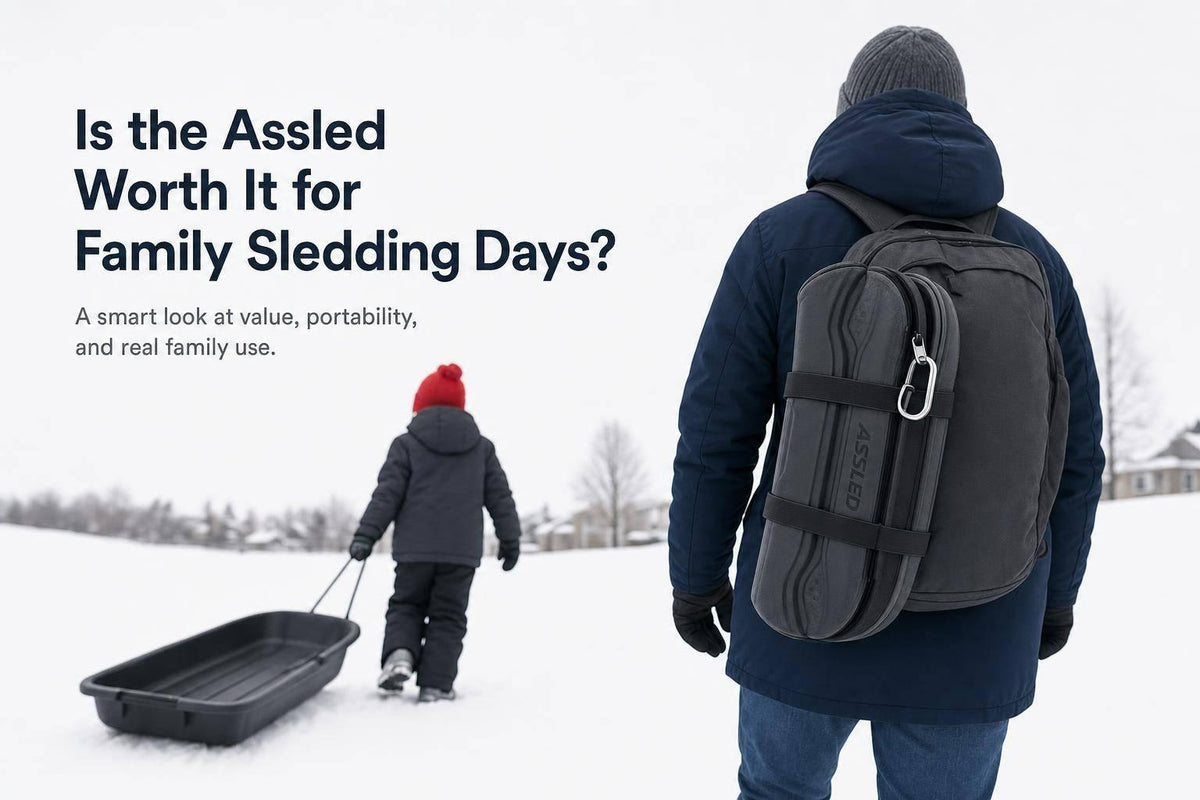
Yes - if your family sleds often, walks to the hill, and wants less stuff to carry. If you just need a cheap sled for a few snow days each winter, I’d skip it and keep the extra $120–$150 in my pocket.
Here’s my short take:
- The Assled is light at 2.8 lbs
- It folds to about 9.5 × 16 × 3 inches
- It costs about $160
- It’s more comfy than hard plastic
- It gives you more control than a basic disc or tub
- It takes more skill, so it’s not my first pick for toddlers or brand-new riders
- It makes the most sense for kids 5+ and adults
So, if you hate dragging bulky sleds uphill, this thing solves that problem in a smart way. If you want simple, cheap, and kid-proof, a plain plastic sled still wins :)
My bottom line: I’d call the Assled a good buy for active families with small storage space, older kids, and lots of sled days. For casual use, it’s hard to justify at $160.
Assleding - New Olympic Sport? | Assled - Wearable Foldable Sled | by Snowfeet
Quick Comparison
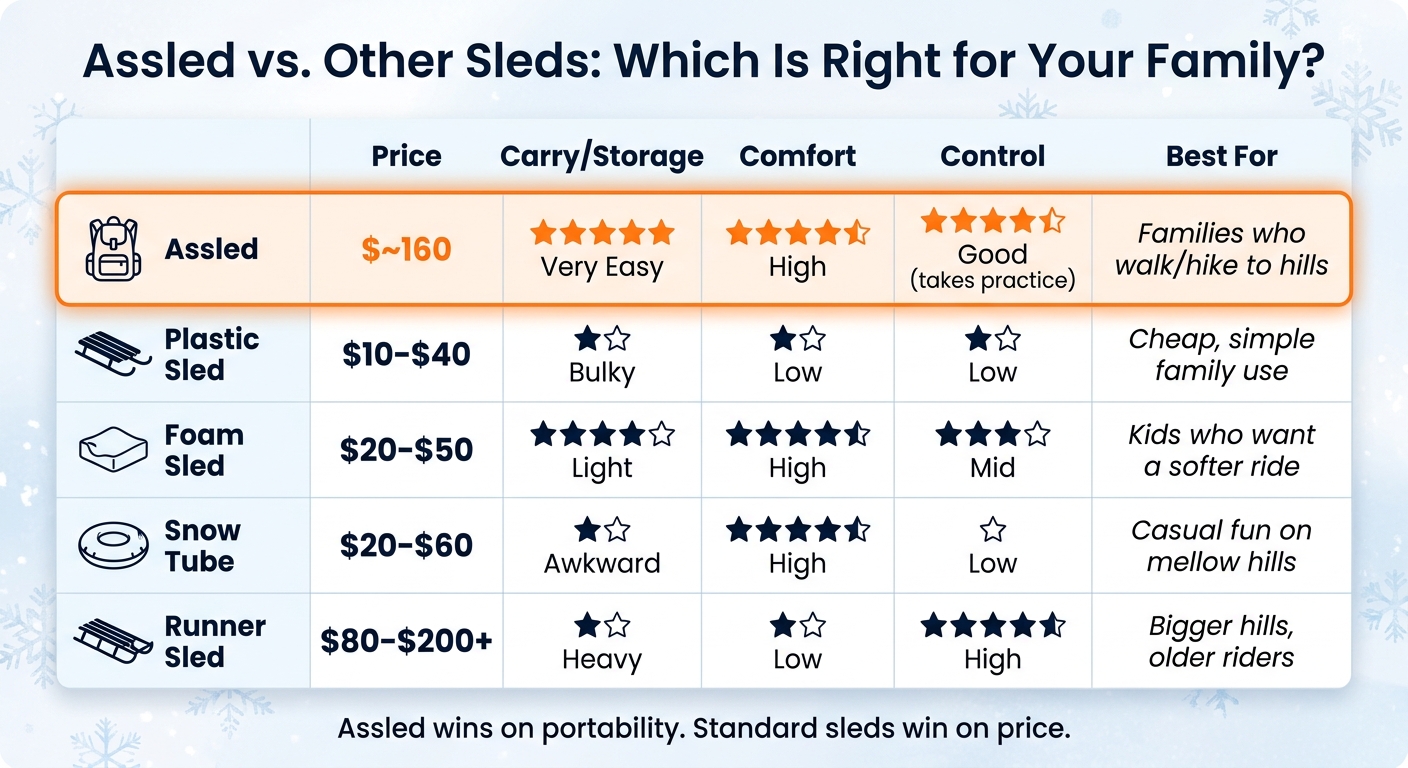
Assled vs. Other Sleds: Price, Portability & Performance Compared
| Option | Price | Carry/Storage | Comfort | Control | Best For |
|---|---|---|---|---|---|
| Assled | ~$160 | Very easy | High | Good, but takes practice | Families who walk/hike to hills |
| Plastic sled | $10–$40 | Bulky | Low | Low | Cheap, simple family use |
| Foam sled | $20–$50 | Light | High | Mid | Kids who want a softer ride |
| Snow tube | $20–$60 | Awkward | High | Low | Casual fun on mellow hills |
| Runner sled | $80–$200+ | Heavy | Low | High | Bigger hills and older riders |
If I were helping a parent in my shop, I’d say this: buy the Assled for convenience, not to save money. That’s the whole pitch in one line.
Design, Comfort, and Day-to-Day Use
How the Assled's Wearable, Foldable Design Works in Practice
For families, the main question is simple: does a wear-and-ride sled save enough hassle to make the extra setup worth it?
The biggest change shows up on the walk back uphill. With a standard plastic sled, someone has to carry it or drag it by a rope. The Assled works differently. It stays strapped to your body between runs, so you can walk up hands-free without taking it off.
That’s the big win.
The catch? You do have to strap it on before each run. So, it asks a bit more from you than a basic sled. But the upside is that you can keep wearing the Assled for the whole outing instead of picking it up and putting it down over and over. For a long sledding day, that can make life a lot easier.
Of course, that only matters if it’s comfortable enough to wear and ride for hours. If it’s a pain after 20 minutes, the whole idea kind of falls apart.
Comfort and Ease of Use for Adults, Older Kids, and Younger Riders
The Assled uses a thick foam pad to soften bumps, and you can fold it in half for extra cushioning. That’s a nice touch, because hard snow has a way of reminding you who's boss.
The straps give it some range too. The waist belt extends to 47 inches, and the thigh straps extend to 35 inches. It also supports more than one riding position, including sitting, kneeling, and tandem use. For adults and older kids, that gives more room to adjust than a plain plastic sled.
Younger kids are a different story. For a quick trip to the park, a standard pull-sled with a high backrest may still be the easier pick. Small children will need an adult to help strap the Assled on, so it tends to work best when parents or older kids can handle their own gear.
So yeah, portability matters, but comfort is the part that makes or breaks it.
Comparison Table: Assled Design and Comfort vs. Standard Sleds
Here's how the Assled's wear-and-ride design compares with a standard sled in everyday family use.
| Feature | Assled | Standard Plastic Sled |
|---|---|---|
| How You Carry It | Wearable - straps to waist and thighs | Hand-carried or pulled by rope |
| Setup Time | Requires strapping in | Instant - sit and go |
| Uphill Use | Hands-free; stays on between runs | Must be carried or dragged |
| Comfort | Foam pad; foldable for extra cushioning | Hard plastic; feels every bump |
| Ease for Young Children | Moderate - straps need adult help | Easier for very young kids |
sbb-itb-17ade95
Hill Performance, Control, and Safety With Kids
Speed, Steering, and Stability on Park Hills
Portability matters, sure. But once you’re standing at the top of the hill, control is what makes or breaks the ride.
The Assled is fast on packed snow. Its thin shape and tarpaulin bottom help it glide over soft snow without bogging down, which is where many standard sleds can struggle. Snowfeet made the Assled for speed and tight turns. Instead of just leaning side to side like you would on a standard sled, riders steer by pressing their heels and hands into the snow. That gives the ride a more hands-on feel.
On packed park hills, the Assled feels stable once you get the rhythm of steering and braking down. That’s the key part. There’s a learning curve. On icy hills, speed builds fast and steering gets much tougher, which makes it a bad fit for beginners or younger kids. Heel-drag braking gives you more control than dragging your feet, but kids will need a few runs to get the hang of it.
Safety Points for Family Sledding Days
If kids are riding the Assled, helmets and gloves are non-negotiable. It can move fast on packed hills, so head protection matters. Gloves matter too, since riders use their hands to help steer and brake.
The manufacturer says the Assled is for ages 5 to 105. That sounds playful, but the age 5+ note has a clear reason: steering and braking take coordination. This isn’t the kind of sled where a child just sits and goes. They need to stay engaged.
A few things help keep family sled days smoother:
- Start kids on a gentle slope so they can learn heel-braking first
- Stick to packed snow, not ice, since slick hills make the Assled faster and harder to control
- Keep adults close by, mainly for the first few runs
- Skip rocky hills because sharp objects can tear the tarpaulin base
So, yeah, it can be a blast. But it asks a bit more from the rider than a basic plastic sled.
The next thing to weigh is price. Does that extra speed and control make the higher cost worth it?
Comparison Table: Assled Performance and Safety vs. Standard Sleds
| Feature | Assled | Standard Plastic Sled / Disc |
|---|---|---|
| Speed | High; tarpaulin base glides well over packed snow | Moderate to high; depends on sled type |
| Steering | Active heel and hand control | Minimal; mostly body leaning |
| Braking | Heel-drag; takes practice | Passive; dragging feet or bailing out |
| Stability | Depends on rider skill and body control | High (toboggans) to low (discs) |
| Best Surface | Packed snow; avoid ice and sharp objects | Groomed neighborhood hills |
| Age Suitability | Ages 5+ with adult supervision | All ages; toddler-friendly options available |
| Shared Riding | Supports 1–2 riders | Varies; toboggans often fit 2–3 |
Portability, Storage, Durability, and Price
Why Portability Is the Assled's Strongest Selling Point
Once ride quality is clear, most families move to the next question: is this thing easy to carry, stash away, and worth the money?
This is where the Assled stands out.
It folds down to about 9.5 × 16 × 3 inches and weighs just 2.8 lbs, which means you can slip it into a backpack or tote instead of lugging it around by hand. After a day in the snow, it doesn’t need a chunk of garage floor either. It can sit on a closet shelf or even in a drawer. For city families, travelers, or anyone low on storage, that’s a big deal.
Durability, Upkeep, and What You Get for the Price
The Assled uses a foam inner layer with a tarpaulin canvas bottom. On smooth, packed sledding hills, that setup usually works well. On rough ground, not so much.
The bottom is less tough than molded plastic when it hits rocks, roots, or other debris, and it can tear on rough terrain. So if your local hill has thin snow or patchy coverage, a standard plastic sled will put up with more abuse.
Care is pretty simple. Since it uses foam and fabric, you should let it air-dry before long-term storage. That’s a bit more work than plastic, but we’re talking basic dry-it-off-and-put-it-away stuff, not a weekend project.
Then there’s the price. The Assled costs about $160, while basic plastic sleds usually run about $10 to $40. So yes, it sits in the premium camp. It makes more sense for families who sled a lot and put convenience ahead of the lowest price.
That’s the heart of the choice: easy storage and carry vs. lower cost.
Comparison Table: Assled Cost vs. Standard Sled Costs
| Feature | Assled | Standard Plastic Sled |
|---|---|---|
| Price Range | ~$160 | $10–$40 |
| Storage Size (Folded) | 9.5 × 16 × 3 in | Bulky / rigid, about 35+ in. long |
| Portability | High - wearable and backpack-friendly | Low - must be carried or dragged |
| Comfort | High - foam padded | Lower - less cushioning |
| Durability | Moderate - can tear on sharp objects | More rugged on rough terrain |
| Best Value For | City families, hikers, travelers | Budget-conscious backyard use |
Final Verdict: When the Assled Is Worth Buying for Families
Yes - for the right family, the Assled is worth buying.
But let's be straight about it: this is a premium-priced sled. That means it makes the most sense when portability and convenience matter a lot.
If you're hiking to a park hill, traveling to the snow, or tight on storage space, the Assled fixes a very common pain point: getting the sled there and putting it away later. That's where it shines. The foam padding, wearable straps, and compact fold make life easier in a way a standard sled just doesn't.
For families who sled often, that convenience can be worth the price. For once-in-a-while use, it usually isn't. That’s the whole game here. How often do you sled? And how far do you have to carry the thing to the hill?
The Assled wins on carry and storage. Standard sleds still win on price and simplicity.
Who Should Buy It and Who Should Skip It
Here’s the simple version:
- Buy the Assled if you have kids 5+, walk or hike to the hill, and want gear that folds into a backpack. It’s a smart pick for parents, older kids, and families who sled a lot, travel to the snow, or live in smaller homes or apartments.
- Skip it if you have toddlers under 5, only sled now and then, or want a low-cost option. In that case, a basic plastic sled is still the better bargain.
FAQs
Can one Assled work for kids and adults?
Yes. The Assled works for both kids and adults, thanks to adjustable straps that fit a wide range of body sizes.
The thigh straps extend up to 35 in. and the waist strap up to 47 in., so it’s a handy one-size option for families. That said, Snowfeet* is still the better pick for most riders because it gives you more control and more ways to ride.
How hard is the learning curve for first-time riders?
The Assled is easy to learn. It’s built for a simple sit-and-go ride, so most first-time riders need little to no practice.
Snowfeet products take a bit more time at the start. They feel closer to skating, which can take a minute to get used to. But once the basics click, you get more control, cleaner carving, and more ways to ride. For most people, that makes Snowfeet the more fun pick over time.
Will the Assled hold up on rough neighborhood hills?
The Assled is not a great fit for rough, uneven neighborhood hills. The foam pad does take the edge off some bumps, but its low-profile shape makes every dip and lump stand out more than it would on a regular sled.
And because it doesn’t have a hard frame, the ride can feel bouncy and a bit rough on choppy snow. It also feels less steady when conditions get messy. If you want better performance, more stability, and more control, Snowfeet* products are the stronger pick.











コメントを残す
このサイトはhCaptchaによって保護されており、hCaptchaプライバシーポリシーおよび利用規約が適用されます。