



















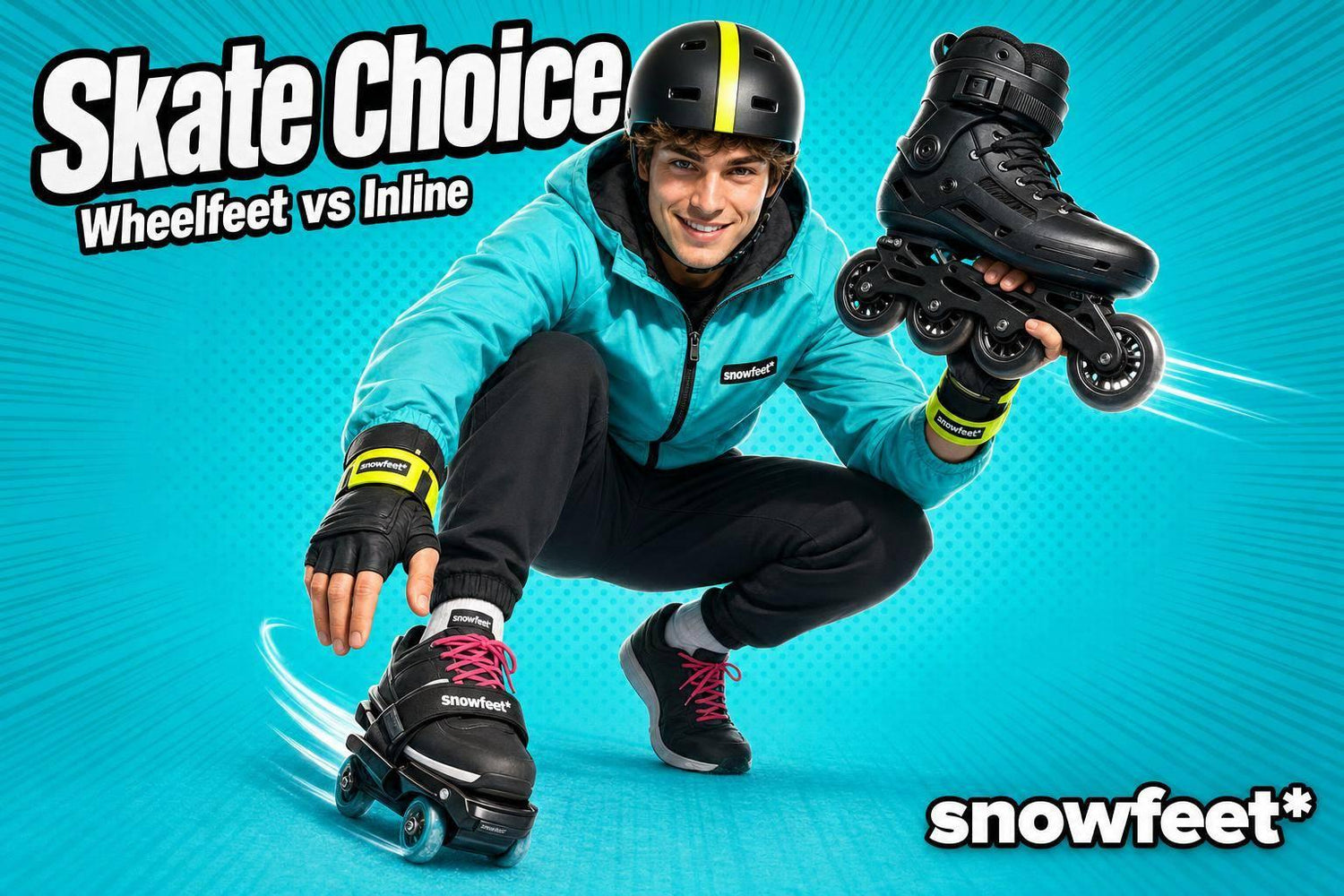
Si je veux faire court : je choisirais les Wheelfeet pour un plaisir simple et immédiat, et les rollers en ligne pour les sorties plus longues, un meilleur maintien et des arrêts plus faciles.
Voici la version en termes simples :
- Les Wheelfeet se fixent sur mes propres baskets, ce qui les rend plus faciles à transporter, à ranger et à enfiler
- Les rollers en ligne offrent une chaussure intégrée, un meilleur maintien de la cheville et un meilleur contrôle sur les longues sorties
- Les Wheelfeet fonctionnent mieux sur un revêtement lisse et plat
- Les rollers en ligne s’adaptent mieux aux surfaces plus accidentées, aux fissures et aux revêtements variés
- Les rollers en ligne pour débutants incluent souvent un frein au talon, ce qui aide beaucoup les nouveaux pratiquants
- Les Wheelfeet commencent généralement autour de 199 $
- Les rollers en ligne coûtent souvent environ 80 à 250 $ pour les modèles de loisir et de fitness
Si je pars pour une balade de 20 minutes, que je veux moins d’équipement et que j’aime la sensation de rouler avec mes propres chaussures, les Wheelfeet sont plus adaptés. Si je veux rouler plus longtemps, développer ma technique ou emprunter des pistes cyclables à vitesse élevée, les rollers en ligne sont un meilleur choix.
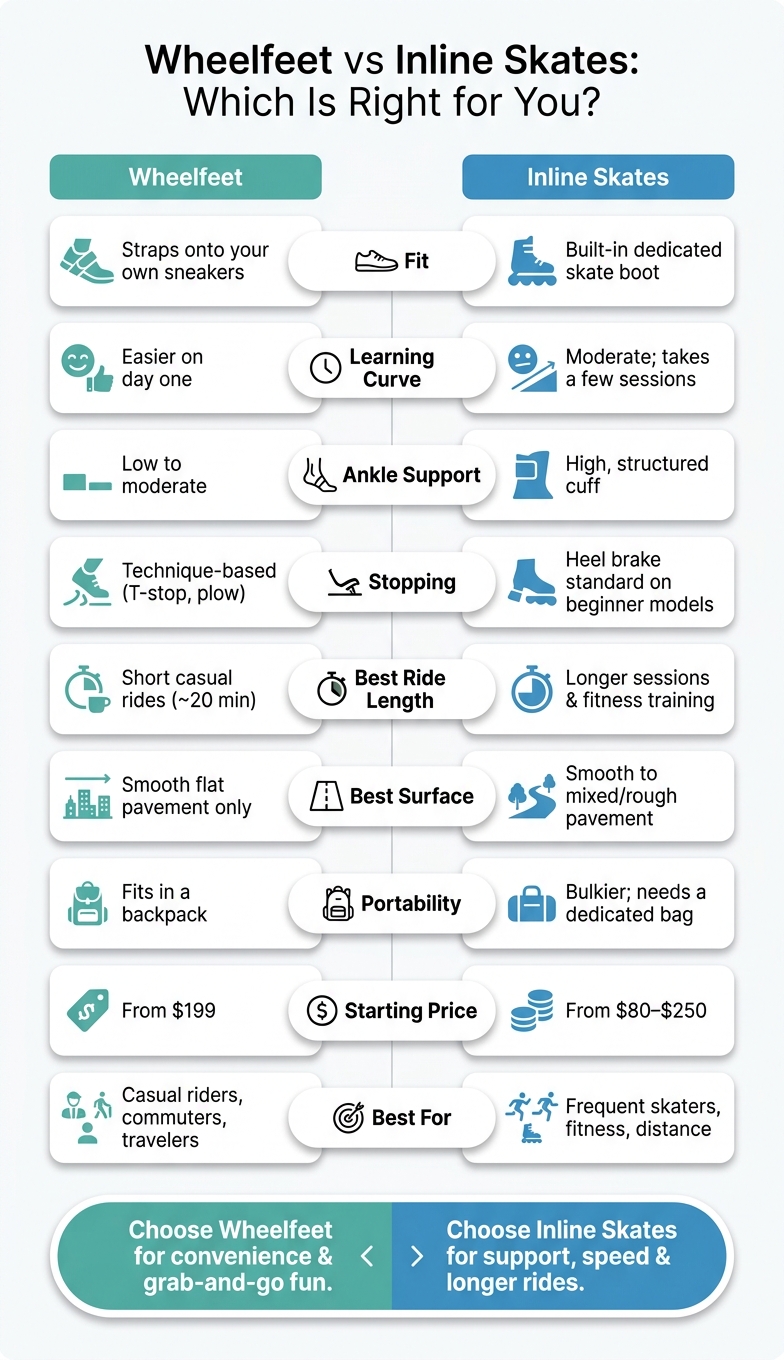
Wheelfeet ou rollers en ligne : comparaison complète des caractéristiques
Rollers portables | Rollers en ligne | Rollers sur chaussures | Wheelfeet | Non électriques
Comparaison rapide
| Caractéristique | Wheelfeet | Patins à roues alignées |
|---|---|---|
| Ajustement | Se fixent sur mes baskets | Chaussure de roller intégrée |
| Courbe d’apprentissage | Plus facile au début | Demande plus de temps |
| Maintien de la cheville | Plus faible | Plus élevée |
| Arrêt | Arrêts qui dépendent de la technique | Frein au talon sur de nombreux modèles pour débutants |
| Durée idéale de la sortie | Courtes balades décontractées | Séances plus longues |
| Surface idéale | Revêtement lisse | Du revêtement lisse au revêtement varié |
| Transportabilité | Plus faciles à transporter | Plus encombrants |
| Prix | Environ 199 $ et plus | Environ 80 à 250 $ |
Donc, si ce qui compte le plus pour moi, c’est la praticité, je pencherais pour les Wheelfeet. Si je privilégie le maintien, la vitesse et le contrôle, je choisirais les rollers en ligne. C’est aussi simple que ça :)
Ajustement, sensations et courbe d’apprentissage
Vos propres chaussures ou des chaussures de roller dédiées
Les Wheelfeet se fixent sur les baskets que vous portez déjà. Cela signifie qu’il n’y a ni tableau des tailles, ni chausson à faire, ni sac à chaussures supplémentaire qui se balade dans le coffre. Il suffit de les clipser et de rouler.
Les rollers en ligne, c’est une autre histoire. La chaussure est intégrée au roller, donc l’ajustement compte beaucoup. Le talon doit être bien maintenu, avec un peu d’espace pour les orteils et aucun mouvement latéral. La plupart des rollers en ligne de loisir offrent un niveau de rigidité modéré. Les modèles de performance sont plus rigides, ce qui favorise un transfert de puissance plus direct, c’est-à-dire la précision avec laquelle votre poussée se transmet aux roues. La plupart des chaussures de roller en ligne nécessitent aussi quelques sorties avant que le chausson s’assouplisse et que les zones de pression s’atténuent.
Pour une sortie rapide de 20 minutes dans le quartier, les Wheelfeet l’emportent par leur facilité d’utilisation. Pour un entraînement plus long, lorsque le maintien de la cheville commence à compter, une botte de roller en ligne bien ajustée devient beaucoup plus pertinente.
Quelle option est la plus facile pour les débutants ?
Une fois l’ajustement trouvé, la prochaine question est simple : lequel vous semblera naturel en premier ?
Les Wheelfeet semblent généralement plus faciles dès le premier jour. Comme vous portez déjà des chaussures que vous connaissez, vous n’avez pas à vous habituer à la forme d’une toute nouvelle botte. Vous pouvez ainsi vous concentrer sur l’équilibre et l’adaptation au roulement.
Les rollers en ligne présentent une courbe d’apprentissage modérée. Le cadre plus haut et le col rigide modifient votre équilibre au début, et il est souvent conseillé aux débutants de limiter leurs premières séances à 10–30 minutes sur un revêtement lisse et plat. La position de départ habituelle est une posture prête à patiner : genoux fléchis, poids légèrement vers l’avant, pieds parallèles et écartés à peu près de la largeur des épaules. Après quelques séances, cette posture devient naturelle, et les rollers en ligne constituent le meilleur choix pour un patinage plus technique.
Les Wheelfeet semblent plus simples au début ; les rollers en ligne deviennent plus avantageux une fois qu’on y consacre du temps.
Confort lors des petites sorties et des séances plus longues
Voici la comparaison côte à côte :
| Caractéristique | Wheelfeet | Patins à roues alignées |
|---|---|---|
| Compatibilité avec les bottes | Vos propres baskets | Botte intégrée et fixe |
| Maintien de la cheville | Faible à modéré, selon la chaussure | Élevé, avec un col structuré |
| Confort initial | Élevé : aucune période d’adaptation nécessaire | Variable : prévoyez une période d’adaptation |
| Petites sorties (environ 20 min) | Excellent : faciles à enfiler et à retirer, sans équipement supplémentaire | Bien, mais vous transportez les bottes |
| Séances plus longues | La pression des sangles peut augmenter avec le temps | Mieux adaptés à l’endurance grâce à une ventilation adéquate |
Pour les petites balades, les Wheelfeet sont difficiles à surpasser. Ils s’enfilent rapidement, se retirent facilement et ne demandent pas beaucoup d’effort. Pour les sorties plus longues, les bottes de rollers en ligne offrent généralement un meilleur rembourrage et une meilleure circulation de l’air, ce qui permet de mieux contrôler la chaleur et la pression qu’avec une chaussure de sport fixée à un cadre.
Cette différence de confort se fait rapidement sentir lorsque la sortie se prolonge. Voyons maintenant la stabilité et le freinage.
sbb-itb-17ade95
Performances sur les surfaces pavées : stabilité, virages, freinage et terrain
Si le confort détermine la durée pendant laquelle vous voulez rouler, le revêtement détermine le niveau de contrôle dont vous disposez.
Stabilité et virages dans les espaces restreints
Les Wheelfeet privilégient un contrôle rapide et facile. Les rollers en ligne privilégient une glisse plus stable sur de plus longues distances.
Les Wheelfeet ont une empreinte courte et compacte. Cela vous maintient près du sol et rend les pivots rapides naturels. Dans les trottoirs bondés et les parkings, ils tournent plus vite. Les rollers en ligne, en revanche, gardent une trajectoire plus droite une fois lancés.
Les rollers en ligne jouent dans une autre catégorie. Un cadre plus long procure davantage de stabilité à vitesse élevée. Les cadres urbains courts sont conçus pour tourner rapidement, tandis que les cadres de fitness plus longs sont faits pour garder une trajectoire droite sur les pistes cyclables et les rues du quartier. Donc, si vous voulez effectuer des virages serrés, la longueur du cadre compte beaucoup.
Freinage et contrôle pour les débutants
La plupart des rollers en ligne pour débutants sont équipés d’un frein au talon, qui est le moyen le plus facile de s’arrêter pour les nouveaux pratiquants. Vous avancez un pied et appuyez sur le frein pour ralentir. Cela fonctionne bien à vitesse débutant — jusqu’à environ 10 mph — et laisse aux patineurs prudents une marge d’erreur supplémentaire sur les pentes douces.
Les Wheelfeet n’ont pas de frein mécanique intégré. Pour ralentir, vous devez utiliser une technique, comme l’arrêt en T ou le chasse-neige. Sur un revêtement plat, cela convient généralement. Dès qu’il y a des montées ou même de légères pentes, la courbe d’apprentissage se complique rapidement.
Les rollers en ligne disposent d’un frein intégré plus facile à utiliser. Les Wheelfeet gardent leur charme parce qu’ils sont simples et faciles à transporter, et non parce qu’ils surpassent les rollers en ligne au freinage.
Et oui, le revêtement sur lequel vous roulez peut changer l’importance de cet écart.
Les meilleurs revêtements pour chaque modèle
Les Wheelfeet sont plus à l’aise sur les revêtements lisses et plats. Pensez aux trottoirs propres, aux parkings tranquilles et aux allées de parc bien entretenues. Leur châssis court risque davantage d’accrocher les fissures, les débris et l’asphalte irrégulier.
Les rollers en ligne peuvent s’adapter à davantage de types de revêtements, principalement parce que vous pouvez les configurer selon le trajet prévu. Les roues extérieures plus souples, d’une dureté de 78A à 82A, adhèrent mieux et atténuent les vibrations sur les trottoirs fissurés et l’asphalte irrégulier, tandis que les roues plus grandes franchissent plus facilement les petits débris et les interstices. Une configuration 4×80 mm est généralement préférable pour les déplacements urbains et les virages serrés. Une configuration 3×110 mm franchit plus doucement les bosses sur les trajets plus longs.
Pour les courtes balades faciles sur un revêtement propre, les Wheelfeet conviennent mieux. Les rollers en ligne prennent l’avantage lorsque le trajet devient plus long, plus accidenté, ou les deux.
| Caractéristique | Wheelfeet | Patins à roues alignées |
|---|---|---|
| Stables à vitesse élevée | Agiles à faible vitesse ; plus sensibles aux bosses | Plus stables à vitesse élevée ; le châssis plus long franchit les irrégularités |
| Rapides dans les espaces exigus | Excellents dans les espaces exigus | Varie selon la longueur du châssis ; les châssis urbains tournent serré |
| Frein au talon standard | Basé sur la technique (arrêt en T, chasse-neige) | Frein au talon standard sur la plupart des modèles pour débutants |
| Vitesse | Idéals pour les courtes sessions décontractées | Vitesse soutenue plus élevée sur les trajets plus longs |
| Idéals sur les revêtements lisses | Trottoirs lisses, parkings, allées de parc | Pistes cyclables, rues de quartier, revêtements variés |
| Débris et fissures | Sensibilité accrue | Se manient mieux, surtout avec de grandes roues |
Ensuite : transport, entretien et prix.
Transport, entretien et prix
Une fois l’ajustement et le contrôle réglés, il reste à examiner un point simple : est-il facile de transporter, d’entretenir et de financer cet équipement ?
Lesquels sont les plus faciles à transporter et à ranger
Les Wheelfeet sont plus faciles à transporter, car ils s’attachent à vos chaussures. Vous pouvez les glisser dans un sac à dos ou un coffre, les détacher une fois terminé, puis reprendre la marche. C’est un vrai plus pour les personnes qui se déplacent quotidiennement, les voyageurs et tous ceux qui ne veulent pas transporter un équipement complet de patinage.
Les patins à roues alignées sont plus volumineux par nature. La chaussure, le cadre et les roues sont intégrés en une seule pièce ; vous aurez donc besoin d’un sac pour patins ou de plus d’espace dans le coffre. C’est parfait si vous allez directement à une séance de patinage. Mais si vous prévoyez d’alterner entre patiner et marcher, cela peut vite devenir agaçant.
L’écart devient encore plus évident lorsqu’on pense à l’entretien.
Entretien et pièces de rechange
Les deux options nécessitent le même entretien de base des roues et des roulements. Nettoyez-les régulièrement et remplacez les roulements lorsqu’ils sont usés. La bonne nouvelle ? Les roulements sont peu coûteux à remplacer.
La différence se remarque dans le reste de la configuration. Avec les Wheelfeet, vos chaussures font partie du système. Si vos semelles sont usées, si vos chaussures sont trop lâches ou si leur partie supérieure est très abîmée, le contrôle peut en pâtir. Vous devrez également vérifier de temps en temps la tension des sangles et l’état des boucles.
Avec les patins à roues alignées, la plupart de l’usure se limite aux patins eux-mêmes, ce qui est pratique. Mais il faut aussi surveiller quelques éléments supplémentaires, comme l’entretien de la doublure ainsi que la vérification des chaussures et du cadre. Aucune des deux options n’est difficile à entretenir, mais les Wheelfeet sont plus simples, car il y a tout simplement moins d’équipement.
L’entretien est assez simple dans les deux cas. C’est au niveau du prix que la différence est la plus marquée.
Où va votre argent
Les Snowfeet Wheelfeet commencent à environ 199 $ pour la version standard et à 674 $ pour le modèle électrique. Le modèle non électrique se situe dans la même fourchette générale qu’une bonne configuration de patins à roues alignées de milieu de gamme.
Les patins à roues alignées coûtent généralement entre 80 et 250 $ pour les modèles de loisir et de fitness, et entre 150 et 350 $ environ pour les configurations performantes.
Les Wheelfeet consacrent une plus grande part de votre budget à la commodité. Les patins à roues alignées en consacrent davantage aux performances et au maintien. Alors oui, tout dépend de la fréquence à laquelle vous roulez et du type d’expérience que vous recherchez.
| Caractéristique | Wheelfeet | Patins à roues alignées |
|---|---|---|
| Facilité de rangement | Se rangent dans un sac à dos standard | Plus volumineuses ; nécessitent généralement un sac dédié |
| Rangement | Minimal : une petite étagère ou un tiroir | Davantage d’espace nécessaire dans un placard ou au sol |
| Entretien | Roues, roulements, sangles, état des chaussures | Roues, roulements, entretien de la doublure, vérification des chaussures et du cadre |
| Prix de départ | Environ 199 $ | Environ 80 à 250 $ |
| Prix haut de gamme | Environ 674 $ (électriques) | Environ 150 à 350 $ et plus |
| Meilleur rapport qualité-prix pour | Utilisateurs occasionnels, navetteurs, voyageurs | Patineurs réguliers, entraînement physique |
Que choisir : utilisateurs occasionnels, patineurs et fans de Snowfeet*
Après avoir pris en compte l’ajustement, le contrôle, la portabilité et le prix, le choix dépend de la façon dont vous voulez rouler.
Choisissez Wheelfeet pour une sensation similaire à celle des Snowfeet
Si vous voulez faire de courtes balades dans le quartier, longer la promenade ou voyager facilement avec votre équipement, les Snowfeet Wheelfeet sont le meilleur choix. Ils s’attachent à vos chaussures et vous permettent de partir rapidement. C’est pratique lors des journées où vous devez alterner entre rouler et marcher sans transporter d’équipement supplémentaire.
Si vous recherchez l’équivalent le plus proche de la sensation compacte des Snowfeet sur le bitume, Wheelfeet remplit très bien ce rôle. Ils conservent le style court et agile dans les virages que les fans de Snowfeet apprécient déjà. Si vous voulez donc une option hors saison offrant une sensation familière sur le bitume, c’est le choix le plus proche.
Choisissez les rollers en ligne pour des performances dédiées
Si votre objectif principal est moins la praticité que l’entraînement et la distance, les rollers en ligne prennent l’avantage. Ils sont mieux adaptés aux sessions plus longues et plus techniques, et leur cadre plus long offre une meilleure stabilité directionnelle à vitesse élevée sur les pistes cyclables ou les parcours urbains plus longs.
Si vous souhaitez vous lancer dans le slalom, le fitness ou le roller urbain, un roller dédié vous offrira une meilleure base. Le compromis est simple : plus d’équipement, moins de praticité et davantage d’engagement.
En résumé
Choisissez en fonction de la portabilité, du maintien et de la durée de la sortie. Pour la plupart des utilisateurs occasionnels, Wheelfeet est le choix le plus pratique. Pour un entraînement régulier et des sessions plus longues, les rollers en ligne sont plus performants.
FAQ
Wheelfeet est-il sûr pour les débutants ?
Oui : Wheelfeet, et en particulier Snowfeet*, sont sûrs et adaptés aux débutants.
Ils sont plus faciles à apprendre que les skis longs, et beaucoup de gens en maîtrisent les bases en environ cinq minutes. C’est un bon début si vous ne voulez pas que votre première descente ressemble à un combat avec du matériel de location.
Leur petite taille vous rapproche du sol, ce qui peut favoriser l’équilibre et le contrôle. De plus, ils se fixent à vos propres chaussures d’hiver ou de snowboard, et leur ajustement semble donc souvent plus confortable que celui de chaussures de ski de location rigides.
Quelles chaussures conviennent le mieux à Wheelfeet ?
Les modèles Wheelfeet et Snowfeet s’utilisent avec les chaussures que vous possédez déjà. Vous n’avez donc pas besoin de chaussures de ski spéciales pour commencer.
Voici l’essentiel :
- Chaussures d’hiver : idéales pour s’amuser tranquillement, les sentiers faciles ou le jardin
- Chaussures de snowboard : idéales pour les pistes, avec un bon maintien de la cheville, de la chaleur et de la souplesse
- Chaussures de ski : idéales pour les virages appuyés sur les pistes damées
Les fixations réglables conviennent aux pointures américaines 4,5 à 14,5.
Puis-je utiliser Wheelfeet sur des pentes ou du bitume accidenté ?
Non. Snowfeet et les produits similaires de rollers à sangles sont conçus pour les terrains enneigés, pas pour les surfaces bitumées accidentées.
Ils sont adaptés aux pistes damées, aux sentiers de randonnée et aux pentes de luge. Sur le bitume, ils peuvent être endommagés et ne vous offriront ni le contrôle ni la sécurité nécessaires.
Pour les surfaces lisses et dures comme l’asphalte et les pistes urbaines, utilisez plutôt des rollers en ligne.
Articles de blog associés
- Que sont les rollers à sangles et comment fonctionnent-ils ? (Snowfeet et Wheelfeet expliqués)
- Meilleurs rollers électriques en ligne en 2026 (Wheelfeet face aux alternatives)
- Rollers quad ou rollers en ligne : lesquels sont les plus faciles pour les débutants ?
- Rollers pour débutants qui se fixent à toutes les chaussures (sélection 2026)












Laisser un commentaire
Ce site est protégé par hCaptcha, et la Politique de confidentialité et les Conditions de service de hCaptcha s’appliquent.