



















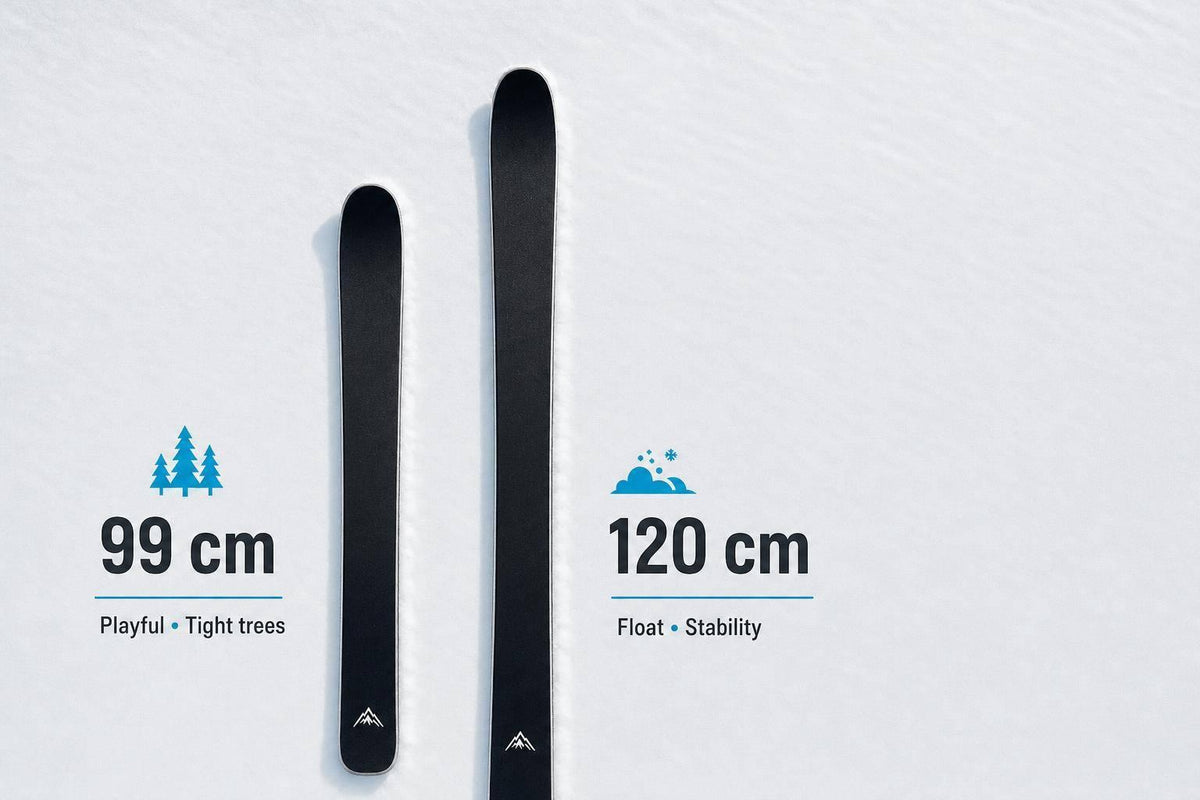
If I had to make this simple: pick the 99 cm for tight trees and playful powder laps, and pick the 120 cm for more float, more calm, and more support when snow gets deep or chopped.
Here’s the short answer:
- POWDER 99 cm = lighter feel, tighter turns, easier to pack
- 120 cm short skis = more surface, better composure, smoother at higher pace
- Price gap = about $690 vs. $950
- Turn radius = about 6 m vs. 8 m
- Best use = trees and short soft-snow laps vs. mixed resort days and deeper snow
If you want the fast takeaway, it’s this: the 99 cm is more fun in tight spots, while the 120 cm gives you more confidence when conditions get messy. And yes, in deep powder, full-length powder skis still float better than both.
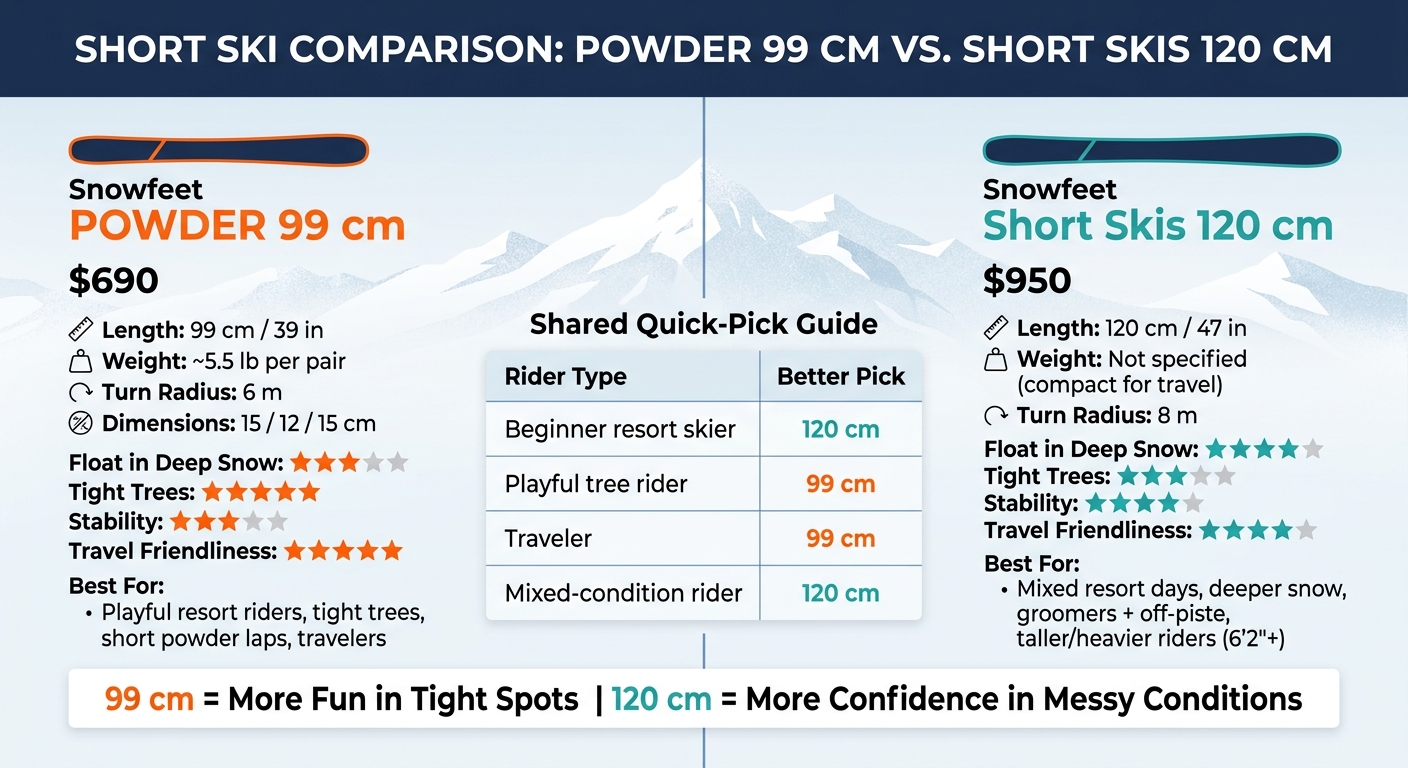
POWDER 99 cm vs 120 cm Short Skis: Side-by-Side Comparison
ULTIMATE SHORT SKIS 🔥 Snowfeet Skiblades 99 cm | Unboxing & First Look
Quick Comparison
| Ski | Best For | Float in Deep Snow | Tight Trees | Stability | Travel |
|---|---|---|---|---|---|
| POWDER 99 cm | Playful resort riders, short laps | Good for its size | Best | Lower | Best |
| Short Skis 120 cm | Mixed days, deeper snow | Better | Good | Better | Good |
So, if you’re choosing between them, I’d say this: go short for fun, go 120 for more margin. That’s the whole story in one line :)
Snowfeet* POWDER 99 cm: wider shape, faster turns
The Snowfeet* POWDER 99 cm uses a wide platform, rocker, and a short turn radius to stay loose and quick in soft snow. Put simply: it feels fast and playful when the snow is soft.
How the wide 99 cm shape floats and turns in soft snow
In soft snow, the wide 99 cm shape gives you enough float for light to moderate powder, especially if you ride with a centered stance. In fresh powder and soft resort snow, this is where it feels at home.
It works well in places like:
- tight trees
- side stashes
- short powder laps
The short length lets you pivot almost on the spot and smear turns without locking into a long arc. That gives it a surfy feel, and it stays easy to swing around at slow to medium speeds. That’s the fun part. The trade-off shows up once the snow gets faster, heavier, or deeper.
Where the short length loses stability
At higher speeds, the short length gets knocked around more in chopped-up or heavy snow. In very deep powder, the width still helps, but the ski needs more speed and a more active stance to keep floating.
You’ll notice that trade-off even more when you look at the 120 cm model, which gives you more support once the snow gets deeper.
sbb-itb-17ade95
Snowfeet* Short Skis 120 cm: more support, more range
If the POWDER 99 feels a bit loose once the snow gets deeper, the Snowfeet* Short Skis 120 cm give you more support without losing that quick, short-ski feel. At 47 inches (120 cm), they bring more calm and control in deeper snow and chopped-up conditions. Snowfeet says the 120 cm works best for taller or heavier riders, roughly over 6'2", since the extra surface area helps with stability and float.
How 120 cm improves float and stability
That extra length makes the 120 cm feel calmer in rough snow. It doesn’t get knocked around as easily as a shorter ski, which you’ll notice most on deeper powder runs and when you pick up speed. Its waist is still on the narrow side, so the float comes from length, not width.
In lighter powder, the POWDER 99 can still feel very floaty. But once the snow gets deeper or heavier, the 120 cm starts to pull ahead. That added length does more to keep the ski steady and composed.
Why it works well for mixed resort days
The 120 cm is a better fit for a full resort day. Think hard morning groomers, then softer snow by late morning, then chopped powder and a few off-piste laps after lunch. That’s where it shines. Its rocker-camber shape helps it hold an edge on groomers and keeps the ride smoother when the snow turns soft and uneven.
For riders who want one short ski that can handle:
- groomers
- soft bumps
- chopped powder
- the occasional off-piste run
the 120 cm is the more forgiving pick. It’s the better all-mountain short ski, especially if you want a bit more range without going to a full-length setup.
Side-by-side: powder laps, trees, groomers, and speed
Here’s the plain-English version on snow: POWDER 99 is quicker. 120 cm is steadier. That’s the trade-off, and you’ll feel it right away in the spots below.
| POWDER 99 cm | Short Skis 120 cm | |
|---|---|---|
| Flotation | Wider 15 / 12 / 15 cm shape and 99 cm length give it solid float for its size in powder | Longer 120 cm platform gives it more surface in the snow and more support in deeper snow |
| Trees & tight terrain | More agile, quicker to pivot, and easier to redirect | Still manageable, but better suited to wider glades and open lines |
| Mixed groomers | Fun and snappy, but less composed once the terrain gets faster or choppier | More stable and comfortable on groomers and variable resort snow |
| Speed stability | Best for moderate speeds | More predictable when you want a bit more pace |
| Turning feel | Very quick and pivot-friendly, with a 6 m radius | Smoother and more traditional, with an 8 m radius |
| Braking & speed control | Short, frequent turns and quick skidded turns work best | Longer, more traditional turns feel easier to manage |
| Portability | 99 cm / 39 in. and about 5.5 lb per pair | 120 cm / 47 in.; compact for travel and storage |
| Ideal rider | Travelers and playful resort riders who want maximum agility | Riders who want more support, more stability, and more range across the mountain |
Flotation vs maneuverability
POWDER 99 floats well for its size and changes direction faster in soft snow. It feels nimble, light, and easy to throw around.
The 120 cm brings more calm and support as the snow gets deeper. So if you want a bit more margin when conditions get soft and uneven, it’s the safer bet.
Turning feel, speed control, and learning curve
POWDER 99 leans toward a short-turn style and quick speed checks. That makes it a nice fit for trees and for newer riders who want skis that feel easy to point, scrub, and redirect.
The 120 cm makes a smoother, more standard arc. In plain terms, it feels easier to stay settled when speed picks up or when the snow gets mixed up. Think of it like this: the 99 likes quick footwork, while the 120 likes a calmer rhythm.
Full-length powder skis vs Snowfeet* in deep snow
That’s also why full-length powder skis still come out ahead on pure float, even if Snowfeet* wins on convenience. Full-length powder skis still give you more float in deep snow, but Snowfeet* keeps powder days simpler, lighter, and easier to handle for casual resort riders.
Which one to buy
If the performance gap feels clear, this is the fastest way to match each ski to the way you ride.
After the on-snow comparison, here’s the short version.
| Rider Type | Better Pick | Why |
|---|---|---|
| Beginner resort skier | 120 cm | Extra length adds stability and a steadier feel underfoot |
| Playful tree rider | POWDER 99 cm | Shorter length pivots faster in tight spots |
| Traveler | POWDER 99 cm | Lighter to pack and carry |
| Mixed-condition rider | 120 cm | Better all-around fit for days that mix groomers with soft snow |
Use the table as a quick filter. The next two sections make the choice even simpler.
Choose POWDER 99 if agility comes first
If your powder days look like short laps through the trees, quick hits off a side trail, or playful resort runs at easy speeds, POWDER 99 cm is the move. The short length makes it fast to pivot and easy to point somewhere else when terrain gets tight. That matters a lot in trees, where a split-second turn can save you from an awkward line... or a face-full of snow :)
It’s also the better pick for travel. It’s easier to fit in a bag, lighter to carry, and less of a pain to store.
Choose 120 cm if you want more support across the mountain
Snowfeet* Skiblades 120 cm make more sense if you want one setup that can handle deeper snow and groomers on the same day. It’s the stronger all-around option in the Snowfeet* short-ski lineup, especially if you’re newer to short skis or you split your day between powder and packed runs.
In plain English: if you want a bit more support underfoot and a steadier ride across more parts of the mountain, go with the 120 cm.
FAQs
Are 99 cm skis enough for deep powder?
Yes - but the model matters.
Standard 99 cm skiblades work best on groomed runs and in light, shallow powder. If you’re heading into deeper snow, Snowfeet* POWDER 99 cm is the better pick.
Its wider parabolic shape and rockered profile help it stay on top of 6–12 inches of resort powder. It won’t give you the same high-speed stability or deep-snow float as 170+ cm powder skis in waist-deep snow. But in trees and tight terrain, it’s a lot easier to turn and way more nimble.
So, if your day is mostly groomers with some soft snow on the side, standard 99 cm skiblades can do the job. If powder is the main plan, go with Snowfeet* POWDER 99 cm :)
Which length is easier for beginners?
Both are beginner-friendly when you compare them with long, standard skis. But they fit slightly different needs.
The Snowfeet POWDER 99 cm* is the easiest one to learn on. It feels compact, light, and easy to move around. That makes turning and stopping simpler, which helps new riders build confidence fast.
The 120 cm model is also a good pick for beginners. It gives you a smoother ride and a bit more stability. The trade-off? It needs a little more effort to control than the 99 cm version.
How do rider height and weight affect the choice?
Weight matters most because it tells you how much surface area you need for support, flotation, stability, and control. Height can help as a starting point, but it doesn’t matter as much.
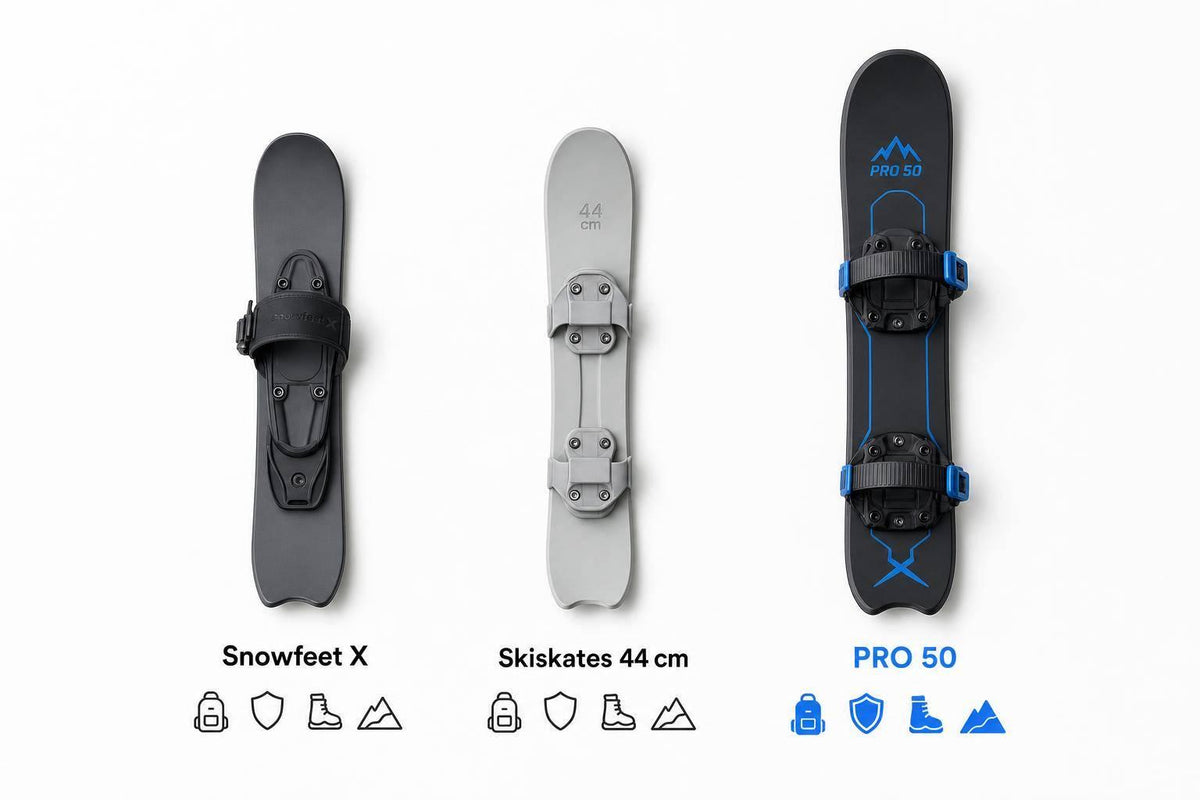
If you’re a lighter or average-weight rider, you’ll often do well with a 44 cm to 65 cm model. Heavier riders, especially those around 200 lb or more, should look at the 99 cm or 120 cm options. And once you hit 220 lb or more, the 120 cm model is the safest, most reliable pick.











Laisser un commentaire
Ce site est protégé par hCaptcha, et la Politique de confidentialité et les Conditions de service de hCaptcha s’appliquent.