



















Réponse courte : non. Mais si vous patinez, vous pouvez apprendre les sports de neige bien plus rapidement. En clair, le patinage vous donne une longueur d’avance en matière d’équilibre, de carres, de position et de mouvements latéraux. Cette longueur d’avance est surtout visible avec un équipement court comme les Snowfeet*, et non avec de longs skis alpins ou un snowboard.
Voici l’essentiel :
- Les hockeyeurs et les patineurs confirmés prennent souvent en main les Snowfeet* Skiskates (44 cm) ou les Skiblades (65 cm) en 1 à 2 heures
- Les patineurs occasionnels progressent tout de même mieux avec un court cours, notamment pour s’arrêter, prendre les remontées et respecter les règles des pistes
- Les skis longs demandent davantage de réapprentissage, car leur plateforme est plus longue et ressemble moins à celle de patins
- Les snowboards offrent une certaine sensation de prise de carre, mais la position de côté déstabilise de nombreux patineurs
- Même si vous patinez bien, vous devez tout de même apprendre des compétences propres à la neige, comme :
- le contrôle de la vitesse sur les pentes
- l’utilisation du télésiège
- les règles de priorité
- comment s’arrêter sans freiner brusquement sous l’effet de la panique
Donc, si je devais résumer en une phrase, ce serait celle-ci : le patinage peut réduire votre temps d’apprentissage, mais ne remplace pas au moins un court cours d’initiation.
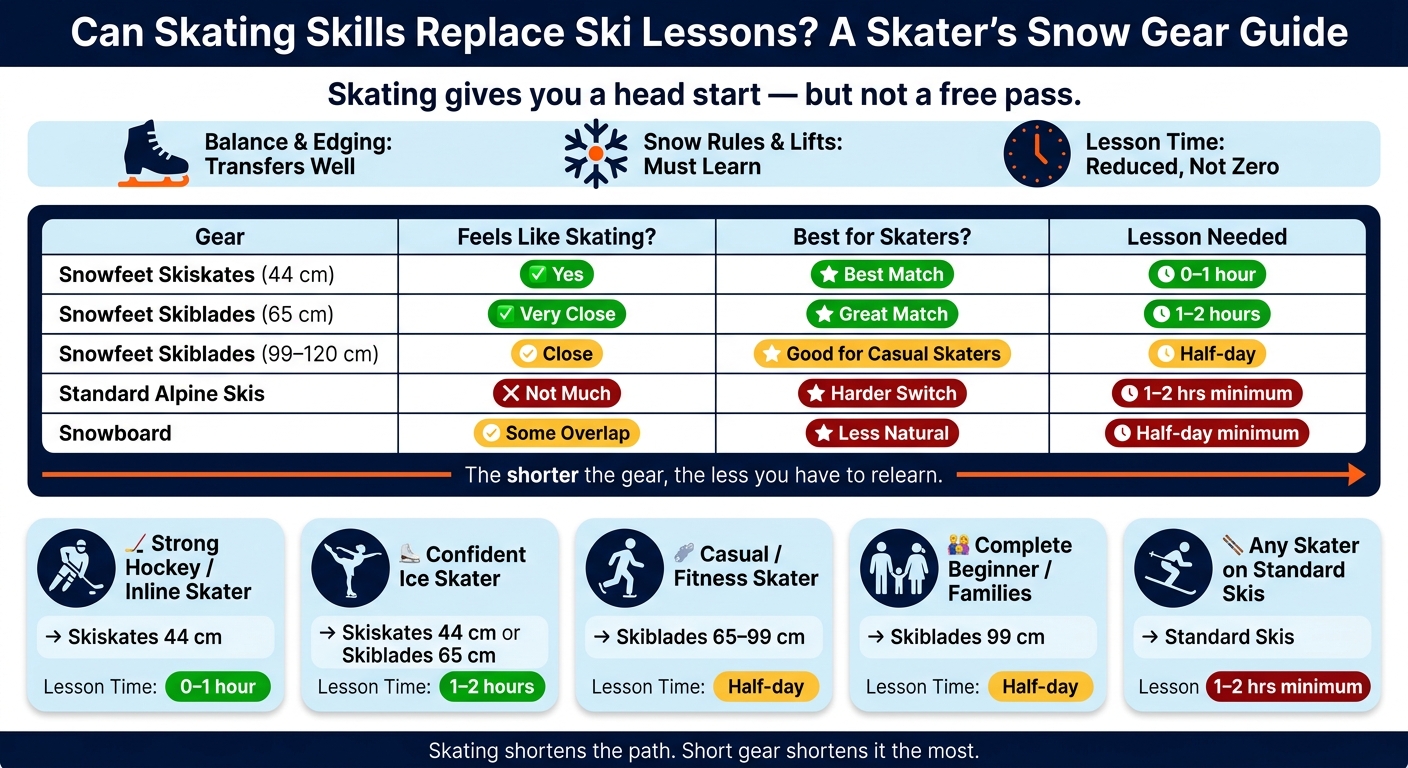
Compétences de patinage et sports de neige : guide de l’équipement et du temps de cours pour les patineurs
Ski ou patinage sur neige ? Avec les Snowfeet 65 CM, vous pouvez faire les deux.

Comparaison rapide
| Équipement | Ressemble le plus au patinage ? | Idéal pour les patineurs ? | Besoin d’un cours |
|---|---|---|---|
| Snowfeet* Skiskates (44 cm) | Oui | Meilleure correspondance | 0 à 1 heure |
| Snowfeet* Skiblades (65 cm) | Très proche | Excellente correspondance | 1 à 2 heures |
| Snowfeet* Skiblades (99 cm / 120 cm) | Proche | Bon choix pour les patineurs occasionnels | Une demi-journée pour beaucoup de personnes |
| Skis alpins standards | Pas vraiment | Changement de carre plus difficile | Minimum de 1 à 2 heures |
| Snowboard | Quelques similitudes | Moins naturel pour la plupart des patineurs | Minimum d’une demi-journée |
Une bonne règle générale ? Plus l’équipement ressemble à des patins, moins vous avez l’impression de devoir tout recommencer. C’est pourquoi l’équipement de neige court est souvent rapidement adopté par les patineurs. Cela dit, la neige a ses propres règles et la montagne sait vite remettre les gens à leur place :)
Comment les compétences de patinage se transposent au ski
Équilibre, prise de carre et position du corps
Les patineurs connaissent déjà une grande partie de la position requise en ski. Vous êtes bas, centré, les genoux fléchis, les chevilles souples et le poids réparti au milieu des pieds. À lui seul, cela rend la première journée sur la neige moins déroutante et réduit les erreurs d’équilibre du début.
La prise de carre se transpose également très bien, surtout avec un équipement plus court. Avec les Snowfeet Skiskates (44 cm)* et les Skiblades (65–99 cm), de petits mouvements des chevilles et des pieds suffisent à changer rapidement de direction, un peu comme en patinage. L’équipement réagit immédiatement. Avec des skis longs, le même principe fonctionne toujours, mais les sensations sont plus lentes et sollicitent davantage les jambes.
Les habitudes de patinage s’accordent donc le mieux avec les Snowfeet Skiskates* et les Skiblades. Elles sont moins utiles sur les skis longs, où le schéma de mouvement reste présent, mais s’installe moins rapidement.
Compétences d’arrêt et de virage transférables
Les hockeyeurs bénéficient généralement de la plus grande longueur d’avance ici. Un arrêt hockey ressemble beaucoup à un arrêt avec les Snowfeet Skiskates* ou des Skiblades plus courts. La plateforme courte pivote rapidement et la sensation des carres est familière. Sur des skis longs, la plupart des débutants apprennent d’abord l’arrêt en chasse-neige, qui a tendance à sembler moins naturel aux patineurs.
Les croisements en patinage en ligne peuvent également aider à enchaîner les virages à ski. Sur les _Snowfeet Skiskates (44 cm)_* et les Skiblades (65–99 cm), ce rythme d’un côté à l’autre s’installe souvent rapidement, car la plateforme courte réagit très vite d’une carre à l’autre. Sur des skis plus longs, ces habitudes restent utiles, mais elles ne suffisent pas à elles seules. Vous devez tout de même adopter des mouvements propres au ski.
Compétences de patinage et compétences de ski : comparaison côte à côte
Voici comment les compétences se recoupent selon la compétence et l’équipement.
| Domaine de compétence | Version patinage | Version ski | Transposition sur l’équipement Snowfeet* | Transposition sur des skis longs standard |
|---|---|---|---|---|
| Position et équilibre | Chevilles fléchies, poids centré, pieds écartés de la largeur des hanches | Même repères : genoux souples, poids au-dessus du milieu des skis | Très élevé - la plateforme compacte semble proche des patins | Modéré - les skis plus longs rendent l’équilibre avant-arrière plus difficile |
| Prise de carre | Inclinaison de la cheville et pression sur la carre intérieure/extérieure | Mouvements similaires des chevilles et des genoux pour placer les carres des skis | Très élevé - la plateforme courte réagit rapidement | Modéré - les mouvements doivent être plus progressifs |
| Arrêt | Arrêt hockey : pivoter de côté, placer les carres, déraper | Arrêt en chasse-neige ou parallèle | Élevé - les pivots et le dérapage semblent naturels | Faible - l’arrêt en chasse-neige semble moins intuitif |
| Virages | Croisements et rythme carre à carre | Virages enchaînés avec transfert de poids | Élevé - les virages peuvent s’enchaîner rapidement | Modéré - même principe, mais il faut plus de temps pour s’y habituer |
| Contrôle de la vitesse | Pression sur les carres et dérapage | Angle des carres et forme des virages | Élevé - l’équipement court permet de gérer facilement la vitesse | Faible - le contrôle nécessite davantage d’accompagnement et de pratique |
Ces compétences peuvent vous aider à vous relever plus rapidement. Mais elles ne vous feront avancer qu’une partie du chemin. La neige a ses propres règles, et la technique du ski va au-delà de ce que le patinage peut enseigner à lui seul.
sbb-itb-17ade95
Quand l’expérience du patinage cesse d’être utile
Techniques de glisse que les débutants doivent encore apprendre
La première grande compétence sur neige est le chasse-neige, ou coin. Vous rapprochez les spatules et écartez les talons. Cela exerce une pression sur les carres intérieures, crée de la friction et vous ralentit. Pour les patineurs, cela peut sembler étrange dès le départ. Pourquoi ? Parce que vous ralentissez en agissant contre votre mouvement. Cela n’a rien à voir avec un arrêt en T ou un arrêt de hockey.
La dérapage latéral et le contrôle de la vitesse par la forme des virages sont également nouveaux. En dérapage latéral, vous gardez vos skis perpendiculaires à la pente, relâchez les carres, laissez les skis glisser sur le côté, puis augmentez la pression sur les carres pour ralentir ou vous arrêter. Il n’existe pas d’équivalent direct en patinage. Le contrôle de la vitesse par la forme des virages fonctionne de manière similaire : vous guidez votre virage à travers la pente et légèrement vers l’amont à la fin, au lieu d’attendre trop longtemps avant de freiner brusquement. Beaucoup de patineurs essaient de freiner tard. Sur une piste raide, c’est une mauvaise habitude.
L’équilibre avant-arrière sur une pente est un autre point où les habitudes de patinage peuvent vous attirer des ennuis. Lorsque la vitesse augmente dans une descente, beaucoup de personnes se penchent instinctivement en arrière. Sur la neige, cela rend la direction plus difficile et réduit la pression exercée sur les spatules de vos skis ou skiblades. Vous devez appuyer vos tibias contre l’avant de vos chaussures, garder les hanches centrées et effectuer de petites corrections à mesure que le terrain change.
Avec les Snowfeet* Skiskates (44 cm) et les Skiblades (65, 99 et 120 cm), la plateforme plus courte facilite le maintien du centrage, de sorte que ces changements d’équilibre sont moins importants qu’avec de longs skis. Ils restent néanmoins nécessaires. C’est à ce moment que le transfert des compétences du patinage s’arrête et que commence le contrôle propre à la neige.
Sécurité, utilisation des remontées et règles sur les pistes
Lorsque le défi passe des mouvements du corps aux règles de la montagne, les choses changent rapidement. Le « Code de responsabilité » de la National Ski Areas Association établit les règles générales dans les stations américaines. La plus importante : le skieur situé en aval a la priorité. Vous êtes responsable d’éviter les personnes en contrebas, car elles ne peuvent pas vous voir arriver. C’est l’inverse de la circulation sur une patinoire, où les personnes se voient généralement les unes les autres.
L’endroit où vous vous arrêtez compte aussi. Si vous vous arrêtez au milieu d’une piste étroite, juste sous une rupture de pente ou sous la zone de réception d’un snowpark, vous vous placez dans l’angle mort des personnes situées au-dessus de vous. Les endroits plus sûrs se trouvent sur le côté de la piste, là où les skieurs en amont peuvent vous voir.
Les télésièges ont eux aussi leur petite courbe d’apprentissage :
- Monter et descendre proprement
- Utiliser la barre de sécurité
- Garder les skis parallèles
Même les patineurs sportifs et expérimentés peuvent tirer beaucoup d’une courte leçon pour débutants ici. Elle aide à comprendre les règles de la station, à utiliser les remontées et à éviter ces arrêts disgracieux de dernière seconde sur un terrain qui semble encore nouveau. Ces contraintes sont moins gênantes avec l’équipement Snowfeet* court, mais elles ne disparaissent pas.
Snowfeet* contre skis standard et snowboards : le meilleur équipement pour les patineurs
Si vous faites déjà du patinage, vous ne partez pas de zéro. Mais votre équipement fait tout de même une grande différence. Il peut préserver cette sensation naturelle ou vous obliger à réapprendre plus de choses que nécessaire.
Pourquoi Snowfeet* ressemble le plus au patinage
Snowfeet* garde les deux pieds indépendants et orientés vers l’avant, ce qui rend la position beaucoup plus proche de celle du patinage. Les Skiskates Snowfeet* (44 cm) et les Skiblades (65, 99 et 120 cm) sont également beaucoup plus courts que les skis standard, ce qui les rend immédiatement plus familiers. Pour de nombreux patineurs, Snowfeet* est le chemin le plus court entre la patinoire et la neige.
Autre avantage : de nombreux modèles Snowfeet* sont compatibles avec des chaussures d’hiver ordinaires, des bottes de snowboard ou des chaussures de ski. Vous pouvez ainsi éviter une partie de la sensation encombrante des équipements de ski alpin complets. Ils sont également beaucoup plus faciles à transporter et à ranger que de longs skis.
Sur la neige, les mouvements s’assimilent rapidement. Les changements rapides d’une carre à l’autre et le freinage de type arrêt hockey semblent naturels. Comme l’équipement est plus court et plus léger, il peut également être moins fatigant pour les jambes.
Comparaison des skis standard et des snowboards pour les patineurs
Les skis standard, c’est une tout autre histoire. Leur longueur supplémentaire offre davantage de levier, ce qui signifie une réaction plus lente et des virages plus larges. C’est très différent des pivots rapides auxquels la plupart des patineurs sont habitués. Les patineurs ont aussi tendance à se pencher en arrière lorsque la vitesse augmente, et sur des skis longs, c’est problématique. Il faut rester davantage penché vers l’avant, ce qui demande une certaine rééducation.
Les snowboards partagent certains principes de prise de carre, mais la position de côté semble généralement moins naturelle aux patineurs que celle des Snowfeet*.
C’est en grande partie pourquoi les utilisateurs ont souvent besoin de moins de leçons avec Snowfeet*.
Snowfeet* contre skis standard et snowboards : tableau comparatif pour les patineurs
| Caractéristique | Snowfeet* (Skiskates / Skiblades) | Skis alpins standard | Snowboard |
|---|---|---|---|
| Courbe d’apprentissage pour les patineurs | Faible – les mouvements sont très proches de ceux du patinage | Moyenne – une plateforme longue ajoute de l’inertie et ralentit les virages | Plus élevée – la position de côté est peu familière |
| Similitude de l’équilibre avec le patinage | Élevée – position orientée vers l’avant, pieds indépendants | Moyenne – la position est similaire, mais l’appui diffère | Faible – la position tournée change tout |
| Familiarité avec le contrôle des carres | Élevée – passage rapide d’une carre à l’autre, comme avec des patins | Moyenne – la prise de carre fonctionne, mais les virages sont plus larges | Moyenne – le concept est similaire, mais l’exécution diffère |
| Facilité d’arrêt et de virage | Élevée – les arrêts hockey et les glissades fonctionnent bien | Moyenne – le chasse-neige et les arrêts parallèles sont encore peu familiers | Faible – les arrêts côté talon et côté pointe demandent de la pratique |
| Transportabilité | Tient dans un sac à dos | Nécessite généralement un sac à skis ou une galerie de toit | Nécessite généralement un sac pour planche ou une galerie de toit |
| Besoin habituel en matière de cours | Souvent plus court, et parfois inutile sur un terrain facile | Recommandé pour la plupart des débutants | Fortement recommandé aux débutants |
Snowfeet* aide les patineurs à passer à la neige plus facilement. Si votre objectif est de skier dans une poudreuse profonde ou de faire des courbes rapides, les skis classiques ou un snowboard conviendront peut-être mieux à ces conditions. Mais si vous voulez vous sentir à l’aise rapidement, Snowfeet* vous permet de conserver davantage de vos habitudes de patinage. Alors oui, les patineurs ont souvent besoin de moins d’enseignement avec Snowfeet* — mais pas de zéro.
Cette différence peut déterminer si un cours officiel reste pertinent.
Avez-vous encore besoin de cours ? Réponse directe et guide des équipements
La question essentielle n’est pas de savoir si le patinage est utile. Il l’est. La vraie question est : de combien d’enseignement avez-vous encore besoin avec l’équipement que vous choisissez.
Le patinage raccourcit surtout la courbe d’apprentissage avec les équipements Snowfeet* courts, mais il n’élimine pas le besoin d’acquérir les bases propres à la neige. Cette différence est particulièrement visible avec les équipements Snowfeet* courts, sur lesquels les habitudes de patinage se transfèrent le mieux.
Qui peut apprendre rapidement avec peu d’enseignement
Les apprenants les plus rapides ne sont pas seulement ceux qui ont un bon équilibre. Ce sont ceux qui utilisent l’équipement le plus adapté aux patineurs.
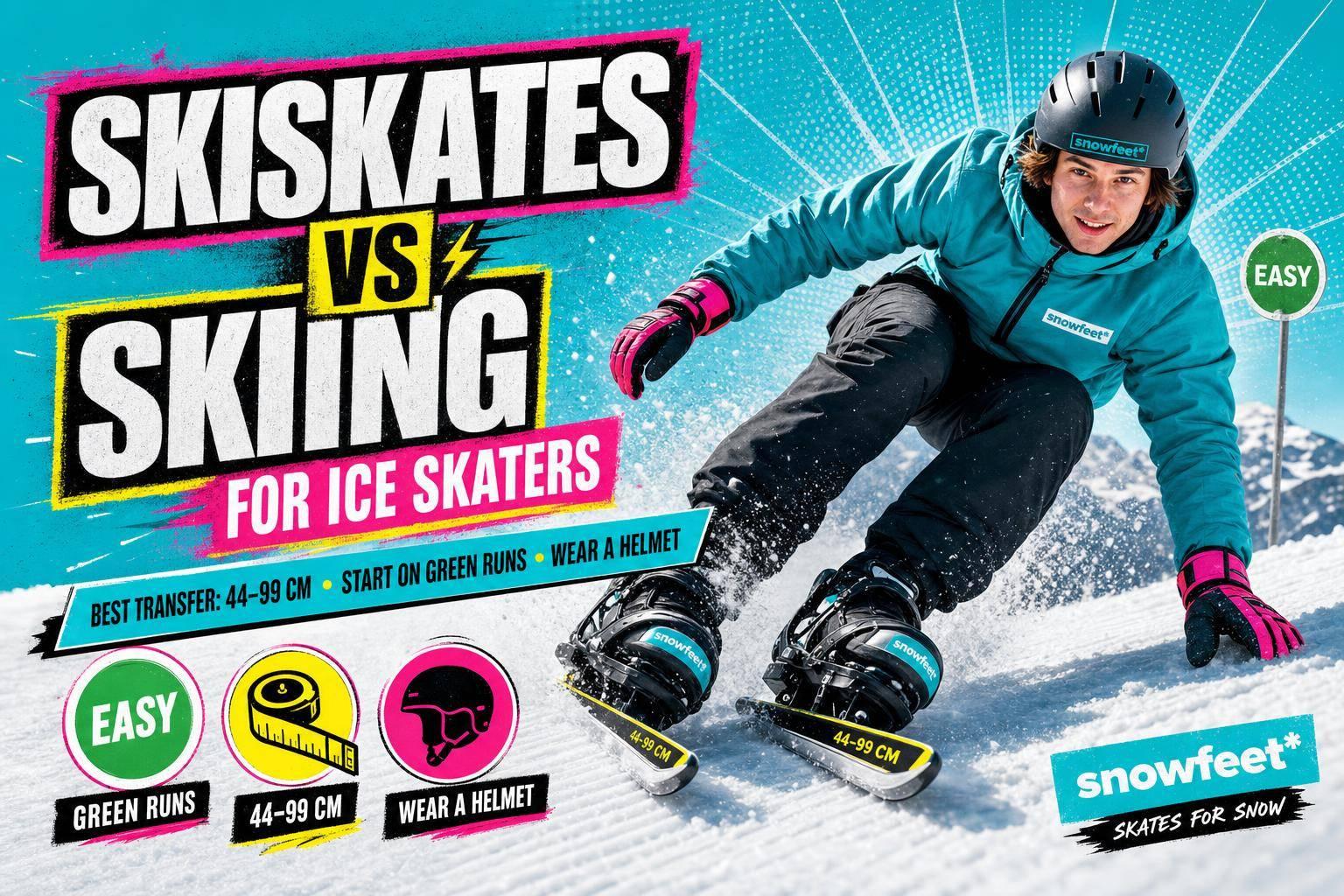
Les hockeyeurs confirmés, les patineurs sur glace à l’aise et les patineurs en ligne expérimentés s’adaptent généralement le plus rapidement aux équipements Snowfeet* courts. Avec les Skiskates Snowfeet* (44 cm) ou les Skiblades (65 cm) sur des pistes vertes damées, ce groupe peut souvent commencer à avancer et à enchaîner des virages contrôlés dès la première ou les deux premières heures.
Cependant, même les patineurs confirmés devraient prévoir au moins une séance d’initiation d’une heure. Cette séance devrait couvrir :
- comment s’arrêter rapidement sur la neige
- comment monter dans les télésièges et en descendre avec un équipement court
- les règles de base sur les pistes, comme la priorité et les endroits où il ne faut pas s’arrêter
Qui devrait tout de même réserver un cours officiel
Les patineurs occasionnels, les débutants complets et les familles avec enfants devraient réserver un cours officiel. Les débutants en skis classiques ou en snowboard ont également besoin d’un enseignement officiel pour maîtriser leur vitesse et prévenir les chutes. Dans de nombreux cas, un court cours collectif suffit.
Les adultes sportifs peuvent se laisser tromper ici. Vous pouvez vous sentir à l’aise et bien coordonné, mais si vous prévoyez de vous lancer directement sur des pistes plus pentues, mieux vaut faire une pause et reconsidérer l’idée de partir seul. La condition physique peut masquer de véritables lacunes en matière de contrôle de la vitesse et de prévention des chutes.
Type de patineur, équipement recommandé et durée du cours : tableau récapitulatif
Consultez le tableau ci-dessous pour avoir une idée rapide du temps de cours généralement nécessaire pour chaque type de patineur.
| Type de patineur | Meilleur modèle Snowfeet* | Cours nécessaire |
|---|---|---|
| Hockeyeur confirmé / patineur en ligne | Skiskates 44 cm | 0 à 1 heure (sécurité et remontées mécaniques) |
| Patineur sur glace confirmé | Skiskates de 44 cm ou Skiblades de 65 cm | 1 à 2 heures |
| Patineur occasionnel / de loisir | Skiblades de 65 cm ou 99 cm | Une demi-journée |
| Débutant complet / familles avec enfants | Skiblades de 99 cm | Une demi-journée |
| Tout patineur sur des skis classiques | Pas le meilleur choix | Minimum de 1 à 2 heures |
| Tout patineur sur un snowboard | Pas le meilleur choix | Minimum d’une demi-journée |
Le patinage raccourcit le parcours. Snowfeet* le raccourcit encore davantage.
FAQ
Les joueurs de hockey peuvent-ils éviter les cours de ski ?
Pas pour le ski alpin au sens habituel. Les joueurs de hockey possèdent tout de même certaines compétences utiles, comme l’équilibre, le contrôle des carres et l’aisance à vitesse élevée. Mais les skis longs et lourds sont d’une tout autre nature. Ils exigent des mouvements spécifiques à ce sport, dont certains peuvent entrer en conflit avec les habitudes du patinage.
Avec les Snowfeet Skiskates ou les Skiblades, la transition paraît beaucoup plus naturelle. Leur taille compacte de 44 cm à 120 cm est plus proche de celle des patins à glace, si bien que les joueurs de hockey peuvent s’appuyer sur leur mémoire musculaire et glisser et s’arrêter avec une courbe d’apprentissage moins déroutante.
Quel équipement Snowfeet* est le plus facile pour les patineurs ?
Pour les patineurs, la transition vers la neige est la plus facile avec les Snowfeet Skiskates de 44 cm*. Leur courte longueur ressemble beaucoup plus à celle des patins à glace ou des rollers, de sorte que l’équilibre, les transferts de poids rapides, l’agilité et le contrôle des carres sont conservés, avec une courbe d’apprentissage moins déroutante.
C’est là tout l’avantage. Ils ne paraissent ni imposants ni encombrants. Comparés aux skis classiques, ils sont légers, réactifs et faciles à manier. Vous pouvez également les utiliser avec des bottes d’hiver classiques ou des chaussures de snowboard, ce qui simplifie l’équipement. Ainsi, les premiers virages et arrêts paraissent plus naturels dès le départ.
Quelles compétences sur la neige ne se transfèrent pas du patinage ?
Le patinage vous donne une bonne longueur d’avance en matière d’équilibre, de contrôle des carres et de stabilité du bas du corps.
Mais la neige a ses propres particularités.
Cela ne réagit pas comme la glace ou le bitume. Ainsi, même si vous êtes à l’aise sur des patins, certaines sensations vous paraîtront un peu étranges au début.
Vous devrez :
- moins compter sur de fortes poussées latérales
- contrôler la dérive avec de petites variations de pression plutôt que d’essayer de forcer le dérapage
- garder le haut du corps plus immobile
- vous habituer à des virages qui semblent plus retardés et plus dessinés, pas aussi instantanés qu’en patinage
C’est cette dernière partie qui pose souvent problème. Sur des patins, la réaction peut sembler rapide et précise. Sur la neige, le virage se construit plus progressivement. C’est moins un « claquement » qu’un « arc ». Une fois que vous ressentez ce rythme, tout commence à devenir plus naturel.











Laisser un commentaire
Ce site est protégé par hCaptcha, et la Politique de confidentialité et les Conditions de service de hCaptcha s’appliquent.