



















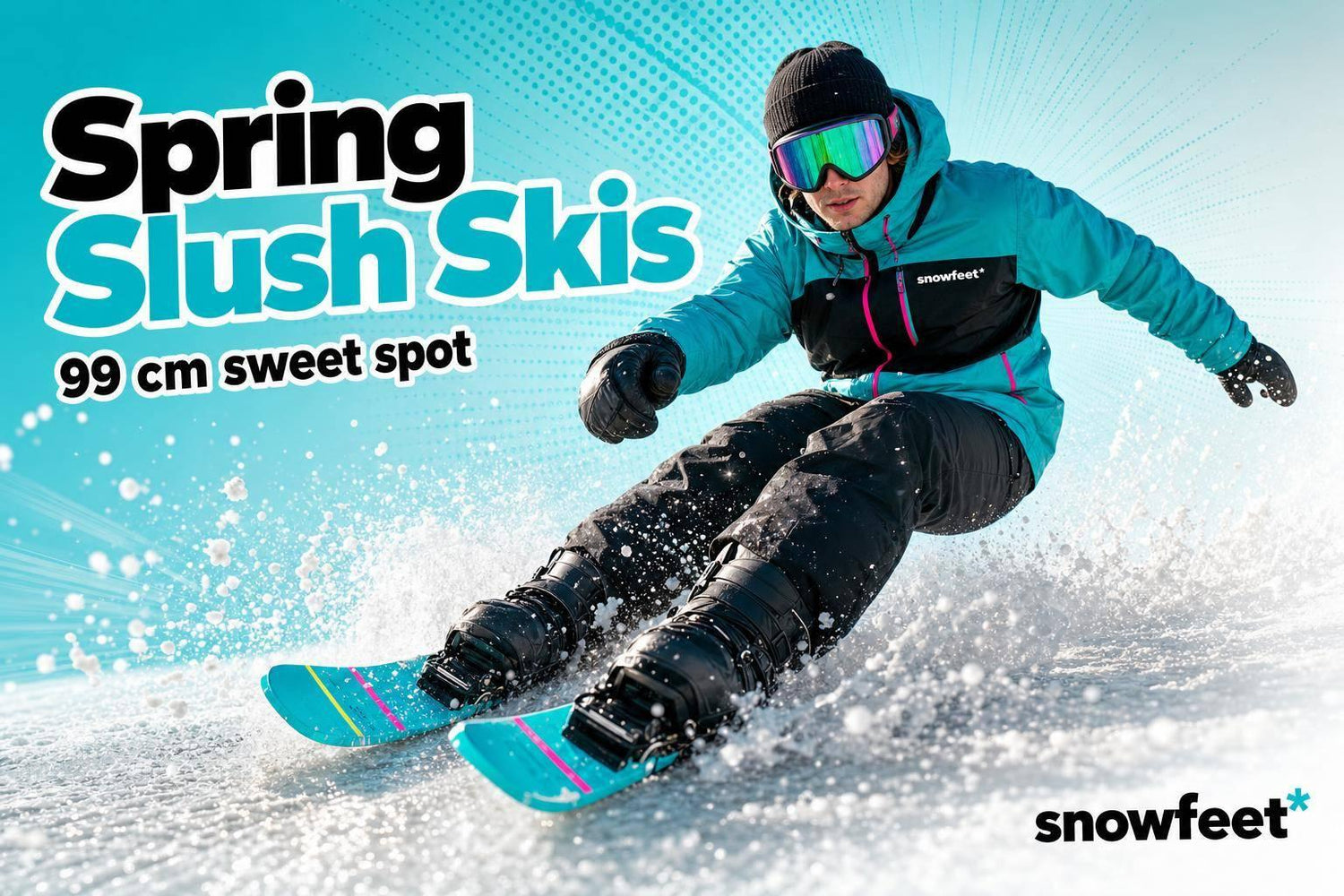
Si vous voulez une réponse courte : choisissez les Snowfeet* de 99 cm pour la plupart des journées printanières. Ils offrent le meilleur équilibre entre virages faciles, soutien suffisant dans la neige fondue travaillée et sensation stable aux vitesses habituelles en station.
La neige printanière se dégrade rapidement. Le matin, elle peut sembler ferme. L’après-midi, elle se transforme en tas de neige humide, ornières et neige pâteuse. Dans ce type de neige, je m’intéresserais à la flottaison, au contrôle dans la neige travaillée, à la sensation en virage et à la vitesse maximale avant toute autre chose.
Voici l’essentiel :
- Les meilleurs dans la neige fondue printanière variable : Snowfeet* 99 cm
- Les meilleurs dans la neige fondue profonde et humide : Snowfeet* POWDER 99 cm
- Les meilleurs pour les descentes lentes et ludiques : Snowfeet* 65 cm
- Le meilleur ski court pour les descentes plus difficiles : Snowfeet* 120 cm
- Les meilleurs pour les pistes damées longues et rapides : Skis all-mountain de 85 à 100 mm
Quelques tendances claires se dégagent :
- Les 65 cm tournent le plus rapidement, mais ce sont aussi ceux qui se font le plus ballotter.
- Les 99 cm offrent le compromis que la plupart des skieurs apprécieront.
- Les POWDER 99 cm restent mieux en surface de la neige humide que les autres modèles courts.
- Les 120 cm offrent la sensation la plus stable dans la neige printanière travaillée.
- Les skis all-mountain pleine longueur restent les meilleurs lorsque la vitesse et la stabilité sur les longues descentes sont prioritaires.
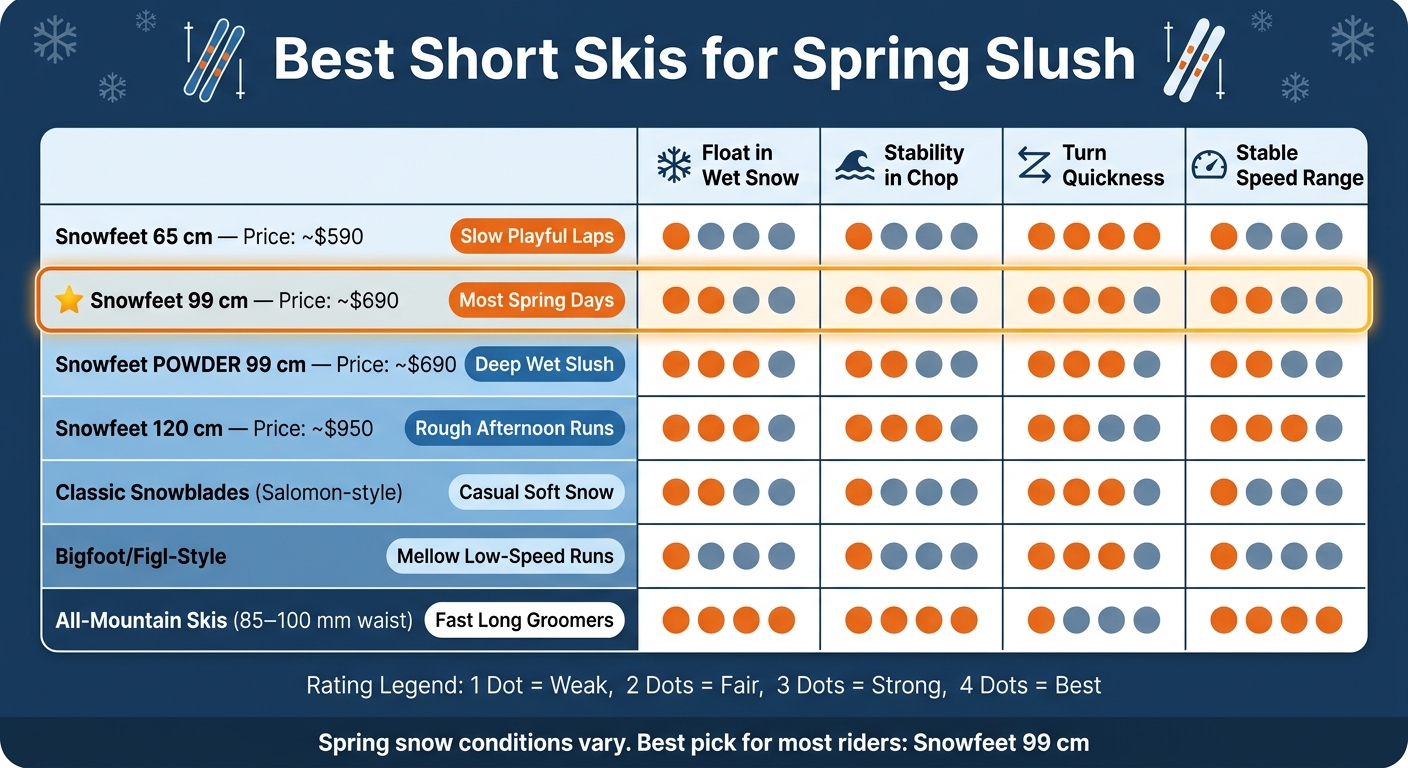
Les meilleurs skis courts pour la neige fondue printanière : comparaison côte à côte
Un snowboardeur essaie les Snowfeet* | Quel ski court Snowfeet* est le meilleur ? | Avis sur les snowblades 44, 65 et 99
Comparaison rapide
| Ski | Neige fondue humide | Neige travaillée | Sensation en virage | Utilisation idéale |
|---|---|---|---|---|
| Snowfeet* 65 cm | Faible soutien | Se font davantage ballotter | Les plus rapides | Descentes sur pistes vertes/bleues, snowpark, faible vitesse |
| Snowfeet* 99 cm | Solides | Bon équilibre | Très rapides | La plupart des journées printanières en station |
| Snowfeet* POWDER 99 cm | Meilleure flottaison parmi les skis courts | Bon | Sensation débridée et propice aux dérapages | Neige fondue profonde et souple |
| Snowfeet* 120 cm | Élevé | Élevé | Moins réactives | Descentes difficiles l’après-midi |
| Snowblades classiques | Correctes dans une neige légèrement fondue | Faible | Réactives | Descentes tranquilles sur neige souple |
| Style Bigfoot/Figl | Faible soutien | Faible | Pivot très rapide | Descentes courtes et faciles |
| Skis all-mountain de 85 à 100 mm | Meilleur choix global | Meilleur choix global | Passage d’une carre à l’autre plus lent | Pistes damées rapides, longues descentes |
Côté prix, la gamme Snowfeet* présentée dans cet article va d’environ 590 $ à 950 $. Alors, euh, le choix est assez simple : si vous voulez le maximum de plaisir pour skier normalement en station au printemps, commencez par les 99 cm. Si votre piste se transforme en soupe humide vers midi :) choisissez les POWDER 99 cm. Si vous skiez plus vite ou voulez davantage de stabilité sous les pieds, optez pour les 120 cm.
Voilà l’article résumé en quelques mots. Passons maintenant aux modèles sélectionnés.
1. Skiblades Snowfeet* de 65 cm
La version de 65 cm est la plus maniable de la gamme. Cela dit, sa courte longueur entraîne un compromis évident lorsque la neige fondue printanière devient profonde, humide et pleine de blocs.
Performances dans la neige humide et lourde
Dans la neige fondue profonde et humide, les Skiblades de 65 cm ont tendance à s’enfoncer plutôt qu’à flotter. Cela les aide à rester réactives sous les pieds, mais signifie aussi moins de soutien. Le contact plus court avec les carres facilite les pivots, et les dérapages semblent naturels, ce qui est un grand avantage pour les débutants sur un terrain peu pentu. Sur les pistes à faible inclinaison, l’accroche des carres est correcte. Mais lorsque la neige devient très humide et irrégulière, elles ont tendance à déraper davantage qu’à effectuer des virages carvés propres.
Maniabilité dans la neige fondue hachée
Lorsque la neige fondue de l’après-midi s’accumule en bosses et en ornières, la faible longueur de contact vous aide à vous faufiler dans le désordre grâce à des virages rapides et réactifs. Cette sensation est amusante. Cependant, lorsque les bosses grossissent ou que votre vitesse augmente, ils sont davantage secoués. Ils fonctionnent donc mieux avec un style léger et actif, à un rythme modéré. Sur un terrain plus raide ou plus accidenté, cette sensation nerveuse ressort encore davantage, ce qui nous amène au compromis concernant la vitesse.
Virages serrés et vitesse
À vitesse élevée sur des pistes damées et accidentées, la faible longueur de contact commence à jouer contre vous. Comme l’a expliqué un utilisateur vérifié :
"Le seul compromis se manifeste à vitesse élevée, lorsque les skis plus longs restent plus stables."
Si vous skiez toute la journée sur un terrain plus raide et haché, les options de 99 cm ou de 120 cm sembleront plus stables.
À qui s’adressent-ils
Ils conviennent bien aux débutants et aux skieurs joueurs qui restent sur des terrains printaniers faciles. Ce ne sont pas les meilleurs choix pour la vitesse, les pistes raides ou la neige fondue difficile de l’après-midi. Le prix est d’environ $590.
Si vous recherchez cette même sensation vive et joueuse, mais avec davantage de stabilité dans la neige fondue hachée, le modèle de 99 cm est l’étape suivante idéale.
2. Snowfeet* Skiblades de 99 cm
Les Skiblades de 99 cm sont le juste milieu si vous passez du modèle de 65 cm. Ils restent rapides et joueurs, tout en offrant davantage de contrôle lorsque la neige printanière devient humide, lourde et un peu désordonnée. Si la version de 65 cm commence à sembler un peu trop nerveuse dans la neige hachée de l’après-midi, c’est le choix le plus judicieux.
Performances dans la neige humide et lourde
Cette longueur supplémentaire offre une carre effective plus longue, ce qui aide beaucoup dans la neige fondue collante et pleine d’ornières. Au lieu d’être secoués, les skis suivent leur trajectoire avec davantage de contrôle. Ils avancent également dans la neige collante en donnant moins cette sensation de s’y enliser.
Gérer la neige fondante hachée et les virages serrés
C’est là que le modèle de 99 cm se démarque. Snowfeet* le formule ainsi :
"Grâce à leur courte longueur, les Skiblades... sont amusants et faciles à manier lorsque les pistes damées se transforment en bosses l’après-midi." – Snowfeet*
Sur les tas de neige, les bosses de neige fondue et les ornières, ils semblent plus stables que la version de 65 cm. Mais ils restent plus agiles que le modèle de 120 cm lorsque le terrain devient étroit, bosselé et irrégulier. Cet équilibre est essentiel. Les changements de direction rapides, les virages dérapés et les arrêts hockey restent fluides dans la neige printanière collante, notamment sur les traversées étroites et les pistes fréquentées des stations.
Mike E a bien résumé la question de la vitesse :
"VEUILLEZ NOTER qu’ils ne sont pas aussi rapides que des skis classiques. Si vous aimez dévaler les pistes à toute vitesse, vous préférerez des skis plus longs. Pour tout le reste, ils sont absolument incroyables." – Mike E
Vitesse et stabilité
À vitesse lente à modérée, les Skiblades de 99 cm semblent stables et prévisibles. En les poussant davantage sur de longues pistes damées et accidentées, les gros amas de neige fondue peuvent toutefois encore les faire dévier de leur trajectoire. C’est le compromis. Les skis plus longs restent plus efficaces lorsqu’on veut aller tout droit et lâcher les chevaux.
À qui s’adressent-ils
Les Skiblades de 99 cm conviennent à plusieurs types de skieurs :
- Les skieurs intermédiaires en station
- Les skieurs de park qui aiment jouer
- Les voyageurs qui veulent quelque chose de facile à transporter et à skier
- Les débutants sûrs d’eux qui veulent un ski plus facile à faire tourner et à arrêter qu’un modèle pleine longueur
Cela dit, certains débutants apprécieront peut-être encore la stabilité supplémentaire des skis de 120 cm sur les pistes bien dégagées. À partir de $690, le modèle de 99 cm constitue une évolution judicieuse par rapport à la version de 65 cm si vous voulez plus de contrôle sans renoncer aux sensations d’un ski court.
Si vous voulez plus de portance dans une neige fondue plus profonde et plus humide, le POWDER 99 cm est l’étape suivante.
3. Snowfeet* POWDER 99 cm
Le POWDER 99 cm est le meilleur choix pour la neige fondue. Il est plus large, avec davantage de rocker à l’avant et un peu à l’arrière, ce qui l’aide à rester à la surface d’une neige lourde et humide. Lorsque la neige printanière devient plus profonde et plus collante, cette largeur supplémentaire commence à faire la différence.
Performances dans la neige humide et lourde
Cette plateforme plus large réduit la sensation d’accroche que peuvent avoir les skis étroits dans une neige fondue dense et humide. Le flex plus souple aide également à lisser les bosses irrégulières et collantes, pour une glisse moins nerveuse.
Gérer la neige fondante hachée et les virages serrés
Dans la neige d’après-midi déjà tracée, le rocker permet au POWDER 99 cm de glisser par-dessus les petits amas au lieu de s’y accrocher. Il offre une sensation un peu surfy à vitesse moyenne et reste facile à faire pivoter lorsque la surface passe de monticules souples à des plaques plus fermes. Dans la neige fondue printanière, il favorise davantage les virages courts et dérapés qu’une accroche franche en carving, et honnêtement, c’est souvent la meilleure approche dans ces conditions.
Vitesse et stabilité
À vitesse lente ou moyenne, le POWDER 99 cm est tolérant et facile à maîtriser. En revanche, si vous accélérez trop sur de longues pistes damées et irrégulières, il semblera moins stable qu’un ski all-mountain de 170 à 180 cm. Il est idéal pour des descentes ludiques à vitesse moyenne dans une neige printanière souple, pas pour une attaque à pleine vitesse.
À qui s’adressent-ils ?
Ce ski convient aux skieurs intermédiaires à confirmés qui veulent tracer dans les conditions printanières sans avoir l’impression de lutter avec leur équipement. Il convient bien aux personnes qui recherchent plus de portance et moins d’accroche que le modèle standard de 99 cm. Si votre style repose davantage sur la vitesse, la puissance et les grandes courbes de type GS, un ski all-mountain pleine longueur restera plus adapté. Les prix commencent à environ $690.
Si vous voulez plus de stabilité pour des descentes printanières sur un terrain plus difficile, le modèle de 120 cm est l’étape suivante.
4. Snowfeet* Skis courts de 120 cm
Si les modèles de 99 cm commencent à sembler un peu nerveux lorsque la neige bosselée de l’après-midi apparaît, la version de 120 cm est l’étape suivante évidente. C’est le ski court le plus stable de cette gamme, ce qui en fait la meilleure option Snowfeet* pour la neige fondue printanière lorsque la neige devient irrégulière, lourde et difficile. Vous perdez un peu de la vivacité et de la réactivité des modèles de 99 cm, mais vous gagnez en contrôle lorsque la montagne devient difficile.
Performances dans la neige humide et lourde
La semelle en graphite aide le ski à mieux glisser dans la neige fondue humide et réduit la résistance créée par la neige printanière lourde. Le noyau en bois et les carres métalliques améliorent le contrôle et résistent bien dans le temps.
Gérer la neige fondante hachée et les virages serrés
Le cambre avec un rocker en spatule et au talon aide le ski à rester stable lorsque la surface passe de tas de neige souple à des plaques plus fermes. Snowfeet* le conçoit pour offrir du contrôle, des virages rapides et une glisse fluide sur terrain non damé. La ligne de cotes prononcée garde des virages nerveux, même lorsque la neige semble complètement désordonnée.
Vitesse et stabilité
À vitesse modérée en station, ce ski semble plus stable que les modèles de 99 cm, tout en étant beaucoup plus facile à manœuvrer qu'un ski all-mountain pleine longueur. Cette stabilité dans la neige défoncée est la principale raison de passer d'un modèle de 99 cm à une longueur supérieure. Vous perdez un peu de cette sensation de vivacité fulgurante, mais gagnez en sérénité lorsque la neige fondante devient agitée.
À qui s’adressent-ils ?
Ce ski convient aux skieurs de niveau intermédiaire à avancé qui souhaitent davantage de contrôle dans des conditions printanières difficiles sans passer directement à un ski classique long. À $950, c'est le modèle le plus cher ici, mais c'est aussi celui qui convient le mieux aux conditions printanières variables.
Ensuite, la comparaison se concentre sur les snowblades classiques et d'autres formats de skis courts afin de voir comment ils se comportent dans les mêmes conditions de neige fondante.
sbb-itb-17ade95
5. Snowblades classiques (style Salomon)
Les snowblades classiques sont conçues pour effectuer des virages faciles et nerveux. Leur ligne de cotes prononcée les rend très réactives sous les pieds, ce qui est un vrai plaisir lors des journées printanières où la neige est plus souple. Le compromis, c'est le maintien. Une fois que la neige devient lourde et compacte, elles tiennent moins bien leur trajectoire.
Performances dans la neige humide et lourde
Dans la neige fondante de printemps, le principal problème n'est pas la rapidité avec laquelle vous pouvez tourner. C'est la portance. Les lames de style classique gèrent assez bien une neige fondante légère, mais lorsque la neige devient plus profonde et plus défoncée, leur plateforme étroite est plus facilement malmenée. Leur faible longueur vous aide certes à effectuer des corrections rapides, mais les lames à patin étroit offrent tout simplement beaucoup moins de portance que les modèles plus larges conçus pour la poudreuse.
Gérer la neige fondante hachée et les virages serrés
C'est là que les lames classiques restent amusantes. Leur faible longueur et leur ligne de cotes prononcée rendent les changements de direction rapides faciles, même lorsqu'une piste damée et lisse se transforme en neige irrégulière et compacte l'après-midi. Elles restent agiles dans la neige fondante et bosselée, mais leur plateforme étroite offre moins de portance et une glisse moins stable que les modèles Snowfeet* POWDER ou de 120 cm.
Alors oui, ils sont rapides et ludiques. Mais lorsque la neige devient plus humide et plus profonde, les modèles Snowfeet* offrent davantage de contrôle.
Vitesse et stabilité
La vitesse est leur point faible. Les lames classiques de 99 cm sont moins stables à haute vitesse que des skis plus longs. Elles conviennent donc mieux à une glisse tranquille et à des descentes ludiques qu'à une vitesse maximale sur de longues pistes damées.
"À NOTER : ils ne sont pas aussi rapides que des skis classiques. Si vous aimez dévaler les pistes à toute vitesse, mieux vaut choisir des skis plus longs. Pour tout le reste, ils sont absolument incroyables." - Mike E, utilisateur vérifié
À qui s’adressent-ils ?
Voici dans quelles conditions ils sont les plus performants :
- Les débutants
- Les skieurs occasionnels en station
- Les personnes qui recherchent une entrée en virage facile et une sensation ludique
Ils sont moins adaptés à la neige fondante épaisse ou aux pistes damées rapides.
Pour plus de stabilité dans une neige fondue printanière plus profonde, la comparaison suivante porte sur les skis courts de style Bigfoot/Figl.
6. Skis courts de style Bigfoot/Figl
Les skis de style Bigfoot et Figl sont ultra-courts — environ 20 à 39 pouces (soit environ 50 à 100 cm) — avec un avant large et très peu de ligne de cotes. Cette forme les rend rapides à faire tourner sur neige ferme. Mais lorsque la neige devient humide, molle et dégradée, ils peuvent sembler beaucoup moins tolérants.
Performances dans la neige humide et lourde
Dans la neige fondue profonde du printemps, le véritable test est simple : le ski reste-t-il en surface ou s’y enfonce-t-il ?
Ces skis ont tendance à s’enfoncer et à labourer la neige lourde ; ils fonctionnent donc mieux lorsque la neige printanière reste relativement peu profonde. Sur les zones plus fermes, l’accroche des carres reste correcte. En revanche, lorsque la surface devient gorgée d’eau, la conduite en virage coupé commence à disparaître. La glisse devient alors davantage une affaire de dérapage et d’étalement qu’une courbe fluide.
Gérer la neige fondante hachée et les virages serrés
C’est là tout leur intérêt.
Comme ils sont très courts, leur inertie en rotation est très faible. Les pivots rapides, les changements de direction vifs et les virages serrés deviennent donc faciles. C’est là que les skis de style Bigfoot/Figl peuvent vous donner le sourire :) Ils sont ludiques et rapides, comme s’ils voulaient virevolter dans tous les sens.
Le revers de la médaille ? Ils ne glissent pas par-dessus les bourrelets de neige fondue ou les bosses regelées comme peut le faire un ski plus long. Ils sont au contraire davantage malmenés. Pour garder le contrôle, il faut solliciter activement les jambes et absorber les irrégularités sans relâche jusqu’en bas.
Vitesse et stabilité
C’est à la vitesse que ces skis atteignent leur limite.
Dès que vous commencez à accélérer sur les longues pistes damées printanières, la plateforme courte devient nerveuse. Les tas de neige meuble peuvent la faire dévier, et chaque creux, bosse et ornière se fait sentir. Ils sont très amusants sur les courtes descentes à faible vitesse, mais ne sont pas conçus pour les descentes printanières irrégulières où l’on recherche une glisse stable.
Si vous voulez davantage de stabilité sur les longues pistes printanières, la comparaison suivante porte sur les skis all-mountain de 85 à 100 mm.
À qui s’adressent-ils ?
Ils conviennent surtout aux pratiquants expérimentés qui recherchent de courtes descentes ludiques, des sauts dans le snowpark et des passages printaniers étroits.
Si vous passez la journée sur de longues pistes ou affrontez une neige printanière irrégulière en fin de saison, vous serez généralement plus à l’aise avec les Snowfeet* de 99 cm ou de 120 cm. Ils offrent davantage de portance et de stabilité, sans perdre ce caractère ludique.
7. Skis all-mountain (patin de 85 à 100 mm)
Si vous comparez les skis courts à un équipement standard, c’est le point de comparaison axé en priorité sur le contrôle.
Les skis all-mountain de longueur classique, avec un patin de 85 à 100 mm, sont la référence incontournable pour le ski en station au printemps, lorsque la stabilité est primordiale. Sur les longues pistes damées printanières, bosselées et irrégulières, ils gardent bien leur trajectoire, glissent par-dessus les bourrelets de neige fondue et restent plus stables que les skis courts lorsque la neige devient inégale. Autour de 95 mm, on atteint généralement le juste équilibre : suffisamment de portance pour la neige fondue, humide et dense, sans le volume supplémentaire d’un ski de poudreuse.
Gérer la neige fondante hachée et les virages serrés
Ces skis restent bien ancrés, mais ils ne s’engagent pas dans les passages étroits avec la vivacité des skis courts. Le rocker en spatule les aide à glisser sur les amas de neige molle au lieu d’y enfoncer les spatules, tandis que le cambre sous le pied apporte du dynamisme et de l’accroche lorsque la surface est plus ferme le matin.
Cette combinaison fonctionne bien dans une neige printanière variable. Mais dans les sous-bois, les bosses ou les pistes fréquentées, ils demandent toujours plus d’effort qu’un ski court de 99 cm ou 120 cm. C’est le compromis. Vous avez davantage de ski sous les pieds, et vous le ressentez lorsque l’espace se resserre.
Vitesse et stabilité
C’est précisément là que les skis all-mountain sont nettement meilleurs.
À vitesse élevée sur de longues pistes printanières damées, ils procurent une sensation calme et rassurante. Leur construction légèrement plus lourde et plus rigide les aide à ne pas se faire déstabiliser lorsque la neige devient accrocheuse, bosselée et irrégulière.
À qui s’adressent-ils ?
Les skis de cette catégorie conviennent aux skieurs assurés qui privilégient la vitesse, les virages carving et la stabilité plutôt qu’une sensation libre et joueuse. C’est un excellent choix si vous passez la majeure partie de la journée à descendre de longues pistes damées à bonne vitesse.
L’inconvénient est une maniabilité plus lente dans les passages printaniers étroits ou fréquentés. Pour de nombreux skieurs occasionnels au printemps, les Snowfeet* de 99 cm ou 120 cm resteront plus faciles à manier et plus amusants dans les espaces restreints.
Comment chaque option se comporte dans les conditions printanières réelles
La neige printanière change d’une heure à l’autre. Une descente peut sembler fluide, puis la suivante donne l’impression de skier dans un Slurpee renversé sur un parking. Le meilleur ski de printemps est donc celui qui reste stable lorsque la neige fondante devient lourde et hachée.
Pour ce type de neige, quatre éléments comptent le plus :
- flottabilité
- stabilité sur neige hachée
- rapidité des virages
- plage de vitesses utilisable
Voici la version courte : ces options vont du plus rapide et joueur au plus stable et rassurant.
Les Snowfeet* Skiblades 65 cm tournent presque sur commande. Ils sont très amusants dans les espaces étroits, mais leur surface réduite les rend moins performants dans la neige fondante profonde et humide.
Les Snowfeet* Skiblades 99 cm offrent un excellent équilibre. Ils restent rapides, tout en apportant suffisamment de stabilité pour gérer la neige printanière hachée sans devenir trop nerveux.
Les Snowfeet* POWDER 99 cm sont plus adaptés lorsque la neige devient plus lourde et plus humide. Leur plateforme plus large leur permet de mieux rester en surface au lieu de s’enfoncer.
Les Snowfeet* Short Skis 120 cm vous offrent le meilleur contrôle lorsque la neige hachée commence à s’accumuler. Le compromis est simple : ils pivotent moins rapidement que les modèles plus courts.
Les snowblades classiques et les skis de type Bigfoot/Figl restent amusants à vitesse réduite. Mais dès que la neige devient irrégulière, ils perdent un peu de cette sensation de stabilité rassurante.
Et oui, les skis all-mountain avec un patin de 85 à 100 mm restent les meilleurs en matière de portance et de stabilité à grande vitesse. C’est la réalité. Mais sur un terrain printanier étroit et fréquenté, ils sont plus lents à manœuvrer.
| Option | Portance dans la neige humide | Stabilité dans la neige défoncée | Rapidité des virages | Plage de vitesse stable |
|---|---|---|---|---|
| Snowfeet* Skiblades 65 cm | Faible | Faible | Meilleur | Faible |
| Snowfeet* Skiblades 99 cm | Moyen | Moyen | Élevé | Moyen |
| Snowfeet* POWDER 99 cm | Élevé | Moyen | Élevé | Moyen |
| Snowfeet* Short Skis 120 cm | Élevé | Élevé | Moyen | Élevé |
| Snowblades classiques | Moyen | Faible | Élevé | Faible |
| Style Bigfoot/Figl | Faible | Faible | Élevé | Faible |
| All-mountain (85–100 mm) | Meilleur | Meilleur | Faible | Meilleur |
Ensuite, transformons ces différences en avantages et inconvénients clairs.
Avantages et inconvénients de chaque option
Chaque option présentée atteint ses limites dans la neige fondue printanière. Pas de solution miracle ni de raccourci. Le tableau ci-dessous se concentre sur l’essentiel.
| Article | Principaux avantages | Principaux inconvénients | Meilleur usage dans la neige fondue |
|---|---|---|---|
| Snowfeet* Skiblades 65 cm | Très faciles à tourner, légers et rapides à pivoter | Nerveux à grande vitesse ; les spatules s’enfoncent dans la neige profonde et humide | Descentes lentes et ludiques sur pistes vertes ou bleues et modules de snowpark |
| Snowfeet* Skiblades 99 cm | Meilleur équilibre entre agilité et accroche des carres | Moins stables que les 120 cm dans la neige fortement défoncée | Descente à vitesse modérée dans la neige fondue de l’après-midi déjà tracée |
| Snowfeet* POWDER 99 cm | Meilleure portance dans la neige lourde et humide ; tolérants et agréables à surfer | Moins précis sur la neige plus ferme du matin | Neige fondue printanière profonde et lignes de bosses souples |
| Snowfeet* Short Skis 120 cm | Le ski court le plus stable ; assurance accrue sur les pistes damées plus longues et défoncées | Moins agiles que les modèles plus courts ; peu adaptés aux figures dans le snowpark | Descentes rapides et directionnelles sur des pistes damées printanières accidentées |
| Snowblades classiques (style Salomon) | Vifs et rapides dans la neige printanière souple | Vibrations et instabilité en ligne droite dans la neige fondue ; portance limitée | Descentes dans le snowpark au printemps, sur neige souple |
| Style Bigfoot/Figl | Pivot très rapide | Très faible stabilité ; moins sûrs et moins aboutis que les options modernes | Terrain doux, descentes à faible vitesse sur neige printanière souple |
| Skis all-mountain (patin de 85 à 100 mm) | Les plus stables à grande vitesse ; meilleure portance dans les conditions printanières variables | Lents à pivoter dans une neige fondue épaisse et collante ; plus encombrants à transporter | Descentes à grande vitesse sur de longues pistes damées printanières aux conditions variables |
Ainsi, une fois les compromis comparés côte à côte, le choix devient beaucoup plus simple. Pour enchaîner rapidement les descentes sur des pistes damées printanières accidentées, les skis all-mountain restent plus performants. Mais pour la plupart des skieurs occasionnels, le Snowfeet* 99 cm ou les Snowfeet* Short Skis 120 cm conviendront mieux à la plupart des descentes de printemps sans donner l’impression d’avoir trop de ski aux pieds.
Conclusion : quel ski court choisir ?
Pour la plupart des skieurs, le meilleur choix polyvalent est le Snowfeet* Skiblades 99 cm.
Pourquoi celui-ci ? Il offre le juste équilibre entre portance, stabilité et rapidité des virages. Sa largeur est suffisante pour rester en surface dans la neige fondue printanière, sa longueur suffisante pour rester stable sous les pieds, et ses pivots rapides rendent la neige irrégulière beaucoup moins pénible. Pour la plupart des journées de printemps, cet équilibre est difficile à égaler.
Si votre ski de printemps se transforme souvent en neige fondue profonde et humide, optez plutôt pour le POWDER 99 cm. Sa plateforme plus large l’aide à rester en surface d’une neige plus lourde, et les retours des utilisateurs sont très positifs. Lorsque la neige fondue devient plus profonde et plus humide, le POWDER 99 cm est le meilleur choix.
Le 65 cm est l’option la plus maniable. C’est un choix amusant pour les descentes ludiques à basse vitesse et le snowpark. Le 120 cm offre davantage de stabilité pour les descentes plus longues et accidentées, tout en restant différent d’un ski pleine longueur. Un bon compromis.
Si vous voulez la réponse la plus courte, commencez ici :
| Votre priorité au printemps | Meilleur choix |
|---|---|
| Neige fondante variable | Snowfeet* 99 cm |
| Neige fondante profonde et humide | Snowfeet* POWDER 99 cm |
| Jeu à basse vitesse, snowpark | Snowfeet* 65 cm |
| Longues descentes accidentées | Snowfeet* 120 cm |
| Longues pistes damées accidentées | Skis all-mountain pleine longueur de 85 à 100 mm |
Les skis all-mountain pleine longueur restent plus performants à grande vitesse sur les longues pistes damées et accidentées. Mais pour la neige fondante de printemps au quotidien, les Snowfeet* constituent le meilleur choix pour la plupart des skieurs.
FAQ
Comment choisir entre 99 cm et 120 cm ?
Tout dépend de la ludicité ou de la stabilité.
Choisissez les Snowfeet Skiblades de 99 cm* si vous recherchez des virages rapides et nerveux, des tours dans le snowpark et un contrôle facile. Ils conviennent bien aux débutants, aux skieurs occasionnels et à tous ceux qui souhaitent une sensation plus tolérante sur des pistes à vitesse lente ou modérée.
Optez pour les skis courts de 120 cm si vous passez davantage de temps sur des pistes damées rapides et souhaitez une glisse plus stable et posée. La longueur supplémentaire offre un meilleur contact des carres et davantage de stabilité.
Le POWDER 99 cm en vaut-il la peine pour la neige fondante de printemps ?
Oui, le Snowfeet* POWDER 99 cm est un excellent choix pour la neige fondante de printemps.
Par rapport aux Skiblades standards de 99 cm, il possède une ligne de cotes plus large et une spatule rocker. Cette combinaison l’aide à mieux flotter dans la neige molle, humide et travaillée.
En termes simples : vous avez davantage de surface sous les pieds, ce qui vous permet de rester au-dessus de la neige fondante au lieu de vous y enfoncer. La glisse est plus facile à diriger, plus ludique et tout simplement plus amusante lorsque les conditions deviennent lourdes et difficiles.
Si vous skiez souvent dans la neige de printemps molle, cela en vaut la peine.
Les skis courts sont-ils adaptés aux débutants dans la neige fondante ?
Oui. Les skis courts sont un excellent choix pour les débutants dans la neige fondante, car ils sont plus faciles à contrôler, à faire tourner et à arrêter que les skis standards lourds. Les nouveaux skieurs peuvent ainsi se sentir plus à l’aise et prendre confiance plus rapidement.
Dans la neige de printemps molle et humide, les Snowfeet Skiblades* paraissent légers aux pieds et faciles à diriger, ce qui aide à réduire la fatigue des jambes. Si vous souhaitez davantage de stabilité sur un terrain varié en station, les modèles de 99 cm sont un excellent choix. Si vous débutez et recherchez l’option la plus facile et la plus maniable, la version de 65 cm est idéale.











Laisser un commentaire
Ce site est protégé par hCaptcha, et la Politique de confidentialité et les Conditions de service de hCaptcha s’appliquent.