



















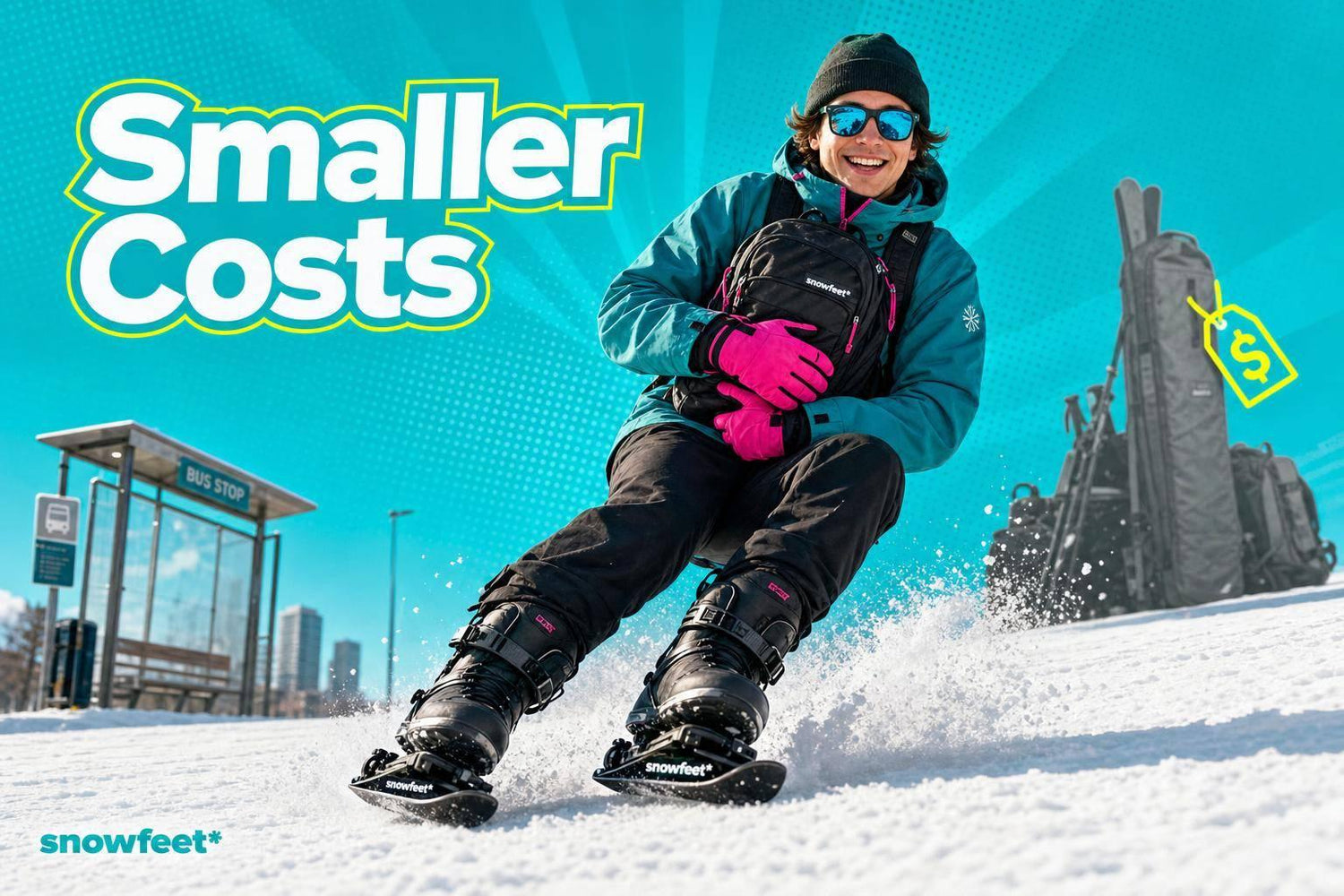
Oui : les skis courts sont souvent moins chers au total, mais pas toujours moins chers en magasin.
Si je compare la configuration complète, les skis courts coûtent souvent moins cher, car vous pouvez éviter les chaussures à 200–600 $ ou plus, les fixations séparées à 80–300 $, et même certains frais de transport ou de rangement. Une configuration de skis classiques coûte souvent environ 700–1 600 $, tandis que de nombreuses configurations de skis courts commencent bien plus bas, autour de 190 à 950 $, selon le modèle et les chaussures que vous possédez déjà.
Voici la réponse simple :
- Les skis classiques peuvent sembler moins chers au départ si vous comparez uniquement les skis
- Les skis courts sont souvent plus avantageux au total une fois que j’ajoute les chaussures, les fixations, les bâtons, les sacs, les porte-skis et l’entretien
- La plus grande économie : utiliser les chaussures d’hiver ou les chaussures de snowboard que vous possédez déjà
- Les skis classiques restent pertinents si vous skiez rapidement, recherchez la poudreuse profonde ou souhaitez un contrôle de type compétition
Ainsi, si vous êtes débutant, pratiquant occasionnel, parent qui achète pour ses enfants ou simplement quelqu’un qui ne veut pas transporter un équipement encombrant, les skis courts peuvent vous faire économiser une somme importante. Si vous recherchez des performances à grande vitesse, les skis classiques peuvent malgré tout justifier leur prix plus élevé.
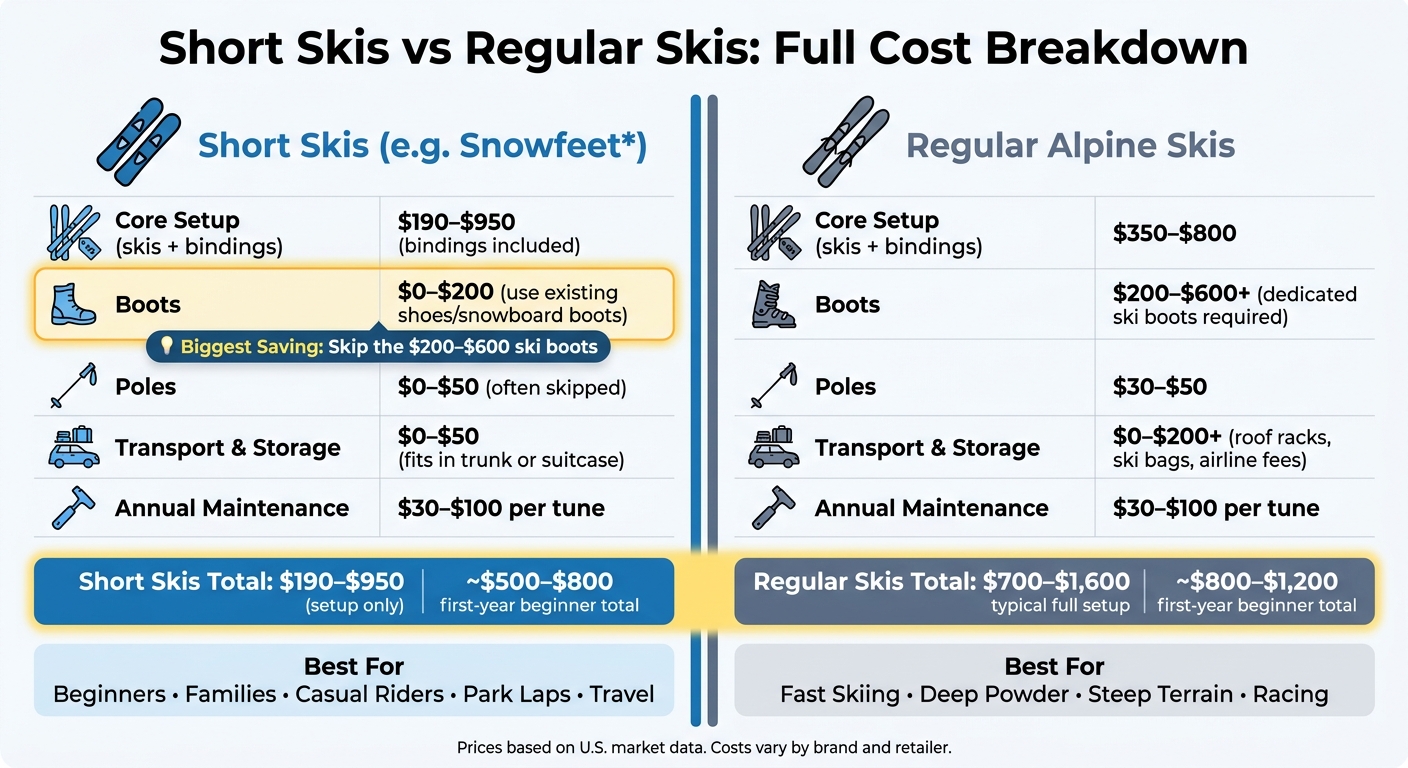
Skis courts contre skis classiques : analyse complète des coûts
Avis sur les Snowfeet* : les Skiskates en valent-ils la peine ? | Mini-ski | Patins pour la neige | Ski-patinage | Ski court
Comparaison rapide
| Configuration | Coût initial | Équipement supplémentaire nécessaire | Idéal pour | Poste de dépense principal |
|---|---|---|---|---|
| Skis courts / skiskates | 190–950 $ | Parfois aucun équipement supplémentaire au-delà des chaussures que vous possédez | Débutants, pratiquants occasionnels, descentes dans le snowpark, voyages | Certains modèles nécessitent encore des chaussures de ski ou de snowboard |
| Skis classiques | 700–1 600 $ au total pour de nombreuses configurations | Chaussures, bâtons, parfois fixations, équipement de transport | Ski rapide, poudreuse, terrains pentus | Les chaussures et les accessoires font grimper le prix |
Mon avis : si vous vous intéressez à la facture totale, et pas seulement au prix des skis, les skis courts reviennent souvent moins cher. Et pour beaucoup de pratiquants, c’est cette partie qui pèse le plus sur le portefeuille :)
Si vous le souhaitez, je peux aussi transformer cela en introduction d’article entièrement réécrite + méta-description + section FAQ.
Coût initial : skis courts contre ensembles de skis classiques
Voici à quoi ressemble l’écart de prix dès le premier jour entre les skis courts et une configuration alpine complète.
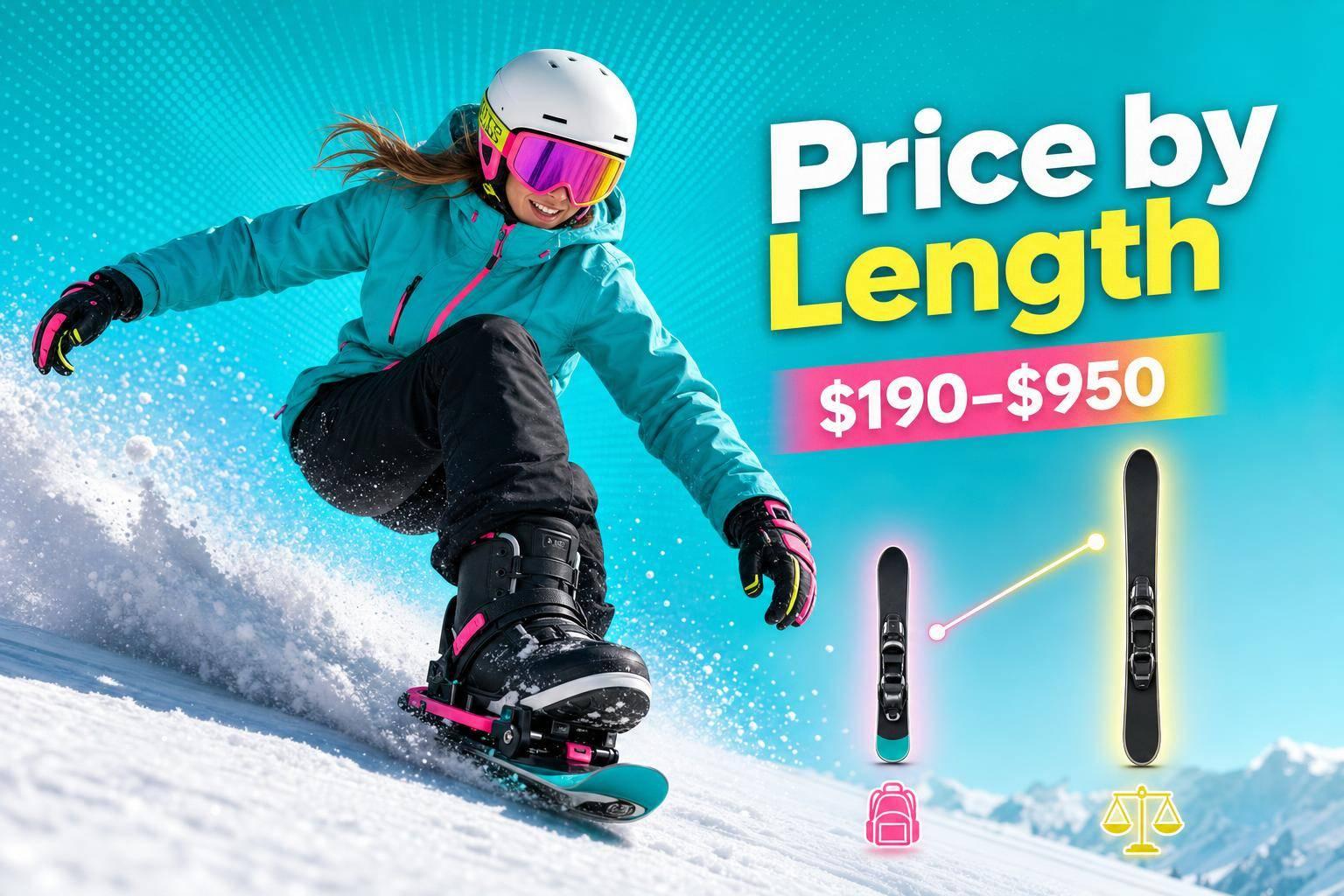
Gamme de modèles et prix Snowfeet*
Snowfeet* coûte moins cher que de nombreuses configurations de ski classiques. La gamme commence par de simples skiskates utilisables avec des chaussures d’hiver et va jusqu’à des skiblades plus longs conçus pour les chaussures de ski ou de snowboard. Autre avantage appréciable : la plupart des modèles Snowfeet* incluent déjà les fixations, ce qui vous évite de payer séparément leur montage.
Combien coûte un ensemble de skis classique aux États-Unis ?
Une nouvelle configuration alpine peut rapidement coûter cher. Les skis et fixations d’entrée de gamme coûtent généralement 450–800 $. Les chaussures ajoutent 200–350 $, et les bâtons coûtent encore 80–150 $.
Cela porte le prix d’un nouvel équipement débutant à environ 600 à 800 $. Un équipement de milieu de gamme coûte généralement autour de 900 à 1 400 $. Si vous passez à du matériel performant, comptez 1 500 à 2 500 $ et plus.
Là où les skis courts réduisent les coûts dès le départ
Les plus grandes économies viennent généralement du fait de ne pas acheter de chaussures de ski alpin. Certains modèles Snowfeet* fonctionnent avec des chaussures d’hiver classiques. D’autres s’utilisent avec des chaussures de snowboard que vous possédez peut-être déjà. Vous pourriez donc éviter de dépenser ces 200 à 350 $ supplémentaires pour des chaussures alpines.
Ce seul changement peut effacer une grande partie de l’écart de prix.
Il y a un autre élément à prendre en compte. D’autres marques de skis courts comme Salomon Snowblades, Bigfoot, Figl et ODR Skis se situent dans une fourchette de prix similaire à celle de Snowfeet*. Mais elles nécessitent tout de même des chaussures de ski, ce qui réduit rapidement leur rapport qualité-prix.
Le prix initial ne représente qu’une partie de l’histoire. L’écart suivant vient des chaussures, du transport du matériel, du stockage et de l’entretien.
| Produit | Prix (USD) | Incluses | Chaussures requises | Idéal pour |
|---|---|---|---|---|
| Snowfeet* Mini Ski Skates (Basic) | À partir de 190 $ | Skates + fixation à sangle | Chaussures d’hiver classiques | Débutants, pratiquants occasionnels |
| Snowfeet* PRO Mini Ski Skates | À partir de 299 $ | Skates + fixation réglable | Chaussures d’hiver classiques | Débutants, pratiquants occasionnels |
| Snowfeet* Skiskates (44 cm) | À partir de 460 $ | Skates + fixation | Chaussures de ski ou de snowboard | Pratiquants intermédiaires, pratiquants de snowpark |
| Snowfeet* Skiblades (65 cm) | À partir de 590 $ | Skis courts + fixation | Chaussures de ski ou de snowboard | Débutants à intermédiaires |
| Snowfeet* Skiblades (99 cm) | À partir de 690 $ | Skis courts + fixation | Chaussures de ski ou de snowboard | Pratiquants intermédiaires |
| Snowfeet* Short Skis (120 cm) | $950 | Skis courts + fixation | Chaussures de ski ou de snowboard | Pratiquants occasionnels confirmés |
| Équipement alpin classique (entrée de gamme) | 600 à 800 $ | Skis + fixations + chaussures + bâtons | Chaussures de ski alpin | Skieurs débutants |
| Équipement alpin classique (milieu de gamme) | 900 à 1 400 $ | Skis + fixations + chaussures + bâtons | Chaussures de ski alpin | Skieurs intermédiaires à confirmés |
sbb-itb-17ade95
Coût total de possession : chaussures, fixations, transport et entretien
Une fois ajoutés les chaussures, le transport et l’entretien, l’écart de prix paraît très différent. Le prix affiché des skis seuls ne raconte pas toute l’histoire. Le coût réel vient de l’équipement complet : chaussures, fixations, transport et entretien.
Chaussures et fixations : là où le coût du ski classique s’accumule
Avec un équipement alpin classique, les chaussures et les fixations s’achètent séparément et, oui, la facture grimpe vite. Les chaussures de ski d’entrée de gamme coûtent généralement 200 à 300 $, tandis que les modèles performants peuvent dépasser 600 $. Les fixations sont parfois incluses avec les skis d’entrée de gamme. Mais si vous les achetez séparément, comptez 80 à 300 $ pour le matériel, plus environ 65 à 100 $ de main-d’œuvre en magasin pour le montage et les tests.
Snowfeet* élimine l’achat séparé des fixations et des chaussures. Les fixations sont incluses et, si vous avez déjà des chaussures compatibles, le coût de vos chaussures peut passer à $0.
Les skis courts sont plus faciles et moins chers à transporter et à ranger
C’est le genre de coût que l’on oublie jusqu’au moment où l’on se débat avec son équipement sur un parking.
Les skis courts Snowfeet* tiennent dans un coffre, un placard ou même une valise. Cela peut vous éviter d’acheter des porte-skis de toit et des sacs à skis volumineux, ainsi que de nombreux frais de transport aérien. Le rangement devient aussi beaucoup plus simple. Plus besoin de leur trouver un coin encombrant dans le garage ni de glisser un énorme sac derrière une porte.
Les coûts d’entretien sont similaires, mais Snowfeet* reste plus avantageux au total
Les coûts d’entretien sont assez proches pour les deux équipements. Les ateliers facturent généralement l’entretien par paire, si bien que les skis courts coûtent souvent aussi cher à entretenir que les skis classiques. Un fartage et un affûtage coûtent généralement 30 à 45 $, tandis qu’un entretien complet avec travail de la semelle, affûtage des carres et fartage coûte généralement entre 50 et 100 $ dans la plupart des ateliers américains.
L’entretien n’est donc pas là que se trouve le principal écart. Le vrai problème concerne le coût total de l’équipement et son adéquation avec votre façon de skier.
Le tableau ci-dessous présente les coûts :
| Poste de dépense | Skis courts Snowfeet* | Skis alpins classiques |
|---|---|---|
| Équipement de base | 460 à 950 $ (fixations incluses) | 350 à 450 $ (skis et fixations uniquement ; chaussures et bâtons toujours nécessaires) |
| Fixations | Incluses | 80 à 300 $ si achetées séparément |
| Chaussures | 0 à 200 $ ou plus (utilisez vos boots de snowboard existantes ou achetez des boots compatibles neuves) | 200 à 600 $ ou plus (chaussures de ski dédiées) |
| Bâtons | 0 à 50 $ (souvent inutiles) | 30 à 50 $ |
| Transport et rangement | 0 à 50 $ (se range dans un coffre, un placard ou une valise) | 0 à 200 $ ou plus au départ pour les porte-skis et sacs, auxquels peuvent s’ajouter des frais de bagage hors format |
| Entretien annuel | 30 à 100 $ par entretien | 30 à 100 $ par entretien |
Pour un débutant lors de sa première année, un équipement alpin classique peut atteindre 800 à 1 200 $ une fois les chaussures, le transport et au moins un entretien ajoutés. Un équipement Snowfeet* similaire peut revenir à environ 500 à 800 $, surtout si vous possédez déjà des boots de snowboard compatibles. Ajoutez les frais de déplacement et de stockage, et l’écart peut devenir encore plus important.
Ainsi, le choix le plus avantageux ne dépend pas seulement de la longueur des skis. Il dépend surtout de votre façon de skier, de l’équipement que vous possédez déjà et de la quantité de matériel supplémentaire que vous souhaitez transporter :)
Quelle option offre le meilleur rapport qualité-prix selon votre style de pratique ?
La valeur se résume à une chose : le type d’expérience que vous obtenez pour votre argent.
Pour les acheteurs américains, Snowfeet* revient souvent moins cher une fois les chaussures et les fixations prises en compte. La grande question n’est donc pas seulement le prix. C’est à qui cet équipement est destiné.
Le meilleur rapport qualité-prix pour les pratiquants occasionnels, les débutants et les familles
Si vous débutez dans les sports de neige ou si vous achetez pour toute la famille, le calcul devient simple.
Les skis courts ont tendance à offrir davantage pour moins cher. Ils sont plus faciles à prendre en main, à transporter, et l’équipement complet coûte généralement moins cher. Les Snowfeet* PRO Ski Skates sont proposés à partir de $299et selon le modèle, ils sont compatibles avec des chaussures d’hiver classiques, des boots de snowboard ou des chaussures de ski. Cette flexibilité compte, surtout pour les familles. Moins d’achats supplémentaires. Moins de contraintes. Plus de temps sur la neige.
Les Skiblades plus courts sont également très intéressants ici. Le modèle de 65 cm commence à 590 $ et offre aux débutants une sensation plus proche de celle des skis, sans l’effet « waouh, qu’est-ce que c’est grand ! ». Ils tournent rapidement et semblent plus tolérants que les skis pleine longueur. Cela peut aider un nouveau skieur à prendre confiance sans être déséquilibré.
Une excellente option pour le park et le tout-terrain
Si vous aimez skier de manière ludique sur des pistes damées, dans le park ou sur des terrains aux conditions variées, Snowfeet* a beaucoup d’atouts.
Les Snowfeet* Skiskates 44 cm (à partir de 460 $) et les Skiblades de 65 cm, 99 cm et 120 cm conviennent parfaitement aux skieurs qui recherchent des virages rapides et un équipement qui ne donne pas l’impression de transporter des poteaux de clôture. Ils sont compacts, réactifs et tout simplement amusants.
Pour une pratique tout-terrain décontractée, les Skiblades de 99 cm et 120 cm se situent dans une agréable zone intermédiaire. Vous bénéficiez de plus de stabilité qu’avec les modèles plus courts, tout en tournant beaucoup plus rapidement qu’avec des skis alpins pleine longueur. Et le coût total reste souvent bien inférieur à celui d’un équipement de ski standard comparable.
Quand les skis longs classiques valent leur prix plus élevé
C’est là que les skis longs continuent de justifier leur prix.
Si vous skiez vite, recherchez la neige profonde, participez à des courses ou évoluez sur des pentes raides et techniques, les skis pleine longueur gardent l’avantage. Ils sont plus performants à grande vitesse, offrent une meilleure flottaison en neige profonde et procurent davantage de soutien sur les terrains exigeants. Pour ce type de skieur, le prix plus élevé peut se justifier. Un équipement complet de gamme intermédiaire coûte souvent 900 à 1 400 $ et plus, mais si la performance haut de gamme est l’objectif, cette dépense peut en valoir la peine.
Cela dit, Snowfeet* couvre tout de même certains usages plus exigeants sans vous imposer le coût d’un équipement complet de skis longs. Le POWDER 99 cm (à partir de 690 $) et les Short Skis 120 cm (950 $) permettent de skier hors-piste et sur des terrains plus difficiles, tout en conservant un coût total inférieur à celui d’un équipement spécialisé de skis longs.
| Type de skieur | Idéal pour | Niveau de coût initial | Avantage principal | Quand les skis longs l’emportent |
|---|---|---|---|---|
| Débutant / loisir | Snowfeet* Mini Ski Skates, PRO Ski Skates | Faible | Apprentissage facile, flexibilité au niveau des chaussures | Pas un facteur majeur |
| Famille / usage occasionnel | Snowfeet* Skiblades 65 cm | Faible à moyen | Ludiques, compacts, coût total réduit | Pas un facteur majeur |
| Park / tout-terrain | Skiskates 44 cm, Skiblades 99 cm | Moyen | Agiles, adaptés au carving, faciles à transporter | Stabilité à grande vitesse |
| Confirmé / poudreuse | POWDER 99 cm, skis courts 120 cm | Moyen à élevé | Polyvalents, coût total inférieur à celui d’un équipement complet | Flottaison en neige profonde, compétition |
| Expert / compétiteur | Skis alpins traditionnels | Élevé | Vitesse maximale, stabilité, précision | Idéal pour cet usage |
Conclusion : le choix le moins cher dépend de l’équipement complet
Les skis courts coûtent souvent moins cher si l’on prend en compte l’ensemble du matériel : chaussures, déplacements, rangement et entretien.
L’essentiel pour les acheteurs américains
Voici la version simple. Une configuration de ski classique coûte souvent entre 700 et 1 600 $, tandis que les Snowfeet* PRO Ski Skates commencent à 299 $. Et comme de nombreux modèles fonctionnent avec des bottes que vous possédez peut-être déjà, vous pouvez souvent éviter d'acheter des chaussures de ski alpin. Cela seul peut vous faire économiser une somme importante.
Il faut aussi compter l'entretien. Les skis classiques alourdissent davantage la facture au fil du temps. Pour les pratiquants occasionnels, les débutants et les familles, cet écart de prix n'est pas négligeable. C'est une somme que vous remarquerez.
Snowfeet* facilite également les choses au quotidien. Leur format plus compact les rend plus faciles et moins coûteux à transporter, à ranger et à stocker. Pour la plupart des skieurs occasionnels, Snowfeet* coûte moins cher à acheter, à déplacer et à conserver chez soi.
Quand il est pertinent de payer plus cher pour des skis classiques
Il existe un cas évident où les skis classiques restent plus performants. Si vous skiez vite, dévalez des pistes raides ou verglacées, ou recherchez une précision digne de la compétition, les skis longs restent l'outil le plus adapté. Dans ce cas, une configuration à 900–1 400 $ et plus peut être pertinente.
C'est un usage plus spécifique. Pour les skieurs du week-end, les familles et les amateurs de snowpark, Snowfeet* offre davantage pour moins cher. Pour la plupart des pratiquants, l'option la plus économique est Snowfeet*.
FAQ
Les skis courts fonctionnent-ils dans la plupart des stations de ski ?
Oui. Les skis courts fonctionnent dans la plupart des stations de ski.
Les modèles Snowfeet dotés de carres métalliques sont généralement autorisés sur les pistes damées, dans les snowparks et sur les terrains modérés des stations. Ils conviennent donc parfaitement à une journée classique à la montagne, et pas seulement à une expérience improvisée sur une pente secondaire.
Cela dit, les règles des stations peuvent varier d'un endroit à l'autre. La plupart des domaines skiables aux États-Unis et en Europe les autorisent, mais il reste préférable de vérifier auprès de votre station avant de partir. Une vérification de deux minutes sur le site de la station ou un rapide appel peuvent vous éviter des problèmes au télésiège :)
Puis-je utiliser mes bottes d'hiver ordinaires avec des skis courts ?
Oui : les skis courts Snowfeet sont conçus pour être utilisés avec des bottes d'hiver ordinaires. Leurs fixations réglables peuvent également convenir aux chaussures de randonnée ou aux bottes de snowboard, ce qui marque une grande différence par rapport aux configurations de ski classiques nécessitant des chaussures de ski.
Cela peut vous faire économiser de l'argent et rendre les trajets vers et depuis les pistes bien plus confortables. Pour un meilleur contrôle et davantage de stabilité, optez pour des bottes d'hiver imperméables offrant un maintien ferme de la cheville.
Les skis courts conviennent-ils suffisamment aux adultes ou sont-ils réservés aux débutants ?
Les skis courts et les produits Snowfeet* conviennent parfaitement aux adultes et aux débutants. Leur petite taille et leurs sensations proches du patinage rendent l'apprentissage plus facile. Et pour les pratiquants plus expérimentés, ils offrent une façon amusante, agile et facile à transporter de profiter de la montagne.
Les Skiblades de 99 cm et 120 cm vous offrent davantage de stabilité et de contrôle. Les modèles plus courts sont davantage orientés vers les figures, les bosses et la glisse décontractée.
Articles de blog associés
- Pourquoi les skis sont-ils si chers ? Comprendre la technologie et les coûts
- Les skis all-mountain sont-ils vraiment adaptés à tout ? (Perspective 2026)
- Que se passe-t-il lorsque les skis sont plus courts que votre taille ?
- Skis courts vs skis traditionnels : lesquels devriez-vous vraiment choisir ?











Laisser un commentaire
Ce site est protégé par hCaptcha, et la Politique de confidentialité et les Conditions de service de hCaptcha s’appliquent.