



















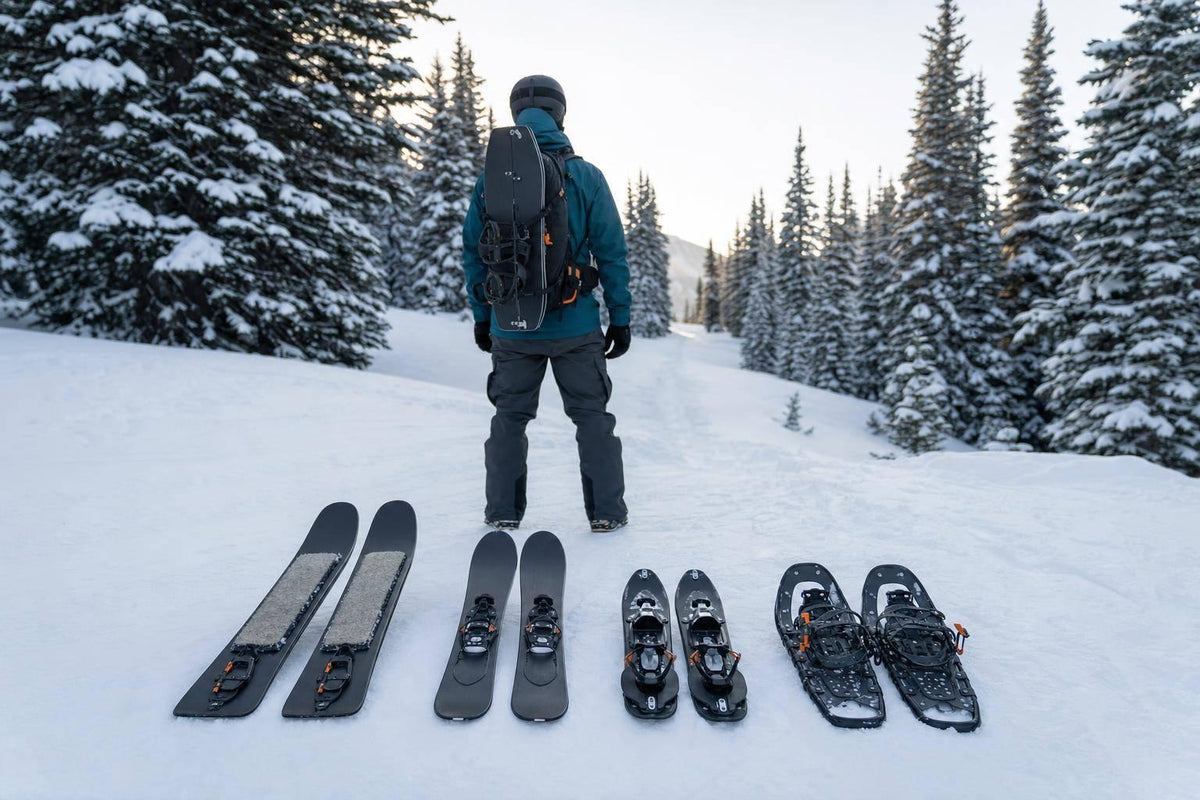
Yes - short skis can replace your splitboard approach setup on short missions. If your approach is about 30–90 minutes, on firm to moderate snow, and you want to use your regular snowboard boots, short skis can cut bulk and trim transition hassle.
Here’s the short version:
- WALKSKI 100 cm is the best fit for mixed short approaches because it has skins, risers, and multi-mode use
- Skiblades 99 cm work best on flat or gently rolling access
- Skiskates 44 cm are best for very short, firm-snow approaches
- A standard splitboard setup still wins for deep snow, long climbs, and full touring days
- Integrated-skin approach skis sit in the middle: more glide than snowshoes, but more drag on flats
- Snowshoes still make sense for short, steep, direct climbs
I’d think about it like this: if you’re heading out for a dawn patrol lap, a short sidecountry hit, or a mellow resort-edge run, short skis can save space, weight, and setup time. But if the day includes deep powder, steep skin tracks, or long distance, I’d still grab the splitboard.
Snowboarder tries Snowfeet* | Which Snowfeet* Short Ski is the Best? | Snowblades 44, 65, 99 Review
Quick Comparison
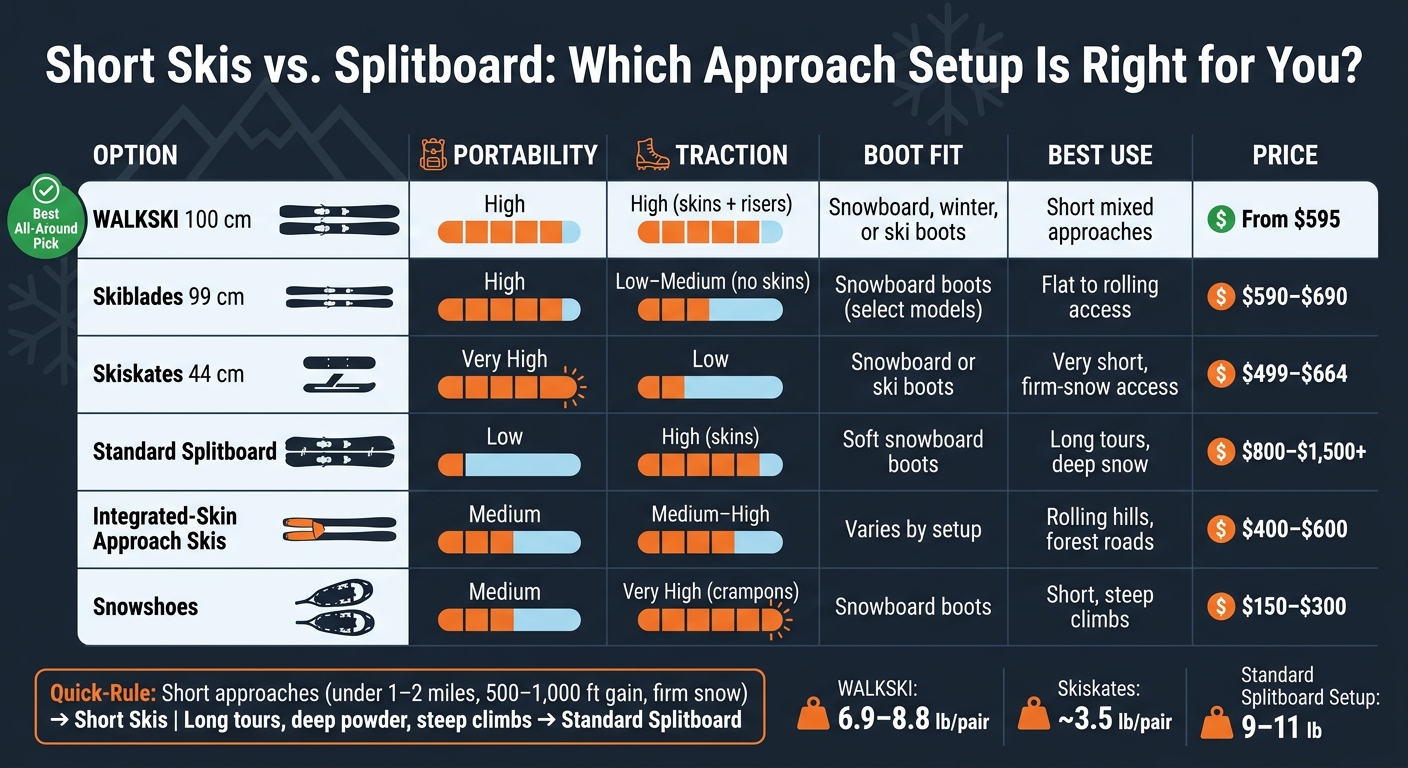
Short Skis vs. Splitboard: Which Approach Setup Is Right for You?
| Option | Portability | Traction | Boot Fit | Best Use | Price |
|---|---|---|---|---|---|
| WALKSKI 100 cm | High | High | Snowboard, winter, or ski boots | Short mixed approaches | From $595 |
| Skiblades 99 cm | High | Low–Medium | Snowboard boots on some models | Flat to rolling access | From $590–$690 |
| Skiskates 44 cm | Very high | Low | Snowboard or ski boots | Very short, firm-snow access | $499–$664 |
| Standard splitboard | Low | High | Soft snowboard boots | Long tours, deep snow | $800–$1,500+ |
| Integrated-skin approach skis | Medium | Medium–High | Varies by setup | Rolling hills, forest roads | $400–$600 |
| Snowshoes | Medium | Very high | Snowboard boots | Short, steep climbs | $150–$300 |
A few numbers jump out:
- WALKSKI weighs about 6.9–8.8 lb per pair
- Skiskates weigh about 3.5 lb per pair
- A splitboard setup often lands around 9–11 lb
- Short-ski use makes the most sense on routes under about 1–2 miles and 500–1,000 ft of gain if snow is firm
So, if I wanted one simple takeaway, it’d be this: use short skis for short access; use a splitboard for full tours. And if you want the best one-tool option from this group, WALKSKI is the clear front-runner.
If you want a quick visual before buying, these YouTube searches can help:
- WALKSKI Backcountry Touring videos
- Skiblades 99 cm videos
- Skiskates 44 cm videos
- Splitboard approach setup videos
Bottom line: I’d pick WALKSKI for the broadest short-approach use, Skiblades for flatter trails, Skiskates when pack size matters most, and snowshoes or a splitboard when the route gets steep, deep, or long.
1. Snowfeet* WALKSKI Backcountry Touring 100 cm
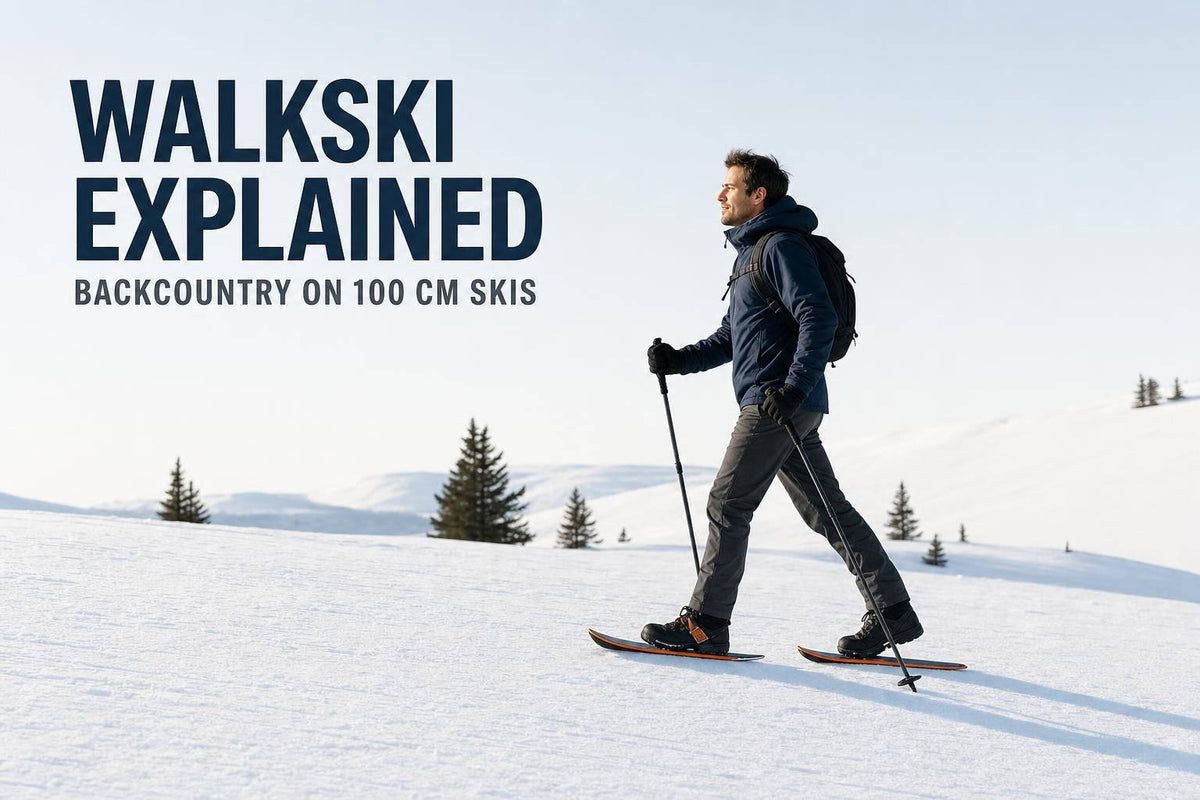
The WALKSKI Backcountry Touring 100 cm is Snowfeet*’s short touring ski built for splitboard approaches. It has four modes, so you can switch between flat walking, locked-heel skiing, and climbing with either a low or high riser. It also comes with removable climbing skins in the box.
Portability
This setup is easy to haul around. The wood-core version weighs 6.9 lb per pair (3,116 g), while the fiberglass-core version comes in at 8.8 lb per pair (3,980 g). At 100 cm, these skis strap onto a pack without much drama. That makes them easier to carry and less awkward on tight, narrow trails than full-length touring skis.
Boot Compatibility
One nice touch here: you don’t need a separate boot setup. The universal free-heel binding works with:
- Snowboard boots
- Winter boots
- Ski boots
Sizing runs from US 6 to 14.5, so most riders are covered. You can use the same boots for the walk in and the ride down, which means no AT boots required.
Traction and Short-Approach Efficiency
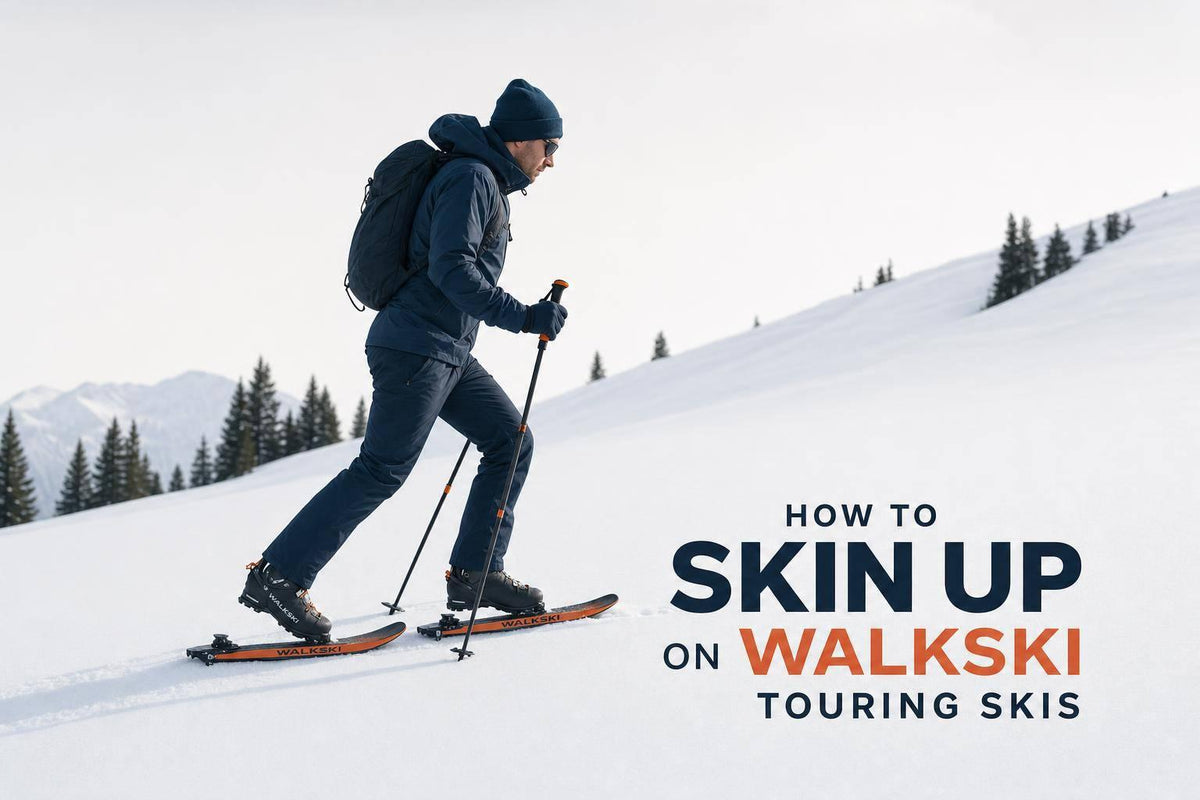
For mellow to moderate terrain, the included skins and dual-height risers cover most of the approach angles splitboarders run into on local hills or sidecountry laps. The high riser helps on steeper pitches, so you can handle short approaches without dragging along a full touring kit.
If you want something even shorter and easier to carry, the 99 cm Skiblades trim the setup down a bit more.
2. Snowfeet* Skiblades 99 cm
For splitboarders who want a short ski that still feels like a ski on moderate approach trails, the Skiblades 99 cm hit the middle ground. You get more glide and more stability than Skiskates, but they’re still much easier to haul than full touring skis.
They use a wood core, metal edges, a graphite base, and a tight sidecut, so they can handle actual mountain terrain without the bulk of a full setup. That’s why they make sense as the next step down from WALKSKI when you want less stuff on your pack but still want decent glide.
Portability
At 39 inches (99 cm), they’re easy to strap to a pack and way less awkward than full-length skis. That shorter length also helps in tight spots.
They work better than full-length skis on:
- Tight singletrack
- Trees
- Short sidecountry laps
- Low-angle access trails
So, if you’re weaving through the woods instead of marching up a big open skin track, they feel a lot less clunky.
Boot Compatibility
The snowboard-boot binding fits US men’s sizes 6–14.5. That means most splitboarders can use their normal riding boots for the approach, which keeps things simple and cuts down on extra gear.
The tradeoff is pretty clear: there are no skins or risers. So once the climb gets steep, the setup starts to run out of steam.
Traction and Short-Approach Efficiency
These are poor for steep or long climbs. That’s the catch.
But on mellow to rolling terrain, they do a nice job. Think packed forest roads, gentle meadows, and low-angle glades. In those spots, they glide well and turn fast. Use them when the approach is short, moderate, and more about moving cleanly than grinding uphill.
For 30- to 90-minute approaches on moderate terrain, this is the sweet spot. At around $590–$690, they sit in the middle as the value-focused option.
Here’s the simple way to think about it:
For steeper climbs, WALKSKI is better; for minimal carry weight, move to Skiskates.
If pack space matters more than glide, the 44 cm Skiskates shave things down even more.
3. Snowfeet* Skiskates 44 cm
At 44 cm (17.3 in), these are the smallest option in the lineup. They pack fast and carry easy. Weight is about 1.6 kg per pair, which comes out to roughly 3.5 lb total or about 800 g (1.8 lb) per ski.
Portability
This is where the small size stands out. On short local outings - closed forest roads, resort sidecountry traverses, and low-angle access trails - they’re easy to clip to the outside of a pack. The short length helps keep tips from snagging brush, and they won’t push your stance wide on tight trails.
They’re also handy on mixed approaches where snow comes and goes. You can take them on and off fast without much fuss. That said, this works best when the snow is firm. Once conditions get soft, that easy-carry upside matters less because glide drops off.
Boot Compatibility
The snowboard-boot version fits US men's sizes 6–14.5. So if you already splitboard, there’s a good chance you can use the same boots you ride in. That keeps the setup simple and saves you from hauling extra footwear. Nice and clean.
Traction and Short-Approach Efficiency
Skiskates do best on packed or hard-packed snow. Think boot-packed trails, firm access roads, and refrozen tracks. That’s their lane.
In soft snow or deep powder, things get tougher fast. Control fades, and breaking trail can feel like trying to push a shopping cart through sand. It’s not much fun.
For that reason, they make the most sense on:
- Short, low-angle approaches under 1–2 miles
- Routes with about 500–1,000 ft of gain
- Firm-snow days where fast transitions matter
Once the terrain gets steeper or the snow gets deeper, skins or a full touring setup make more sense.
The Skiskates cost $499 to $664 (regular prices up to $732). For splitboarders, they’re the easiest item to carry in the Snowfeet* lineup when the goal is a fast in-and-out on short, firm-snow days. For longer or steeper approaches, the standard splitboard setup is still the cleaner point of comparison.
4. Standard Splitboard Approach Setup
A standard splitboard setup includes a splitboard, touring bindings, skins, and poles. The full board-and-binding system usually comes in around 9–11 lb (4–5 kg). So, it’s one setup, which is nice. But it’s still bulkier than short skis.
That’s the baseline. If short skis are going to earn a spot in your kit, they need to beat this setup on grip, carry weight, and transition speed. Otherwise, you’re just hauling extra stuff for no good reason.
Portability
Compared with short skis, a splitboard is bulkier but simpler as one system. The board stays under your feet, which means less weight on your back. That part feels good, especially on longer approaches.
The downside shows up when the terrain gets tight. Full-length board halves can feel clumsy in kick turns, trees, or brushy trailheads. It’s a bit like trying to turn a long shopping cart in a packed gas station parking lot. You can do it. It’s just not smooth.
That’s where short skis start to make sense. In narrow approach zones, they’re easier to manage.
Traction
Compared with short skis, a splitboard with skins gives you better float and better uphill grip. The wide platform keeps you riding higher in the snowpack, which helps cut down on trenching in soft snow.
But there’s a catch. On icy skin tracks, you’ll often need splitboard crampons to hold a traverse. A wide splitboard can slip more than a narrower ski on sidehills. And when skins ice up in wet snow, things can go south fast. Progress slows, tempers drop, and nobody looks cool scraping ice with cold fingers :)
Boot Compatibility
This is one of the big reasons the standard setup still holds its spot on longer tours. Split-specific bindings work with standard soft snowboard boots, so most riders can tour and ride in the same boot.
More than that, the standard splitboard setup wins on single-setup simplicity. One boot. One board. One system from trailhead to summit to descent.
That matters. You’re not changing into another boot system or juggling extra gear halfway through the day.
Short-Approach Efficiency
Compared with short skis, this setup is slower in transitions, but it’s more complete for bigger days out. Transition time - skins off, board assembled - usually lands around 3–7 minutes for riders who know their system.
That’s slower than a minimalist short-ski setup. Still, the splitboard only asks for one main changeover. You’re not carrying a second board or swapping footwear, which keeps the day simpler and lowers the odds of gear drama in the cold.
That’s why the standard setup stays the safest default for longer tours. For riders who want less bulk and more ski-style travel, the next option is approach skis with integrated skins.
sbb-itb-17ade95
5. Approach Skis with Integrated Skins
Approach skis with integrated skins are built for one job: getting you in. They’re narrow, usually 85–147 cm long, and they have a climbing skin fixed right into the base. A good example is the Union Rover Approach Skis, a compact 100 cm model with an integrated skin. So, this is a dedicated access tool, not a full touring swap for your splitboard.
For splitboarders, the main question isn’t whether these climb well. They do. The better question is simpler: on short, mellow approaches, do they beat Snowfeet* short skis?
Portability
They’re lighter than a full splitboard setup, which is nice when you’re hauling gear at 6:30 a.m. in a cold parking lot. But they’re still bulkier than ultra-short options like Skiskates.
The big plus is simple: no loose skins to deal with. No peeling, folding, sticking, or dropping one in the snow while your gloves are half on. That saves hassle.
Traction
The fixed skin gives steady grip on firm snow, crust, and low-angle skin tracks. That’s where this setup feels smooth and predictable.
On steeper sidehills or icy traverses, though, you’ll still want ski crampons. And here’s the catch: on flat or rolling terrain, that always-on skin creates drag. You move slower than you would on a short ski with an exposed base that can actually glide.
Boot Compatibility
The Union Rover is made to work with splitboard-compatible bindings, so you can stay in your soft boots from the car to the climb. For soft-boot splitboarders, that’s a nice little win. Fewer gear changes. Less faffing around.
Short-Approach Efficiency
For short approaches, integrated-skin skis are a clear step up from snowshoes. You get glide with each stride, which cuts effort and helps you move faster. The fixed skins also make transitions simpler, and they’re easier to handle than a full splitboard on mixed coverage, tight switchbacks, and creek crossings.
The trade-off is one extra transition before the descent, since you still need to switch back to your splitboard. That puts integrated-skin skis in the middle ground:
- More glide than snowshoes
- Less all-around use than WALKSKI
Snowshoes are still the simpler option. But you give up more glide, and on even short approaches, you’ll feel that pretty fast.
6. Snowshoes for Snowboard Approaches
Snowshoes are the low-cost, low-fuss starting point for splitboard access. No skins. No skin glue. No setup drama. You just strap them over your snowboard boots and start walking.
That simple setup works best on short, direct approaches. But there’s a trade-off: snowshoes are slower and less smooth than skins on flat or rolling ground. So the main issue isn’t whether snowshoes work - they do. It’s where they still make sense, and where short skis pull ahead.
Portability
Modern backcountry snowshoes usually weigh 3–5 lb per pair. At 22–30 inches, they’re easier to strap to a pack than full-length skis.
That said, they don’t fold or shrink down. You carry the full size the whole time. On the ride down, that bulk can catch on tight trees or just feel a bit clunky on your back. Not a deal-breaker, but yeah, you’ll notice it.
Traction
This is where snowshoes shine.
Aggressive underfoot crampons and side rails bite into firm snow, crust, and icy traverses with strong grip. Once slopes get above about 20–30°, skins tend to lose grip sooner. That can force more traversing or even bootpacking. In those steep, direct climbs, snowshoes can beat skins.
On mellow terrain, though, the story flips. Snowshoes use a step-and-plant motion, and that takes more energy than gliding on skins. So this is the heart of the comparison: traction versus glide.
Boot Compatibility
Snowshoes work with regular snowboard boots. Most backcountry models use secure strap systems made for bulky winter boots, so you don’t need any special footwear.
Short-Approach Efficiency
For short, steep, or heavily wooded approaches, snowshoes can be a solid fit. Think tight forest lines, creek crossings, or bootpack-style routes near resort sidecountry gates. In spots like that, simple is good.
The transition is easy too:
- Unstrap the snowshoes
- Attach them to your pack
- Ride down
On routes with long flat sections or rolling terrain, snowshoes lose steam fast. With no glide, you spend more time and more energy getting in. That makes them a simple but limited tool: strong for short, steep access and weak when glide matters.
Head-to-Head: Where Short Skis Work and Where They Fall Short
Now that each option has been looked at on its own, it helps to put them side by side. For splitboarders on short approaches, four things matter most: portability, traction, boot compatibility, and efficiency. The table below makes the trade-offs easy to scan.
WALKSKI is the most complete short-ski pick here. It packs small, climbs better than the other short skis, and works with standard snowboard boots.
Skiblades 99 cm work for short, easy approaches on packed snow or mellow descents. But once the climb gets steeper, traction drops off.
Skiskates 44 cm are the easiest to carry. The catch? They make sense only for very short, firm-snow approaches with little elevation gain.
Compared with the short-ski choices, standard splitboard touring still wins for longer climbs. Snowshoes still do well on steep, direct lines where glide doesn’t matter. Each one has its own give-and-take, and the table lays that out fast.
| Option | Portability | Traction | Boot Compatibility | Efficiency | Best Terrain | Approx. U.S. Price |
|---|---|---|---|---|---|---|
| WALKSKI 100 cm | High | High (skins + risers) | Universal (snowboard, winter, and ski boots) | High | Rolling roads, mellow backcountry | From $595 |
| Skiblades 99 cm | High | Low–Moderate (no skins) | Varies by model | Medium | Flat/downhill approaches | From $690 |
| Skiskates 44 cm | Very High | Low | Universal (snowboard and ski boots) | Low–Medium | Short, flat terrain | From $460 |
| Standard Splitboard | Low | High (skins) | Splitboard-specific | High (long tours) | Deep backcountry, long climbs | $800–$1,500+ |
| Integrated-Skin Approach Skis | Medium | Medium–High | Usually AT/tele boots; some universal bindings | Medium | Rolling hills, forest roads | $400–$600 |
| Snowshoes | Medium | Very High (crampons) | Universal | Low (no glide) | Steep, icy, direct climbs | $150–$300 |
If you want one short-ski option with the best shot at replacing snowshoes without giving up too much grip, WALKSKI stands out. Skiblades and Skiskates can still work, but their use case is tighter.
The next section breaks these trade-offs down by trip type.
Pros and Cons by Trip Type
Trip type should drive the pick. WALKSKI fits short mixed approaches. Skiblades fit flat access. Skiskates fit ultra-short stretches on firm snow. And for big missions, a full splitboard still takes it.
The main idea is simple: match the tool to the route, not the label.
For short sidecountry laps and dawn patrols, WALKSKI is the best short-ski option for rolling approaches and modest climbs. Skiblades can work too, but only if the approach stays flat or gently rolling. They don’t have climbing risers, so your legs start to feel it sooner on any climb that keeps going.
On packed roads and groomed forest tracks, short skis make a lot of sense. They glide better than snowshoes, and they’re cleaner to carry too. Less flailing, more moving.
Tree approaches also lean toward compact gear. WALKSKI is the easiest to control, while Skiblades still do fine on low-angle terrain.
Once the day turns into a real tour, though, the math changes. For longer all-day tours, a standard splitboard still wins on glide, flotation, and energy use.
Here’s the fast sort by trip type.
| Option | Best Terrain | Key Advantage | Main Drawback |
|---|---|---|---|
| WALKSKI 100 cm | Rolling access roads, mellow backcountry, short tree approaches | Skins and risers handle mixed short approaches | Less stable at speed; not built for long tours |
| Skiblades 99 cm | Flat to gently rolling terrain, packed snow | Compact and quick to set up | No climbing risers; traction drops on sustained climbs |
| Skiskates 44 cm | Short flat segments, hard-packed access | Smallest footprint; fits in a pack easily | Poor flotation; loses tracking in soft or variable snow |
| Standard Splitboard | Deep powder, sustained climbs, alpine terrain | Best uphill efficiency and flotation over distance | Heavier, bulkier, and slower to transition |
| Integrated-Skin Approach Skis | Rolling hills, forest roads, moderate sidecountry | Combines glide and grip in one system | Less compact than the shortest short-ski options |
| Snowshoes | Very steep or icy direct lines | Maximum grip on technical terrain | No glide; loses efficiency fast on flats and long approaches |
Conclusion
After looking at portability, traction, boot fit, and uphill feel, the answer is pretty clear: short skis make the most sense for splitboarders on short missions close to the trailhead.
If your usual approach runs along rolling forest roads or mellow sidecountry terrain, a compact setup like the Snowfeet* WALKSKI Backcountry Touring 100 cm can stand in for your standard splitboard approach setup without giving up much uphill efficiency. The WALKSKI starts at $595, and compared with a typical splitboard touring setup, it gives you a lot in one package. Its four-mode binding includes walk, ski, and two climb-riser settings. That makes it a smart pick for short, low-drama approaches.
If you want the shortest carry and easy access on flatter terrain, the Snowfeet* Skiblades 99 cm are a good match when the approach is flat or gently rolling. And if pack space is the main issue, the Snowfeet* Skiskates 44 cm are the right move.
For bigger days and colder, deeper snow, a standard splitboard setup still wins. Longer tours, deeper snow, and long sustained climbs still lean in favor of a standard splitboard setup.
The rule is simple: short approaches call for short skis; longer tours still call for a standard splitboard setup. Go with WALKSKI for mixed approaches and moderate climbs, Skiblades for flat-to-rolling access, and Skiskates when packability matters most.
FAQs
Can short skis fully replace a splitboard setup?
No. Short skis like the Snowfeet WALKSKI can make more sense for short tours, local hills, travel, and tight trees. They’re easy to carry, simple to use, and a lot less of a hassle when space is tight.
A traditional splitboard still wins in deep powder, on long backcountry approaches, and for riders who want that snowboard feel on the way down. So, it’s pretty simple: convenience vs. downhill performance built for a specific job.
Which Snowfeet* option fits my approach terrain?
For most approach trails and laid-back backcountry missions, Snowfeet WALKSKI 100 cm* is the best pick. It hits the sweet spot for mixed use, and its four-mode binding system plus included climbing skins make approach-trail transitions much smoother.
Go with Skiblades POWDER 99 cm if you expect deep, soft snow and want more flotation. If you're heading out for short sidecountry descents without skinning uphill, Skiblades 99 cm are the most maneuverable choice.
Do short skis work in deep powder or icy tracks?
Short skis like the Snowfeet WALKSKI are flexible and fun, but they do have a ceiling.
In deep powder, the 100 cm WALKSKI works well in light snow up to 4 inches. Past that, longer and wider skis tend to float better, plain and simple. That extra surface area helps keep you from sinking, which matters a lot once the snow gets soft and deep.
On icy tracks, there’s a simple fix that helps: trim the skins so 5 to 7 mm of metal edge stays exposed. That gives you more bite and better grip. Even so, touring skis still feel more stable on icy slopes.
That said, the WALKSKI still holds its own with high-grip nylon skins. It’s dependable - you just want to be realistic about where short skis shine and where longer skis have the edge.











Zanechte komentář
Tento web je chráněn službou hCaptcha a vztahují se na něj Zásady ochrany osobních údajů a Podmínky služby společnosti hCaptcha.