



















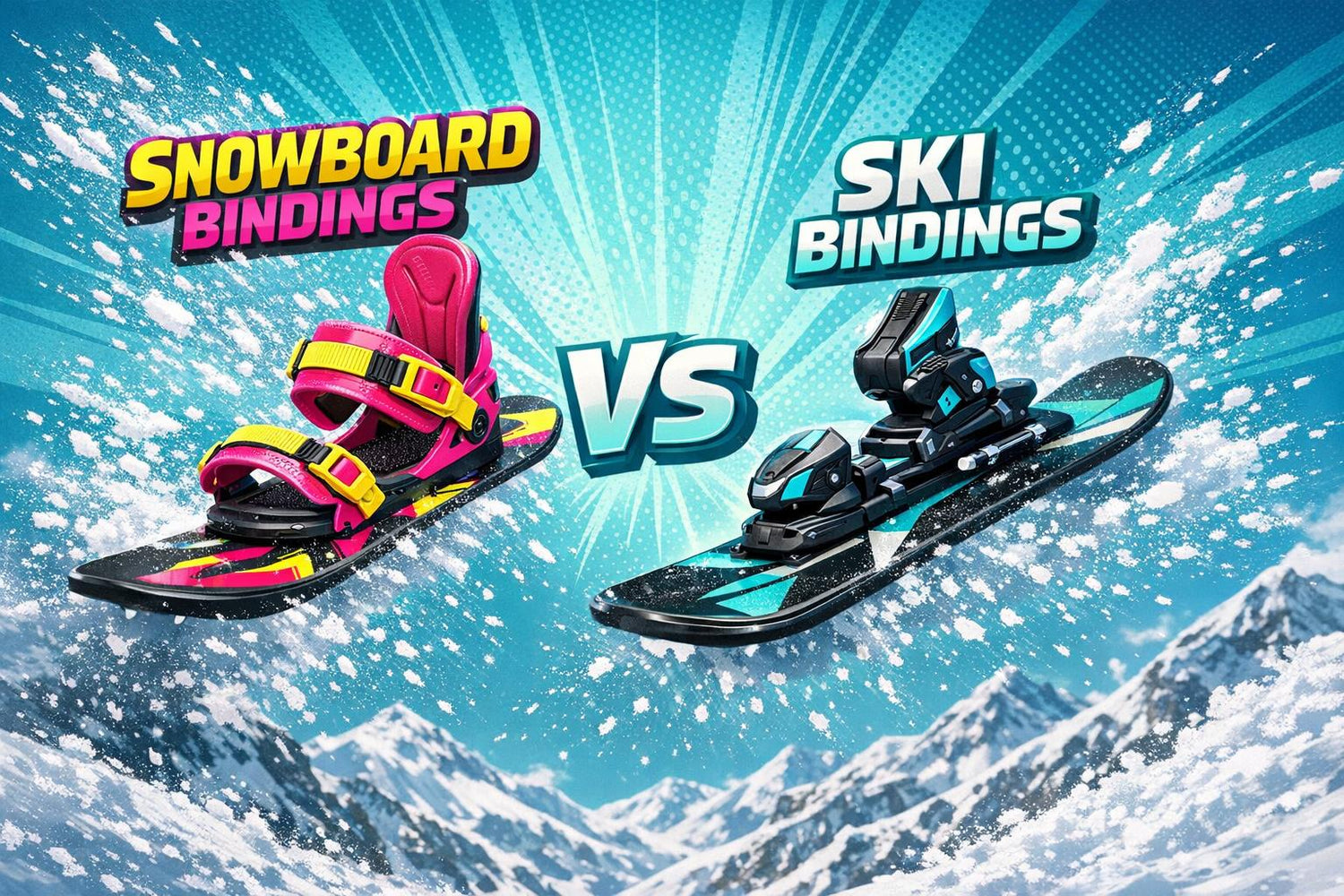
Looking to hit the slopes with skiblades but unsure about bindings? Here’s the deal: snowboard bindings prioritize comfort and freestyle moves, while ski bindings focus on safety and carving control. Both options work with Snowfeet* skiblades, known for their short, portable design (65–120 cm) and compatibility with multiple binding systems.
Key Takeaways:
- Snowboard Bindings: Use soft boots for comfort and easy walking. Great for tricks and park riding but lack a safety release.
- Ski Bindings: Offer safety with release mechanisms and precise control for speed and carving but require rigid boots.
Quick Tip: If you love freestyle riding, choose snowboard bindings. If speed and safety are your thing, go with ski bindings. Snowfeet* skiblades are compact, easy to learn, and fit in a backpack, making them perfect for both options.
Quick Comparison:
| Feature | Snowboard Bindings | Ski Bindings |
|---|---|---|
| Safety | No release mechanism | Includes release system |
| Comfort | Soft boots, easy walking | Rigid boots, less comfy |
| Performance | Great for tricks | Ideal for carving |
| Portability | Bulky setup | Compact but heavy boots |
Snowfeet* skiblades make it easy to switch between styles. Pick what fits your riding style and hit the slopes with confidence!
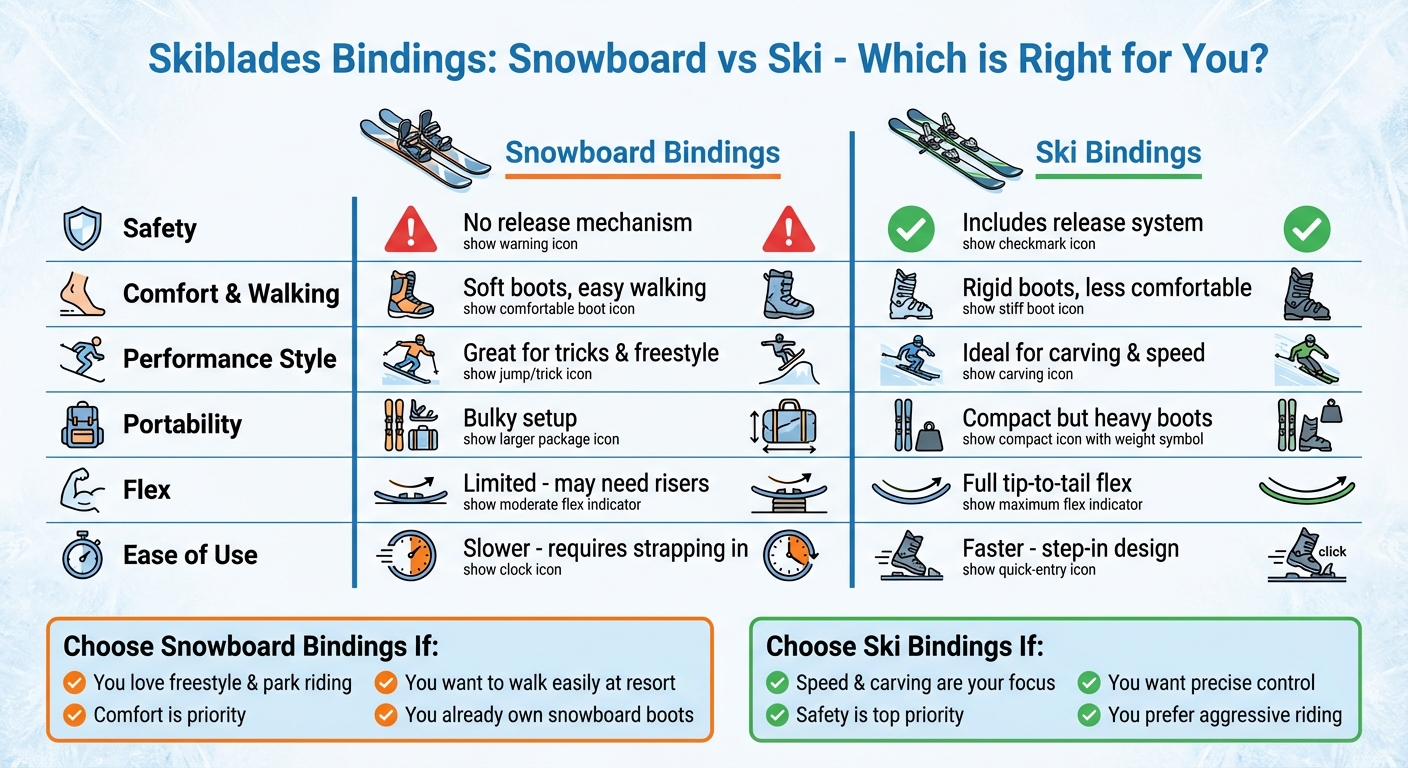
Snowboard vs Ski Bindings for Skiblades: Complete Comparison Chart
Snowfeet* Skiblades: The Best Choice for Any Binding
Key Features of Snowfeet* Skiblades
Snowfeet* skiblades take the flexibility of skiblades to the next level with their impressive compatibility with various bindings. Whether you're using snowboard or ski bindings, Snowfeet* has you covered. The 65 cm and 99 cm models are equipped with mounting systems that work with three types of bindings: regular release ski bindings, simple non-release ski bindings, and specialized snowboard bindings. This means you can easily adjust your setup based on your riding style or the demands of your adventure.
When it comes to construction, Snowfeet* stands shoulder-to-shoulder with traditional ski manufacturers. These skiblades feature sustainable wood cores, metal edges, and graphite bases, ensuring both precision and speed. The lightweight design is another standout feature - at just 5.89 lbs per pair for the snowboard binding version and 3.79 lbs for the ski binding version, the 65 cm model is easy to carry. In fact, they’re compact enough to fit in a standard backpack, making them perfect for public transportation, quick day trips, or even hiking to those off-the-beaten-path spots.
To top it off, Snowfeet* offers custom snowboard bindings specifically designed for the narrower shape of skiblades. Unlike the bulky and overpriced standard bindings offered by competitors, Snowfeet* bindings come in three tiers: Basic, Standard, and Pro X. These bindings feature anti-slip surfaces and adjustable straps that fit boot sizes ranging from 6 to 14.5 US. The Standard and Pro X models even include extra straps for larger snowboard boots, providing a secure and comfortable fit.
Why Snowfeet* Beats Traditional Skis and Skiboards
Snowfeet* skiblades don’t just deliver on binding versatility - they also shine when it comes to portability and ease of use. Traditional skis, often exceeding 135 cm in length, can be a hassle to transport and store. In contrast, Snowfeet* skiblades, ranging from 65 cm to 120 cm, are compact enough to take just about anywhere. This portability makes them ideal for navigating narrow hiking trails and rough terrain where longer skis fall short, all while maintaining the convenience of their adaptable binding options.
The learning curve is another area where Snowfeet* outshines traditional skis. While mastering traditional skiing can take weeks or even months, most riders become comfortable on Snowfeet* skiblades in just a day. Some users even report getting the hang of it in as little as five minutes. Members of skiboarding communities often highlight how Snowfeet* provides greater freedom and the ability to explore the entire mountain with minimal practice. Their short, skate-like design makes turning and stopping almost effortless, helping riders build confidence quickly.
With a global community of over 50,000 riders and an impressive 4.9 out of 5-star rating from more than 5,500 verified reviews, Snowfeet* proves that shorter skiblades pack just as much punch as their longer counterparts. The twin-tip design and snowboard-inspired widths make them versatile enough for groomers, powder, and park terrain alike. Unlike older skiboards that rely on outdated 4-hole insert systems, Snowfeet* supports modern direct-mount ski release bindings for enhanced safety and flexibility. Plus, their snowboard bindings with risers help prevent edge catching, offering a level of performance that older designs simply can’t match.
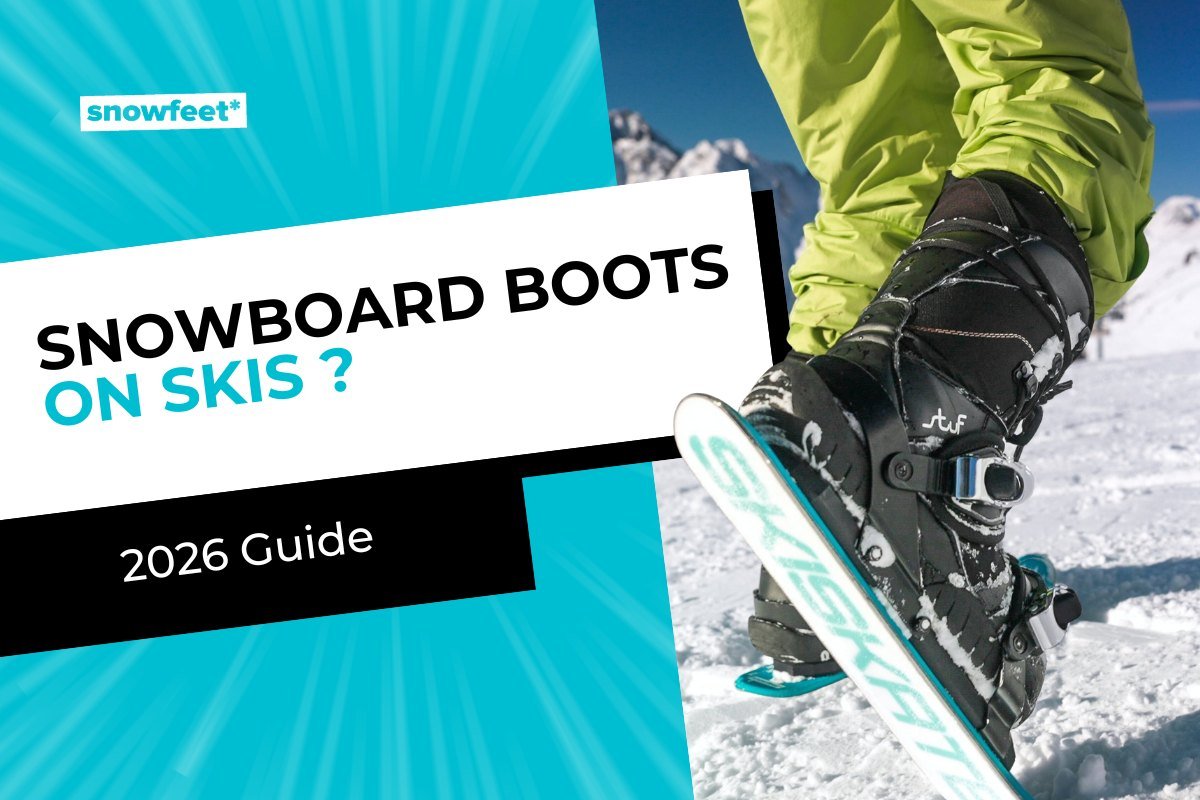
Snowfeet Snowblade / Skiboard Review! Short Skis with SNOWBOARD BINDINGS!
Snowboard Bindings on Skiblades: Pros and Cons
Snowfeet* skiblades work well with both types of bindings, but let's dive into what snowboard bindings bring to the table.
Benefits of Snowboard Bindings
Snowboard bindings bring a freestyle edge to Snowfeet* skiblades. They allow for flexible ankle movement, which makes spins, jumps, and even riding backward feel more natural - great for snow park tricks and improving your skills. Unlike stiff ski boots, snowboard boots are soft, cozy, and look a lot like regular winter boots. This means they’re not just more comfortable, but also easier to walk around in at the resort. Plus, if you already snowboard, you can use the same boots for both activities. That’s a win for convenience and your wallet, as snowboard boots tend to cost less than premium ski boots.
"Snowboard bindings give you more flexibility while performing all kinds of tricks, they're super comfortable and you can walk with them anywhere without a problem." - Snowfeet Team
Snowfeet* has even created custom snowboard bindings tailored to the narrower design of skiblades. These bindings come with an anti-slip surface and tool-free adjustability, simplifying the setup and avoiding the hassle of bulky, overpriced alternatives.
Drawbacks of Snowboard Bindings
One major downside of snowboard bindings is the lack of a release mechanism. Unlike ski bindings, which have DIN settings to release during a fall, snowboard bindings stay locked onto your boots. If your skiblades are longer than 100 cm, using safety leashes is highly recommended to reduce risks associated with non-release bindings.
Another tradeoff is precision. Snowboard bindings don’t provide the same carving responsiveness as ski bindings, which offer rigid power transmission. While the flexibility is great for tricks, it can make aggressive carves feel less sharp. Adding a riser plate or a wide third strap can help improve carving performance and ensure the bindings don’t feel too loose for the ski. Also, the combination of shorter skiblades and soft snowboard boots requires better front-to-back balance, especially in powder deeper than 4 inches.
Comparison Table: Snowboard Bindings on Snowfeet* Skiblades
| Feature | Snowboard Bindings on Snowfeet* | Traditional Skiboards (Other Brands) |
|---|---|---|
| Design | Custom-made for narrow skiblades | Often use standard, bulkier snowboard bindings |
| Flex & Playfulness | High; great for tricks and freestyle | Can feel restrictive without proper adjustment |
| Comfort | Soft boots for easy walking | Varies; may need mounting tweaks |
| Safety Mechanism | Non-release; needs safety leashes | Non-release; also needs safety leashes |
| Adjustability | Tool-free adjustability | Often overpriced and harder to mount |
| Best For | Park tricks, freestyle, casual rides | Depends on brand and setup |
Next, we’ll explore how ski bindings stack up on Snowfeet* skiblades.
sbb-itb-17ade95
Ski Bindings on Skiblades: Pros and Cons
Ski bindings bring the precision and control of traditional skiing to Snowfeet* skiblades, offering an experience that blends classic skiing techniques with the unique appeal of skiblades.
Benefits of Ski Bindings
Snowfeet* ski bindings combine the stability of traditional ski gear with a modern twist. On the 99 cm and 120 cm models, they include release mechanisms designed to detach your boots during falls, which adds a layer of safety for those high-speed adventures. The rigid ski boots provide excellent ankle support, enabling precise edge control and powerful carving - perfect for jumps and hard-packed snow. Plus, these bindings accommodate a wide range of boot sizes, from 4.5–14.5 US (36–49 EU).
"If you're used to wearing your ski boots and love the fast aggressive ride, go for the ski bindings." – Snowfeet Team
These features make ski bindings a great choice for those who prioritize performance and control.
Drawbacks of Ski Bindings
While ski bindings offer impressive performance, they come with a few trade-offs. Traditional ski boots are heavy and can be uncomfortable, which takes away from the portability that makes skiblades so appealing. Walking around the resort in rigid boots? Not exactly fun.
Another factor to consider is cost. Release ski bindings are the most expensive option for Snowfeet* skiblades. While non-release bindings are lighter and more affordable, they increase the risk of injury during falls. Snowfeet* advises using non-release bindings only on models shorter than 100 cm. These trade-offs highlight the balance between performance and convenience when choosing ski bindings for skiblades.
Comparison Table: Ski Bindings on Snowfeet* Skiblades
| Feature | Ski Bindings on Snowfeet* | Traditional Skis |
|---|---|---|
| Safety | Release mechanisms on 99 cm+ models | Standard release bindings |
| Boot Compatibility | Rigid ski boots (sizes 4.5–14.5 US) | Rigid ski boots |
| Portability | High; fits in most cars | Low; heavy and cumbersome |
| Maneuverability | Very high; easy turns and tricks | Lower; long length restricts movement |
| Learning Curve | Fast; easier to control | Slower; harder to master |
| Walking Comfort | Low; boots are clunky | Low; boots are clunky |
Snowfeet* offers ski binding setups for their 99 cm ($675) and 120 cm ($775) models. These setups strike a balance between portability and performance, making them a standout choice for skiblade enthusiasts.
Snowboard Bindings vs Ski Bindings: Direct Comparison
Full Comparison Table
When picking between snowboard and ski bindings for your Snowfeet* Skiblades, there are four main factors to think about: safety, flex, ease of use, and portability. Here's a quick side-by-side breakdown:
| Metric | Snowboard Bindings | Ski Bindings (Release) |
|---|---|---|
| Safety | Lower – no release mechanism or brakes; uses straps for security | Higher – includes a release mechanism and brakes for safer ejection |
| Flex | Limited – multi-hole inserts may need risers, reducing flex | Full tip-to-tail flex – direct mounting ensures peak performance |
| Ease of Use | Slower – requires strapping in and bending down | Faster – step-in design allows quick entry/exit |
| Portability | Bulkier setup due to risers | More compact mounting, though boots can feel rigid off the slopes |
Ski bindings are the go-to choice if you're after top-notch carving and high-speed control. They mount directly to Snowfeet* Skiblades, delivering full tip-to-tail flex without the need for inserts or risers. This setup is perfect for smooth turns and maintaining stability at higher speeds. On the other hand, snowboard bindings, which rely on multi-hole inserts, can limit flex unless you add risers.
When it comes to safety, ski bindings clearly take the lead. With their reliable release mechanisms and built-in brakes, they're designed to reduce the risk of injury during falls. Summit Skiboards even highlights ski bindings as the safest option for mountain performance. These factors should help you weigh the pros and cons and find the right fit for your riding style.
Which Binding Is Right for You?
Here’s how to decide which binding suits your needs best. If you're into park riding and value comfort and freestyle tricks, snowboard bindings are the way to go. But if you're chasing precision, speed, and carving control, ski bindings are the better option.
For example, the Snowfeet* 99 cm and 120 cm models pair exceptionally well with ski bindings, offering a dynamic and controlled carving experience. So, if you prioritize freestyle versatility, snowboard bindings are your friend. But if safety and performance at high speeds are your top goals, ski bindings will be your best bet.
Conclusion: The Best Setup for 2026
Final Recommendation
Your perfect setup really comes down to how you like to ride. If you're all about freestyle park riding - hitting jumps, nailing spins, and getting creative - the Snowfeet* 99 cm Skiblades with snowboard bindings are a solid choice. They’re designed to make those tricks feel smooth and natural.
On the other hand, if speed and precise carving are your thing, go for the 120 cm model with ski bindings. These longer skiblades are built for versatility, handling everything from freshly groomed runs to light powder, without the bulk or leg fatigue you often get with traditional long skis.
The 99 cm model strikes a great middle ground. It’s stable but responsive, making it easy to learn and build confidence quickly. With their fast learning curve, Snowfeet* Skiblades let you skip the endless lessons and dive right into enjoying your time on the slopes.
Why Choose Snowfeet*?
Snowfeet* stands out for good reason. Unlike traditional skis, which lock you into one binding type and require bulky roof racks for transport, Snowfeet* gives you flexibility. You can choose between ski or snowboard bindings based on your style, and they’re compact enough to fit in a backpack - no more wrestling with oversized gear.
With over 50,000 riders worldwide and a glowing 4.9/5 rating from more than 5,500 verified reviews, Snowfeet* has proven that shorter skiblades can deliver serious carving power and stability. They eliminate the weight, storage headaches, and steep learning curves of traditional skis. Whether you go with snowboard or ski bindings, you’re getting gear that’s portable, easy to use, and packed with fun for the mountain.
FAQs
How do snowboard bindings compare to ski bindings when used on skiblades in terms of safety?
When it comes to skiblades, the type of bindings you use plays a big role in both performance and safety. Most snowboard-style bindings for skiblades are non-release systems, meaning they stay locked in place even if you take a tumble. While these bindings give you a wider, more stable platform to work with, the downside is they don’t release during falls. This can lead to a higher chance of leg or ankle injuries if you hit the ground hard.
In contrast, traditional ski bindings, especially Alpine models, are equipped with DIN-certified release mechanisms. These are designed to let the boot detach when the force of a fall exceeds a certain limit, which helps protect your lower body from serious injuries.
Snowfeet bindings, which are also non-release, are specifically crafted for the unique demands of Snowfeet skiblades. They’re lightweight, adjustable, and tailored for the slower speeds and shorter skis that come with this style of riding. That said, making sure your bindings are properly fitted and compatible is key to avoiding equipment issues and injuries. Snowfeet’s integrated binding system takes the guesswork out, offering a dependable and safe choice for skiblade fans.
How are Snowfeet* skiblades more portable than traditional skis?
Snowfeet* skiblades are all about keeping things compact and easy to handle. At just 25 inches (65 cm), 39 inches (99 cm), or 47 inches (120 cm) long, they’re way shorter than traditional skis, which usually range from 59 to 79 inches (150–200 cm). This smaller size means you can toss them into a backpack or small travel bag without breaking a sweat - no more lugging around oversized gear.
Their lightweight, compact design also makes them super simple to transport and store. Whether you’re sliding them into your car trunk, tucking them into a closet, or bringing a few pairs along for a group trip, these skiblades are a dream for anyone who’s tired of dealing with bulky equipment. They pack the performance you want, minus the hassle.
What type of bindings are best for beginners using Snowfeet* skiblades?
For those new to Snowfeet* skiblades, ski-release bindings are a solid choice. These bindings are super easy to use, thanks to their simple step-in design. Plus, they’re built to automatically release during a fall, which helps reduce the chance of injuries. Another bonus? They’re compatible with standard ski boots, making them a straightforward and beginner-friendly option.
On the flip side, snowboard-style bindings tend to be wider and can feel a bit clunky on the smaller platform of skiblades. They also don’t have the same precise release mechanisms as ski bindings, which might make them less ideal for beginners. To make things even easier, Snowfeet* offers integrated bindings that work with both ski and snowboard boots. These are designed to give newcomers a hassle-free experience, making ski-release bindings or Snowfeet's integrated options the best picks for anyone just starting out on the slopes.











Leave a comment
This site is protected by hCaptcha and the hCaptcha Privacy Policy and Terms of Service apply.