



















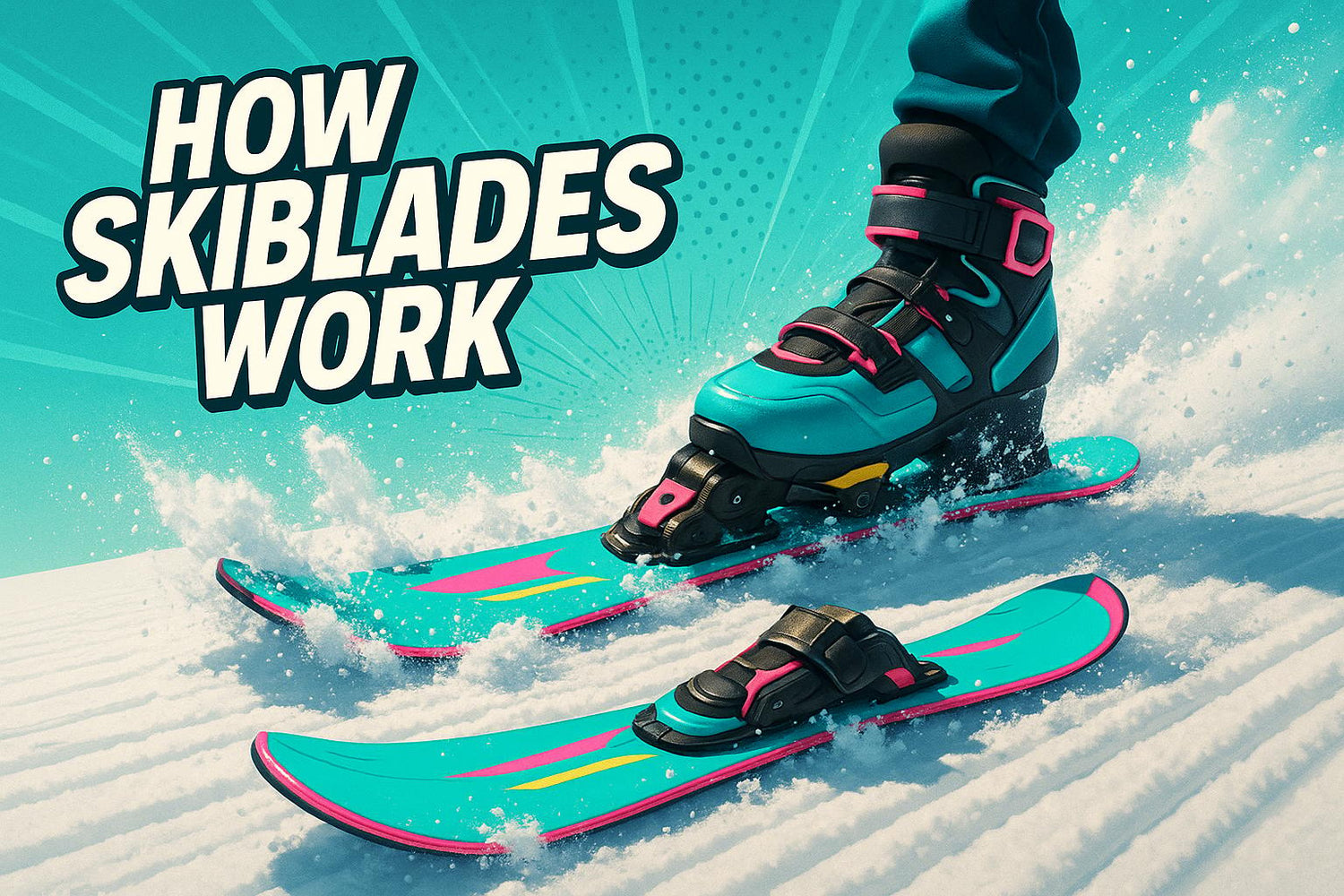
Skiblades, also called snowblades or skiboards, are short, lightweight skis (65–120 cm) that combine the control of skiing with the fun of rollerblading. They’re easy to learn, portable enough to fit in a backpack, and perfect for beginners or anyone who wants a hassle-free ride on the slopes. Unlike longer skis, skiblades are easier to turn, stop, and maneuver, making them great for tight spaces, tricks, and even light powder.
Here’s why skiblades are worth considering:
- Compact and lightweight: No need for bulky gear; they’re easy to carry and store.
- Beginner-friendly: You can master the basics in just a day.
- Versatile: Work well on groomed runs, terrain parks, and even backyard snow.
- No special boots required: Many models work with regular winter or snowboard boots.
Snowfeet* leads the skiblade market with models in three sizes (65 cm, 99 cm, and 120 cm), offering options for every skill level and style. Prices start at $635, and they’re built with durable materials for long-lasting fun.
If you’re tired of heavy skis or snowboards, skiblades might just be the lightweight, fun-packed alternative you’ve been looking for.
Snowfeet* & Skiskates Complete Guide | All you need to know about Skiskating
What Are Skiblades?
Skiblades, also called snowblades or skiboards, are short skis ranging from 65 cm to 120 cm in length. To put that in perspective, they’re about half the size of traditional skis, which usually start around 150 cm and can exceed 200 cm. These compact skis first gained popularity in the late 1990s, inspired by snowboard designs.
What makes skiblades special is their focus on agility and control. Their shorter length means less ski to handle, making them easier to turn and stop compared to longer skis. This design allows for quick, sharp turns and smooth navigation across different types of terrain.
How Skiblades Differ from Traditional Skis
Traditional skis are built for stability and precision, especially at high speeds. Skiblades, on the other hand, are lighter, shorter, and prioritize maneuverability over straight-line speed. Their compact size reduces the effort needed to control them, which can help minimize leg fatigue and let you ski longer.
Another key difference is their width. Skiblades are often wider at the tips and tails, offering better balance and stability. This extra width helps with control on firmer snow, provides decent flotation in softer conditions, and allows for quick edge-to-edge transitions on groomed runs. Thanks to these features, skiblades perform well on a mix of terrains - from groomed slopes and powder to terrain parks and even your own backyard.
These unique traits explain why Snowfeet* Skiblades have become a leader in the market.
Snowfeet* Skiblades Overview
Snowfeet* takes the skiblade experience to the next level with three size options: 65 cm ($635), 99 cm ($675), and 120 cm ($775). Whether you’re into quick, playful turns and tricks with the 65 cm model or prefer the speed and carving capabilities of the longer sizes, there’s an option for every style.
What really sets Snowfeet* apart is their innovative, tool-free binding system. It works with winter boots, snowboard boots, or ski boots, giving you unmatched flexibility and a lightweight setup.
Design Features of Skiblades
Shorter Length for Better Control
Skiblades, ranging from 65–120 cm (26–47 inches), are significantly shorter than traditional skis, which typically measure 150–200+ cm. This compact size makes them perfect for quick, tight turns. Whether you're weaving through crowded runs or navigating tricky spots, the shorter length feels much more manageable compared to longer skis.
"One of the best things about snowblades is how easy they are to control. Because they're shorter, there's less ski to manage, making them perfect if you're new to the slopes or just want something a bit more laid-back. You won't have to stress about tricky techniques or get intimidated by long, heavy skis." - Snowfeet Team
Another bonus? Stopping is smoother and requires less effort, which means less fatigue during those all-day sessions on the slopes. The compact design not only simplifies skiing but also paves the way for other performance-enhancing features.
Wide Base and Twin-Tip Design
The shape of skiblades is just as important as their length. A wider base at both ends provides extra stability, whether you're gliding over groomed trails or softer snow. This added stability is a game-changer for beginners, helping them feel more confident faster.
The twin-tip design is another standout feature. It allows you to ski forward or backward with ease, making it ideal for pulling off tricks, jumps, and spins in terrain parks. Unlike traditional skis, which are usually designed for one direction, skiblades open up a whole new level of versatility and fun.
Snowfeet* Advantage: Portability and Quality Materials
Snowfeet* Skiblades shine when it comes to portability. They're light and compact enough to fit in a backpack, making them easy to carry on buses, trains, or even stow in your car. This convenience is a huge plus, especially compared to lugging around traditional skis or snowboards.
But portability doesn’t mean compromising on quality. Snowfeet* Skiblades are handmade in Europe and built to last. They feature sustainable wood cores, fiberglass reinforcement, metal edges, and graphite bases, creating a durable, high-performance product. Whether you're hitting the slopes or exploring more remote areas, this combination of portability and tough construction makes Snowfeet* a standout choice over traditional gear.
How Skiblades Work on Snow
Basic Techniques for Beginners
Skiblades are surprisingly beginner-friendly. To get started, focus on keeping your weight centered over your feet, with your legs about shoulder-width apart and your knees slightly bent. Lean forward just a bit to maintain balance. For added stability, you can position one foot slightly ahead of the other. Thanks to their shorter length, skiblades are easier to control compared to traditional skis, making them perfect for first-timers or anyone looking for a laid-back experience. Stopping works much like it does with regular skis or even skates, but it's less demanding because of their compact size. If you’ve ever tried rollerblading or ice skating, you’ll likely find skiblades easier to pick up since the techniques are quite similar.
Once you’ve nailed the basics, you can start exploring more advanced moves.
Advanced Moves and Terrain Options
Once you're comfortable with the fundamentals, skiblades unlock a whole new level of fun. Their shorter, lightweight design allows for quick, precise turns and smooth maneuvering, which is especially handy on crowded slopes or in tight spots. If carving is your thing, longer skiblades - ranging from about 35 to 47 inches - are perfect for those fast, sweeping turns. Some seasoned skiers even use a hand for balance during sharp, carved turns.
Skiblades also shine when it comes to tricks and agility. You can easily pull off jumps, spins, and other freestyle moves. Specific models like the Snowfeet* 65 cm excel in terrain parks and tight tree runs, while the 99 cm model offers great control for carving on groomed slopes and tackling terrain parks. For those who want more stability and better floatation in powder or off-piste terrain, the 120 cm model is a solid choice. Snowfeet* even recommends their 99 cm, 120 cm, or 99 Powder models for powder enthusiasts.
Here’s how Snowfeet* skiblades stack up against traditional skis and snowboards.
Comparison Table: Snowfeet* Skiblades vs. Traditional Skis and Snowboards
| Feature | Snowfeet* 65 cm | Snowfeet* 99 cm | Snowfeet* 120 cm | Traditional Skis | Snowboards |
|---|---|---|---|---|---|
| Length | 26 inches | 39 inches | 47 inches | 59–71+ inches | 55–67+ inches |
| Weight | Lightest | Light | Light | Heavy | Varies, generally heavier |
| Best Terrain | Parks, moguls, tight tree runs | Groomed slopes, moderate powder, terrain parks | Groomed runs, light powder, off-piste | All-mountain, deep powder | All-mountain, powder |
| Learning Curve | Easiest | Easy | Easy | Moderate to difficult | Moderate |
| Portability | Fits in a backpack | Fits in a backpack | Compact | Requires a ski bag | Requires a board bag |
| Poles Required | No | No | No | Yes | No |
| Fatigue Level | Minimal | Low | Low | Higher | Moderate |
sbb-itb-17ade95
Skiblades vs. Traditional Skis and Snowboards
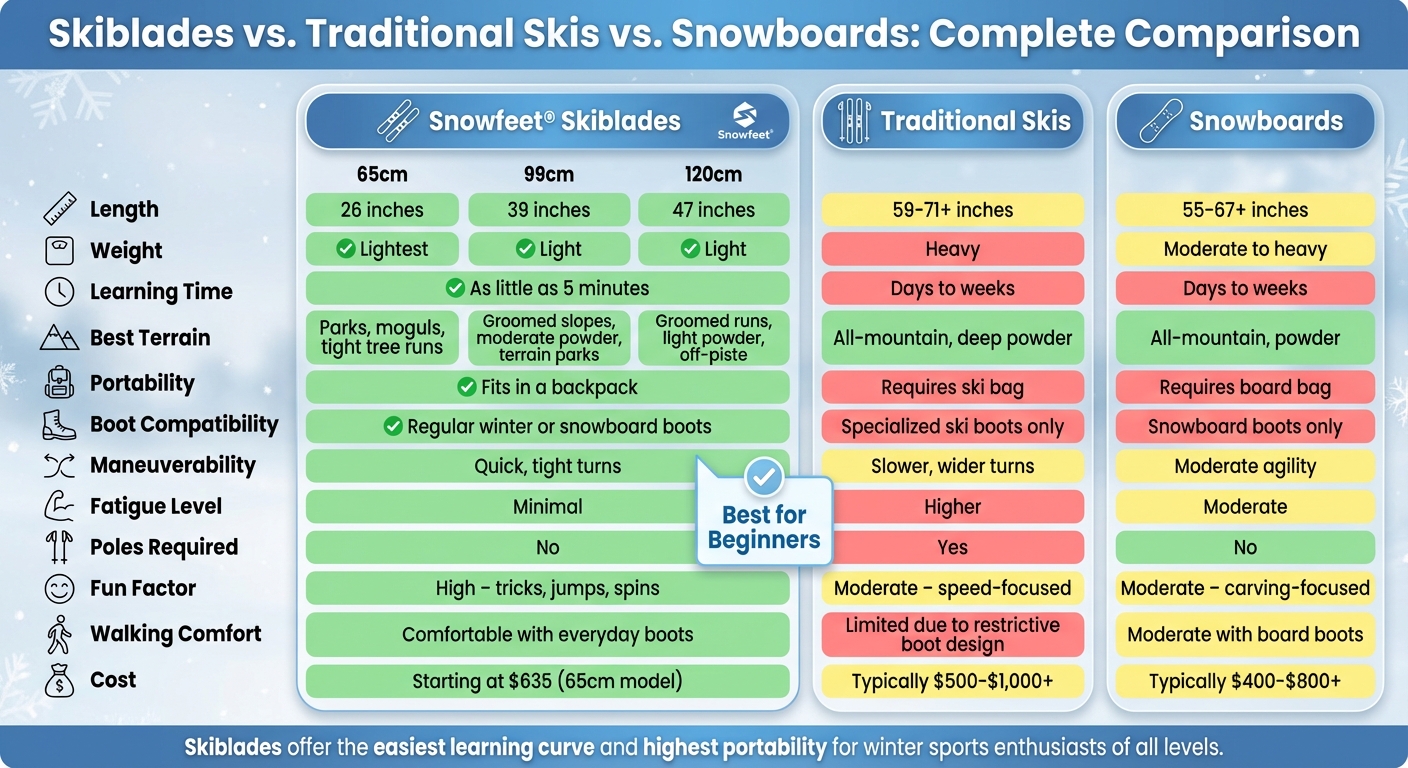
Skiblades vs Traditional Skis vs Snowboards Comparison Chart
Ease of Use and Learning Curve
Feeling overwhelmed by the size of traditional skis or the stance required for snowboarding? Skiblades might be just what you’re looking for. Snowfeet* Skiblades are much easier to pick up and control, especially for beginners. Thanks to their compact size, turning and balancing become simpler, and you’re less likely to feel worn out. Plus, shorter equipment means less risk when you take a tumble compared to the longer, bulkier traditional skis.
"With less length to maneuver, they make basic skills, such as turning and remaining upright, very easy." – ASO Mammoth experts
Many people find they can get comfortable with Snowfeet* in just five minutes. The learning process is quicker and less intimidating than traditional skiing or even ice skating. It’s a bit like rollerblading on snow - fun and approachable. And when you do fall, it’s usually less of a big deal, leaving you with more energy to enjoy the slopes.
On the flip side, traditional skis and snowboards require more technical skills and physical effort. Their size and weight make them tricky to handle in tight or crowded areas, which can be frustrating and exhausting for beginners.
Snowfeet* also stand out for their convenience, making them a breeze to use both on and off the slopes.
Portability and Convenience
When it comes to portability, Snowfeet* Skiblades are in a league of their own. Their compact design means they can easily fit into a backpack, unlike traditional skis or snowboards that need bulky bags and extra car space. This makes them perfect for spontaneous trips or traveling by bus or train.
"Light, compact, and fit your gear, your car, and your lifestyle." – Snowfeet Store
Another bonus? Many Snowfeet* models work with regular winter shoes or snowboard boots. No need for heavy, specialized ski boots. For models with snowboard bindings, you get added flexibility for tricks and can comfortably walk around when you’re off the slopes. Compare that to traditional skis and snowboards, which lock you into specialized gear that’s heavier and takes longer to set up - not exactly ideal for casual riders or travelers.
Here’s a quick side-by-side comparison to show how Snowfeet* stack up against traditional gear:
Comparison Table: Snowfeet* Skiblades vs. Traditional Gear
| Feature | Snowfeet* Skiblades | Traditional Skis | Snowboards |
|---|---|---|---|
| Learning Time | As little as 5 minutes | Days to weeks | Days to weeks |
| Weight | Lightweight | Heavier | Moderate to heavy |
| Portability | Fits in a backpack | Requires ski bag/space | Requires board bag |
| Boot Compatibility | Regular winter or snowboard boots | Specialized ski boots only | Snowboard boots only |
| Maneuverability | Quick, tight turns | Slower, wider turns | Moderate agility |
| Fatigue Level | Minimal | Higher | Moderate |
| Fun Factor | High – tricks, jumps, spins | Moderate – speed-focused | Moderate – carving-focused |
| Cost | Starting at $520 (65 cm model) | Typically $500–$1,000+ | Typically $400–$800+ |
| Walking Comfort | Comfortable with everyday boots | Limited due to restrictive boot design | Moderate with board boots |
As you can see, Snowfeet* Skiblades offer a lightweight, easy-to-use, and portable option that’s perfect for beginners and those looking for a fun, hassle-free experience.
Benefits and Getting Started with Snowfeet* Skiblades
Top Benefits of Snowfeet* Skiblades
Snowfeet* Skiblades bring a fresh twist to winter sports. Their compact design transforms the slopes into a playground for sliding, carving, and pulling off tricks.
Thanks to their shorter length and wider base, they’re easier to handle than traditional skis. This means better balance, less fatigue, and an extra boost of confidence as you glide down the mountain. Plus, they’re versatile! Whether you’re cruising on groomed runs, tackling moguls, or even dipping into light powder, Snowfeet* Skiblades deliver a smooth ride.
With these perks, hitting the slopes becomes less intimidating and a whole lot more fun.
How to Get Started
Getting started with Snowfeet* is simple. Pick the right size: the 65 cm model is perfect for beginners seeking control, while the 99 cm or 120 cm options offer more stability as you gain experience. These skiblades are compatible with both ski boots and snowboard boots, so you can choose whichever feels more comfortable.
Make sure you’re geared up with essentials like a helmet, goggles, waterproof clothing, gloves, and sunscreen. Begin on gentle slopes and use a sideways push, similar to rollerblading, to get moving. Keep your weight centered over the middle and back of your feet - don’t lean forward like you might on long skis. To turn, shift your weight to the opposite leg, and to stop, make a sharp turn to one side with both skiblades.
Once you’ve mastered the basics, take care of your gear to keep it in top shape. Regularly wax the base and dry the metal edges after use to prevent rust. A little upkeep ensures your skiblades stay ready for action.
Why Choose Snowfeet* Skiblades
Snowfeet* stands out with high-quality materials, thoughtful design, and versatility for all skill levels. These skiblades are built to handle different terrains while offering a balance of performance and convenience. Starting at $635 for the 65 cm model, they’re a solid investment in gear that’s built to last - without the bulk or hassle of traditional skis or snowboards.
Conclusion
Skiblades combine a compact size, a wide base, and a twin-tip design to offer exceptional control, quick turns, and an overall fun experience on the slopes. Unlike traditional skis, which require more effort and technical skill, Snowfeet* Skiblades provide a playful, intuitive ride that feels similar to rollerblading.
With less ski to handle, you get better balance and faster stops. Their small and portable design makes them versatile enough to tackle groomed runs, moguls, and even terrain parks, all while being light enough to fit in your backpack. Beginners can pick up the basics in no time thanks to the short learning curve, while seasoned riders will appreciate the responsiveness that allows for creative tricks and sharp maneuvers. This mix of ease and performance creates a riding experience that’s hard to beat.
Snowfeet* Skiblades are all about delivering top-notch design and performance without the bulk of traditional ski gear. As Skiboards.com puts it, skiblades bring "instant fun" and "greater confidence for any level rider". Whether you’re new to winter sports or a seasoned pro, these skiblades are ready to elevate your time on the mountain.
Ready to shake up your winter adventures? Snowfeet* Skiblades come in 65 cm, 99 cm, and 120 cm models, offering a perfect fit for every rider. Take them out and experience an effortless, fun-filled ride like never before.
FAQs
Why are skiblades easier for beginners to use than traditional skis?
Skiblades are a fantastic choice for beginners, thanks to their shorter length - typically between 25 and 47 inches - which makes them much easier to handle compared to traditional skis. This compact size lets you make quick, sharp turns with less effort, giving you more control on the slopes.
Another big plus? Skiblades don’t demand as much strength or balance, which means new skiers can focus on building confidence and picking up the basics faster. Their easy-to-use design and adaptability make them perfect for anyone who wants to dive into winter sports without tackling the steeper learning curve of traditional skis.
How do Snowfeet skiblades handle different types of snow?
Snowfeet skiblades are built to handle all kinds of snow with ease. Their thoughtful design and range of lengths let you tackle packed trails, light powder, or even bumpy terrain without missing a beat.
If you're looking for more stability and float in deeper snow, the 99 cm skiblades are a solid pick. Their longer length helps you stay steady in tougher conditions. Plus, their compact and user-friendly design makes them a breeze to control, offering a smooth and enjoyable ride no matter what the snow throws at you.
Can I wear regular winter boots with Snowfeet skiblades?
Yes, you can use your everyday winter boots with Snowfeet skiblades. One of the coolest things about Snowfeet skiblades is that they work with regular winter footwear, so you don’t need to splurge on special ski boots. This makes them super convenient, especially for beginners or anyone who wants to try out the slopes without committing to a ton of extra gear.
Just make sure your boots fit snugly and offer solid ankle support for a smoother ride. Snowfeet skiblades are all about making winter sports easy and enjoyable for everyone!











Leave a comment
This site is protected by hCaptcha and the hCaptcha Privacy Policy and Terms of Service apply.