



















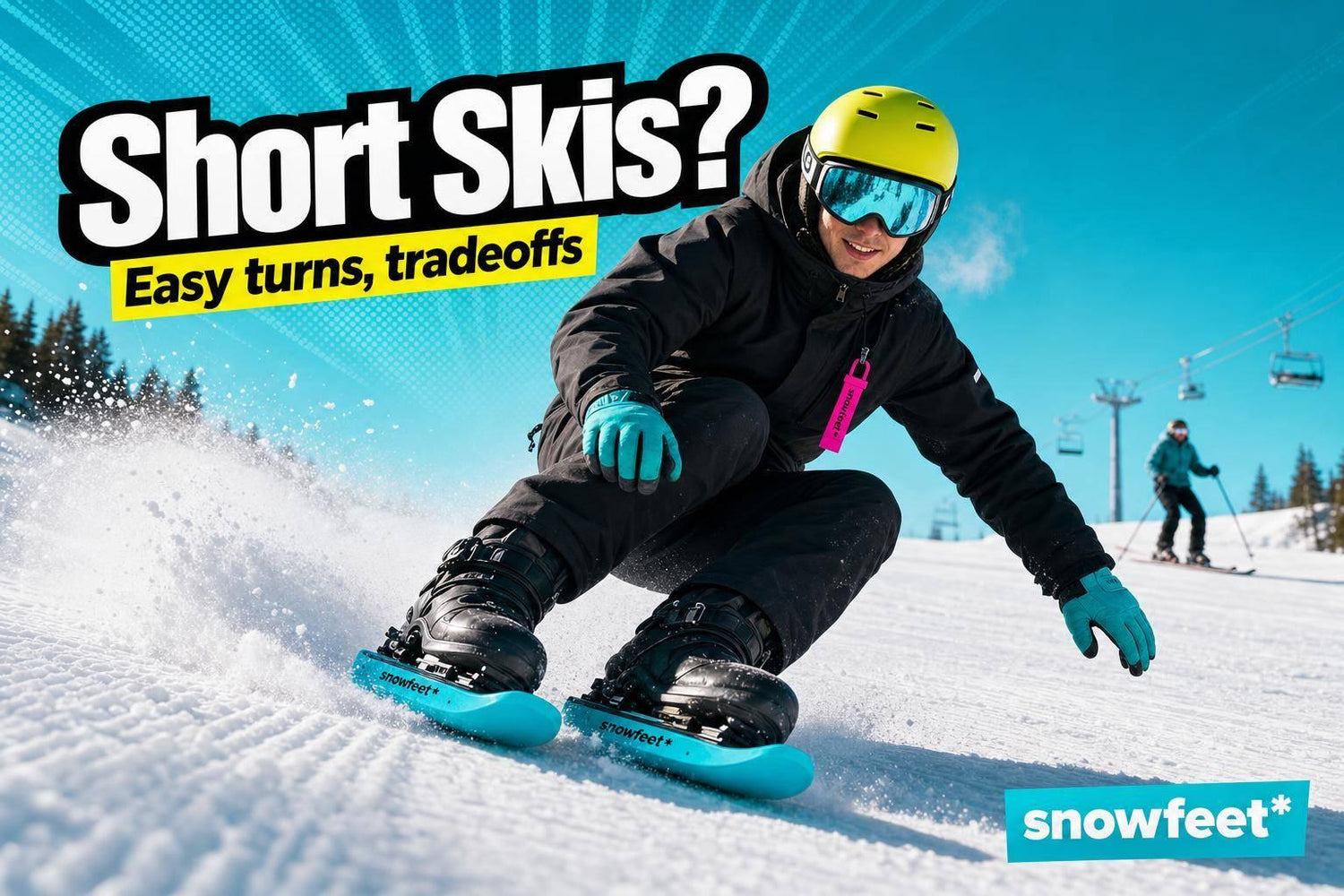
Yes - if you ski mostly at resorts and care more about easy turns than top speed, 120 cm short skis can make sense. From what I see in this article, the 120 cm Snowfeet* model is aimed at beginners, returning skiers, snowboarders, and casual riders who spend most of their time on groomers, bumps, trees, and small park features.
Here’s the short version:
- Best for: resort laps, short turns, moguls, small park features, travel, and easy handling
- Less good for: high-speed carving, deep powder, chopped snow, and hard charging
- Price: $950 for the 120 cm model
- Main tradeoff: more control and less bulk, but less stability than 150–180+ cm skis
- Best fit: people who ski for fun, not people trying to ski at race pace
If I had to sum it up in one line: 120 cm short skis can work as a main setup for many casual U.S. resort skiers, but not for powder days or fast expert skiing.
Quick Comparison
| Ski Type | Best Use | Main Upside | Main Downside | Price |
|---|---|---|---|---|
| Snowfeet* 120 cm | Resort skiing, short turns, bumps, small park | Easy to turn, easy to carry, less tiring | Less stable at speed, weaker in powder | $950 |
| Snowfeet* 99 cm | Park, playful laps, tight spaces | Lighter feel, easier to slash and pivot | Less stable than 120 cm | $690 |
| Standard 150–180+ cm skis | Fast groomers, deep snow, hard carving | More stable, better float, better at speed | More bulk, more effort | Varies |
What stands out most is the use case. The article does not claim 120 cm skis beat full-length skis at everything. It says they fit a big chunk of how many people in the U.S. ski: a few trips a year, crowded runs, moderate speed, and a lot of “I just want this to feel easy” energy. And, uh, that’s a pretty honest lane :)
For me, that makes the value pitch simple:
- If you want easy control, they look worth a look.
- If you want speed, powder float, and hard carving, stick with longer skis.
If you want a quick feel for short skis on snow, these YouTube searches can help:
- Short skis / skiblades reviews on YouTube
- 120 cm skiblades carving and resort skiing
- Snowfeet skiblades review
So, based on this article, my take is simple: 120 cm short skis are worth it for the right skier - just not for every skier.
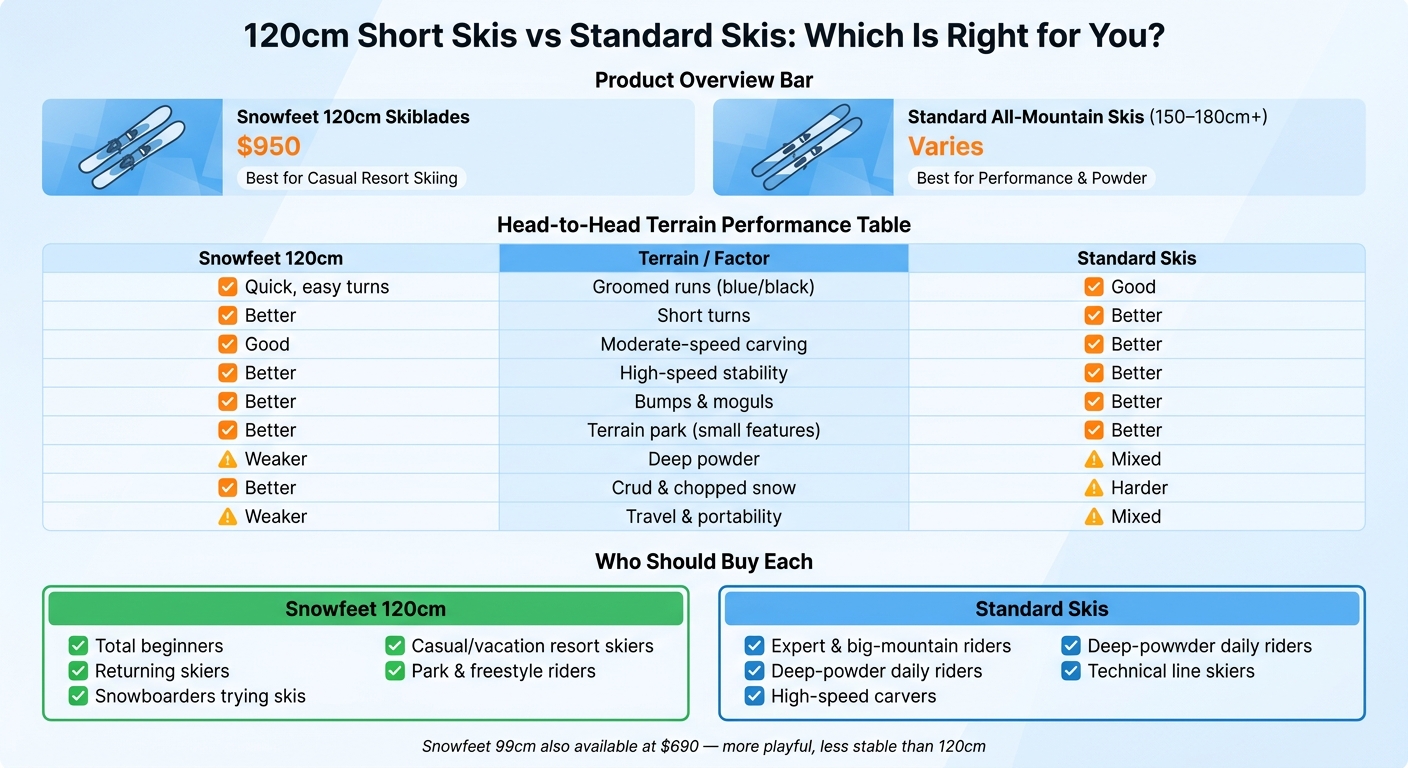
120cm Short Skis vs Standard Skis: Which Is Right for You?
Short Skis vs. Long Skis
How 120 cm Short Skis Perform on Resort Terrain
Snowfeet* 120 cm is the longest option in the Snowfeet* lineup, sitting above the 99 cm and 65 cm Skiblades. That extra length gives you more stability, but keeps the quick, playful feel that makes short skis fun in the first place.
Compared with standard all-mountain skis, Snowfeet* 120 cm give up some high-speed calm for faster turns, easier control, and way less hassle when you’re hauling gear around. For the kind of terrain most U.S. resort skiers spend time on, that trade makes a lot of sense.
| Terrain / Factor | Snowfeet* 120 cm | Standard All-Mountain Skis |
|---|---|---|
| Groomed runs (blue/black) | ✅ Better for quick, low-effort turns | ✅ Good |
| Short turns | ✅ Better | Mixed |
| Moderate-speed carving | ✅ Good | ✅ Better |
| High-speed stability | ⚠️ Weaker | ✅ Better |
| Terrain park (small features) | ✅ Better | Mixed |
| Bumps and moguls | ✅ Better | ⚠️ Harder |
| Travel and portability | ✅ Better | ⚠️ Weaker |
| Deep powder | ⚠️ Weaker | ✅ Better |
| Crud and chopped snow | ⚠️ Weaker | ✅ Better |
The tradeoff is simple: you get less calm at top speed, but more ease, control, and freedom to move. For most casual resort skiing, that’s a good deal. Honestly, for a lot of skiers, it’s the sweet spot.
Where Snowfeet* 120 cm Outperform Longer Skis
The big win is quick response. There’s less ski to swing around, so edge-to-edge moves feel faster and lighter. On a crowded blue groomer or a tight tree run, that matters. You can make quick turns without feeling like you’re fighting the ski.
Bumps and moguls are another strong spot. The shorter platform is easier to pivot and redirect, which helps casual skiers stay in control with less effort. Instead of wrestling each turn, you can keep things loose and smooth. That’s a pretty nice feeling when the run gets messy.
In the park, the 120 cm length also feels easier on boxes and small jumps. It’s less cumbersome, which can make smaller features feel less intimidating.
Travel is a clear plus too. At 120 cm, they’re much easier to carry through the parking lot, stash in a car, or store at home. Anyone who’s ever tried to jam full-length skis into a packed SUV knows this is no small thing :)
Where Longer Skis Still Have the Edge
At higher speeds, longer skis still do better. They track with more confidence over rough or mixed snow, and they feel more settled when you open things up.
They also give you more float and support in soft snow, crud, and chopped-up conditions. So if you ski hard, ski fast, or spend a lot of time in demanding terrain, longer skis still make more sense. That’s the main line where standard skis pull ahead of the 120 cm model.
Next, compare the 120 cm model with the 99 cm version and traditional skis.
Snowfeet* 120 cm vs 99 cm vs Standard Skis
At this point, it comes down to one thing: control vs. range. The 99 cm model is the most playful. The 120 cm sits in the middle and does a bit of everything. Standard skis still bring the most power.
| Factor | Snowfeet* 120 cm | Snowfeet* 99 cm | Standard Adult Skis |
|---|---|---|---|
| Stability | ✅ Good | ⚠️ Less stable | ✅ Best |
| Carving feel | ✅ Moderate | ⚠️ Limited | ✅ Best |
| Beginner friendliness | ✅ Best | ✅ Good | ⚠️ Steeper curve |
Snowfeet* 120 cm vs Snowfeet* 99 cm
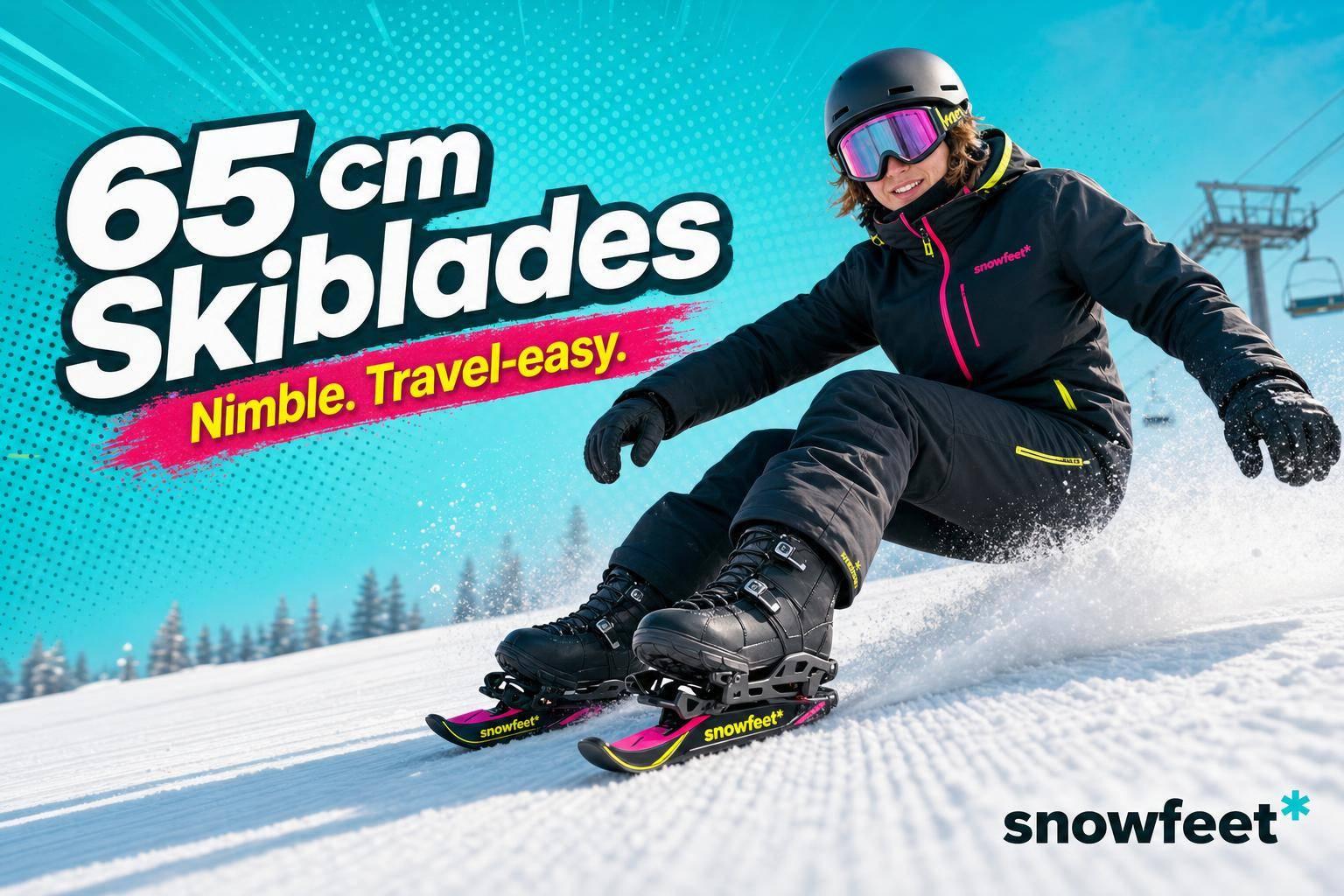
The 99 cm Skiblades are the smaller, trick-focused choice. They feel lighter on your feet and are easier to spin, slash, and pivot. If you care most about freestyle fun or want the most portable short ski you can grab and go with, the 99 cm does that job well.
The 120 cm feels more settled. You notice it on groomers right away. It grips better through turns and stays calmer at moderate speeds. So if you want one short ski that can handle a full resort day instead of just a few park laps, the 120 cm is the better bet.
Put simply, the 99 cm leans more park-and-play. The 120 cm feels more like an all-day resort tool. Same family, different mood :)
Snowfeet* 120 cm vs Older Snowblades and Full-Length Skis
Older snowblades often felt like a side toy. Fun for a bit, sure, but not something most people wanted to ride all day. Snowfeet* 120 cm aims at everyday resort use, which puts it in a useful middle lane.
Full-length skis still take the top spot for pure performance. They handle higher speeds better, make longer carved turns, and float better in soft snow. No surprise there.
But they also bring more bulk, more effort, and, for a lot of casual riders, more ski than needed. The Snowfeet* 120 cm at $950 lands in a practical middle ground: enough resort performance for laid-back skiing, without the extra hassle that comes with full-length skis.
So now the last call is pretty simple: who should go with 120 cm, and who should stick with 99 cm or standard skis?
sbb-itb-17ade95
Who Should Buy Snowfeet* 120 cm - and Who Should Not
Now that the tradeoffs are out in the open, here’s the simple version: Snowfeet* 120 cm are best for control, easy turns, and low stress, not flat-out speed.
| Rider Type | Recommendation | Why |
|---|---|---|
| Total beginners | ✅ Best choice | Shorter length means faster edge control, harder to catch an edge, less intimidating gear |
| Returning skiers | ✅ Best choice | Rebuilds confidence quickly on groomers |
| Snowboarders trying skis | ✅ Best choice | Twin-tip shape and short length make pivoting easy |
| Vacation/casual resort skiers | ✅ Best choice | Easy to manage on crowded U.S. holiday slopes |
| Park and freestyle riders | ✅ Good choice | Playful, quick to pivot, stable enough for casual resort laps |
| Intermediate all-mountain skiers | ⚠️ Situational | Works well at moderate speeds; less ideal if you push hard every run |
| Expert skiers / big-mountain riders | ❌ Skip | Not enough platform for high-speed charging or technical lines |
| Deep-powder daily riders | ❌ Skip | Traditional powder skis float better in deep powder |
The best match is someone who wants easy handling over top speed. That’s the heart of it.
Best For: Beginners, Returning Skiers, Snowboarders, and Casual Riders
For beginners, the 120 cm length makes skiing feel less like a wrestling match. You get less fatigue, easier turns, and gear that feels less scary on day one. That matters a lot. When skis feel simple to steer, learning tends to click faster, and the whole day is more fun.
For returning skiers, this length hits a nice middle ground. You still get enough edge grip to feel planted, but the ski stays forgiving if your technique is a little rusty. And on busy U.S. resort days, that quick-turn feel helps a ton. Narrow trail? Crowded run? A surprise slow group in front of you? These are easier to deal with when your skis respond fast.
Snowboarders often settle in fast too. The compact shape is easy to pivot, and the twin-tip design helps the skis feel more playful and less awkward during the switch.
Casual resort skiers are also a strong fit. If you ski a few days each season and just want something easy to handle, these make a lot of sense. They’re simple, light-feeling, and less tiring when the slopes get packed.
Skip Them If You Prioritize Speed, Powder, or Hard Carving
Skip the 120 cm if your main goal is high speed, deep powder, or hard, aggressive carving. That’s where longer skis still win.
If you’re an expert skier who likes to charge, ski technical lines, or push hard every run, this ski will likely feel too short and too limited. Same deal for deep-powder riders. In soft snow, longer powder skis give you better float, better support, and a better tool for the job.
So, if your happy place is groomers, mellow resort laps, and quick control, Snowfeet* 120 cm fit well. If your happy place is bombing steep lines or surfing deep snow, you’ll want something longer.
Conclusion: Are 120 cm Short Skis Worth It?
Yes - for most casual resort riders, Snowfeet* Skiblades 120 cm are worth it.
After looking at performance, control, and where they work best, the 120 cm model stands out for one simple reason: it makes skiing feel easier and more fun. You get quick turns, easy edge control, and less leg burn, which is a big deal if you're not out there trying to ski like a World Cup racer.
That’s why they’re a strong fit for:
- beginners
- returning skiers
- snowboarders
- casual resort riders
At $950, they offer a lot for that group. But, yeah, there’s a trade-off. Longer skis still do better at high speed, in deep powder, and during hard carving. If that’s your thing, short skis may feel a bit out of their lane.
If you care more about portability and a playful ride than extra stability, go shorter. The Snowfeet* Skiblades 99 cm at $690 feels more nimble, while the 120 cm gives you a bit more balance and support.
The smart move is to match the ski to how you actually ride, not how you imagine yourself riding on your best day :) For most people who want ease over brute force, the 120 cm is the better buy.
FAQs
Can 120 cm short skis replace regular skis?
Yes. For a lot of riders, 120 cm short skis can take the place of regular skis and feel more nimble, easier to handle, and plain more fun.
That said, regular skis still win when you’re going fast, laying down hard carves, or dealing with deep, tough snow. But 120 cm skis like Snowfeet Skiblades* hit a nice middle ground. They feel closer to regular skis than super short blades do, while still being easier to turn, less tiring on your legs, and handy for laid-back resort days.
Are 120 cm short skis hard for beginners to learn on?
No. 120 cm short skis are often easier for beginners to learn on than long, standard skis.
The big reason is simple: they’re easier to control.
Because they’re shorter, they turn with less effort, feel more natural under your feet, and make it less likely that you’ll cross the tips. That alone can save a lot of awkward wipeouts :) For many new skiers, that means a smoother first day on snow and a lot more confidence.
A lot of beginners can pick up the basics in a single day on short skis. They don’t have to fight the ski as much, so they can focus on the stuff that matters:
- stopping
- turning
- balance
- linking easy runs
So, if you’re just starting out, 120 cm short skis can feel more forgiving and less intimidating than longer skis.
Should I get 120 cm or 99 cm Snowfeet* skiblades?
It comes down to how you ride and where you ride.
The 99 cm is the easier, more all-around pick. It works well on groomers, in the park, and in light powder up to 4 inches. If you want something simple to handle and easy to move around on, this is the safer bet.
Go with the 120 cm if you want more stability and stronger carving at speed. It feels closer to a standard ski, but it’s still easier to turn and easier to carry. One catch: it does need ski boots for the ankle support to work well.











Leave a comment
This site is protected by hCaptcha and the hCaptcha Privacy Policy and Terms of Service apply.