



















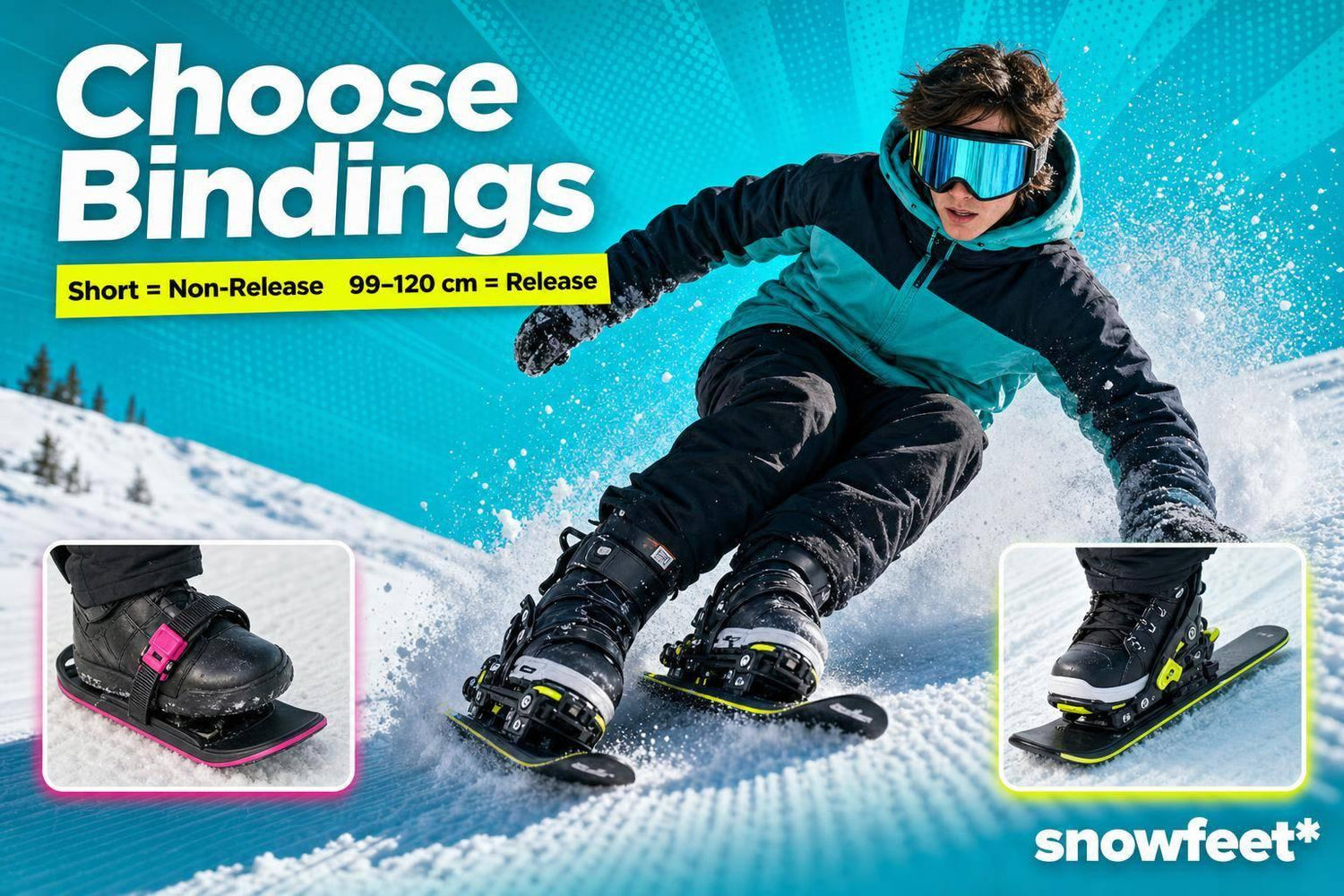
If you want the short answer: use non-release on 65 cm skiblades, and lean toward release on 99 cm and 120 cm setups. That’s the simple version. As skiblades get longer, they can put more twist on your legs in a fall. That’s why release bindings start to matter more once you move past the shortest models.
Here’s the quick take:
- 65 cm: non-release usually makes the most sense
- 99 cm: either can work, but release is often the safer pick if you ski faster
- 120 cm: release is the smart move for most riders
- Snowboard boots: best matched with strap-style, non-release setups on shorter models
- Ski boots: work best if you want step-in release bindings and more edge hold
A few facts worth knowing:
- 65 cm Snowfeet* start at $590
- 99 cm Snowfeet* start at $690
- 120 cm Snowfeet* start at $950
- Release bindings use a DIN setting, which should be set by a ski shop tech
- Non-release bindings need a safety leash since they don’t have brakes
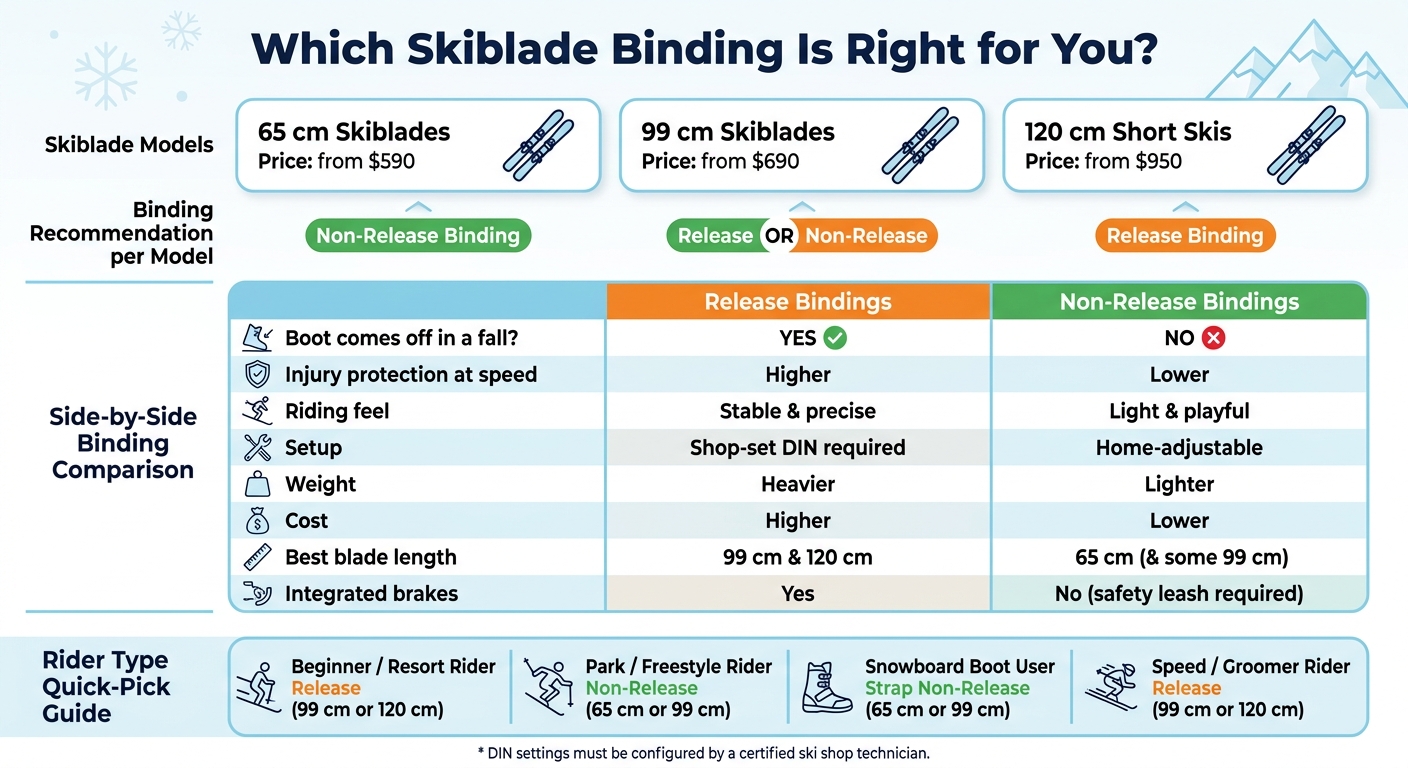
Skiblade Binding Comparison: Release vs Non-Release by Model & Rider Type
Bindings for Short Skis | All You Need to Know
Quick Comparison
| Setup | Best skiblade length | Boot comes off in a fall? | Feel on snow | Best for |
|---|---|---|---|---|
| Release bindings | 99 cm, 120 cm | Yes | More planted at speed | Groomers, beginners, higher-speed riding |
| Non-release bindings | 65 cm, some 99 cm | No | Lighter, more playful | Park laps, slower riding, simple setup |
| Snowboard strap bindings | 65 cm, some 99 cm | No | Softer, less sharp edge feel | Riders who want one-boot use |
So, if you’re stuck on this choice, I’d keep it simple: pick release for speed and added fall protection, and pick non-release for short, playful skiblades and park use. No drama, no gear-shop headache :)
How each binding system works on skiblades
On skiblades, the big choice comes down to this: do you want ski-style release safety, or a locked-in feel? Simple idea, big difference.
Release bindings can let go in a fall. Non-release bindings stay locked on.
Release bindings: how ski-style safety release works
Release bindings use a ski-style step-in system. You step in with the toe first, then press the heel down to lock the boot in place. The toe and heel pieces hold the boot tight.
If you fall and your leg twists or takes too much force, the binding is built to release the boot before that force reaches your knee or ankle. The DIN setting should match your weight and riding style. Have a ski technician set it so it releases in a fall, not during normal turns.
Release bindings also come with integrated brakes. When the boot comes off, the brakes drop down to help stop the skiblade from sliding away. That matters even more on longer skiblades, where a loose blade can travel farther.
This setup fits riders who want ski-style safety and don’t mind a more technical binding.
Non-release bindings: fixed hold for direct control
Non-release bindings use a simpler setup. They rely on adjustable metal brackets and a toe clip to grip the boot sole and hold it in place. There are no release settings, so the boot stays connected to the skiblade whether you fall or not.
Because there’s no release mechanism, non-release bindings are lighter and less bulky. That makes them easier to handle, which is a nice match for shorter skiblades. You can also adjust them at home without tools: press the center buttons, slide to your boot length, and lock them in.
There’s one catch. Since these setups don’t have integrated brakes, you need a safety leash attached to your ankle to keep the skiblade connected if it comes loose.
That simple design is a big reason non-release bindings are still popular on shorter, more playful skiblades.
sbb-itb-17ade95
Release vs non-release: safety, control, and daily use compared
Here’s the quick side-by-side view of how both systems compare in the stuff that matters most day to day:
| Factor | Release Bindings | Non-Release Bindings |
|---|---|---|
| Injury risk | Lower leverage on short blades; more twist risk as length increases | Lower leverage on short blades; more twist risk as length increases |
| Riding feel | More stable and precise at speed | Light and playful |
| Setup | Shop-set DIN | Home-adjustable |
| Weight | Heavier | Lighter |
| Cost | Higher | Lower |
Those trade-offs hit different depending on who’s riding. A beginner doing mellow resort laps won’t weigh them the same way as a park rider or someone using snowboard boots.
When release bindings make more sense
On Snowfeet* 99 cm and 120 cm models, release is usually the safer default. As blade length goes up, the odds of your leg getting twisted or stuck in a fall go up too. That’s why release bindings make more sense from 99 cm and up.
They’re also a smart call for beginners skiing at resorts or riders going faster on groomers. The firmer connection feels more stable, which helps when you start carving harder or heading onto steeper runs.
When non-release bindings are often preferred
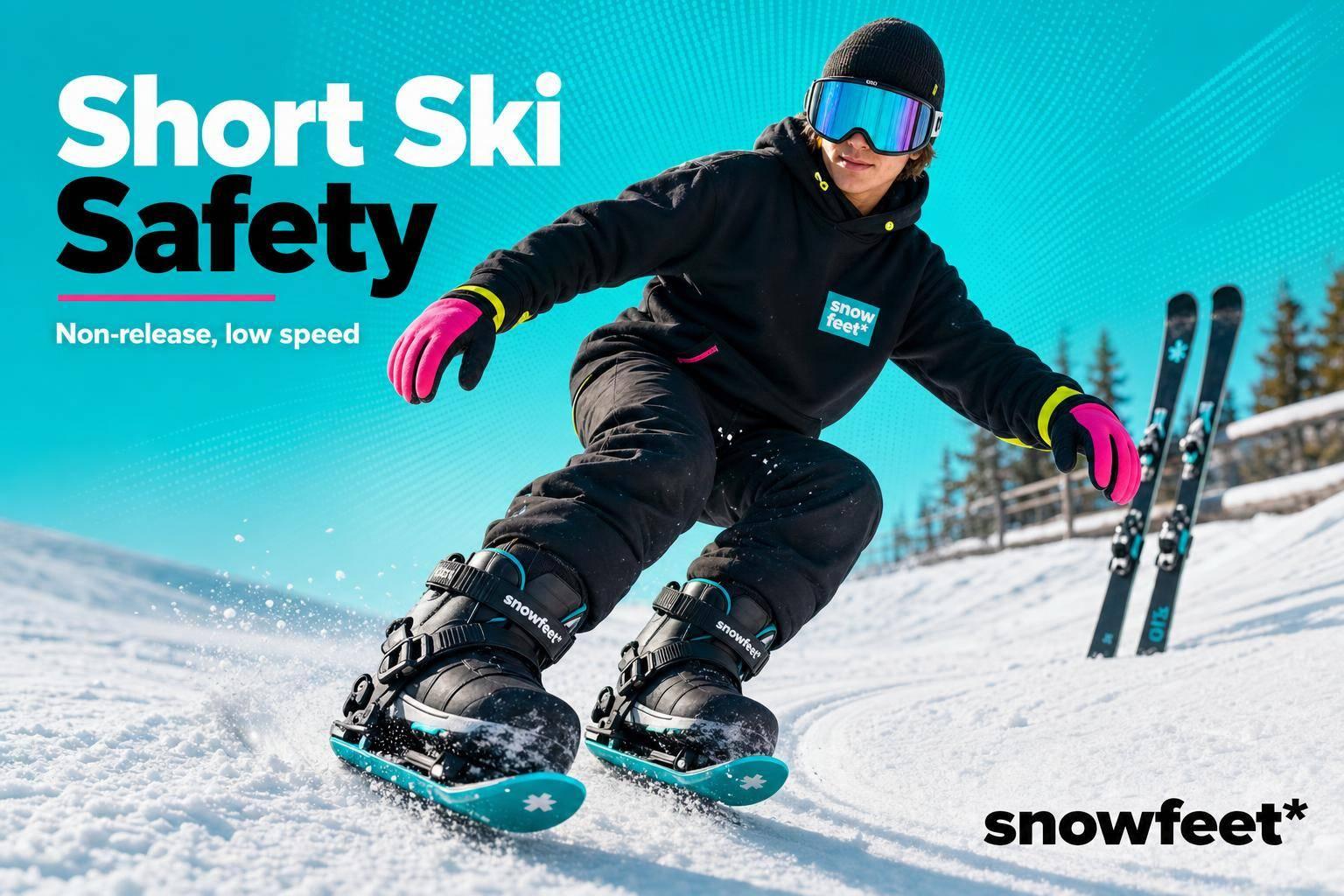
On Snowfeet* 65 cm Skiblades, fixed bindings are often the better match. On very short skiblades - under about 65 cm - release bindings usually don’t physically fit. And because shorter blades create less leverage in a fall, fixed bindings stay practical and playful.
Park riders, freestyle skiers, and people working on spins or jumps often lean toward non-release too. The fixed connection gives a more direct feel, which can help on trick landings. The catch? If you fall, the binding stays locked in.
Convenience, weight, and maintenance differences
Non-release bindings win on simplicity. Release bindings need a ski shop tech to set the DIN based on your weight and skill level. Non-release setups can be adjusted at home, so you can skip the shop trip.
Weight matters too. Release systems add more bulk. Non-release setups are lighter and smaller.
So, yeah, rider type matters just as much as binding type.
Best binding choice by rider type and Snowfeet* model
Here’s the fast way to pick the right setup by rider type and model. For casual riders, the main thing is skiblade length.
The Skiblades 65 cm (from $590) are the natural match for non-release bindings. The Skiblades 99 cm (from $690) can go either way, but release bindings start to make more sense as speed goes up and terrain gets steeper. The Short Skis 120 cm (from $950) are the clear pick for release bindings.
| Snowfeet* Model | Recommended Binding | Best For |
|---|---|---|
| 65 cm | Non-release / snowboard | Slow, playful riding |
| 99 cm | Release or Non-release | Casual resort, all-mountain versatility |
| 120 cm | Release | Higher speeds, groomed runs, safety priority |
Beginners and casual resort riders: Snowfeet* Skiblades 65 cm, 99 cm, and Short Skis 120 cm
If you’re just out to have fun on resort runs, this choice is pretty simple.
The 65 cm model fits slow, playful riding. The 99 cm sits in the middle and gives you more range, which is nice if you want to cruise and still have room to grow. The 120 cm is built more for higher speeds on groomed terrain, so release bindings make the most sense there.
Park riders and playful all-mountain users: why non-release stays popular
If you want to hit rails, spin, or just cruise with a looser, surf-like feel, non-release bindings on the 65 cm or 99 cm models are still the go-to. They’re lighter, and they keep your skiblades attached through minor spills, which helps when you’re trying new tricks and don’t want to yard-sale a ski down the hill.
Of course, there’s a catch. The binding stays locked during a fall. So yeah, fun and simple - but with that trade-off.
That same simple setup also works well for riders who want a one-boot system.
Snowboard-boot riders: one boot setup vs ski-boot release systems
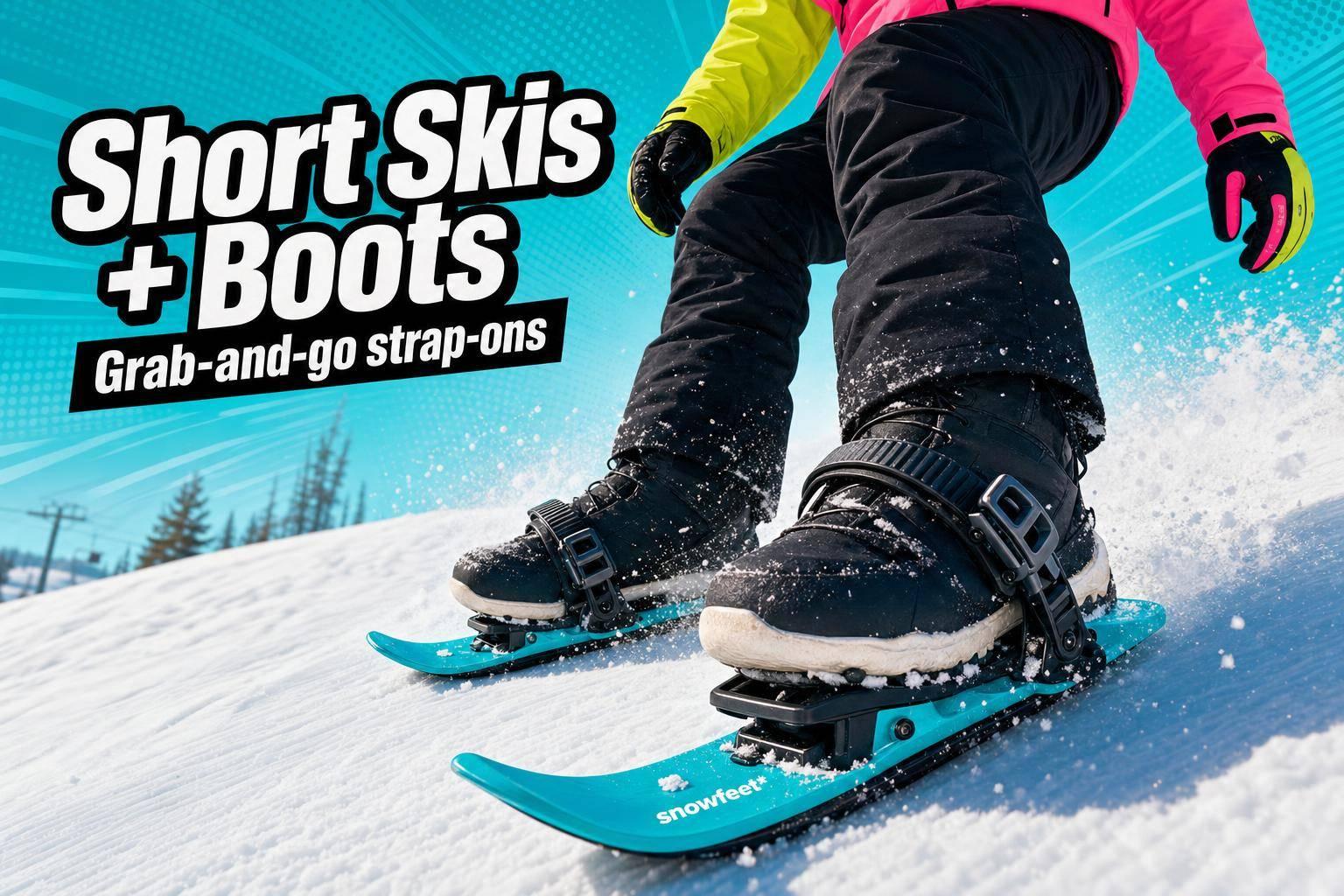
If you already snowboard, snowboard-boot bindings on the 65 cm or 99 cm models let you use one pair of snowboard boots for both snowboarding and skiblades. That’s clean, easy, and pretty appealing if you don’t want extra gear cluttering up the car.
The trade-off is less precise edge control. When terrain gets steeper or speeds climb, a ski-boot release setup on the 99 cm or 120 cm gives you sharper edge response and the added safety of a mechanical release.
Conclusion: Which skiblade binding is right for you
When you stack up safety, control, and ease of use, release bindings are the safer choice for the 99 cm and 120 cm models. Non-release bindings make more sense on the 65 cm model, and they also work on the 99 cm if you want a lighter, simpler, and lower-cost setup.
For most riders, the 99 cm is where the choice gets real. Go with release bindings if you plan to ski faster on groomed runs or want more protection in a fall. Go with non-release bindings if you want a more direct feel, easy adjustment, and a setup that suits park laps and skating-style moves. If comfort and flexibility top your list, Snowfeet* snowboard-boot bindings are a strong pick on the shorter models.
So, match the binding to how and where you ride. Choose release for speed and protection. Choose non-release for simplicity and a more playful feel.
FAQs
Can I switch from non-release to release bindings later?
No, in most cases, they can’t.
These binding types use different mounting interfaces, so you usually can’t swap them on the same pair of skiblades after you buy them.
Release bindings have more complex toe and heel parts. Non-release bindings use simpler fixed baseplates. So the hardware doesn’t line up the same way.
If you want a certain feel on snow or specific safety features, pick the binding setup that matches your riding style from the start. It’ll save you a headache later :)
How do I know if my speed and terrain call for release bindings?
Release bindings make the most sense if you care about high-speed carving or ride 99 cm or 120 cm skiblades. At those lengths and speeds, you get more leverage, so a release system matters more for safety if you crash or make a hard, sudden move.
If you ski hard on technical terrain or like to ride fast, release bindings give you more steady security and performance. But if you're riding more casually or spending time in the terrain park on shorter models, non-release bindings are still the go-to pick. They’re lighter and give you that direct, snappy feel.
Are non-release bindings safe enough for beginners?
Yes. Non-release bindings are usually safe and a good fit for beginners.
Because skiblades are shorter than full-length skis, they create less leverage and torque during a fall. That can help lower the risk of leg or ankle injury.
The fixed connection also feels direct and easy to control. For a beginner, that can make balance and speed control easier to learn.
One thing matters here: attach the required safety leash. If you fall, it helps keep your skiblades from sliding away.











اترك تعليقًا
This site is protected by hCaptcha and the hCaptcha Privacy Policy and Terms of Service apply.