



















Want to improve your skiing or snowboarding skills? It all starts with balance and edge control. These two skills help you turn, stop, and stay steady on any slope. Whether you're gliding through packed snow or navigating tricky terrain, mastering these basics will boost your confidence and control.
Key Takeaways:
- Balance keeps you steady and centered, while edge control helps you steer and manage speed.
- Snowfeet* gear, like Skiskates (44 cm) and Skiblades (65–120 cm), makes learning faster and easier with their compact size and sharp responsiveness.
- Practice drills, both on and off the snow, to build strength, stability, and control.
Quick Tips:
- Start Small: Use Skiskates for agility and quick balance drills.
- Progress Gradually: Move to longer Skiblades (65–120 cm) to refine edge control and tackle steeper slopes.
- Drills Matter: Practice static balance, gliding, turning, and edge transitions.
- Off-Snow Training: Balance exercises like one-leg stands and lateral drills help you prepare for the slopes.
- Safety First: Warm up, wear protective gear, and practice on groomed trails to stay safe.
Ready to take your skills to the next level? Let’s break down how to use Snowfeet* gear and drills to master balance and edge control. :)
Balance & Edging Drills On Skis
Choosing the Right Snowfeet* Gear for Balance Practice

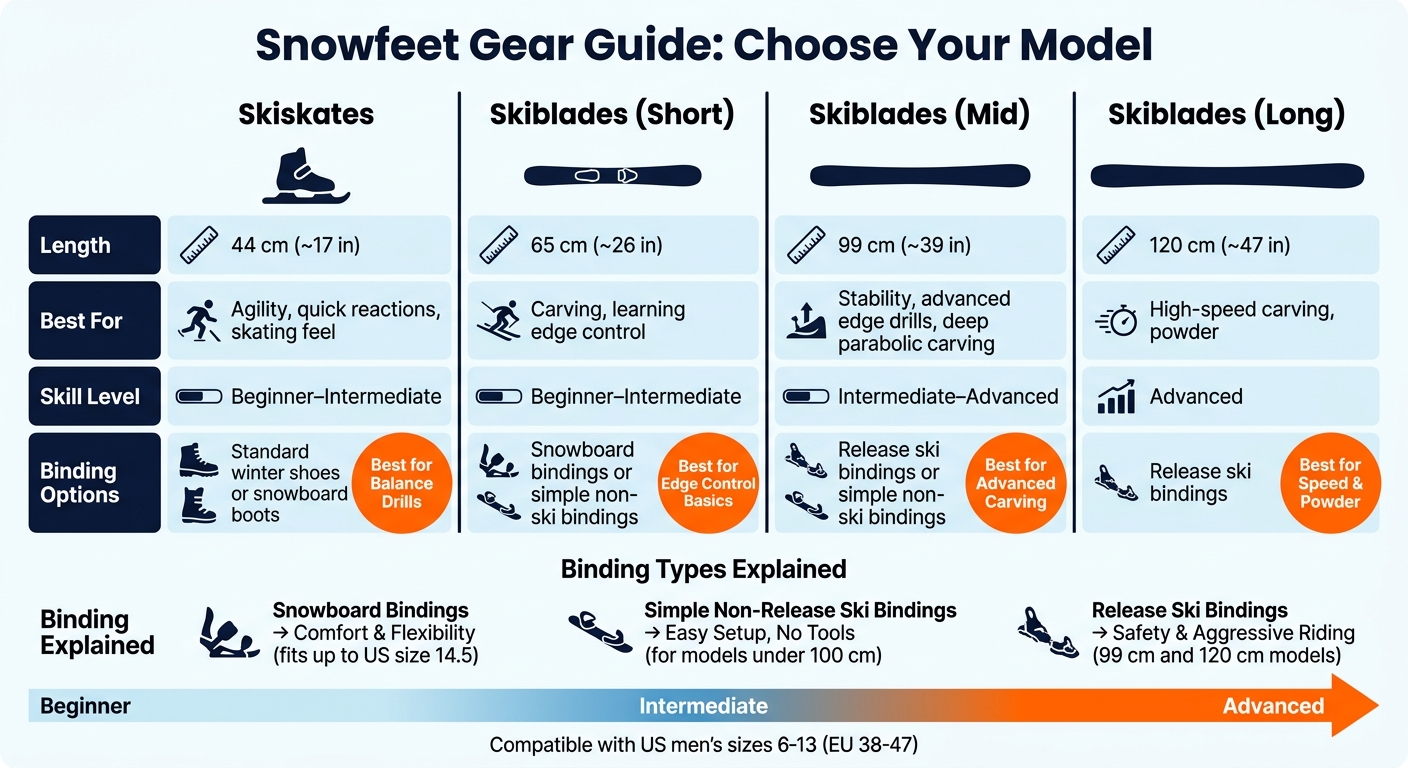
Snowfeet Gear Comparison: Skiskates vs Skiblades for Balance & Edge Training
Snowfeet* Model Breakdown
When it comes to Snowfeet* gear, your choice between Skiskates and Skiblades depends on your practice goals.
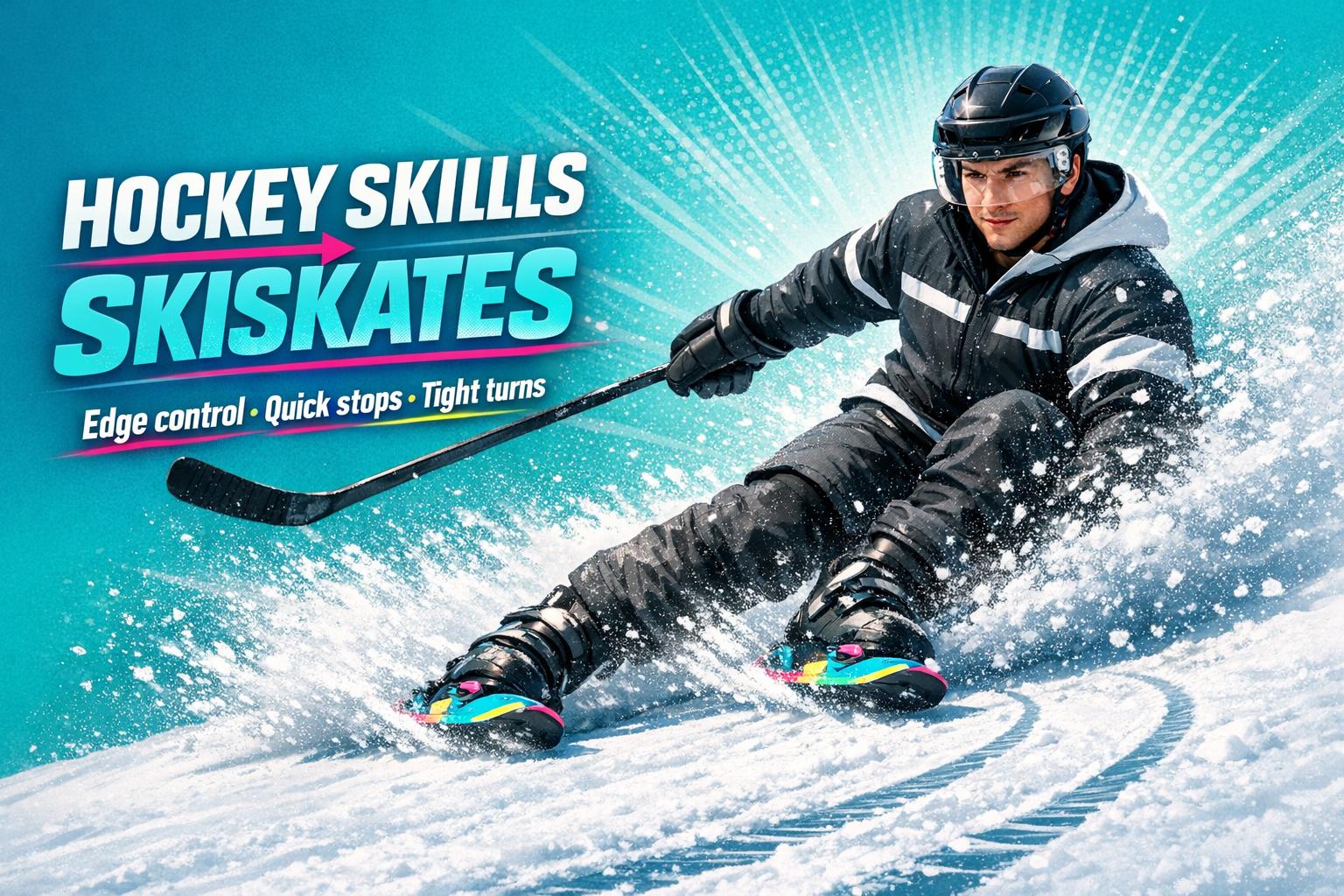
Skiskates (44 cm/~17 inches) are designed to mimic ice skating but on snow. Their short length encourages quick reflexes and sharpens your ability to stay balanced. On the other hand, Skiblades (65–120 cm/~26–47 inches) offer a more traditional ski-like experience. The longer the blade, the more stable they feel, but they also demand greater effort for turning and maintaining control.
| Model | Length | Best For | Skill Level |
|---|---|---|---|
| Skiskates | 44 cm (~17 in) | Agility, quick reactions, skating feel | Beginner–Intermediate |
| Skiblades | 65 cm (~26 in) | Carving, learning edge control | Beginner–Intermediate |
| Skiblades | 99 cm (~39 in) | Stability, advanced edge drills | Intermediate–Advanced |
| Skiblades | 120 cm (~47 in) | High-speed carving, powder | Advanced |
Shorter models are perfect for mastering balance fundamentals quickly, while longer models are better suited for advanced riders who want to refine their control at higher speeds. Once you've picked your model, make sure your footwear and bindings are compatible for the best experience.
Boot and Binding Compatibility
One of the perks of Snowfeet* gear is its flexibility when it comes to footwear. The 44 cm Skiskates work with standard winter shoes or snowboard boots - no need to invest in specialized ski boots.
For Skiblades, you have three binding choices:
- Snowboard bindings: Ideal for comfort and flexibility. If you already own snowboard boots, this is a great option for a relaxed and walk-friendly setup.
- Simple non-release ski bindings: Lightweight and easy to set up without tools. These are typically used on shorter Skiblades (under 100 cm).
- Release ski bindings: Found on the 99 cm and 120 cm models, these are standard safety bindings designed for faster, more aggressive riding.
As Snowfeet* explains: "Choose ski bindings (ski boots) for classic control, simple non-release bindings (ski boots) for easy setup, or snowboard bindings (snowboard boots) for comfort and flexibility."
The gear accommodates US men's sizes 6–13 (EU 38–47), with snowboard bindings fitting up to US size 14.5.
Which Model to Use for Each Drill
The model you choose will directly impact how effective your drills are. Snowfeet* gear is designed to provide the kind of responsiveness that helps you learn faster than with traditional skis or snowboards.
- For agility and balance reaction drills, the 44 cm Skiskates are your best bet. Their compact size keeps you active and centered, helping you develop strong core balance habits quickly.
- For basic carving and edge control, the 65 cm Skiblades provide a forgiving platform with clear edge feedback, making them great for beginners.
- Once you're comfortable holding an edge, the 99–120 cm Skiblades allow you to tackle longer carves, higher speeds, and more challenging terrain. This is where your edge control skills will truly be put to the test.
"These skiblades are easy to control with enhanced precision." - Andrew B.
Start simple with Skiskates for balance drills, then work your way up to longer Skiblades as your skills and confidence grow.
On-Snow Balance and Edging Drills
Snowfeet* gear, known for its agility, makes balance and edge control drills more effective and engaging.
Static Balance Drills
Begin on flat, groomed snow in a neutral stance - knees bent slightly, weight centered, and shoulders relaxed. Practice slow weight shifts: move your weight to the left, hold for three seconds, then shift to the right. Once comfortable, try lifting one foot for a single-ski stand. The compact 44 cm Skiskates are perfect for this. Their smaller size challenges your ankles and core, helping you build the stability needed for all kinds of on-snow maneuvers. As SkyTechSport explains, "stronger legs and core help absorb bumps, control turns, and hold edges longer."
Once you’ve nailed your static balance, move on to controlled gliding and turning.
Basic Gliding and Turning Drills
With static balance under control, it’s time to add movement. Find a gentle slope and glide forward with soft knees, keeping your eyes on the horizon. To turn, shift your weight to one side and let the edge of your gear guide the movement. The 65 cm Skiblades are particularly helpful here - they make turning easier and more responsive than traditional skis. Brad Tolin, a verified user, shared his thoughts:
"These ski blades are a blast to use. Super easy to control, quick to turn, and way more forgiving than traditional skis. They're great for carving and navigating crowded slopes without feeling bulky."
Once you’re comfortable gliding and turning, focus on improving edge transitions.
Edge Control Drills
Edge transitions are key to smooth skiing and avoiding mishaps like catching an edge. Start on flat ground by practicing rolling your edges: stand still and tilt both Skiblades onto their inside edges, return to flat, then shift to the outside edges. Pay attention to how your ankles engage during these movements.
Next, take it to a gentle slope. Work on making narrow, clean turns by pressing the inside edge into the snow to start the turn, then smoothly releasing it as you transition to the opposite side. The 99 cm Skiblades, with their deep parabolic sidecut, are designed to help you carve clean arcs. As Snowfeet* points out, "With Snowblades, you use your whole body for front-back balancing, which makes skiing not only more exciting, but also a more holistic exercise strengthening your body too."
As you gain confidence, try slightly steeper slopes. The goal isn’t speed - it’s maintaining a clean edge throughout the entire turn. Focus on consistency and control, and let the terrain challenge you as you improve.
sbb-itb-17ade95
Off-Snow Balance Training for Snowfeet*
While on-snow drills are great for building skills, off-snow training is where you can fine-tune the balance needed for Snowfeet* gear. This type of practice helps reduce the time spent adjusting on the snow, so you can make the most of your Snowfeet* experience.
Home and Gym Balance Exercises
Off-snow exercises are a fantastic way to build on your progress from the slopes. Start simple: practice standing on one leg for about 10 seconds, then switch. Once you’re comfortable, take it up a notch by balancing on an unstable surface, like a foam pad or a folded yoga mat. This mimics the unpredictable terrain you’ll encounter while using Snowfeet*. Exercise physiologist Katie Lawton, MEd, highlights the importance of focusing on major muscle groups:
"You really want to target your bigger muscle groups, your primary movers, like your glutes, hamstrings, quads and core."
To complement your balance work, add toe raises to your routine. Slowly lift onto your toes, hold for three seconds, and lower back down. This strengthens your feet, ankles, and calves - key muscle groups for controlling edges on Skiskates or Skiblades. With daily practice, you’ll see improvement in no time.
Dynamic Balance Training
Once you’ve nailed static exercises, it’s time to add some movement. Lateral and directional drills, like side-to-side shuffles or quick changes in direction, are great for developing the muscles needed for fast weight shifts. Competitive skier Randi Young shares her approach:
"I make it a point to do a lot of lateral footwork, like football players."
If you happen to have access to a stand-up paddleboard (SUP) during warmer months, give it a shot. Paddleboarding is excellent for practicing those constant micro-adjustments that help with front-to-back balance.
Combining Off-Snow and On-Snow Training
Pairing off-snow exercises with your on-snow practice creates a powerful combination. Think of off-snow training as a way to maintain and refine your balance. Nordic instructor Lisbeth "Hurricane" Carter underscores the importance of sticking with it:
"Consistency is the foundation of staying in shape because you enter older age and not having to tell yourself that you have to get fit."
Try to fit in two or three short off-snow sessions each week. Spend 15 to 20 minutes on single-leg drills, lateral footwork, and core exercises. When you get back on your Skiblades or Skiskates after these sessions, you’ll notice sharper edge control and smoother weight transfers. Over time, this consistent practice will speed up your skill development with Snowfeet* gear.
Safety and Session Planning
Once you've nailed your on- and off-snow techniques, it's time to focus on safety and smart session planning. These are key to taking your skills to the next level.
Picking the Right Terrain and Conditions
Choosing the right spot to practice is just as important as how you practice. For balance and edge drills with Snowfeet* gear, stick to groomed trails and packed snow. These surfaces give you consistent feedback, making it easier to fine-tune your technique. Snowfeet* gear works best on predictable terrain, helping you stay both effective and safe.
Avoid deep powder or icy patches if you're still getting the hang of things. Ice reduces your edge grip, while heavy powder makes it harder to sense what your edges are doing. Once you’re confident on groomed runs, you can start exploring more varied snow conditions. For example, Skiblades (65 cm or 99 cm) handle firm surfaces beautifully, while Skiskates (44 cm) shine when you make precise weight shifts on packed snow.
Protective Gear and Warm-Up Routine
Safety first! Always wear a helmet, and if you’re new to short skis or skiskating, consider adding wrist guards and padded shorts. Skiskates also come with built-in safety leashes to keep your gear secure during falls.
Before hitting the slopes, spend 5–10 minutes warming up. Simple moves like hip circles, ankle rotations, and bodyweight squats can wake up your joints and muscles. As ski instructor Junior Bounous explains:
"The thing about skiing is reacting to the feel of movement. It takes agility, balance, and body and eye coordination."
A stiff body won’t react quickly, which is why mobility is so important. SkyTechSport agrees:
"A stiff rider is a slow learner. Without mobility, your turns will feel forced rather than fluid."
Even a quick set of lateral shuffles on flat ground can prep your legs for the side-to-side motion required for edge control. A proper warm-up sets the stage for smoother, more effective practice.
How to Structure a Practice Session
Break your session into focused chunks to get the most out of your time. Here’s a simple structure to follow:
- Start on flat terrain (about 15 minutes): Practice static balance drills and edge rolls to get comfortable with your stance.
- Move to a gentle slope (about 25 minutes): Work on guided drills like railroad track turns, one-footed glides, and edge-to-edge transitions.
- Wrap up with free runs (about 20 minutes): Apply what you’ve practiced without overthinking your technique.
To track your progress, focus on one specific skill - like initiating turns with your ankles - and rate your performance on a 1–5 scale before leaving the hill. Over time, you’ll notice patterns that highlight where you need to improve. This structured approach with Snowfeet* gear helps you build skills and confidence session by session.
Conclusion
This guide has explored how a mix of on-snow and off-snow drills, paired with the right gear, can speed up skill development. With a focus on balance and edge control, these techniques make it easier to build confidence and precision on the slopes.
As highlighted in the balance drills and safety tips earlier, mastering weight distribution and ankle engagement is crucial. The foundation of smooth snow movement lies in proper posture, balanced weight, and ankle-driven edge control. These skills are developed progressively, starting with flat-ground drills and advancing to free runs on groomed terrain. Snowfeet* gear plays a big role in this process. Models like the 44 cm Skiskates offer agility, while the 99 cm Skiblades provide stability. Unlike traditional long skis, which can feel demanding and slow to respond, Snowfeet* gear is designed for intuitive control. Their shorter length makes them more forgiving and offers quicker feedback on every move - perfect for refining your technique. With a 4.9/5 overall rating and 95% of Skiskates reviewers giving 5 stars, it’s clear that users are seeing results.
If you're ready to improve your balance and edge control, Snowfeet* is a smart choice. Take your skills to the next level with Snowfeet* and make every slope your playground!
FAQs
How do I know when to switch from Skiskates to longer Skiblades?
When you’re comfortable handling edge control and maintaining balance on shorter gear like Skiskates (44 cm), it might be time to step up to longer Skiblades - options include 65 cm, 99 cm, or 120 cm. These longer Skiblades provide improved stability and smoother maneuvering, making them perfect for refining your skills at a higher level. Snowfeet gear is crafted to make this progression seamless, helping you advance more efficiently than you might with traditional skis or snowboards.
Why do I keep catching an edge, and how do I fix it fast?
Catching an edge often comes down to uneven weight distribution and lack of edge control. To address this, focus on keeping a balanced stance and evenly distributing your weight across your skis, Skiblades, or Skiskates. Snowfeet gear, like Skiblades and Skiskates, can help you fine-tune your technique. Their lightweight and portable design makes them perfect for practicing drills, like shifting your weight from edge to edge. These exercises can help you build muscle memory and boost your confidence on the slopes.
How often should I train off-snow to see real improvement?
To make real progress in your balance and skiing skills, aim to train off-snow at least twice a week for around 10 weeks. Keep each session between 30 and 40 minutes long. Sticking with a routine of focused balance exercises during this period can significantly improve both your static and dynamic balance, which translates to better control and performance on the slopes.











Lämna en kommentar
Denna webbplats är skyddad av hCaptcha och hCaptchas integritetspolicy . Användarvillkor gäller.