



















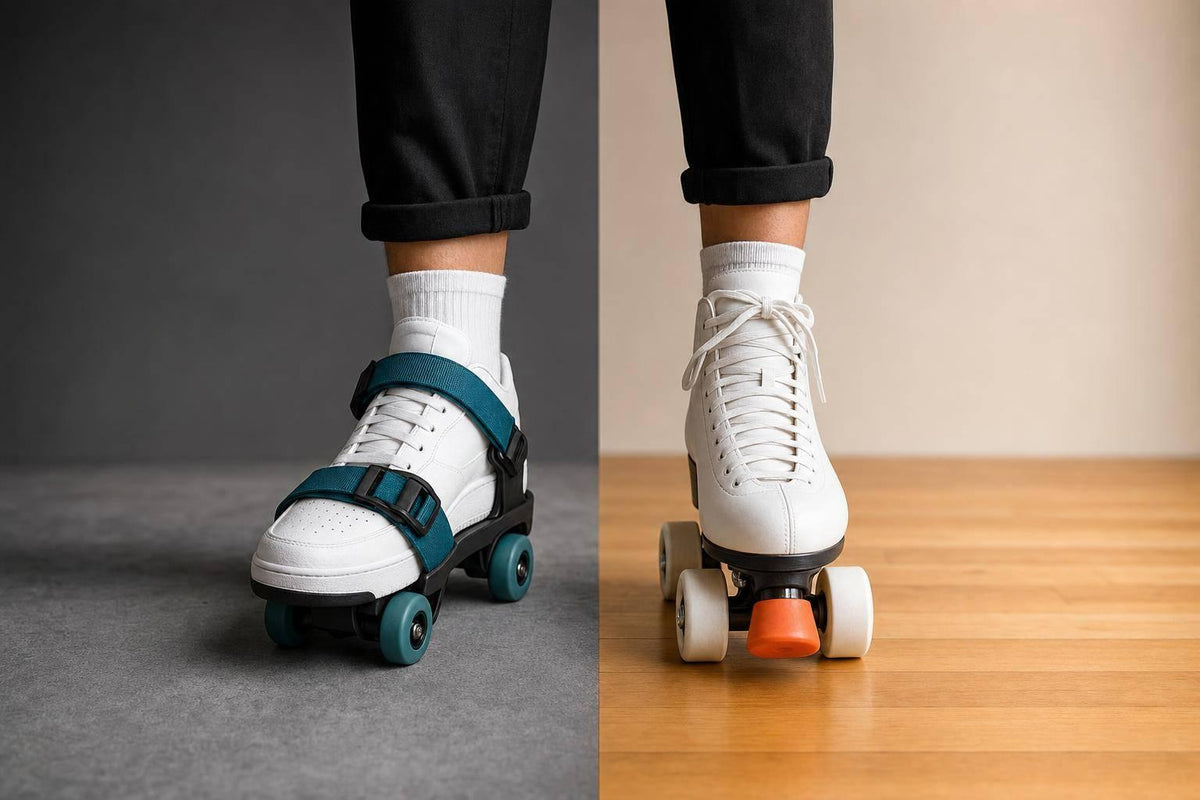
If you want skates for errands, travel, or short rides, I’d go with Wheelfeet. If you want rink time, footwork, or long practice sessions, I’d go with roller skates.
Here’s the short version:
- Wheelfeet strap onto your own shoes
- Roller skates come as a full boot-and-wheel setup
- Wheelfeet cost $199
- Wheelfeet fit about U.S. sizes 6–13
- Roller skates feel more steady at very slow speeds
- Wheelfeet are easier to pack and carry around
- Roller skates make more sense for dance, derby, and rink use
- Wheelfeet make more sense for commuting, campus, trips, and casual cruising
I’d sum it up like this: strap-on wins for day-to-day convenience, while standalone wins for skating as a main hobby. One is easier to toss in a bag. The other gives you a locked-in skate feel.
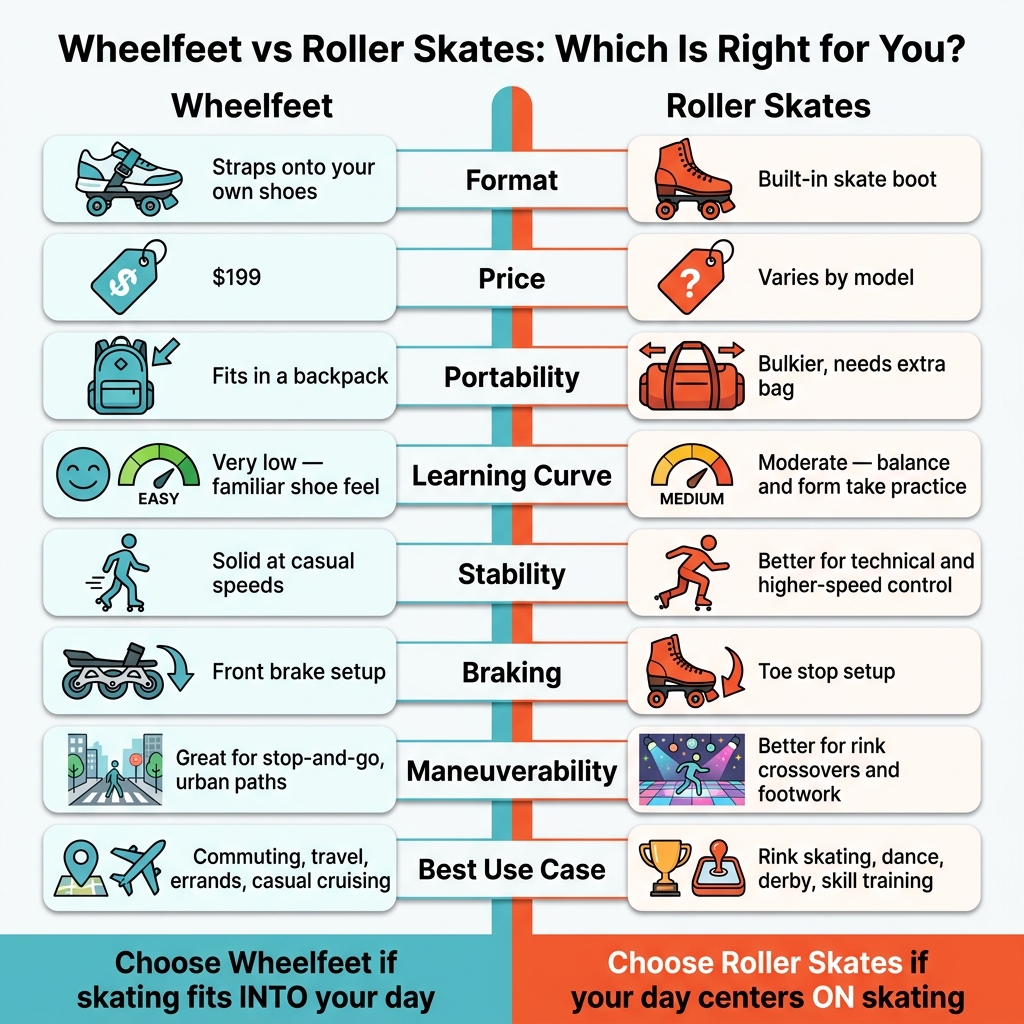
Wheelfeet vs Roller Skates: Side-by-Side Comparison
Wearable Skates | Roller Blades | Skate on Shoes | Wheelfeet | Non-electric
Quick Comparison
| Feature | Wheelfeet | Roller Skates |
|---|---|---|
| Format | Strap onto your shoes | Built-in skate boot |
| Price | $199 | Varies by model |
| Fit | Works with your own shoes | Needs proper skate sizing |
| Learning feel | Simple for casual use | More setup, more skate feel |
| Slow-speed balance | Good once moving | Better when standing still |
| Braking | Front brake setup | Toe stop setup |
| Portability | Fits in a backpack | Bulkier to carry |
| Best use | Travel, errands, short rides | Rink skating, drills, long sessions |
What stood out to me most is how much the format changes the whole experience. With Wheelfeet, you strap in, roll, unstrap, and walk away. With roller skates, you get more support and control, but you’re also carrying a full skate boot. So, yeah, it mostly comes down to one question: Do you want skating to fit into your day, or do you want your day to center on skating? :)
For a quick look at how strap-on skates ride in daily use, a YouTube search like this can help: Wheelfeet review on YouTube
2. Fit, Learning Curve, and Stability
Fit and setup: your own shoes vs a dedicated skate boot
With Wheelfeet, you skip the boot. You strap your sneaker or a sturdy casual boot onto the footbed and cinch the ratchet straps tight. That makes setup simple. It also means the fit won’t be as exact as a skate with a built-in boot. Flat, sturdy shoes tend to work best. For commuting or travel, that’s a nice perk: you’ve got less gear to haul around.
That fit difference changes how fast each option starts to feel normal.
Traditional quad roller skates come with the boot built in. A good quad fit should feel snug, kind of like a secure athletic shoe. Your heel shouldn’t lift when your knees are bent. If you lace from the toes up, you lock the foot in place and help the skate respond in a clean, direct way.
Learning curve for beginners
Quads tend to feel more planted for total beginners. That said, Wheelfeet are still easy to learn for casual riding. The big adjustment is turning and braking. Their 2×2 wheel layout gives new riders a wide base, which helps resist side-to-side tipping. So most people can stand up and roll forward without much drama.
Stability at slow speeds and while moving
Quads feel steadier when you’re standing still or creeping along at low speed. Wheelfeet ask for more active balance, but once you’re rolling, they feel secure. The quad’s wider base spreads your weight more evenly, which helps first-timers stay upright with less effort.
Wheelfeet like a more engaged stance. Think bent knees, weight over the balls of your feet, and a bit more attention. When you ride them that way, they handle well, even on rougher outdoor surfaces like sidewalks with concrete gaps.
That difference in stability leads straight into the next part: which one feels easier to stop, turn, and ride with comfort?
sbb-itb-17ade95
3. Comfort, Braking, and Maneuverability
Comfort during short sessions and daily use
Wheelfeet tend to feel better for short rides and everyday use because you keep your own shoes on. That’s a big deal. You already know how those shoes fit, so there’s no break-in drama or “why does my left foot hate me?” moment.
Roller skates work the other way. They depend on a dedicated boot, and that boot needs to fit well. If it doesn’t, you’ll feel it fast. This comfort edge starts to matter even more once you get into stopping and turning.
Braking and stopping
Quad skates use a toe stop. Wheelfeet use front-mounted brakes.
The stopping motion is similar, but it doesn’t feel the same once you try it. That little shift in feel can change how fast someone gets comfortable with braking, especially in short daily sessions.
From there, the next gap shows up in turning and in how each setup deals with tight spaces and mixed pavement.
Turning, cruising, and moving in tight spaces
Quads feel planted on smooth floors. They like clean, even surfaces.
Wheelfeet, on the other hand, turn more easily on sidewalks and paved paths with cracks or debris. That can make them feel less fussy in the kind of places people use every day, not just on a rink floor.
And yep, that connects straight to portability and day-to-day use.
4. Portability, Use Cases, and Which Format Fits You
Portability and carry-around convenience
Once fit, braking, and stability are clear, portability tends to tip the scales. This is where the strap-on setup wins.
Wheelfeet fit in a backpack or tote. And because they attach to the shoes you already have on, you don't need to lug around a second pair. That's a big deal on days when skating is just one stop on the map.
Traditional roller skates are bulkier. They also usually mean carrying a separate pair of shoes, which makes them less handy for mixed-use days. If you're heading to class, hopping between errands, or walking into a coffee shop after a short ride, that extra gear can feel like a pain.
Best for commuting, casual cruising, travel, and rink skating
Wheelfeet make the most sense when skating is only part of your day. Think a few blocks to class, a boardwalk cruise on vacation, or the last leg of a commute. You skate, unstrap, and walk in. No boot swap. No bag shuffle. Easy.
They fit well for:
- Last-mile trips
- Errands
- Travel days
- Casual cruising
Roller skates make more sense when skating is the plan. A rink session. Dance practice. Derby training. A focused skills session. In those settings, a dedicated boot earns its keep because it's built for that style of use.
Who should pick Snowfeet* Wheelfeet and who should pick roller skates
Pick the setup that lines up with how you actually skate, not how you imagine you'll skate on your best, most organized day :)
| You're a good fit for Wheelfeet if… | You're a better fit for roller skates if… |
|---|---|
| You're a beginner who wants low commitment | You want to practice skills regularly |
| You travel and want to pack light | You skate at rinks or in dance/derby settings |
| You commute or move around campus | You want a dedicated setup for longer sessions |
| You prefer using your own shoes | You're comfortable carrying a separate boot |
| You want a grab-and-go setup | You plan longer, structured skating sessions |
Snowfeet* Wheelfeet are priced at $199, which gives casual riders, families, and anyone skating-curious a simple entry point without a big gear commitment. If that sounds like your lane, Wheelfeet are likely the better match.
5. Final Verdict: Strap-On or Standalone?
For riders picking between strap-on and standalone formats, Snowfeet* Wheelfeet are the more practical pick. They strap onto your own shoes and pack small, which is hard to beat when you're on the move. Roller skates still come out ahead if your main thing is rink sessions, artistic skating, or skill-based training.
Side-by-side comparison table
Side by side, the gap is pretty simple:
| Category | Snowfeet* Wheelfeet | Roller Skates |
|---|---|---|
| Fit | Straps onto your own sneakers | Dedicated boot; needs sizing and break-in |
| Learning curve | Very low; familiar shoe feel from the start | Moderate; balance and form take practice |
| Stability | Solid at casual speeds | Better for technical skating and higher-speed control |
| Comfort | Uses your own broken-in shoes | Depends on fit; padded liners help |
| Braking | Technique-based stopping; front brakes | Toe stops or heel brakes |
| Portability | Fits in a backpack; no extra shoes needed | Bulkier; usually requires carrying a second pair |
| Maneuverability | Great for stop-and-go, urban paths | Better for rink skating, crossovers, and footwork |
| Best use case | Commuting, travel, casual cruising | Rink skating, skill-focused training |
Key points before you buy
One tradeoff matters most: dedicated performance. If you skate at a rink a lot, work on dance moves, or want to build technical skills, a standalone boot gives you more ankle support, a more steady fit, and tighter control. A strap-on setup just doesn't match that as well. And yeah, that edge matters.
The strap-on format shines in a different way. There's no boot swap. You skate, unstrap, and walk away in the same shoes. If skating is the main event, go with roller skates. If skating needs to fit into the rest of your day, go with Wheelfeet.
FAQs
Can Wheelfeet handle rough sidewalks?
Wheelfeet work best on smooth, flat pavement like clean sidewalks, parking lots, and paved park paths.
Their short, compact frame is part of the trade-off. It can catch on cracks, loose debris, and rough asphalt more often than standard inline skates. You’ll feel more bumps and vibration too, so they’re not a great pick for rough or uneven surfaces.
What shoes work best with Wheelfeet?
For the best stability and performance, wear sneakers, athletic trainers, or casual boots with flat, rigid rubber soles and solid ankle and heel support. Basketball shoes and cross-trainers are some of the best picks.
For winter, sturdy winter boots work well for casual outings, while snowboard boots are the better call for slopes. Skip sandals, high heels, flimsy slip-ons, and worn-out sneakers. They’re just asking for a bad time :)
Are Wheelfeet good for beginners?
Generally, no. Wheelfeet usually aren’t the best pick for beginners because they give you less stability and less ankle support than regular skates. A lot of first-time riders also struggle with stopping, balance, and rough ground.
If you do start with Wheelfeet, the non-electric manual model is easier to control than the electric version.











Zanechať komentár
Táto lokalita je chránená testom reCAPTCHA a vzťahujú sa na ňu pravidlá ochrany súkromia a podmienky poskytovania služby hCaptcha.