



















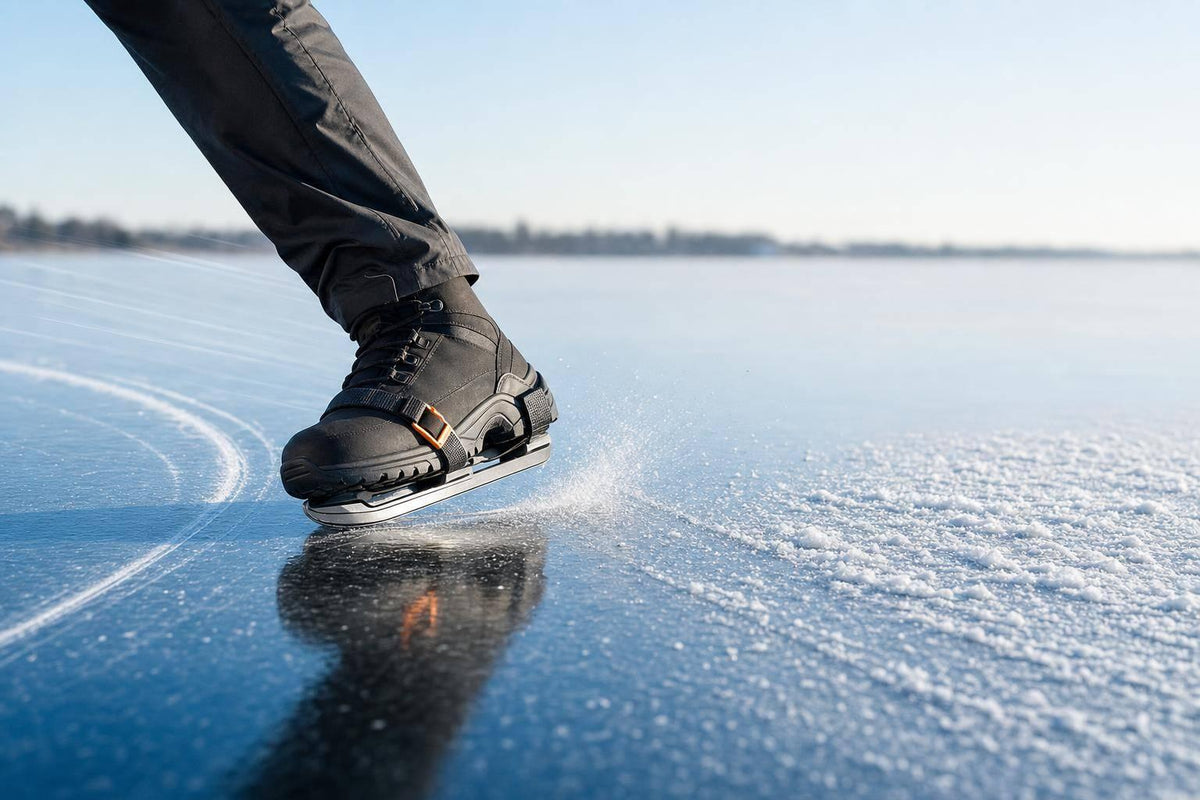
My short take: Icefeet are fun on smooth pond ice, but they’re not the best pick if you want sharp control or easy stops. After 20 days, 60–90 minutes per session, and temps from 18°F to 32°F, I’d say they make sense for casual pond laps, families, and anyone who wants to skate in winter boots without hauling full skate gear.
Here’s the article in one quick hit:
- Best use: flat frozen ponds and rink-style cruising
- Price: $199
- Big plus: small, light, easy to pack, and no boot swap at the shore
- Big downside: rough ice exposes their weak spots fast
- Stopping: takes time to learn; expect 3–5 sessions before it feels under control
- Good ice matters: they feel much better on smooth black ice than on refrozen bumps or snow-dusted patches
- Safer setup: use them only on checked ice, with at least 4 inches of clear ice for skating
- Better options for more control: PRO 50, Skiskates 44 cm, or Skiblades 65 cm
If I put it plain: buy Icefeet for simple winter fun, skip them if you want to progress fast. They’re easy to toss in a bag and fun for relaxed sessions, but if you want more stable turns, stronger stopping, or terrain beyond a pond, you’ll likely outgrow them.
Quick Comparison
| Product | Best For | Boots | Control | Portability | Price |
|---|---|---|---|---|---|
| Icefeet | Frozen ponds, rinks | Winter boots/shoes | Basic on smooth ice | Very easy to carry | $199 |
| Skiskates 44 cm | Ski slopes, park | Ski or snowboard boots | More precise on snow | Backpack-friendly | $460 |
| Snowfeet PRO 50 cm | Easy slopes, casual snow use | Winter or snowboard boots | More stable on snow | Easy to pack | $299 |
| Skiblades 65 cm | Downhill fun, carving | Ski or snowboard boots | Best control of the group | Still compact | $590 |
So, if you want the lowest-fuss pond setup, Icefeet fit that job well. If you want more than that, there’s a better tool for it.
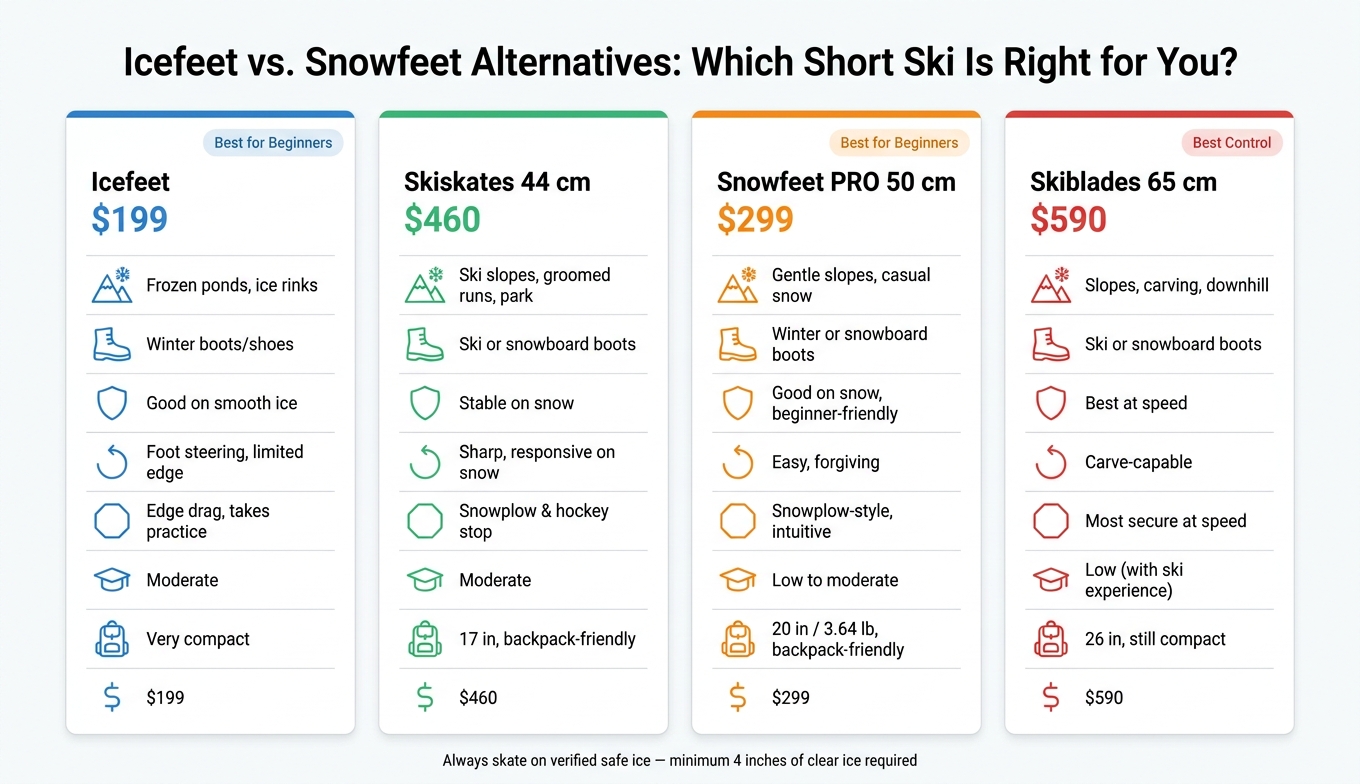
Icefeet vs. Snowfeet Alternatives: Which Short Ski Is Right for You?
How Icefeet Performed on Frozen Ponds
Glide, speed, and stability on smooth vs. rough ice
On clean, glassy pond ice, Icefeet glided well. A few pushes went a long way, and the wider base felt steadier than a single-blade skate. That was a big plus for riders who don’t feel at ease on regular skates.
Rougher ice changed the feel fast. On refrozen ruts and choppy patches, the short twin blades chattered and caught. That meant slowing down and picking lines with more care. A light layer of snow was still workable, but it took stronger pushes and a bit more focus to keep moving cleanly. That smooth, steady glide on good ice made the turning and stopping test more telling.
Turning, stopping, and the real learning curve
Wide, sweeping turns felt natural from the first session. Step turns also worked well at low to medium speeds. You could do some basic carving too, but there was a limit. The short blades, plus the softer flex of winter boots, cut down edge hold, so tight carves just weren’t practical.
Stopping took the most work. The most steady option was coasting to a stop by flattening both blades. A gentle snowplow also worked at lower speeds once riders got a little practice in. For most beginners, it took 3 to 5 sessions before stopping felt under control.
Comfort, boot fit, and portability
Comfort was good for 45- to 90-minute sessions if the boots were right. Medium-stiff, insulated winter boots with a firm heel counter and a snug ankle fit worked best. Softer or bulkier boots let the foot move too much, which led to heel rubbing and sore spots. If the straps were too tight, instep numbness showed up fast. A few minutes spent dialing in the strap tension made a big difference.
Icefeet don’t have the built-in ankle support of skate boots made for the job. On smooth ice at casual speeds, that was fine. On rough or uneven sections, softer boots let the ankle flex more than you’d want, which pushed riders to slow down.
Portability was a clear win. They’re compact, light, and easy to carry, and you don’t need to swap boots at the shoreline. That boot-based comfort tradeoff is a big reason Icefeet fit casual pond use better than hard, aggressive skating.
On natural ice, the next thing to look at is where Icefeet stay safe and where they stop making sense.
Safety Limits and Best-Use Conditions on Natural Ice
Ice thickness, surface quality, and when to stay off
Icefeet don’t change ice safety. Use at least 4 inches of clear ice for skating and 5–6 inches for casual group use. That’s the floor, not a green light to relax. During our 20-day test, we checked more than one spot before every session, especially as we moved farther from shore.
Clear blue or black ice is the strongest. White, gray, or milky ice is weaker. Skip slush, pooling water, cracks, and soft shore ice. Ice near inlets, outlets, docks, reeds, or rocks freezes unevenly and gets thin faster during mild weather.
Stick to evenly frozen center ice. If a spot sounds hollow underfoot, get off it. A deep, hollow sound when you tap the ice is a sign to back off slowly. And if the pond is white, gray, slushy, cracked, or affected by current, stay off. Simple as that.
Protective gear and risk factors with double-blade skates
Safety comes before performance on natural ice. Icefeet’s wider base does feel more stable than narrow skate blades on smooth, clear ice. That part is true. But more stable does not mean fall-proof.
Natural pond ice changes fast. One day it’s smooth. Next day it’s a minefield. Frozen footprints, refrozen slush ridges, and wind-blown snow patches can make one blade ride up while the other stays flat. That’s how you get a sideways spill or a hard, sudden catch.
Bring the right gear:
- Wear a helmet
- Carry ice picks on a neck cord
- Skate with a partner
- Bring a fully charged phone
- Tell someone your plan before you head out
Once the ice passes those safety checks, the next question is control: how Icefeet stack up against Snowfeet* short-ski options.
Snowboarder tries Snowfeet* | Which Snowfeet* Short Ski is the Best? | Snowblades 44, 65, 99 Review
sbb-itb-17ade95
Icefeet vs. Snowfeet* Alternatives: Control, Progression, and Fit
Once the ice is safe, the next question is simple: are Icefeet the right pick, or does a Snowfeet* model give you more control?
| Icefeet | Skiskates 44 cm | Snowfeet PRO 50 cm | Skiblades 65 cm | |
|---|---|---|---|---|
| Best terrain | Frozen ponds, ice rinks | Ski slopes, groomed runs, park features | Gentle slopes, casual snow play | Slopes, carving, downhill fun |
| Boots | Winter boots/shoes (US 6–13) | Ski or snowboard boots only | Winter boots or snowboard boots (US 6–13) | Ski or snowboard boots |
| Stability | Good on smooth ice, less secure on rough ice | Stable on snow | Good on snow, beginner-friendly | Best at speed |
| Turning | Foot steering on ice, limited edge bite | Sharp, responsive on snow | Easy, forgiving | Carve-capable |
| Stopping | Skate-style edge drag; takes practice | Snowplow and hockey stop on snow | Snowplow-style, intuitive | Most secure stops at speed |
| Learning curve | Moderate on ice | Moderate with ski boots | Low to moderate | Low with ski experience |
| Portability | Very compact | 17 in, fits in a backpack | 20 in / 3.64 lb, fits in a backpack | 26 in, still compact |
| Price | From $199 | From $460 | From $299 | From $590 |
Icefeet vs. Snowfeet* Skiskates 44 cm
Icefeet fit ponds and rinks. Skiskates 44 cm fit ski areas. That’s the split.
Icefeet are easier for quick pond sessions. You strap them onto regular winter boots and go glide on flat ice. Nice and simple.
Skiskates 44 cm are a different animal. They need ski or snowboard boots, but in return you get sharper control, real snowplow stops, and access to groomed runs and park features. If you already own ski boots, that trade can feel like a no-brainer.
So, for local pond use, Icefeet are the easier pick. For ski areas, Skiskates 44 cm are the stronger option.
If you want that easy winter-boot setup on snow, though, PRO 50 changes things quite a bit.
Icefeet vs. Snowfeet* PRO 50 cm and Skiblades 65 cm
Snowfeet PRO 50 cm are an easier step up from Icefeet for riders who want mellow snow use with winter boots. You keep the simple boot setup, but gain more stability on snow. And that matters. More stability usually means easier balance and a gentler learning curve. For beginners who want to try easy slopes without buying ski boots, PRO 50 makes a lot of sense.
Skiblades 65 cm bring the most control and room to improve: more speed, stronger carving, and more secure stopping. They do need ski or snowboard boots. But if you already have those, Skiblades open up groomed runs in a way Icefeet just can’t.
Here’s the short version:
- If you already own ski or snowboard boots, Skiskates 44 cm and Skiblades 65 cm are the more capable picks.
- If you don’t, Icefeet or PRO 50 are simpler and lower-cost ways to get started, especially for pond use or a small local hill.
Where long skis still win, and why Snowfeet* fits casual riders better
Full-length skis still win for high-speed racing, deep powder, and technical terrain. No surprise there. That’s their home turf.
But plenty of riders aren’t chasing that. They show up a few times each season, want gear that’s easy to carry, and don’t want to wrestle with a huge setup in the parking lot. That’s where Snowfeet* stands out.
PRO 50 and Skiblades 65 both go beyond pond-only use while staying backpack-friendly. They also give you more terrain options, better control, and a clearer path to getting better than Icefeet, without the bulk of long skis.
That leaves a pretty clean choice: Icefeet for pure pond convenience, or Snowfeet* when control and progression matter more.
Final Verdict: Are Icefeet Worth Buying for Frozen-Pond Fun?
After 20 days on frozen ponds, Icefeet are worth buying if you care more about winter-boot ease than control.
That was the big takeaway from this pond test. On smooth, safe ice, they held up well and felt easy to use. You can toss them in a bag, head to the pond, and skip the whole ski-boot routine. That part is great.
But there’s a catch. That ease comes with less control. Turning feels limited. Stopping takes some practice. And once the ice gets rough, those weak spots show up fast.
Safety still comes first. That convenience only matters on verified safe ice. Check ice thickness and surface quality before you step out, and wear the right protective gear.
Best for: casual pond sessions, families, and winter-boot convenience
Icefeet make the most sense for people who hit a local pond a few times each season and want something simple that fits in a bag. If you don’t want to buy ski boots, that’s a big plus.
At $199, they’re a solid entry point for families that want an easy winter activity without a steep learning curve.
Skip Icefeet if you want more control, more terrain, or faster progression
If you want sharper turns, steadier stops, or more terrain, skip Icefeet and go straight to a Snowfeet* option.
Here’s the short version:
- PRO 50 for more versatility
- Skiskates 44 cm for ski-boot control
- Skiblades 65 cm for maximum stability
If your goal is to cruise around a smooth pond in winter boots and keep things simple, Icefeet can make sense. If you want to push harder, you’ll outgrow them fast.
FAQs
Are Icefeet good for beginners?
Yes. Icefeet are a strong pick for beginners if you care more about stability and ease of use than sharp, high-speed skating.
The big reason is simple: their double-blade design feels less shaky than standard single-blade skates. That can make your first time on the ice feel a lot less sketchy. Instead of fighting for balance right away, you get a steadier base under your feet.
They also strap onto your own sturdy winter boots, which gives you a fit that feels more familiar and comfortable. That matters more than people think. If you already trust your boots, stepping onto the ice feels less like learning from scratch and more like easing into it.
Icefeet make the most sense for casual pond skating, family outings, and low-fuss fun on the ice. So if your goal is to enjoy the day, stay upright, and skip the drama, they’re a pretty smart place to start.
What boots work best with Icefeet?
Icefeet work best with stiff, waterproof winter boots that offer solid ankle support and a flat sole. Yes, the adjustable strap-on bindings fit many shoes and boots in U.S. sizes 4.5 to 14.5. But here’s the plain truth: firmer boots do a much better job of keeping your foot locked in place.
That matters for steering and edge control. If your boot flexes too much, your foot can shift around, and things start to feel a little loose. Not ideal when you’re trying to stay smooth out there :)
If you want more control and support, especially once you start moving onto slopes, snowboard boots are a strong step up from soft winter boots. They hold your foot more securely and give you a steadier feel under pressure.
When should I choose Snowfeet* instead?
Choose Snowfeet* over Icefeet when you want more than smooth, flat ice. Icefeet work best on clean surfaces like skating rinks or backyard ponds.
Snowfeet* PRO 50 cm and Skiskates 44 cm do a better job in mixed winter conditions. That includes snowy trails, light powder, and rough natural ice. You still get the same big perk: they stay compact, easy to pack, and simple to use.











Zanechať komentár
Táto lokalita je chránená testom reCAPTCHA a vzťahujú sa na ňu pravidlá ochrany súkromia a podmienky poskytovania služby hCaptcha.