



















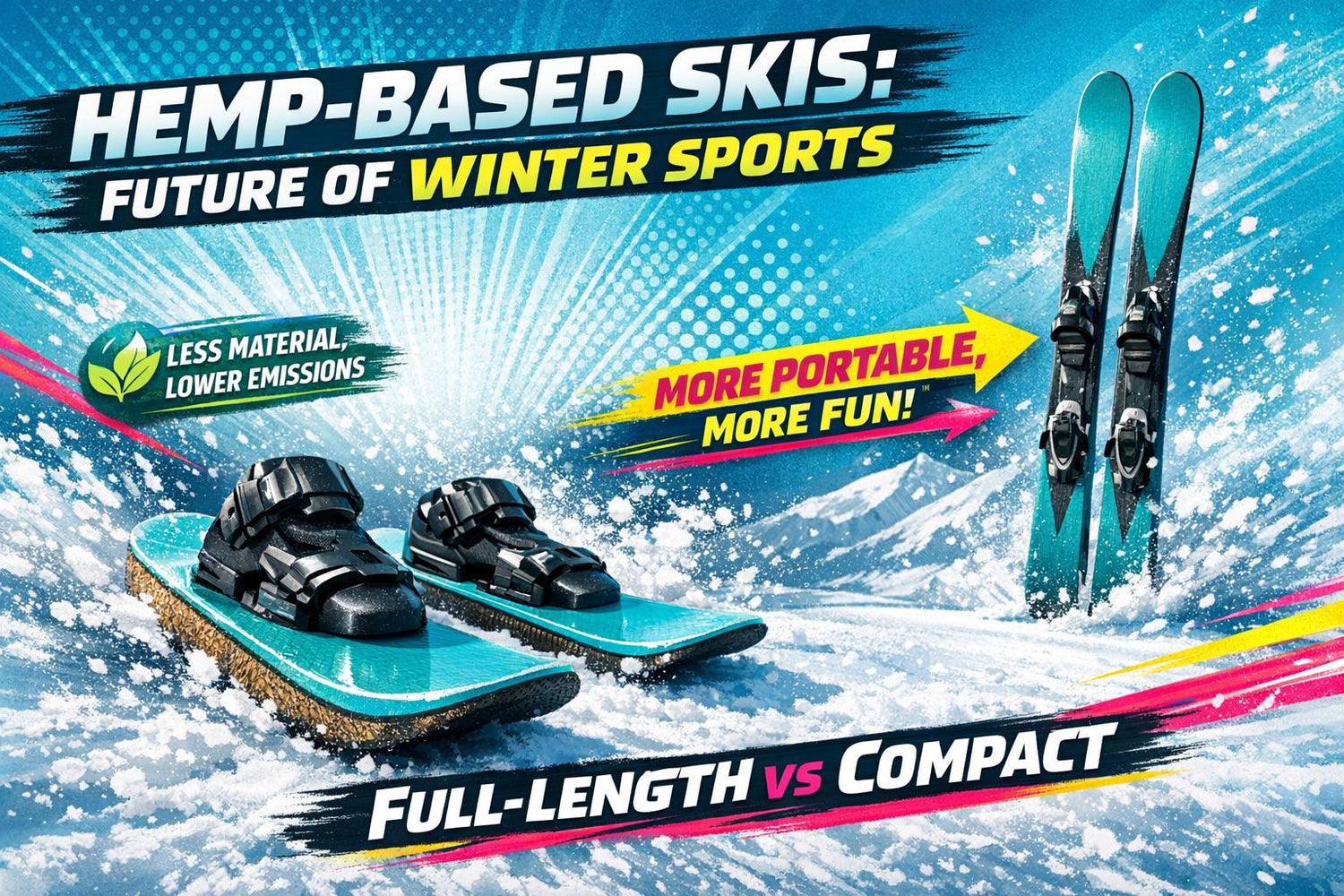
Hemp is shaking up the ski world, offering a greener alternative to traditional materials like fiberglass. At the same time, Snowfeet*, a Czech-based company, is rethinking winter sports gear with compact, eco-friendly short skis that fit in a backpack. Here’s the deal:
- Hemp Skis: Use renewable fibers, reduce CO₂ emissions, and offer smooth rides on uneven terrain. Best for high-speed runs and deep powder.
- Snowfeet*: Short skis (44–120 cm) use fewer materials, work with regular boots, and are perfect for quick turns, tricks, and casual riders. Prices start at $196.
Both options aim to lower the environmental impact of skiing, but they cater to different needs. Hemp skis are ideal for alpine enthusiasts, while Snowfeet* focuses on portability and fun for resort-goers. Let’s break it down further.
Sustainability and Carbon Footprint
Hemp-based skis and Snowfeet* are shaking up the ski industry with their eco-conscious designs. Hemp fibers, which are renewable and absorb CO₂, provide a greener alternative to the petroleum-based composites used in traditional skis. The downside of those conventional materials? They make recycling much harder.
Snowfeet*, on the other hand, takes a different route by focusing on compact, locally produced skis. Their designs range from just 44 cm (17 inches) to 120 cm (47 inches), using far fewer materials compared to standard 160 cm skis. Plus, manufacturing in the Czech Republic helps reduce shipping emissions. Snowfeet* also incorporates sustainability into their premium models with certified sustainable wood cores, while their PRO line uses fiberglass-reinforced polyamide. According to Snowfeet*, this material boosts durability:
"Snowfeet PRO are more durable than skis with woodcore. Trust me, we make both. The main reason is the material - fiberglass reinforced polyamide." - Snowfeet*
This increased durability means Snowfeet* products last longer, reducing waste over time. By combining reduced material use with extended product lifespans, Snowfeet* stands out in an industry that’s only beginning to embrace sustainability.
Other brands are making progress, though often on a smaller scale. For instance, in February 2026, Atomic reported cutting its Scope 2 emissions by 90% and lowering the carbon footprint of raw materials for its Maverick ski line by 24%. Similarly, Extrem Ski Co's "Project 83 Eco" ski achieved a carbon footprint of less than 28.8 kg of CO₂ per pair by using 70% recycled ABS and 50% recycled bases. While these are positive steps, Snowfeet* combines material efficiency and local production in a way that sets it apart.
Here’s a quick comparison of sustainability approaches across different ski types:
| Approach | Method | CO₂ Impact | End-of-Life |
|---|---|---|---|
| Hemp/Bio-Based Skis | Replace petroleum-based materials with renewables | Up to 30% lower per component | Higher recyclability potential |
| Snowfeet* Products | Compact design with reduced raw materials and local production | Lower due to reduced material volume | Less waste volume by design |
| Traditional Skis | Use of standard synthetic composites | High (due to virgin petroleum-based materials) | Largely landfilled |
Performance Characteristics
Hemp-based skis are known for their ability to naturally dampen vibrations, providing a smoother ride even on uneven terrain. However, they’re typically produced in standard lengths, which can limit their agility in newer, more compact designs. This is where Snowfeet* stands out. Their compact ski designs completely rethink traditional formats, delivering unmatched maneuverability.
Instead of tweaking the conventional long ski, Snowfeet* has taken a bold approach by reimagining the concept altogether. Their lineup ranges from 44 cm (around 17 inches) to 120 cm (about 47 inches), allowing for almost instant responsiveness. Whether it’s sharp turns, spins, or jumps, these skis make it easier and less effort-intensive. They’re also perfect for navigating tricky terrain like moguls or narrow forest trails. As Zbyněk, the founder of Snowfeet*, puts it:
"In my opinion, Skiskates is the best product for slopes we developed so far. I love how easy they are to ski and skate and how many different kinds of tricks I can perform without much effort and almost no restrictions."
The Snowfeet* range is thoughtfully designed to cater to different riding styles. Their wood-core models (44 cm, 65 cm, and 99 cm) are built for high-speed carving on groomed slopes, while their fiberglass flex-core models (50 cm and 100 cm) offer a softer, more forgiving experience, making them ideal for casual riders and beginners. For powder enthusiasts, the 99 cm and 100 cm models can handle up to 10 cm of light powder, while the ultra-agile 44 cm Skiskates are perfect for pulling off tricks on groomed trails. This combination of performance and eco-conscious design gives Snowfeet* a standout position in the market.
Of course, shorter skis do come with a trade-off: they’re less stable at high speeds compared to longer skis. As user Brad Tolin notes: "Only trade‐off is at higher speeds, where longer skis still feel more stable - but for overall fun and maneuverability, these are hard to beat." With a stellar 4.9/5 rating from more than 5,500 verified reviews, Snowfeet* has clearly struck a chord with recreational riders, offering a fun and engaging experience on the slopes.
Up next, we’ll dive into how these innovative designs also contribute to material efficiency and sustainability.
Material Use and Design Efficiency
Standard hemp-composite skis, typically over 150 cm in length, rely on layered wood cores like Paulownia (density: 270–310 kg/m³), wrapped in natural fibers and sealed with resin. In contrast, Snowfeet* Skiskates measure just 44 cm - only about 25% the length of a standard 180 cm ski. This compact design slashes the amount of raw materials needed and makes transportation a breeze.
Full-length skis - whether lightweight or not - often require roof racks, oversized luggage fees, or bulky ski bags. Snowfeet* products, on the other hand, fit neatly into a regular backpack. As Snowfeet* puts it:
"Forget heavy equipment and cumbersome long skis. Welcome to the world of Snowfeet* - the revolution in winter sports."
This portability reduces the need for specialized transport, adding to the environmental benefits of their efficient design.
The design philosophies behind these products couldn’t be more different. Hemp-based skis are built for speed and all-mountain performance, using complex composite layers to handle powder and deliver precise control. Snowfeet* takes a simpler, more minimalist route. Their products feature a sustainable wood core for riders who want performance or a fiberglass flex core for a softer, playful feel. This approach leads to easier manufacturing, shipping, and everyday use. Here’s how they compare:
| Feature | Hemp-Based Full-Length Skis | Snowfeet* Short Skis/Skiskates |
|---|---|---|
| Typical Length | 150 cm+ | 44 cm – 120 cm |
| Transport | Requires roof racks or large ski bags | Fits in a standard backpack |
| Core Materials | Paulownia, Bamboo, Ash with natural fibers | Sustainable wood or fiberglass flex core |
| Design Goal | Stability, carving, deep powder | Agility, portability, accessibility |
| Boot Compatibility | Dedicated ski boots required | Works with ski, snowboard, or winter boots |
The everyday convenience of Snowfeet* - no need for special bags or extra fees - makes it a practical choice that full-length skis just can’t compete with. Their compact size and versatility are game-changers for winter sports enthusiasts.
sbb-itb-17ade95
Pros and Cons
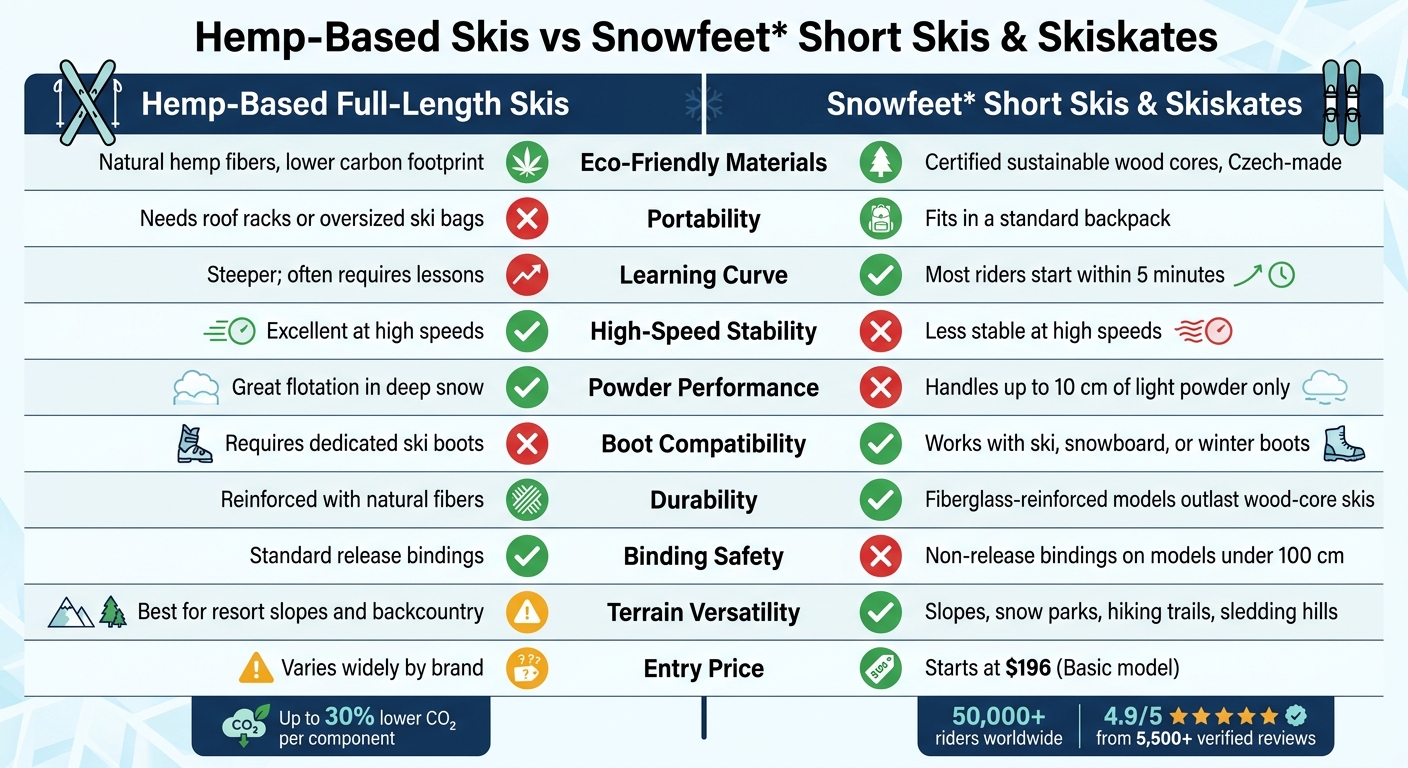
Hemp Skis vs Snowfeet: Eco-Friendly Winter Sports Gear Compared
Here’s how hemp-based full-length skis stack up against Snowfeet* short skis and skiskates, focusing on performance, convenience, and eco-friendliness:
| Hemp-Based Full-Length Skis | Snowfeet* Short Skis & Skiskates | |
|---|---|---|
| Eco-Friendly Materials | ✅ Made with natural hemp fibers, reducing carbon footprint | ✅ Certified sustainable wood cores, crafted in the Czech Republic |
| Portability | ❌ Requires roof racks or oversized ski bags | ✅ Compact enough to fit in a standard backpack |
| Learning Curve | ❌ Steeper; often requires lessons to master | ✅ Most users can start riding within 5 minutes |
| High-Speed Stability | ✅ Excellent stability at high speeds | ❌ Less stable when going fast |
| Powder Performance | ✅ Great flotation in deep snow | ❌ Designed for groomed snow; handles up to 10 cm of light powder |
| Boot Compatibility | ❌ Needs dedicated ski boots | ✅ Works with ski boots, snowboard boots, or even regular winter shoes |
| Durability | ✅ Reinforced with natural fibers for strength | ✅ Fiberglass-reinforced models claim better durability than traditional wood-core skis |
| Binding Safety | ✅ Uses standard release bindings | ❌ Non-release bindings on models shorter than 39 inches (100 cm) |
| Versatility of Terrain | ⚠️ Best for resort slopes and backcountry | ✅ Versatile: slopes, snow parks, hiking trails, and sledding hills |
| Entry Price | ⚠️ Price varies widely depending on the brand | ✅ Starts at $196 for the Snowfeet* Basic model |
Hemp-based skis shine in areas like high-speed stability and deep powder performance, delivering a classic alpine experience with an eco-conscious edge. Their use of natural fibers significantly cuts down on synthetic materials, which is a step forward for environmentally conscious skiers.
On the other hand, Snowfeet* short skis tackle issues that traditional skis can’t. With over 50,000 riders worldwide and a stellar 4.9/5 rating from more than 5,500 verified reviews, their popularity speaks volumes. Whether it’s the ease of use, portability, or versatility, Snowfeet* offers a convenient and fun alternative for resort-goers and casual winter sports enthusiasts. These differences highlight how Snowfeet* is shaking up the winter gear market in ways that traditional skis, hemp-based or not, simply can’t match.
Conclusion
Hemp-based skis are shaking things up in the ski world. By swapping out fiberglass and carbon fiber for natural hemp fibers, manufacturers are cutting down on the environmental impact of production while still delivering top-notch performance - whether you're carving up groomers or floating through powder. It's a solid step forward for skiers who care about the planet.
But sustainability in winter sports isn’t just about materials - it’s also about using fewer resources overall. That’s where Snowfeet* stands out. Their skis, ranging from just 44 cm to 120 cm, use significantly less raw material compared to a standard 170 cm alpine ski. Plus, every pair is handmade in the Czech Republic, which helps keep transportation emissions low. On top of that, their premium models combine performance and eco-friendliness with certified sustainable wood cores.
These two approaches cater to different needs. Hemp-based skis push traditional alpine skiing toward greener practices, while Snowfeet* is reimagining the sport with compact, versatile designs. With over 50,000 riders worldwide and a stellar 4.9/5 rating from more than 5,500 verified reviews, Snowfeet* proves that smaller, resource-efficient gear can still deliver an amazing ride. It’s also easier on the wallet, with their 50 cm PRO model starting at $299.
For most skiers hitting the resorts, Snowfeet* offers a more practical, portable, and eco-friendly option than high-end hemp skis. But for those chasing the thrill of high-speed runs and deep powder, hemp-based skis point to a greener future for traditional ski manufacturing.
FAQs
Are hemp skis actually recyclable?
The recyclability of hemp-based skis isn’t confirmed yet.
If you’re looking for a more eco-conscious and versatile option, check out Snowfeet*. These compact ski alternatives are made with certified sustainable wood cores and reinforced with durable fiberglass. Plus, they’re designed to fit regular winter or snowboard boots, so you can skip the hassle of bulky, specialized gear. This clever design makes them portable, environmentally friendly, and a fun way to enjoy the slopes.
How do Snowfeet* work with regular boots?
Snowfeet* feature a universal binding system that lets you attach them directly to sturdy winter boots or snowboard boots. This means you can skip the bulky, specialized ski boots altogether. Just choose the appropriate binding type when you order, and you’ll be ready to hit the slopes without the usual hassle or cost of traditional ski equipment.
Which is better for powder: hemp skis or Snowfeet*?
Choosing between hemp skis and Snowfeet* for powder skiing largely depends on what you’re looking for. Snowfeet* shines when it comes to versatility. Their 99 cm Powder model features a wider design, making it ideal for better flotation on deep snow. Meanwhile, the 120 cm Short Skis are perfect for tackling backcountry terrain.
These compact skis outperform traditional skis that are over 150 cm long. Thanks to their sustainable wood-core construction, they offer a mix of agility and portability that’s hard to beat, giving you a smoother and more enjoyable powder experience.











Zanechať komentár
Táto lokalita je chránená testom reCAPTCHA a vzťahujú sa na ňu pravidlá ochrany súkromia a podmienky poskytovania služby hCaptcha.