



















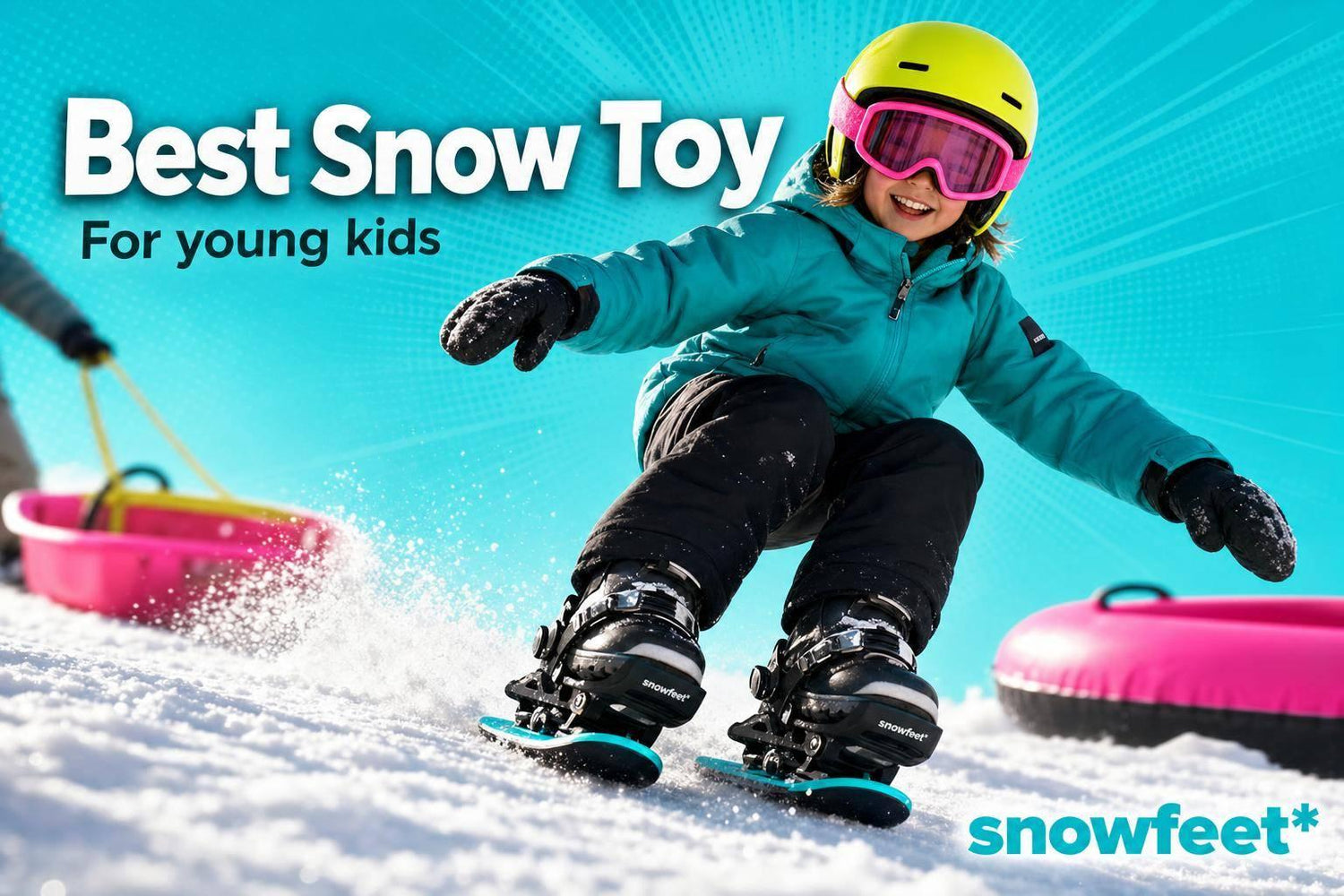
If I had to make this simple: get a toddler pull sled for kids under 3, a snow tube for easy hill fun, and Snowfeet MINI KIDS for kids who are ready to stand, steer, and learn. That’s the short answer.
Here’s the big picture in plain English:
- Under 3: use a toddler pull sled on flat ground only
- Ages 4–6: a snow tube works for fun; MINI KIDS works for learning
- Ages 6–8: Snowfeet MINI KIDS is the best all-around first pick
- Older kids and parents: PRO 50 cm makes more sense
- Kids with ski or snowboard boots: Skiskates 44 cm can work, but they cost about $460
- Regular resort ski school days: standard kids skis still fit best
A few facts stand out:
- Snow tubes can hit up to 25 mph
- MINI KIDS fits US kids’ 10 to adult 6
- PRO 50 cm starts around $299
- MINI KIDS costs about $250
So, if you want the easiest path, I’d think about it like this:
- Pull sled for very small kids
- Snow tube for pure sledding fun
- Snowfeet if you want your kid to learn control
- Kids skis if resort trips become a regular part of winter
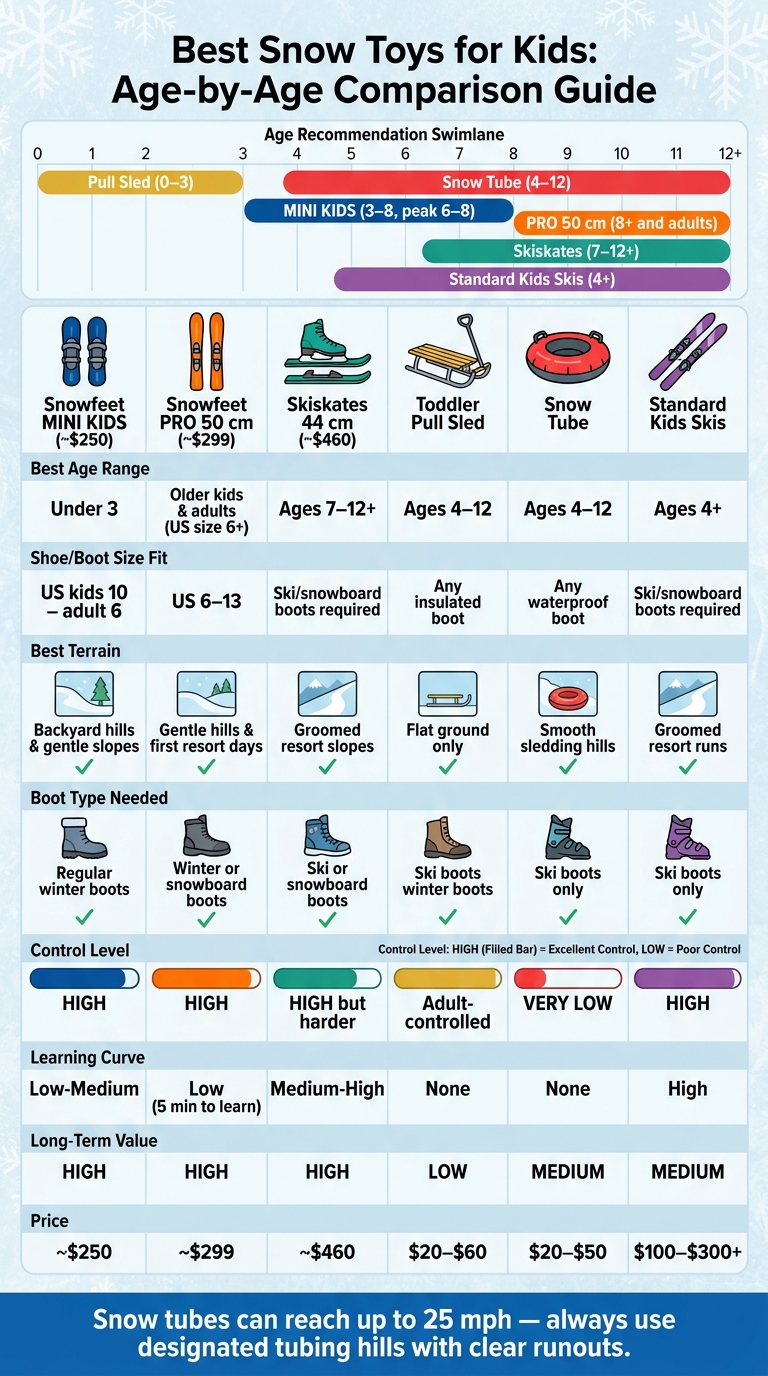
Best Snow Toys for Kids: Age-by-Age Comparison Guide
How to Choose the Best Skis for Kids
Quick Comparison
| Option | Best Age/Stage | Best Use | Boots Needed | Control |
|---|---|---|---|---|
| Snowfeet MINI KIDS | 6–8; some 3–5 with hands-on help | Backyard hills, gentle slopes | Regular winter boots | High |
| Snowfeet PRO 50 cm | Older kids and adults | Gentle groomed hills, first resort days | Winter boots or snowboard boots | High |
| Skiskates 44 cm | 7–12+ with decent balance | Groomed snow | Ski or snowboard boots | High, but harder |
| Toddler Pull Sled | Under 3 | Flat ground, short walks | Regular winter boots | Adult-controlled |
| Snow Tube | About 4–12 | Sledding hills, tubing lanes | Regular winter boots | Low |
| Standard Kids Skis | Kids ready for lessons | Resort runs and ski school | Ski boots | High |
If you’re buying for one season only, go simple. If you want gear that still makes sense as your kid gets older, Snowfeet sits in the middle: more control than tubes, less setup than full ski gear, and less “uh, why did I buy all this?” by February :)
1. Snowfeet* MINI KIDS
Age Fit
Snowfeet* MINI KIDS fit US kids' 10 to adult 6 (EU 27–38; foot length about 6.7–9.1 in / 17–23 cm). That size range gives kids some room to grow, which parents tend to love.
For age, they work best for kids 6–8 who are riding on their own. Kids 3–5 can use them too, but they’ll need close, hands-on help. They’re not for children under 3.
Terrain Match
These work best on packed, groomed snow with a clear runout. Think smooth bunny-slope snow, not chopped-up late-day stuff.
Skip:
- Powder
- Ice
- Rough patches
With short skis like these, smooth snow makes a big difference. Control matters more than speed.
Boot Compatibility
MINI KIDS strap onto regular winter boots, so there’s no need for ski boots. That’s a big plus if you don’t want to buy extra gear for a kid who may outgrow it by next winter :)
The adjustable bindings work best with:
- Insulated, waterproof winter boots
- Firm soles
- Good ankle support
Avoid soft moon boots. They make edging and steering tougher. Smaller snowboard boots can work too, but larger ones won’t fit the MINI KIDS bindings.
Control and Supervision
MINI KIDS come with metal ski edges for stopping and a built-in heel brake to help manage speed. That setup helps kids pick up stopping and turning fast.
Still, don’t treat them like a toy. Kids need active adult supervision. For younger children, stay within arm’s reach at first. As their balance gets better, close visual supervision is usually enough. A ski helmet is a must. Wrist guards are also a smart add-on for kids who tend to throw their hands out when they fall.
If MINI KIDS starts to feel too short or a bit limiting, the next move is PRO 50 cm.
2. Snowfeet* PRO 50 cm
Age Fit
The PRO 50 cm is the next step up from MINI KIDS. It fits US shoe sizes 6–13 (EU 38–47), so it works for bigger kids and for parents who want to ride right alongside them. That makes family outings a lot simpler. Older kids and adults can use the same setup on the same hill, without swapping to a whole new type of gear.
Terrain Match
That extra length helps most on groomed hills, neighborhood sledding spots, and first resort trips. At 20 inches, the PRO 50 cm feels more steady on groomed runs and mixed snow than shorter models. It’s a nice middle ground if your family wants a bit more balance without making things feel big or awkward.
Boot Compatibility
The PRO 50 cm works with regular waterproof winter boots or snowboard boots, which means you can skip ski boot rentals. That’s a win for families. Just strap them onto winter boots or snowboard boots and go. One small thing to check first: bulky boots can affect fit, so it’s smart to test them before you head out.
Control and Supervision
Compared with MINI KIDS, the PRO is easier for bigger riders to balance and steer. It comes with steel edges, a heel brake, and a stable stance, which helps make those first carving turns feel less shaky. Snowfeet says most people can learn the basics in about 5 minutes.
Kids still need close supervision, more so on busy slopes. At resorts, the metal edges and secure bindings make the PRO a better match than toy-style sleds.
3. Snowfeet* Skiskates 44 cm
Age Fit
If MINI KIDS or PRO 50 cm feels too small, Skiskates 44 cm are the next move. They fit kids around 7–12 best, mainly those who already have some balance from skating, rollerblading, or beginner skiing. For younger kids, MINI KIDS is still the safer bet.
Terrain Match
These do best on firm, packed snow. Think gentle sledding hills, bunny slopes, and other smooth runs without much traffic. Powder and rough, chopped-up backyard snow? Yeah, skip that.
Boot Compatibility
There’s one big thing to plan for: unlike MINI KIDS and PRO 50 cm, Skiskates 44 cm need ski boots or snowboard boots. So families can’t just grab them and go unless they already have the right setup.
Control and Supervision
For older kids, these feel more like actual riding gear than a toy. That’s part of the fun. It also means they ask for more control.
Skiskates are harder to stop and turn than longer skis, so it’s smart to start on flat ground or a very gentle slope. Keep the first runs short. A helmet, gloves, and snow pants are a must, and knee or wrist guards can help first-timers a lot.
These work best when a parent is right there teaching, not standing off to the side like it’s a soccer game :) A little hands-on help goes a long way.
Skiskates require ski or snowboard boots and sit at the premium end at about $460. So, they’re a premium, skill-based pick for families weighing fun against ease of use.
4. Toddler Pull Sled
For the youngest kids who aren’t ready to steer, a pull sled is the simplest winter pick.
Age Fit
Toddler pull sleds work best for kids who are usually under preschool age. Age helps, but readiness matters more. Your child should be able to sit steady, hold their head and neck well, and stay okay in the cold.
So, this setup makes sense for toddlers who can sit safely but aren’t ready for balance gear yet. If your child is ready to steer, Snowfeet MINI KIDS is the next step.
Terrain Match
This type of sled is best on flat ground or mild slopes. Use a pull sled only on flat or gently rolling ground. Never use it for downhill rides.
Good places to use one include:
- Backyard loops
- Quiet park paths
- Freshly plowed sidewalks
At resorts, stick to groomed walkways and stay well away from runs and lift traffic.
Boot Compatibility
You don’t need bindings or special boots. Just use insulated, waterproof boots with good traction.
Control and Supervision
This is more of a transport tool than a toy, so adult control matters most. An adult should stay in full control at all times. That means walking only, keeping one hand on the rope, and never letting the sled coast downhill.
Look for a sled with:
- High sides
- A tall back
- An easy-to-buckle harness
That setup helps keep your toddler snug and secure while you do the work :)
sbb-itb-17ade95
5. Snow Tube
A snow tube is a blast if your kid wants simple downhill fun. But compared with Snowfeet*, it doesn’t do much for kids who want to steer, stop, and build skills.
Age Fit
Snow tubes tend to work best for kids around 4–12 years old, based on the tube size, the child’s balance, and how steep the hill is. Kids under 3 should stick with a pull sled. Park rules can differ, so check the minimum height before you head out.
Once a child is old enough to ride, the hill matters even more than age.
Terrain Match
Snow tubes work best on smooth, packed hills with wide lanes and a long, open runout. Skip icy, rutted, or crowded slopes. Good picks include:
- Neighborhood sledding hills
- Schoolyards
- Resort tubing lanes made for this use
If you're using one in the backyard, make sure the runout is fully clear. Don’t use a snow tube on steep resort runs or in backcountry terrain. Tubes pick up speed fast, and there’s almost no way to steer or brake.
That’s the catch: the adult picks the hill, because the tube won’t help much once the ride starts.
Boot Compatibility
Snow tubes work fine with regular waterproof winter boots. Just avoid loose or bulky boots that might catch during the ride.
Control and Supervision
Snow tubes give kids almost no steering or braking control. So, in plain English, parents control the setup, not the ride. That’s a big reason Snowfeet* MINI KIDS and PRO 50 cm make more sense for families who want more control. They also give you more use than one sledding hill.
University Hospitals Rainbow child safety guidance notes that sleds and snow tubes can reach up to 25 mph on a typical downhill run.
A few basics go a long way:
- Ride feet first
- One rider per tube, unless the park allows a linked setup
- Keep the lane clear
- Helmets are a smart move
6. Standard Kids Skis
Standard kids skis take more gear, more setup, and more teaching than Snowfeet. In this group, they’re the most tied to ski resorts and the least easygoing option. For casual families, that extra prep is the big tradeoff.
Age Fit
At many U.S. resorts, ski school starts around age 4, though some start at 3. What matters most isn’t just age. It’s fit. Most beginners do best on skis that reach somewhere between the chin and nose, and junior skis usually range from about 31 to 55 inches.
Terrain Match
Standard kids skis work best on groomed resort runs and bunny hills. That’s their lane.
They’re not a great match for backyard snow, rough hills, or laid-back family play. If you want something for quick fun behind the house, this setup can feel like bringing a full toolbox just to hang one picture.
Boot Compatibility
This is where standard skis ask the most from families. Kids need downhill ski boots plus alpine bindings that a technician sets up.
Soft winter boots won’t work safely. That makes the setup cost more and adds hassle compared with Snowfeet. A full ski setup also costs more up front, so if your family skis only a few times a year, renting often makes more sense.
Control and Supervision
Standard skis can help kids learn real ski technique, but the learning curve is steeper than with Snowfeet. Young kids need close supervision and terrain that fits their skill level.
That also makes standard kids skis the most commitment-heavy choice in this lineup. The gap shows up even more when you compare safety, terrain, fit, and long-term value.
How Each Option Stacks Up: Safety, Terrain, Fit, and Value Over Time
Look at four things: age fit, terrain, boot match, and how much adult help the setup needs. Once you do that, the choice gets a lot easier. You’re mostly deciding between easy right now and more use as your kid gets older.
Pull sleds and tubes are the most simple. You plop in, pull, slide, done. But there’s almost no steering. Snowfeet gives kids more control and keeps making sense as they grow.
Snowfeet lands in the middle of the pack: more control than sleds or tubes, less hassle than full ski gear, and more room to grow than both. Standard kids skis can help build classic ski skills, but they ask the most from families. You need ski boots, resort-style terrain, and more patience on day one than with any Snowfeet model.
Here’s the quick side-by-side:
| Criterion | Snowfeet MINI KIDS | Snowfeet PRO 50 cm | Skiskates 44 cm | Toddler Pull Sled | Snow Tube | Standard Kids Skis |
|---|---|---|---|---|---|---|
| Best fit | US kids' sizes 10 to adult 6 | Older kids / adults (US 6+) | Coordinated kids / teens | Toddlers and very young kids | Around 5–6 and older | Kids ready for ski lessons |
| Best Terrain | Backyard snow, gentle hills, beginner resort terrain | Gentle hills, first resort days | Groomed resort slopes | Flat ground | Gentle sledding hills | Groomed resort runs |
| Boot Requirement | Regular winter boots | Regular winter boots or snowboard boots | Ski or snowboard boots | None | None | Ski boots |
| Control / help needed | High control, moderate help | High control, moderate help | Very high control, more help | Adult-controlled | Very low control, high help | High control, high help |
| Long-term value | High | High | High | Low | Medium | Medium |
The big pattern is hard to miss: passive gear is the easiest to start with, but kids outgrow it fast. Snowfeet asks a bit more up front, then gives more back over time.
Next, the pros and cons make it clear where each one shines and where it comes up short.
Pros and Cons of Each Option
Every option shines in one spot and falls short in another. So the next step is simple: which one gives young kids the most fun with the least hassle over time?
Snowfeet MINI KIDS ($250) are the easiest way in. They’re light, work with regular winter boots, and feel simple for young riders. That said, they’re not a good match for icy or steep terrain, and they’re not for kids who still look wobbly walking in snow.
Snowfeet PRO 50 cm (from $299) make sense for older kids and parents. One setup can work for the whole family, which is pretty handy. But they’re not the pick for toddlers, and they’re not the slowest or most forgiving choice either.
Snowfeet Skiskates 44 cm (from $460) lean the most toward performance. They need ski or snowboard boots, so the total cost can climb. They fit older kids and adults better than little ones. They do best on groomed slopes, and they’re easy to skip if your family doesn’t already own ski or snowboard boots.
Toddler pull sleds are best for kids under 3 on flat ground. Parents stay in full control, which is the whole point. The downside? They’re passive. Once a child wants to steer, slide, or do anything on their own, the magic fades fast.
Snow tubes are all about quick downhill fun. No learning curve. Just hop on and go. But they should only be used on designated tubing hills with clear lanes, because they offer the least control in this group.
Standard kids skis are the best tool for building actual ski skills. But they also ask the most from you: more gear, more cost, and more patience. They make sense for kids who’ll ski often and take lessons. For casual backyard fun, that’s a lot of setup for a small hill.
Use the table below for a quick side-by-side look at fun, control, and long-term use.
| Item | Biggest Pros | Main Cons | Best For | Skip If |
|---|---|---|---|---|
| Snowfeet MINI KIDS | Light; fits regular winter boots; easy to learn | Not for icy or steep terrain | Backyard hills, neighborhood sledding, beginner resort areas | Child isn't walking steadily in snow yet |
| Snowfeet PRO 50 cm | Works for older kids and parents; more stability and glide | More speed than MINI; less forgiving than full skis | Gentle resort runs, sledding hills, family days out | Primarily toddler use |
| Skiskates 44 cm | Skate-like feel; nimble on groomed snow | Requires ski/snowboard boots; highest price | Groomed slopes, older kids and adults | Families without ski boots |
| Toddler Pull Sled | Parent-controlled; safe on flat terrain | Fully passive; short useful age window | Kids under 3 on flat or gently rolling terrain | Child wants to slide independently |
| Snow Tube | Zero learning curve; fast downhill fun; low cost | Hard to steer or stop; least controlled option | Designated tubing hills with clear run-outs | Narrow or tree-lined hills; very young kids |
| Standard Kids Skis | Best skill development; resort-ready edge grip | Requires ski boots and bindings; steepest learning curve | Families committed to regular resort skiing with lessons | Occasional backyard play or tight budgets |
So, yeah, the tradeoffs are pretty clear. The best pick comes down to your child’s age, confidence, and how often your family will use it.
Which Snow Toy Should U.S. Families With Young Kids Buy?
The best pick comes down to your child’s age and where they’ll ride.
For the youngest kids, backyard snow is the easiest place to start. Snowfeet MINI KIDS is the best first pick because setup is simple and it works with regular winter boots. That means less fuss, less gear, and a much easier first day in the snow. If your child still can’t stand and balance on snow, start with a toddler pull sled instead.
For neighborhood sledding hills, a snow tube is the easiest way to have fun. It’s simple, fast, and usually gets the biggest laughs. For the youngest riders, use a toddler pull sled. Save Snowfeet for supervised practice on a quiet side hill. And yes, helmets matter on any hill.
Once your family moves past backyard play and starts heading to actual ski areas, standard kids' skis are still the best first resort option. They work with ski school and beginner lifts, which makes life a lot easier. After kids can stop and turn, Snowfeet PRO 50 cm and Skiskates 44 cm make good next-step gear for parents and older kids, mostly on gentle groomed runs where the resort allows non-standard equipment.
| Family scenario | Best pick | Why |
|---|---|---|
| Backyard beginners | Snowfeet MINI KIDS | Regular boots; simple starter gear |
| Shared sledding hill fun | Snow tube | Easy, high-laughter rides; pair with a toddler sled for the youngest |
| First resort days | Standard kids' skis | Fits ski school and beginner lifts |
For most U.S. families, the simple path looks like this:
- Start with MINI KIDS or a pull sled
- Add a snow tube for sledding hill days
- Move to PRO 50 cm or Skiskates 44 cm if you want one compact setup that can grow with your kids
- Switch to kids' skis when resort trips become a regular thing
That way, you’re not buying too much gear too soon, and your kid can build skills one step at a time.
FAQs
How do I know if my child is ready for Snowfeet MINI KIDS?
Your child is likely ready for Snowfeet MINI KIDS when they’re eager to give them a go, can stand with solid balance, and have a snug, waterproof winter boot with ankle support.
Most kids start somewhere between ages 3 and 8. The fit works for kids’ US size 10 up to adult size 6 (about 17 to 23 cm).
Before heading to bigger slopes, make sure they can do a few basics on flat, packed snow:
- Shuffle
- Glide
- Stop
Can we use Snowfeet at a ski resort?
Yes, usually.
Most ski resorts let you use Snowfeet on their slopes, but rules can change from one resort to the next. It’s a bit like parking signs in mountain towns: same general idea, small local twists.
Snowfeet have the same metal edges that regular skis use, so they usually fit normal safety rules. If a staff member asks about them, just point out the metal ski edges.
They work best on groomed snow. Deep powder and very steep terrain? That’s not where they shine.
What safety gear should my child wear?
Your child should always wear a certified helmet that fits well. It should sit level on their head, about two fingers above the eyebrows, and it shouldn’t wobble or slide around.
For clothing, stick with three simple layers:
- a moisture-wicking base layer
- an insulating mid-layer
- a waterproof, windproof outer shell
Go with mittens instead of gloves, and use one good pair of socks. For boots, make sure their winter or snowboard boots fit snugly in the bindings and give the ankles firm support.











Zanechať komentár
Táto lokalita je chránená testom reCAPTCHA a vzťahujú sa na ňu pravidlá ochrany súkromia a podmienky poskytovania služby hCaptcha.