




Yes - but only if the lake manager allows your exact gear and the ice is safe. I’d keep it simple: check the posted winter rules, ask the local office how they classify your Snowfeet model, and don’t go out unless the ice is at least 4 inches thick for one person. If you can’t confirm both, it’s a no.
Here’s the short version:
- Lake rules come first. “Skating allowed” does not always mean Snowfeet gear is allowed.
- Model matters. Snowfeet Skiskates, PRO, and Skiblades are for snow. Icefeet are for ice.
- Ice safety still rules the day. In the U.S., 4 inches of clear ice is a common minimum for one person on foot or skates.
- Marked skating areas are the safer bet. Open lake ice can change fast, even on the same day.
- If anything is unclear, don’t wing it. Get a written answer from the park, city, or lake office.
A few fast facts worth knowing:
- 4 inches: common minimum for one person on clear, solid ice
- 44 cm / 50 cm / 65 cm: common Snowfeet model lengths that may be treated in different ways under local rules
- 0% certainty from other people on the ice: just because someone else is out there doesn’t mean your gear is allowed :)
If I were making the call, I’d use this filter:
- Is public ice access open?
- Is my exact model allowed?
- Is the ice thick enough today?
- Am I using the right gear for snow vs. bare ice?
If the answer to any one of those is “no” or “I’m not sure,” I wouldn’t ride.
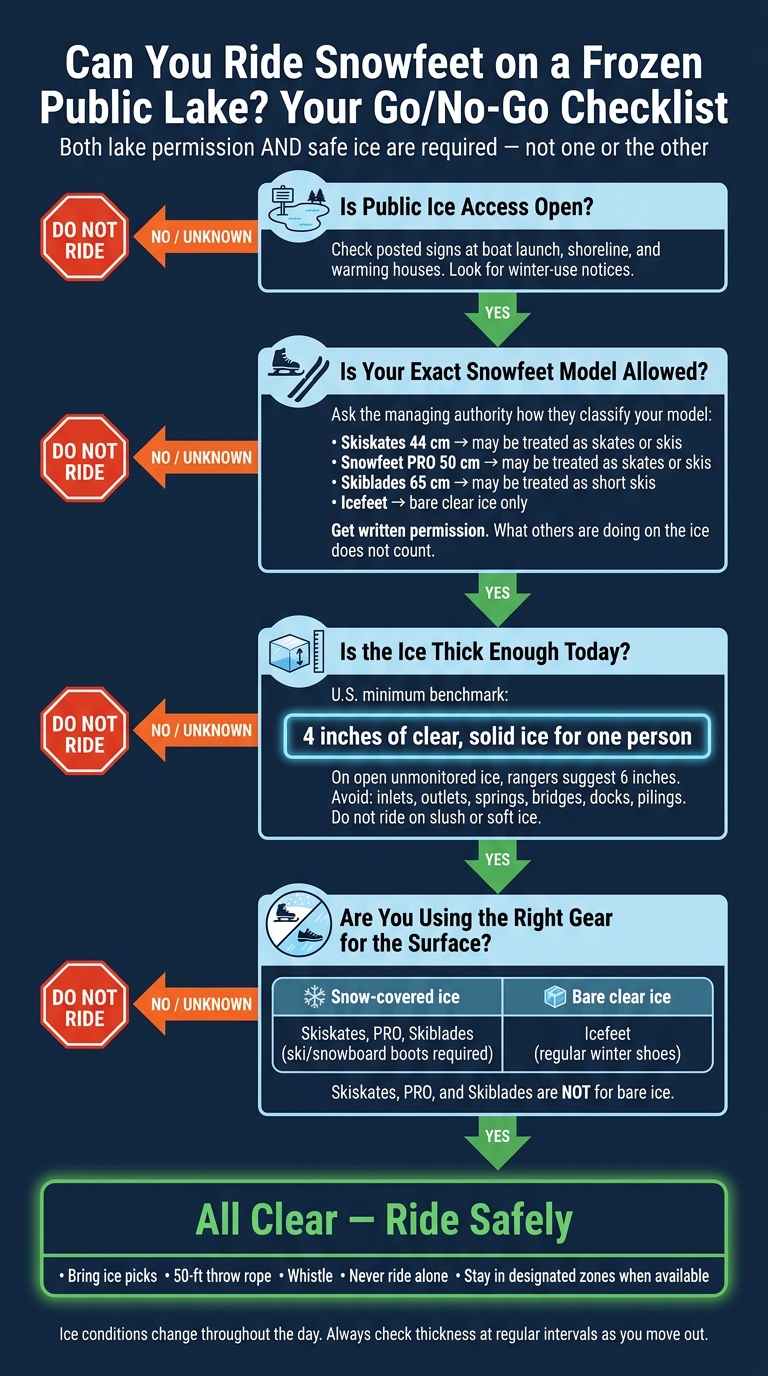
Snowfeet on Frozen Lakes: Go/No-Go Decision Checklist
How to check whether a specific frozen lake allows Snowfeet*
Where to look first: signs, winter notices, and park rules
Snowfeet* models aren't standard skates. So your next move is simple: check how the lake classifies them.
Start with posted signs at the boat launch, shoreline, and any nearby warming houses, plus any marked skating zones. These spots often show winter notices that spell out what gear is allowed and where you can use it. After that, check the lake's official winter-use notice or rules page to see if the wording matches.
Pay close attention to the exact language for skating zones, no-vehicle areas, and bans on tow or sliding gear. A rule that bans towing, sleds, or inner tubes might also knock out Snowfeet*.
If the wording feels fuzzy or leaves room for debate, don’t guess. Move on to the managing office’s written rules or contact them directly.
When the wording is unclear, contact the managing authority directly
At that point, go straight for the yes-or-no questions:
- Is my Snowfeet* model, such as Skiskates 44 cm, PRO 50 cm, or Skiblades 65 cm, treated as skates or banned sliding gear?
- Is skating allowed on the open lake ice, or only inside a designated skating zone?
- Does the current ice-opening notice cover short skis or skates like Snowfeet*?
Written permission matters more than what other people are doing on the ice.
Once you’ve got permission sorted out, the next thing to check is ice thickness.
What public lake policies typically allow or prohibit
Common rule types and what they mean for riders
After you check signs and posted notices, the next step is simple: match the wording to the rule type. Most frozen lake rules fall into a few clear buckets. Once you know which bucket you're dealing with, it's much easier to figure out whether Snowfeet* may be allowed.
One thing to watch for: on larger lakes, shore zones and lake zones may follow different rules. So, the same gear might be fine in one spot and restricted a little farther out.
One broad category is "nonmotorized recreation only." That often includes gear with no engine or wind power behind it, so Snowfeet* may fit, unless the rule also singles out skis or skates.
"Designated areas only" is stricter. That means use is limited to marked, monitored zones where staff have checked the ice. In that case, Snowfeet* may be allowed inside that area, but not out on unmarked lake ice.
Then you get the murky stuff: "skating only" and "no skiing." That's where things can get a bit fuzzy. Some local authorities may treat Snowfeet* as skis, not skates. And if a rule bans towing, sleds, or inner tubes, that can affect Snowfeet* too. So yeah, this is one of those "ask before you go" situations.
If a lake allows winter recreation in general but also bans skis, follow the ski ban. A rule aimed at a specific piece of gear usually matters more than broad recreation language.
Use the table below to read the rule fast.
| Policy wording | Likely impact on Snowfeet* | What the rider should do |
|---|---|---|
| Nonmotorized recreation only | Often allowed, unless there is a separate ski or skate ban | Check for equipment-specific restrictions |
| Designated areas only | Allowed inside the marked zone | Stay within the monitored area |
| Skating only | Gray area - may be limited to conventional skates | Ask how the authority defines skating |
| No skiing / no skis | May be restricted if Snowfeet* are treated as skis | Get clarification before riding |
| No sleds or towed devices | Towed use is banned; ride only under your own power | Ride only under your own power |
| No public ice access | Not allowed | Do not ride there |
Even if the rule allows your gear, ice thickness still decides whether the lake is safe to use.
How Snowfeet* compares with long skis and other short-ski options under lake rules
Long skis are more likely to trip a "no skiing" rule than Snowfeet*. Conventional ice skates usually have the easiest path because many frozen lake rules are written with skating in mind.
Snowfeet* lands somewhere in the middle. In places that allow nonmotorized recreation or even mention cross-country skiing, Snowfeet* can make sense because it's compact, lightweight, and easy to carry. That's a nice plus when you're walking from the parking lot in winter boots with cold hands and zero patience :)
Here’s the quick comparison:
| Gear type | Typical rule treatment on frozen lakes | What to do |
|---|---|---|
| Traditional long skis | More likely to be restricted under "no skiing" rules | Verify the lake allows skis before going out |
| Conventional ice skates | Usually the easiest fit for "skating only" rules | Use them in cleared skating areas when available |
| Snowfeet* Skiskates 44 cm / PRO 50 cm | Gray area - may be treated as skates or skis depending on the authority | Ask how the lake classifies them |
| Snowfeet* Skiblades 65 cm | May be treated as short skis, so verify locally | Check local rules before riding |
Snowfeet* & Skiskates Complete Guide | All you need to know about Skiskating
sbb-itb-17ade95
Ice safety rules apply even when Snowfeet* is allowed
Once Snowfeet* are allowed, the big issue becomes the ice itself. A lake can permit them and still be unsafe to ride. That part comes down to conditions on the day you go.
Minimum ice thickness guidance and areas to avoid
If the lake allows Snowfeet*, the next step is checking whether the ice is strong enough. The standard U.S. benchmark is at least 4 inches of clear, solid ice for one person on foot or on skates. Anything under 4 inches is off limits. On open, unmonitored ice, some rangers suggest closer to 6 inches since conditions can change across the lake.
That’s the tricky part: ice is almost never the same thickness everywhere. One patch may look fine, while another spot a few feet away can be thin and risky. Pay extra attention near:
- Inlets and outlets
- Bridges
- Springs
- Docks
- Pilings
Clear black ice is usually stronger than white ice or ice covered by snow. But don’t guess based on color alone. Measure it. Check thickness with test holes at steady intervals as you move out. And on warmer days, head off the ice early, especially near shore, where things can weaken first.
Why designated skating zones are the safest option
Designated skating areas are usually safer than open, unmonitored ice because they’re marked and checked. Before you go, look at the park’s website, social media pages, or office for the latest ice reports.
"Generally with ice fishing, you trek out slowly and stay in one area that you have checked is safe. With wild ice skating, you generally trek out farther, and it can be harder to determine ice conditions all over." - Joey Livingston, Statewide Public Information Officer, Colorado Parks and Wildlife
Bring ice picks, a 50-foot throw rope, and a whistle. Also, don’t go alone. That might sound like old-school winter advice, but yeah, it still matters.
Permission doesn’t cancel out bad ice. You need both: local approval and safe conditions before you ride.
If the ice passes, choose the Snowfeet* model that fits the surface and the local rule.
Choosing the right Snowfeet* product and making your go/no-go decision
Which Snowfeet* product suits snow-covered lake use vs. bare ice
Once the lake is legal to use and the ice is thick enough, the next step is simple: match the product to the surface.
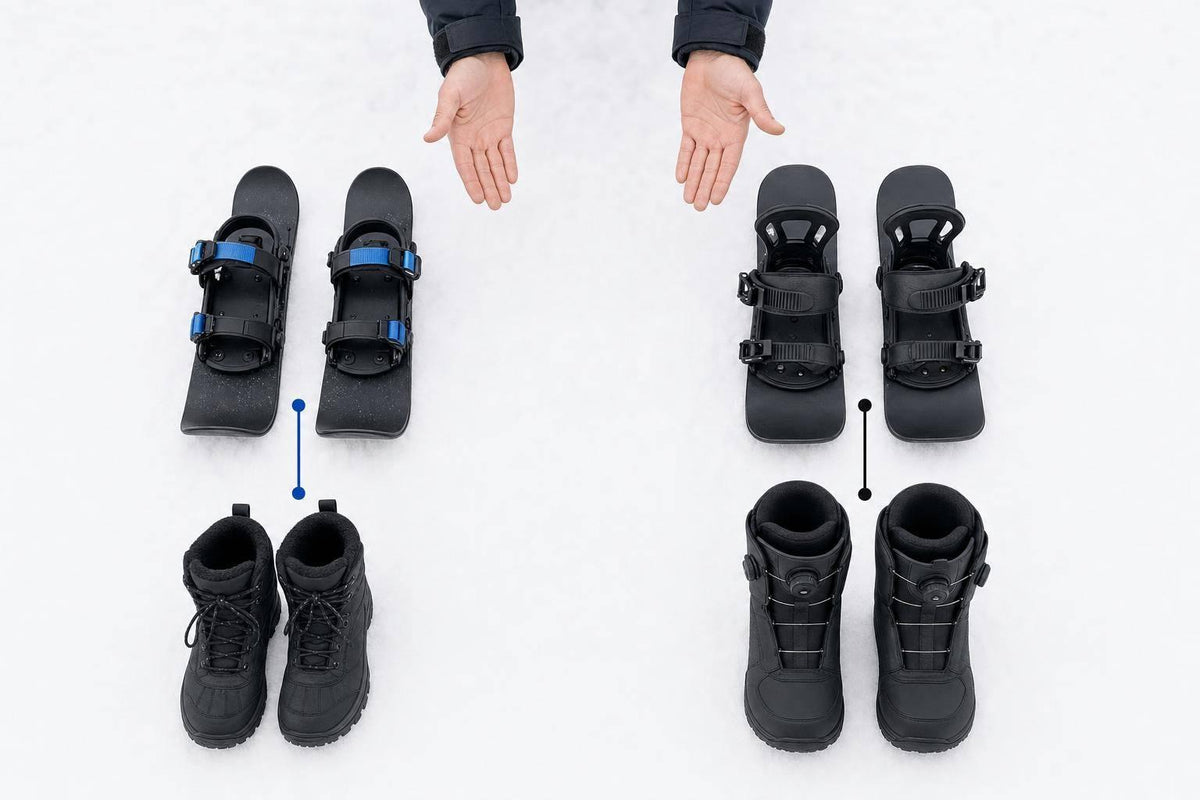
Here’s the plain-English version. Skiskates, PRO, and Skiblades are made for packed snow or a steady snow layer. They are not for bare ice. If the lake has bare, clear ice, Icefeet is the better pick. It’s a strap-on double-blade skate that fits over regular winter shoes, so you don’t need skate boots.
Use this quick surface check to choose the setup that fits.
| Product | Intended surface | Boots needed | Local rule fit |
|---|---|---|---|
| Skiskates (44 cm) | Packed snow | Ski or snowboard boots | Check local classification |
| Snowfeet PRO (50 cm) | Packed snow | Ski or snowboard boots | Check local classification |
| Skiblades (65 cm) | Deeper snow cover | Ski or snowboard boots | Check local classification |
| Icefeet | Bare, clear ice | Regular winter shoes | Check local classification |
One more thing: don’t ride on slush or soft ice. Both are warning signs that the ice is getting weak. That’s your cue to step back, not charge ahead like it’s some winter action movie.
Final checklist before you ride
If the lake passes the rule check, run through this last go/no-go list before you step onto the ice. If any answer is "no" or "unknown," don’t ride.
- Allowed? The managing authority explicitly permits skating or skis/skates on this lake.
- Ice thick enough? Ice meets the minimum thickness threshold.
- Hazards mapped? Inlets, outlets, springs, bridges, and docks identified and avoided.
- Recent thaw? Temperatures have been consistently below freezing with no recent warm spell.
- Safety gear ready? Safety gear packed; not riding alone.
- Right product? Snow-covered ice: Skiskates, PRO, or Skiblades. Bare ice: Icefeet.
FAQs
Do Snowfeet count as skates or skis?
Snowfeet aren’t ice skates, and they aren’t regular skis either. They sit in their own lane: short sliding gear built for mixed frozen surfaces.
They do borrow a bit from skates. For one, they use metal edges that help with grip. But that’s where things start to change.
Unlike skate blades, Snowfeet have a wider platform and a short length. That combo helps them deal with stuff that can make skates a pain, like:
- rough ice
- wind crust
- light snow
So, if skates feel too narrow and skis feel like too much gear, Snowfeet land somewhere in the middle. They’re made for frozen ground that isn’t perfectly smooth, which is often the case out there :)
Can I use Snowfeet outside marked skating areas?
Yes - but only if the lake or park allows skating there and the ice is safe.
Many agencies require skaters to stay in marked skating areas and follow posted access limits. If a site bans skating, that’s the end of the story.
If there aren’t any marked areas:
- Check current conditions with park staff
- Make sure there are at least 4 inches of clear ice
- Stay away from high-risk spots
- Follow all posted rules and closures
Pretty simple, but this is one of those times when simple matters a lot :) Ice doesn’t give second chances.
What should I do if lake rules are unclear?
If lake rules are unclear, don’t guess. Don’t assume the ice is safe. And don’t assume your activity is allowed.
Check the official website or social media pages for the local state park or recreation department. Look for current ice condition reports. You can also call the park office directly.
When in doubt, don’t go out. Never rely on appearance alone. If you can’t confirm the area is marked for skating or sliding, skip it.











Zanechať komentár
Táto lokalita je chránená testom reCAPTCHA a vzťahujú sa na ňu pravidlá ochrany súkromia a podmienky poskytovania služby hCaptcha.