



















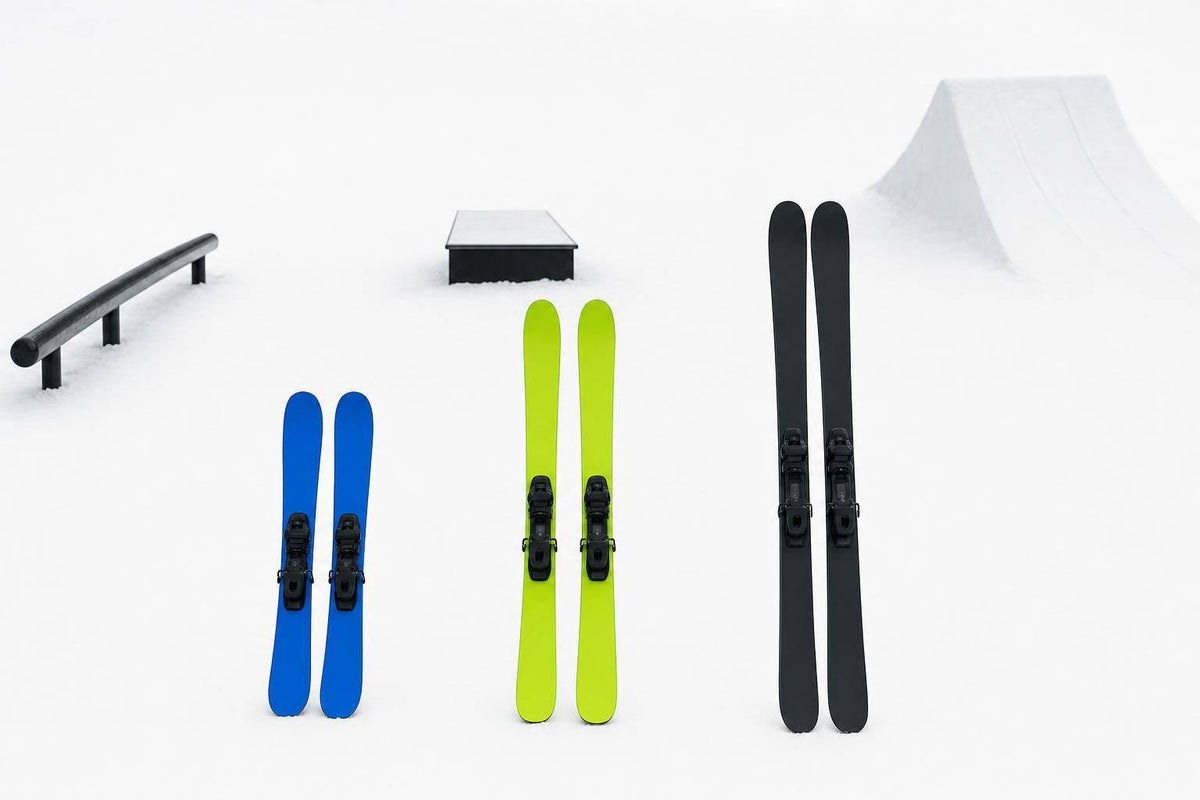
Yes - for most casual park riders, snowblades are worth it in 2026. If you ride boxes, rails, and small-to-medium jumps, short skis can be more fun, easier to spin, and less intimidating than full-length park skis.
Here’s the simple version:
- Buy snowblades if you want easy park laps, tight turns, fast spins, and a compact setup.
- Buy 99 cm snowblades if you want the best mix of agility and control.
- Buy 65 cm snowblades if your focus is small features and jibbing.
- Buy 44 cm skiskates if you want a skate-like feel and ride at lower speeds.
- Stick with full park skis if you hit bigger jumps, faster lines, or large landings.
The article’s main point is pretty clear: shorter skis win on playfulness, while longer skis win on speed and landing support. That’s the whole game.
A few numbers help frame it:
- Snowblades in this guide range from 44 cm to 99 cm
- Full park skis for bigger jump lines often sit around 160–180 cm
- Starting prices run from about $460 to $690
Snowboarder tries Snowfeet* | Which Snowfeet* Short Ski is the Best? | Snowblades 44, 65, 99 Review
Quick Comparison
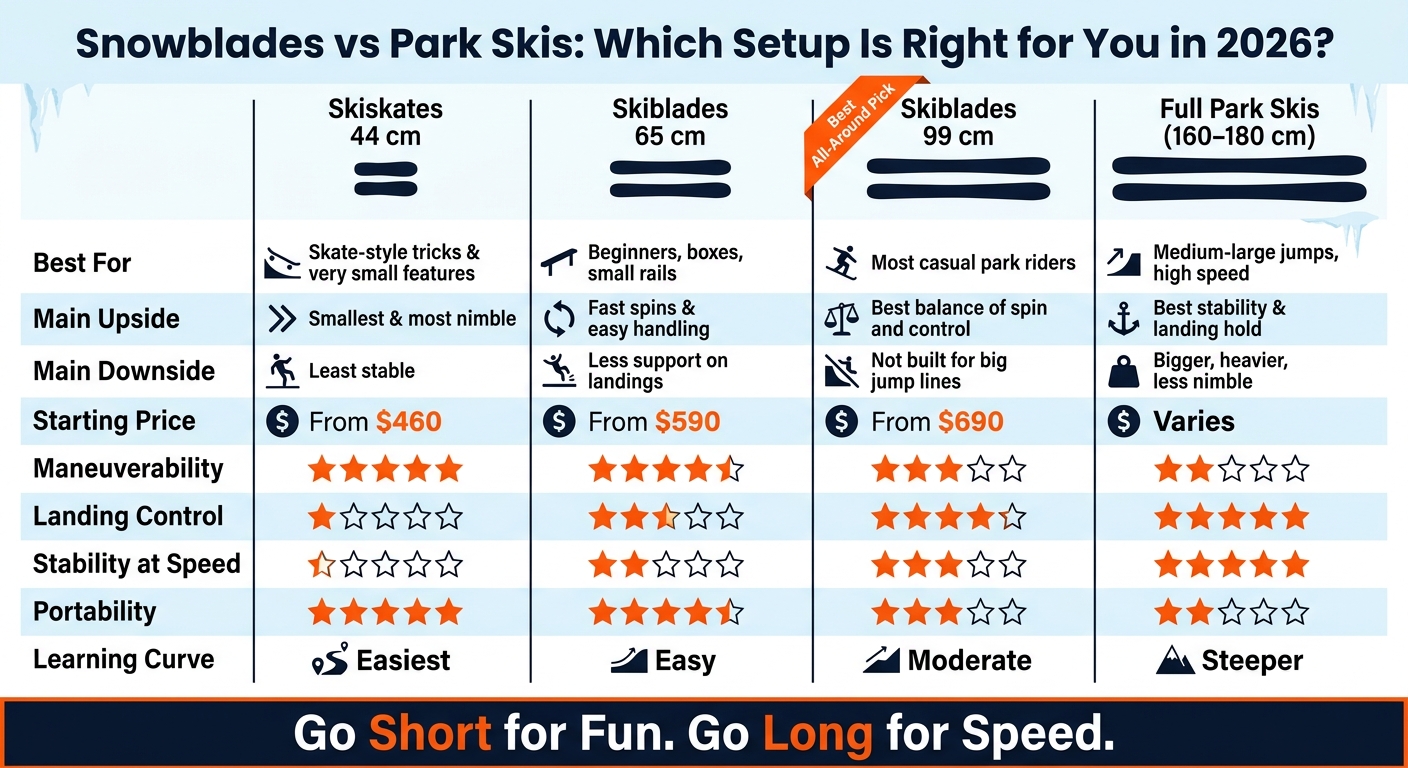
Snowblades vs Park Skis: Which Setup Is Right for You in 2026?
| Setup | Best for | Main upside | Main downside | Starting price |
|---|---|---|---|---|
| Skiskates 44 cm | Skate-style tricks, very small features | Smallest and most nimble | Least stable | $460 |
| Skiblades 65 cm | Beginners, boxes, small rails | Fast spins and easy handling | Less support on landings | $590 |
| Skiblades 99 cm | Most casual park riders | Best balance of spin and control | Still not built for big jump lines | $690 |
| Full park skis | Medium-large jumps, high speed | Best stability and landing hold | Bigger, heavier, less nimble | Varies |
So, if I were giving shop-floor advice in one sentence, it’d be this: go short for fun, go long for speed :)
If you want a compact park setup that works with ski boots or snowboard boots, snowblades make a lot of sense. If your dream day is chasing the big line and stomping large kickers, full-length twins still win.
Snowblades vs. park skis vs. snowboards: park trade-offs side by side
For park riders, the key question is simple: when do short skis beat longer setups, and when don’t they?
Here’s the side-by-side view:
| Criteria | Snowblades | Park Skis | Snowboards |
|---|---|---|---|
| Turns and spins | Fastest to redirect and spin | Stable, but slower to spin | Very good, especially for freestyle riders |
| Rails and boxes | Agile, but less locked-in than full park skis | Stable lock-in and support | Strong on 50-50s and boardslides |
| Jump stability | Good on small jumps | Best on bigger jumps | Very good for many park riders |
| Landing forgiveness | Moderate | Best | Very good |
| Stability at speed | Limited | Best | Very good |
| Learning curve | Easiest | Steeper | Moderate |
| Portability | Most compact | Less compact | Less compact |
| Best for | Beginners, casual riders, lower-speed park riders | Intermediate–advanced park skiers | Riders who prefer a sideways stance |
Among short skis, Snowfeet* is the most park-friendly option for riders who want quick spins, easy carrying, and a simple learning curve.
Where snowblades have a clear advantage
The biggest win is spin speed. Short skis are easier to whip around, so 180s and 360s come around faster.
Snowblades also make a lot of sense for first park sessions. They turn fast, stop with less fuss, and forgive small edge mistakes at low speed. On boxes and smaller rails, the compact platform feels playful and easy to redirect. That’s a big plus when you’re still getting your park legs under you.
Where longer park skis still win
On medium-to-large jumps, longer park skis are still the better tool. More length gives you more stability, better tracking through choppy in-runs, and more support on landings when speed picks up. That’s the trade-off in plain English: snowblades can feel less stable once things get fast.
Snowboards still make plenty of sense for riders who like a sideways stance. On 50-50s and boardslides, they can feel natural, and freestyle park boards use softer flex for jibbing and easier manipulation.
That trade-off is what makes Snowfeet* 44 cm, 65 cm, and 99 cm different from each other.
Quick guide: best option by rider type
For Snowfeet* riders, the right pick comes down to how much spin, stability, and speed you want.
- Snowfeet* Skiskates 44 cm are the most compact option.
- Snowfeet* Skiblades 65 cm are the easiest to spin and the best pick if you want the smallest park footprint.
- Snowfeet* Skiblades 99 cm are the strongest all-around pick for a better balance of agility and stability without moving all the way to park skis.
For bigger jumps and faster in-runs, longer park skis still give you more stability.
Next, the choice comes down to which Snowfeet* length fits your park style: 44 cm, 65 cm, or 99 cm.
sbb-itb-17ade95
Snowfeet* park options compared: 44 cm vs. 65 cm vs. 99 cm
If you're trying to figure out whether snowblades make sense in the park, this length-by-length breakdown makes the choice a lot easier.
| Criteria | Skiskates 44 cm | Skiblades 65 cm | Skiblades 99 cm |
|---|---|---|---|
| Maneuverability | Maximum | Excellent | Very good |
| Landing control | Lowest | Moderate | Best |
| Stability at speed | Lowest | Moderate | Best among Snowfeet* |
| Portability | Most compact | Very compact | Compact |
| Boot compatibility | Ski or snowboard boots (US 4.5–14.5) | Ski or snowboard boots (US 4.5–14.5) | Ski or snowboard boots (US 4.5–14.5) |
| Starting price (U.S.) | From $460 | From $590 | From $690 |
Lengths, boot compatibility, and starting prices are based on current Snowfeet product listings, and the prices are listed as "from" figures because they can vary by model, bundle, and sale period.
All three models use Snowfeet*'s short-ski shape, wood cores, twin tips, and adjustable bindings for ski or snowboard boots. That’s a big plus if you already ride in snowboard boots.
Snowfeet* Skiskates 44 cm: most compact and most skate-like
Snowfeet calls the 44 cm Skiskates its shortest model. And you feel that right away.
They’re super compact, easy to carry, and very quick edge to edge. On snow, they feel the most like skating. That makes them a niche pick for slow laps, tiny features, and riders who want that loose, playful feel. Fun? Yep. Forgiving on faster park laps? Not so much.
Snowfeet* Skiblades 65 cm: quickest-turning option with the least room on takeoff and in spins
The 65 cm Skiblades are the fastest-turning Snowfeet* option for park tricks. At 26 inches long with a roughly 13-foot turn radius, they change direction fast, which helps with spins, quick pivots, boxes, and small rails.
That short length comes with a tradeoff, though. Compared with the 99 cm model, the 65 cm version gives you less support on landings if you're not centered, and less running length once speed starts to build. So, if your style leans more toward spins and jibbing than jump stability, this one fits.
Snowfeet* Skiblades 99 cm: best all-around pick for most park riders
The 99 cm Skiblades are the best all-around Snowfeet* pick for riders who want more front-to-back support and a feel that’s closer to a regular ski.
At 39 inches, they give you more fore-aft support on landings, more calm on faster approaches, and more room to recover when you're a bit off balance. In plain English: they’re less twitchy and more forgiving.
For most casual park riders, the 99 cm model gives the best mix of fun and control without moving all the way to full-length park skis. That also makes it the easiest Snowfeet* model to use across more park situations.
Next, match the length to your boots, speed, and budget.
How to pick the right setup for your boots, riding style, and budget
Pick based on feature size, how fast you like to ride, and what boots you already have. From there, it’s mostly about finding the shortest setup that still feels steady for you.
| Rider type | Feature size | Speed comfort | Boot setup | Best pick |
|---|---|---|---|---|
| First-time park rider | Small boxes, mellow rollers | Low | Ski or snowboard boots | Skiblades 65 cm |
| Casual rider progressing to jumps and rails | Small-to-medium jumps, rails | Moderate | Ski or snowboard boots | Skiblades 99 cm |
| Skater moving to snow | Flat-ground tricks, small features | Low-moderate | Snowboard boots or ski boots | Skiskates 44 cm |
| Snowboarder wanting a compact park setup | Small jumps, jib features | Low-moderate | Snowboard boots | Skiskates 44 cm |
| Frequent park rider, medium-large jumps | Medium-to-large jumps, fast lines | High | Ski boots | Longer park skis |
Start with the features you want to hit, then be honest about your speed comfort. A shorter setup feels playful and easy to throw around. But if it gets too short for your pace, things can get sketchy fast.
Best pick for beginners and casual park riders
If you're new to the park, the 65 cm Skiblades make the most sense for small boxes and mellow rollers. They’re simple, less intimidating, and a nice way to get your feet under you without feeling like you’re driving a bus.
If you can already ride blue runs and want to move into rails and small jumps, go with the 99 cm Skiblades. That extra length helps a lot on landings and gives you better control when the park snow gets chopped up.
Best pick for skaters and snowboard-boot riders
The 44 cm Skiskates feel the closest to skates. They pivot fast and work well for flat-ground tricks. They’re also the most direct pick if you already own snowboard boots, which keeps the setup simple.
That said, the 44 cm model is a specialist tool for low-speed, skate-style sessions. Once your approaches get faster or your jumps get bigger, that short base can start to feel twitchy. At that point, moving up to the 99 cm Skiblades makes a lot of sense. They also work with snowboard boots, so you get more stability without having to switch into ski boots.
When longer park skis are still worth it
For medium-to-large jumps and fast jump lines, longer park skis are still the smarter pick. A twin-tip in the 160–180 cm range gives you more stability at speed and more support on bigger landings.
If your main goal is charging fast and stomping bigger jumps, full-length twins still beat any Snowfeet model. Heavier riders, or anyone who likes more speed, should step up to 99 cm or longer park skis.
That leaves the last piece: which riders get the most bang for their buck from snowblades in 2026?
Final verdict: who should buy snowblades for the park in 2026
Snowblades are worth a look in the terrain park - if you’re the right kind of rider.
If you want playful park laps, easy spins, and a loose, fun feel on small features, they hit the mark.
Pick based on how you ride:
- Best all-around: Snowfeet* Skiblades 99 cm
- Best for low-speed boxes and the smallest park footprint: Skiblades 65 cm
- Best for skate-style tricks and max compact size: Skiskates 44 cm
Snowfeet* shines as a playful park tool, not a speed-first swap for full-length skis. If you like going fast or you’re hitting bigger landings, longer park skis still come out on top.
Choose snowblades for playful park laps. Choose longer park skis for speed and bigger jumps.
FAQs
Are snowblades safe for terrain park beginners?
Yes. Snowfeet* skiblades are a safe, beginner-friendly pick for terrain parks. Their short, light build makes them easier to turn and control than long skis. That gives new riders a smoother way to build confidence and start learning spins, jumps, and rails with fewer awkward wipeouts.
If you're just getting started, the 65 cm model is the best bet for agility. The 44 cm Skiskates have a similar playful feel at low speed. If you want more stability as your skills grow, the 99 cm model is a smart next step.
A few basics matter every time:
- Wear a helmet
- Follow the Responsibility Code
- Check your local resort's equipment rules
That way, you can keep things fun and avoid any annoying surprises at the lift :)
Can I use snowboard boots with Snowfeet* in the park?
Yes. Most Snowfeet* models, including the 44 cm Skiskates and 65 cm Skiblades, work with standard snowboard boots. So if you already own a pair, you can use them.
A lot of park riders like this setup for a simple reason: snowboard boots give you more natural flex and ankle movement than ski boots. That can make spins, jumps, and switch riding feel more comfortable.
The tool-free adjustable bindings usually fit U.S. boot sizes 6 to 14.5.
How do I know if 65 cm or 99 cm is better for me?
It comes down to what you want from the park.
The 65 cm feels looser, more playful, and easier to move around. That makes it a good fit for beginners, skaters, and riders who want to focus on rails, quick spins, and mellow park laps. It’s easier to toss around, but there’s a trade-off: it won’t feel as steady at higher speeds or on bigger jumps.
The 99 cm is the better do-it-all pick. It gives you more stability for medium jumps, longer rails, and faster lines. It also helps on switch landings and handles the occasional groomer a bit better.
So, if you want a board that feels light and fun in tight park features, go with 65 cm. If you want more balance and confidence across more terrain, 99 cm makes more sense.











Оставить комментарий
Этот веб-сайт защищается hCaptcha. Применяются Политика конфиденциальности и Условия использования hCaptcha.