



















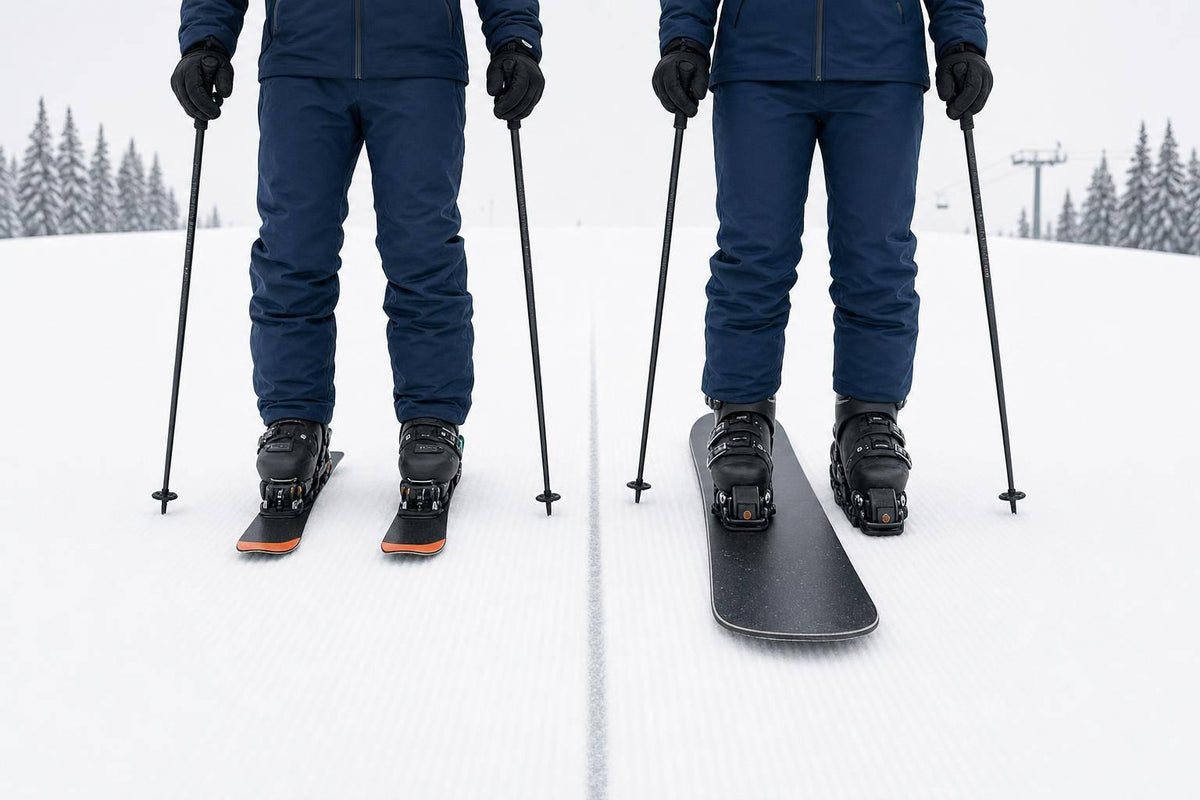
Here’s the short answer: if you want the easiest path to a one-board-style ride at a U.S. resort, I’d pick skiblades for most people. Mono-skis still make sense, but mostly for riders who want long carved turns, more speed calm, and a more niche setup.
If I boil the whole article down, it looks like this:
- Skiblades are easier to learn, easier to carry, and easier to turn in tight spots.
- Mono-skis feel more planted at speed and like bigger carved turns on open runs.
- Short lengths matter a lot: 44 cm and 65 cm feel loose and playful, while 99 cm and 120 cm add more support.
- Boot setup can decide the whole thing: skiblades give you more boot options, while mono-skis need alpine ski boots.
- For beginners, snowboarders, families, and travelers, skiblades are often the safer pick.
- For carving-first riders, mono-skis still have a lane.
A few fast facts from the article:
- Skiblade lengths covered: 44 cm, 65 cm, 99 cm, and 120 cm
- Mono-ski stance: both feet side by side on one ski
- Best all-around pick in the piece: 99 cm skiblades
- Best travel-friendly picks: 44 cm or 65 cm
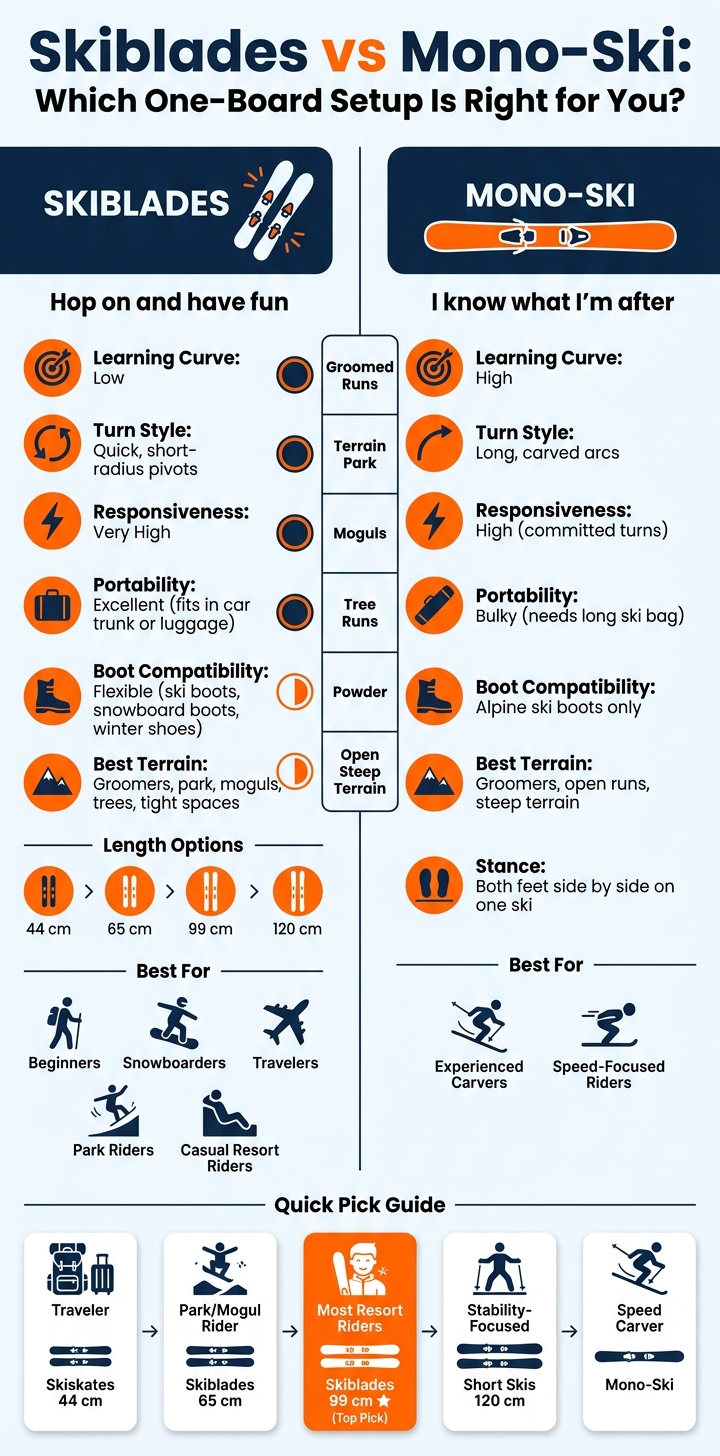
Skiblades vs Mono-Ski: Which One-Board Setup Is Right for You?
Ultimate Short Skis 🎿 Snowfeet* Skiblades 99 CM
Quick Comparison
| Feature | Skiblades | Mono-Ski |
|---|---|---|
| Feel | Playful, light, easy to steer | Stable, locked-in, directional |
| Turning | Short turns, easy pivots | Long carved arcs |
| Speed feel | Better at 99–120 cm | Strong on open groomers |
| Learning curve | Lower | Higher |
| Tight spaces | Strong | Takes more room |
| Travel and storage | Much easier | Bulkier |
| Boots | More options | Alpine ski boots only |
| Best for | Casual resort riding, bumps, park, trees | Carving, open runs, some powder |
So, if you want less fuss and more fun on mixed resort terrain, I’d go skiblades. If you want a single platform feel and don’t mind the extra work, mono-ski is still on the table. Kind of like this: skiblades are the “hop on and have fun” choice, while mono-ski is the “I know what I’m after” choice :)
If you want a quick look at mono-ski riding, here are a couple YouTube searches you can use:
That’s the big picture. Now the article can get into the ride feel, terrain fit, boot setup, and who each option suits best.
How Each Option Feels on Snow
Skiblades: quick, playful, and easy to steer
Skiblades feel a lot like inline skating, just on snow. Each foot moves on its own short ski, so turning feels fast and light. You don’t have to map out every move way ahead of time. Shift your weight, and the ski reacts almost at once.
Length changes the ride more than most people expect.
The Snowfeet* Skiskates at 44 cm feel closest to snow skates. They’re super quick, great in tight spots, and a blast for short turns. The tradeoff? They feel less settled once speed picks up.
The 65 cm Skiblades are the easiest all-around pick for most resort riders. They move fast from edge to edge, feel less scary, and are fun from the first run.
Move up to the 99 cm Skiblades or POWDER 99 cm, and you get more stability plus better float. The POWDER model is set up for soft snow and chopped powder. Then there are the Short Skis at 120 cm, which feel closest to standard skis while still turning faster and feeling more nimble than full-length skis. Short skis react faster and are easier to turn.
That’s a big reason beginners, snowboarders, and casual resort riders often get comfortable on skiblades fast. They just make life easier in bumps, tight spaces, and on quick resort laps.
Mono-ski: stable, directional, and more specialized
A mono-ski is one single riding platform. Both feet sit side by side on one wide board, and the whole thing moves together. When you roll it onto an edge, it wants to hold a long carved turn. The feel is smooth, strong, and direct.
A lot of riders say it feels like being locked into one carve. Your weight stays over one continuous edge, which helps with speed stability and float in powder. That’s the upside.
The catch is that mono-ski asks more from you. It works best when you commit to the turn. Fast pivots, tight corrections, and short turns take more work because both feet have to move as one. In lift lines, narrow cat tracks, or crowded runs, you need more room and a bit more planning than you do on skiblades. That’s the big day-to-day difference for control, stability, and normal resort use.
| Skiblades (Snowfeet*) | Mono-Ski | |
|---|---|---|
| Turn style | Quick, short-radius, easy to pivot | Long, carved arcs, committed |
| Speed stability | Moderate to high, especially at 99–120 cm | High on groomers and powder |
| Tight-space handling | Excellent | Needs more room |
| Day-one ease | High - accessible right away | Builds with technique |
| Best terrain | Groomers, moguls, park, tight spaces | Groomers, powder, open runs |
sbb-itb-17ade95
Head-to-Head: Control, Stability, and Practical Use
Here’s the practical difference at a glance.
| Category | Snowfeet* Skiblades / Skiskates | Mono-Ski |
|---|---|---|
| Stability at speed | Moderate; 99 cm and 120 cm models feel more stable | High on groomers and open runs |
| Turn initiation | Very quick; minimal effort | Deliberate, committed arcs |
| Responsiveness | Very high - reacts to small inputs | Responsive, but best in committed turns |
| Learning curve | Gentle, especially for beginners | Steeper; rewards dedicated practice |
| Portability | Fits in most car trunks | Needs a long bag and much more storage space |
| Boot compatibility | Flexible - some models work with winter boots; others with ski boots | Requires alpine ski boots |
| Terrain fit | Groomers, park, moguls, trees, tight spaces | Groomers, powder, open runs |
Stability and turning on groomers, bumps, and tight spaces
Mono-skis carve well on groomers. Snowfeet* skiblades, on the other hand, change direction much faster and deal with bumps and tight spots with less work. Snowfeet* skiblades flip that equation.
The shorter edge gives you less straight-line stability when speed picks up. But the trade-off is simple: turn initiation feels almost instant. Small leg movements are enough to redirect.
In bumps, that matters a lot. You can snake through a bump line with less timing and less muscle than a mono-ski asks for. The 99 cm and 120 cm Snowfeet* models land in a sweet spot. They feel more stable than the 44 cm or 65 cm options, but they’re still much more nimble than a mono-ski.
Learning curve for beginners and snowboarders
Short skiblades cut out a few common beginner problems. There’s less length to manage, less chance of crossing tips, and less leverage fighting you when you get off balance. That alone can make the first few runs feel way less sketchy.
The stance helps too. It feels closer to walking or inline skating, which many riders pick up fast.
Snowboarders often adapt especially fast. Skiblades still keep your feet separate and respond to light leg pressure, so the movement pattern feels familiar. A mono-ski does the opposite. It locks both feet side by side in a forward-facing stance, and that’s a big shift. Most people need several dedicated days before it starts to feel natural. It can be a blast once it clicks, but getting there takes more patience.
Portability, travel, and carrying gear around the resort
This is the part where compact Snowfeet* gear wins by a mile. The 44 cm Skiskates and 65 cm Skiblades fit into most car trunks or stretch across a back seat. No roof rack. No long ski bag. No awkward parking lot shuffle.
For air travel, the gap gets even bigger. These models can often fit inside checked luggage or a compact duffel, which may help you skip oversized baggage fees tied to a full ski bag. A mono-ski needs a long bag and a lot more storage room. If you do road trips or fly to a resort a few times each season, that extra bulk gets old fast.
From here, terrain and boot setup decide which option fits best.
Terrain Fit, Boot Compatibility, and Best Rider Match
Where each option works best: groomers, park, moguls, trees, and powder
Snowfeet* skiblades handle more types of terrain than a mono-ski. The 44 cm and 65 cm models feel best on groomers, in terrain parks, through moguls, and in tree runs. Why? They turn fast, so tight spots feel less like work and more like play.
The POWDER 99 cm does a much better job in soft snow and still keeps that short-turn feel. The 120 cm gets closer to the feel of a standard ski, but it still feels easier to move around than a full-length setup.
Mono-skis do best on open groomers and steep terrain where you have space to let long carved turns run. In tight trees, terrain parks, or mogul lines, they feel less at home. Fast pivots just aren't their thing.
| Terrain | Snowfeet* 44–65 cm | Snowfeet* POWDER 99 cm | Mono-Ski |
|---|---|---|---|
| Groomed runs | Strong | Strong | Strong |
| Terrain park | Strong | Usable | Weak |
| Moguls | Strong | Usable | Weak |
| Tree runs | Strong | Usable | Weak |
| Powder | Weak | Strong | Weak |
| Open steep terrain | Usable | Strong | Strong |
Once terrain is clear, boot setup is the next big thing.
Boot and binding setup: more flexibility with Snowfeet*
The biggest day-to-day difference is boot compatibility. Snowfeet* works with more boot setups, including ski boots, snowboard boots, and, on some models, winter shoes. That's a big deal if you don't want to buy a whole extra setup.
Mono-skis need alpine ski boots and ski-specific bindings. So if you're coming from snowboarding, or you don't already own ski boots, that's more gear to get and carry around. Kind of a buzzkill, honestly.
That setup gap is often what decides which one people keep riding.
Which riders should choose each option
Snowfeet* works well for beginners, snowboarders, travelers, park riders, and casual resort skiers. Mono-skis make more sense for experienced skiers who want a more committed carving setup and don't mind the extra gear.
| Rider Type | Best Pick |
|---|---|
| Beginner | Snowfeet* Skiblades 65 cm |
| Snowboarder | Snowfeet* Skiskates 44 cm or Skiblades 65 cm |
| Park / mogul rider | Snowfeet* Skiskates 44 cm or Skiblades 65 cm |
| Traveler / casual rider | Snowfeet* Skiblades 65 cm |
| Powder seeker | Snowfeet* POWDER 99 cm |
| Experienced carving-focused skier | Mono-ski |
That leaves one last thing to sort out: which setup gives most riders the best mix of control, convenience, and fun?
Final Verdict: Why Snowfeet* Skiblades Work Better for Most Riders
After looking at control, stability, terrain, and setup, the answer depends on how you ride.
Mono-skis make sense for skilled carvers who want a niche, high-speed, one-board ride. That’s their lane.
For most riders, though, Snowfeet* skiblades are the easier call. They’re easier to learn, easier to carry, and a better fit for mixed resort terrain. And yes, they still give you that one-board feel this whole comparison set out to test. The boot range helps a lot too, especially for casual riders who don’t want a fussy setup.
There is a clear trade-off. Skiblades won’t match a mono-ski when it comes to top-end carving on a big, open groomer at speed. But for most people, that’s a deal worth making. You give up some high-speed carving power and get a setup that’s simpler, more forgiving, and more fun across more parts of the mountain.
Quick picks by rider type
Here’s the fast version.
| Rider Type | Best Pick | Why |
|---|---|---|
| Traveler / casual cruiser | Skiskates 44 cm | Fits almost anywhere, max portability, easy low-speed control |
| Park rider / tight turns | Skiblades 65 cm | Fast pivots, great for park features and mogul lines |
| Most resort riders | Skiblades 99 cm | Best all-around balance of agility and edge hold |
| Stability-focused rider | Short Skis 120 cm | More confidence at speed, firmer snow, longer turns |
| Speed-focused carving enthusiast | Mono-ski | Niche choice for skilled riders who want a specialized challenge |
If you’re unsure where to start, go with the 99 cm. It’s the safest all-mountain pick and the one most riders will get along with right away.
The mono-ski still has its place for dedicated enthusiasts. But for most riders, Snowfeet* skiblades bring the better mix of control, convenience, and plain old fun :)
FAQs
Are skiblades or a mono-ski better for complete beginners?
Skiblades are usually the better pick for complete beginners. They feel less intimidating than a mono-ski and are easier to get used to on day one.
For first-timers, the 65 cm Snowfeet skiblades are the easiest and most playful. They turn fast, feel light, and make learning less of a wrestling match.
If you want a bit more balance and a smoother glide on green runs, go with the 99 cm model. It feels steadier underfoot without losing that easygoing feel.
Both options are versatile and work with comfortable snowboard boots, which is a nice bonus if you want gear that feels familiar and easy to wear.
Which skiblade length should I choose for resort riding?
For most casual adult resort riders, the 99 cm model is the best all-around pick. It gives you a nice middle ground: steady on groomers, decent in light powder, and still easy to flick through short turns.
Go with 65 cm if you want a more playful, easy-to-turn ride. It’s a good fit for beginners, park laps, and moguls.
Pick 120 cm if you want the most ski-like feel, more calm at higher speed, or better float in deeper snow.
Do I need special boots for skiblades or a mono-ski?
For most Snowfeet skiblades, no. The 65 cm and 99 cm models work with snowboard boots, sturdy winter shoes, or standard ski boots, so you can use what you already have.
The one exception is the 120 cm model. That version needs ski boots with release bindings for the right support and safety at higher speeds.











Оставить комментарий
Этот веб-сайт защищается hCaptcha. Применяются Политика конфиденциальности и Условия использования hCaptcha.