



















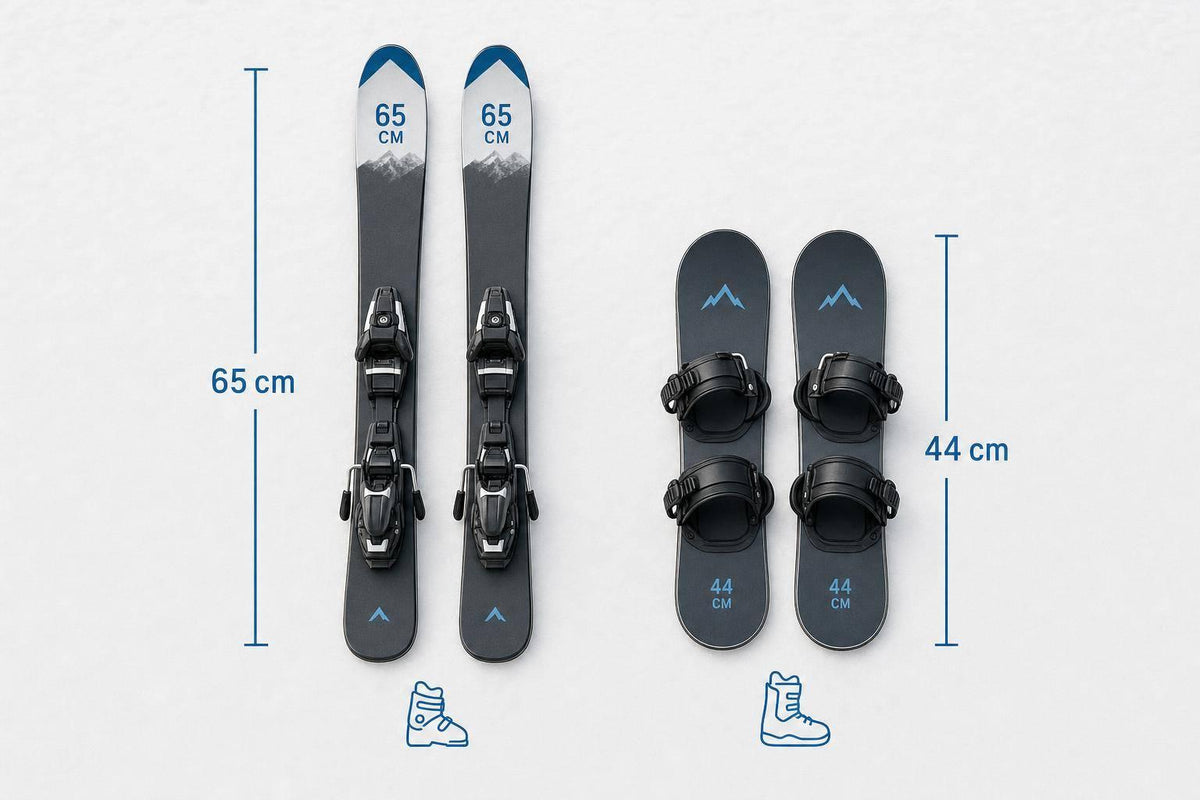
If you want the safer pick for short U.S. hills, I’d go with the 65 cm skiblades. They’re easier to control, easier to stop on groomed snow, and they suit more riders. If you want a more skate-like ride for spins, butters, and tight moves, the 44 cm skiskates are the more fun pick.
Here’s the short version:
- 65 cm Skiblades: better for beginners, calmer at speed, easier stopping
- 44 cm Skiskates: smaller, lighter, sharper turning, more demanding on balance
- Both work best on short runs, bunny slopes, sledding hills, and mellow park laps
- Lengths: 26 in (65 cm) vs 17.3 in (44 cm)
- Turn radius on the 65 cm skiblades: 4 m
- Weight for 65 cm skiblades: about 3.79 lb with ski bindings or 5.89 lb with snowboard bindings
So, if you just want to show up and ride, I’d point you toward the 65 cm skiblades. If you come from hockey, skating, or park riding and want a looser feel, I’d look at the 44 cm skiskates.
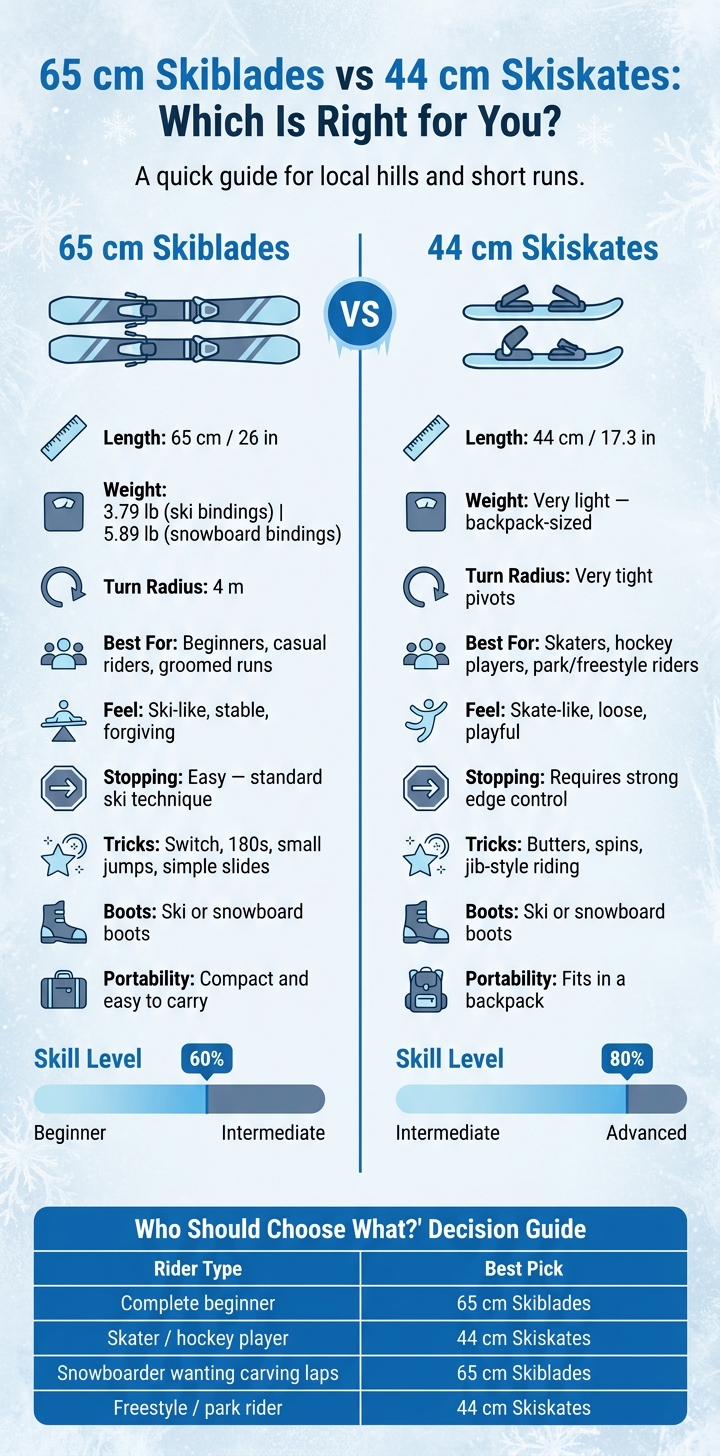
65 cm Skiblades vs 44 cm Skiskates: Which Is Right for You?
All you need to know - Snowfeet* | Skiskates | Skiboards | Snowblades | Skiblades FAQ
Quick Comparison
| What matters | 65 cm Skiblades | 44 cm Skiskates |
|---|---|---|
| Best for | Newer riders, easy laps, mixed users | Skaters, park riders, tight moves |
| Feel | More like short skis | More like skates |
| Control | More stable | More twitchy |
| Stopping | Easier on groomed snow | Takes better edge control |
| Speed range | Low to mid speed | Slow to mid speed |
| Tricks | Small jumps, switch, 180s | Butters, spins, jib-style riding |
| Boots | Ski or snowboard boots | Ski or snowboard boots |
| Portability | Easy to carry | Backpack-sized |
What it comes down to is simple: more platform usually means more forgiveness. And on small local hills, that often wins.
How 65 cm Skiblades Ride on Short Hills
The Snowfeet* Skiblades 65 cm are the more ski-like pick for local hills. They’re short, quick, and easier to handle than full-length skis.
Maneuverability, Stability, and Speed Control
On a typical community hill or small resort run, the 65 cm length feels right at home. You can move through slower traffic, make fast direction changes on narrow connector paths, and line up for small park features without the extra swing of full-length skis.
The steel edges and wood-core build give them a solid feel underfoot. When you need to check speed or hold your line on hardpack, you’ve got something firm to push against. On groomed hardpack and the odd icy patch, that edge grip feels reassuring.
Learning Curve, Stopping, and Basic Tricks
If full skis feel like a lot, the 65 cm format is an easier way in. The stance will feel familiar to skiers: parallel boards, centered weight, and turns that come from edging. Beginners can start with basic skidded turns and then work up to short carved arcs, without dealing with the tip-crossing issues that can happen on longer skis.
Stopping is pretty straightforward on groomed snow. Hockey stops work well because the edges bite cleanly.
For park laps and side hits, the short length makes quick moves easier while still keeping edge control. In a small park, the 65 cm length works well for switch riding, 180s, small jumps, and simple slides.
Boot Options, Comfort, and Getting to the Hill
They work with ski boots and snowboard boots. Ski boots give you sharper edge control. Snowboard boots feel better for walking to the hill. At about 3.79 lbs with ski bindings or 5.89 lbs with snowboard bindings, they’re easy to carry and easy to pack.
For riders who want the most control with the least learning curve on local hills, the 65 cm skiblades are the better fit. That ski-like control is a big reason skiblades do so well on local hills. Next up: how that compares with the lighter, more skate-like feel of snowskates.
sbb-itb-17ade95
How Snowskates and 44 cm Skiskates Ride on Short Hills
Where skiblades lean more toward ski-style control, Skiskates lean hard into a quick, skate-style feel. The Snowfeet* Skiskates 44 cm ride a lot more like inline skates or ice skates than like standard skis. At just 17 inches (44 cm) long, they’re made for fast turns, playful movement, and short runs.
Agility, Trick Potential, and Skate-Like Feel
That short platform makes edge changes, pivots, and little direction fixes feel easy. On a local hill with limited vertical, that kind of snap is a big plus. You don’t need a long run to have fun.
If you come from skating, hockey, or terrain park riding, the motion often feels familiar right away. It’s less “point and carve” and more “move, react, play around.” That’s a big part of the appeal :)
Balance, Stability, and Stopping on Icy or Choppy Snow
The flip side is balance. You’ll need to pay more attention than you would on 65 cm skiblades because the shorter platform gives you less room for error. On groomed hardpack at moderate speed, the 44 cm Skiskates feel lively and fun. Once the snow gets choppy, or your speed starts to climb, that same quick response can get a bit twitchy.
So, these work best at slow to moderate speeds. And on most short local-hill runs, that’s not a problem at all. In fact, it kind of matches the terrain.
Regular Winter Boots vs Ski or Snowboard Boots
The Snowfeet* Skiskates 44 cm use ski or snowboard boot bindings. That means the 44 cm Skiskates need dedicated ski or snowboard boots. Regular-shoe Snowfeet models are easier for casual use, but this setup gives you more control and a more performance-focused ride.
That’s the deal in plain English: more agility, less forgiveness. And that’s what makes the terrain fit, learning curve, and speed control comparison so interesting.
Side-by-Side Comparison: Which One Fits Your Terrain and Riding Style
Direct Comparison by Performance Category
At this point, the main ride differences are already on the table. So now it comes down to where you ride, how you like to move, and what kind of feel you want under your feet.
Here’s the clean side-by-side for short local hills:
| Category | Snowfeet* Skiblades 65 cm | Snowfeet* Skiskates 44 cm |
|---|---|---|
| Maneuverability | Quick turns; ski-like feel | Very tight pivots |
| Learning curve | Gentler; ski technique | Steeper without skate background |
| Stability | More forgiving | Lively; less margin for error |
| Speed control | Reliable carving and stopping | Better at slow to moderate speeds |
| Tricks | Stable landings; approach control | Better for spins, butters, jibbing |
| Stopping | Standard ski techniques | Requires more edge control |
| Portability | Compact | Fits in a backpack |
| Boot compatibility | Ski or snowboard boots | Ski or snowboard boots |
| Weight | About 3.8 lb (ski bindings) | Very light; backpack-friendly |
The biggest split is ride feel.
The 65 cm Skiblades feel closer to short skis. They still turn fast, but they give you a bit more platform and a bit more calm underfoot. The 44 cm Skiskates feel much looser and more playful. They react fast. Fun? Yes. Forgiving? Not as much.
That makes the next part pretty simple: who each one suits best.
Best Choice for Beginners, Skaters, Snowboarders, and Park Riders
Your background matters a lot here. Maybe more than people expect.
Complete beginners usually do better on the 65 cm Skiblades. The longer platform - still only 26 inches - gives you more fore-aft stability and a little more time to react when speed starts to build. Basic moves like snowplow stops and mellow parallel turns carry over from normal ski lessons without much fuss. On the 44 cm Skiskates, things can feel loose at first. If you don’t already have skate or ski balance, they ask for fast corrections, and that takes time.
If you come from skating or hockey, the story flips.
The 44 cm Skiskates tend to feel familiar right away. You’ve already got the side-to-side weight shift, the quick foot reactions, and that “stay loose and react fast” style of movement. That can make the learning curve feel much smaller.
For snowboarders, it usually depends on the kind of day you want.
- If you want clean carving laps on short runs, the 65 cm Skiblades usually make more sense.
- If you want more of a surf-skate crossover feel - butters, switch riding, and small features - the 44 cm Skiskates often feel like the better match.
For park and freestyle riders, the 44 cm Skiskates usually have the edge on small boxes, rails, and rollers. They’re lighter, shorter, and easier to flick around. Still, the 65 cm Skiblades aren’t left out in the cold. They can feel better on stable landings and give you more control on the approach.
How Snowfeet* Compares With Long Skis and Other Brands
Long skis still win in a few clear cases. High-speed groomer laps, big-mountain terrain, and deep powder? That’s their zone. No point dancing around it.
But on a short local hill, full-length skis can feel like bringing a pickup truck to move one chair. They work, sure. They’re just often more than you need.
They’re harder to carry, harder to store, take more time to learn, and can feel like a lot of gear for a quick after-work session.
Here’s how that comparison looks in plain terms:
| Category | Long Skis (traditional brands) | Snowfeet* Skiblades 65 cm | Snowfeet* Skiskates 44 cm |
|---|---|---|---|
| Transport | Bulky to carry and store | Compact | Fits in a backpack |
| Learning | Steeper curve | More manageable on small hills | Playful; fast for skaters |
| Turning | Long-radius, high-speed carving | Short-radius; ideal for tight terrain | Very tight pivots; best at low to moderate speed |
| Local-hill use | Can feel like overkill | Purpose-built for short hills | Best for creative, trick-focused sessions |
| Big mountain | Clear winner | Not designed for it | Not designed for it |
For most casual riders on short local hills, Snowfeet* makes more sense as a practical tool. It’s compact, simple, and built for the kind of fun that fits a short run without turning the whole outing into a production.
That trade-off sets up the final recommendation.
Conclusion: The Better Tool for Everyday Local-Hill Sessions
For most casual riders at local hills, the Snowfeet* Skiblades 65 cm are the better default. They’re compact, stable, and easy to control. That mix makes them a safe bet when you just want to show up, click in, and have a good time.
The Snowfeet* Skiskates 44 cm make more sense if you want a skate-first feel. They’re easier to carry and great for people who already have a skater’s balance and timing. But there’s a trade-off: they’re less forgiving on rough snow, and stopping takes better edge control.
Boot choice can settle this fast. Regular winter boots lean toward Skiskates for quick, spontaneous sessions. Ski or snowboard boots lean toward Skiblades for a more secure, locked-in feel.
FAQs
Which is easier to learn on local hills?
For beginners on local hills, 65 cm Skiblades are usually the easiest place to start.
Why? They give you a more stable, forgiving platform than 44 cm Skiskates, but they’re still much easier to steer and turn than full-length skis. That middle ground makes a big difference when you’re learning. You get control without feeling like you’re wrestling with long skis.
44 cm Skiskates are a blast and super nimble. But they ask more from your front-to-back balance. That’s why they often fit riders who already have a skating or snowboarding background.
So, if you’re new and just want the smoothest learning curve on local hills, 65 cm Skiblades are the safer bet :)
Are 44 cm skiskates too short for icy snow?
Yes. 44 cm skiskates tend to work worse on icy, rough, or firm snow than longer options.
The main reason is simple: they have less edge contact and less surface area. That means they can feel less stable and less locked-in, especially when you pick up speed on hard snow. On ice, that extra bit of ski under your feet matters a lot.
If you ride icy terrain often and want more stability and better tracking, Snowfeet* 99 cm or 120 cm skiblades are a better fit.
Do I need ski boots or snowboard boots for both?
No. Snowfeet* 65 cm Skiblades and 44 cm Skiskates work with snowboard boots, so you can often use what you already have and skip stiff rental ski boots.
They also accept ski boots if you want more edge control and stability. Snowboard boots feel more comfortable, are easier to walk in, and give you a more natural flex. So you can pick the setup that matches your riding style.











Оставить комментарий
Этот веб-сайт защищается hCaptcha. Применяются Политика конфиденциальности и Условия использования hCaptcha.