



















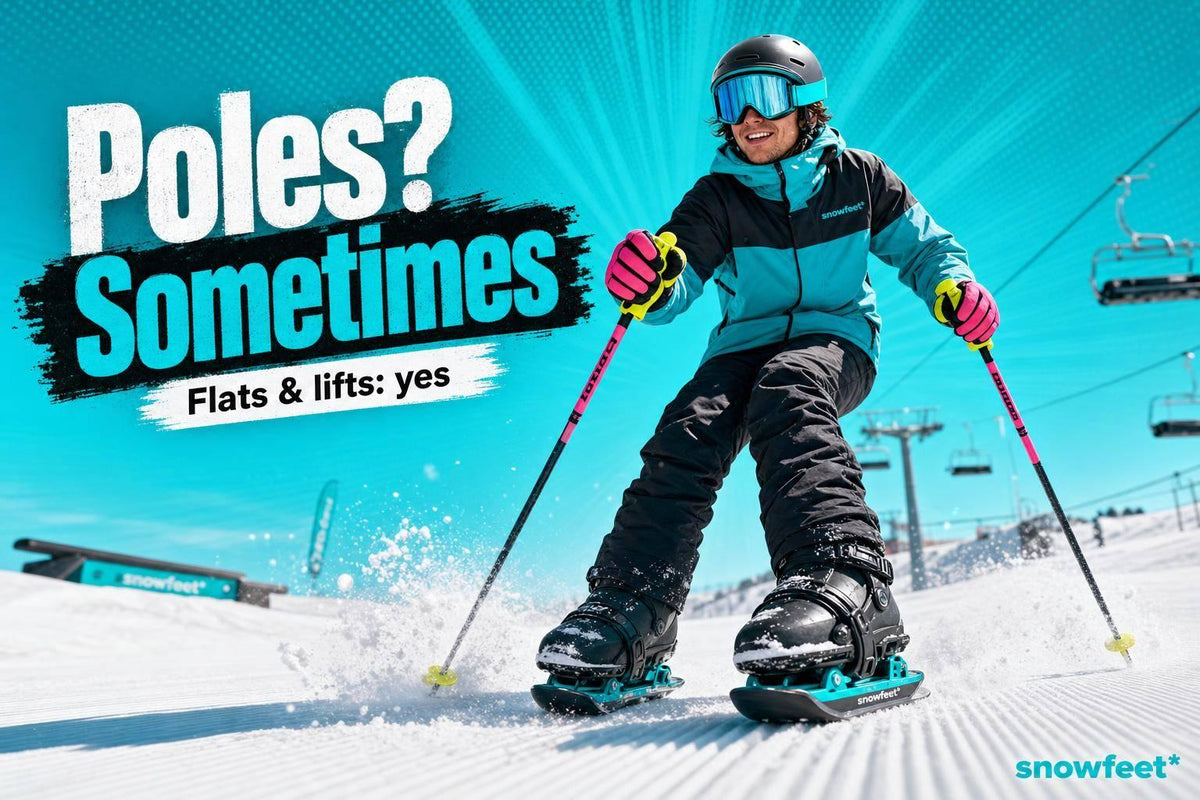
Yes - you can use ski poles with 44 cm (17.3 in) Skiskates, but most people don’t need them on downhill runs.
If I had to give the short answer, it’s this:
- Use poles for flats, lift lines, restarts, and your first day if you feel shaky
- Skip poles for groomed downhill laps, quick turns, and park riding
- Pole-free feels more like skating, which is why many riders prefer it
- A good pole height is between your chin and nose
That’s the whole story in plain English. Because Skiskates are only 44 cm / 17.3 in long, they ride much more like skates than full skis. So your legs, hips, and core do most of the balancing, not your hands.
Here’s the simple rule I’d use:
| Situation | My take |
|---|---|
| First day learning | Poles can help |
| Flat sections | Poles help a lot |
| Lift lines | Poles help |
| Groomed downhill runs | Usually no poles |
| Terrain park | No poles |
A lot of riders start with poles, then drop them after a few runs. That works well. You get a bit of support at slow speed, but you still learn how to balance the way Skiskates want you to.
A good stat to keep in mind: Skiskates at 44 cm are far shorter than normal skis, so pole plants matter much less than on full-length skis. That short platform changes the feel right away.
If you want a quick visual on short ski riding and stance, here are a couple of helpful YouTube searches:
So, if you’re wondering whether to bring poles: bring them if you expect flats or want support early on. Leave them behind if you want the cleanest, most skate-like ride :)
Snowfeet* & Skiskates Tutorial - How to Become a PRO Skiskater
When Ski Poles Actually Help on Skiskates
Poles help most when you're moving slow, trying to stay steady, or dealing with flat snow.
Helping Beginners Feel Stable on Day One
If you're new to snow, or you're coming from skating, poles can make day one feel a lot less sketchy. They give you a bit of support while you learn the Snowfeet* stance: knees bent, feet shoulder-width apart, weight centered or slightly back, and a slight forward lean.
A simple way to use them:
- Start with poles to build confidence
- Then do some runs without them so your legs and hips learn to balance on their own
- If you feel wobbly, put one foot a little ahead of the other to make your stance more stable
Once you feel steady, poles tend to matter less on moving downhill terrain.
Pushing Across Flats and Starting From a Stop
This is where poles earn their keep. Flat sections and slow base areas can be annoying on any short ski, and Snowfeet* Skiskates 44 cm (17.3 in) are no different. On flats, poles help you push forward instead of depending only on skating.
They also help when you stop on a flat patch and need to get going again.
Getting On and Off Lifts and Moving Around the Resort
Lift lines and base areas are often crowded and awkward. Poles give you extra support while you shuffle along. They also help if you take a spill and need a hand getting back up.
That extra help matters most in slow, clunky spots. Once you're back on normal downhill laps, poles don't do much.
When Poles Are Not Needed or Get in the Way
Once you’re past the slow zones, poles don’t do much on downhill laps. On moving snow, Skiskates react more to your stance and edge control than anything happening in your hands.
Downhill Riding Works Better Without Poles
On Skiskates, balance comes from your stance, your edges, and how you move through your lower body. That’s the core of it.
Poles can throw that off. They can interrupt your balance, and just holding them may pull your hands back, which can mess with your position during quick turns or carving. It’s a bit like trying to steer a bike while sitting too far behind the handlebars. Things get awkward fast.
If you start to feel shaky at speed, skip the poles and fix your stance instead. A staggered stance, with one foot a little ahead of the other, is the better move.
That same pole-free setup matters even more in the park.
Terrain Park Laps Are Cleaner Without Poles
In the terrain park, poles often turn into one more thing to deal with. Spins, small jumps, and rail slides are easier without them.
Leaving poles behind also cuts the chance of one catching on a feature or getting in the way on landing. And, well, that’s the kind of problem nobody wants mid-lap :)
sbb-itb-17ade95
Poles or No Poles: How to Choose for Your Riding Style
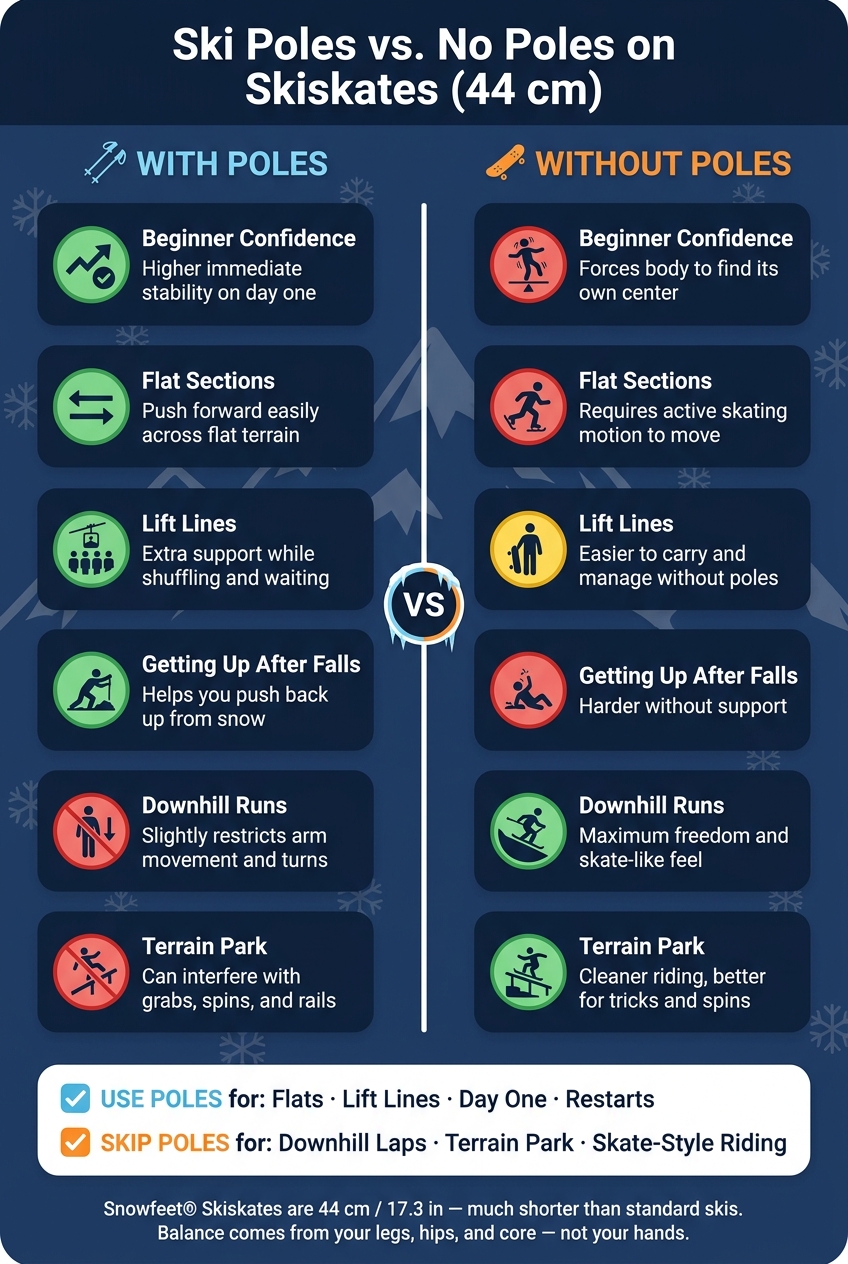
Ski Poles vs. No Poles on Skiskates: When to Use Each
This choice is pretty simple: use poles if you want more support at slow speeds. Skip them if you want a cleaner, more open feel on the way down.
Poles can help on flats, in lift lines, and during those wobbly first runs. But on downhill laps, plenty of riders like going without them. It feels less cluttered and more like skating. If that sounds like your kind of ride, you’re already leaning one way.
If you do want poles, the next thing is getting the length right.
How to Pick the Right Pole Length
Pole size matters more than people think. A solid rule: your poles should reach somewhere between your chin and nose when standing flat on the ground.
That usually gives you a natural bend in your elbows and keeps your arms relaxed. Too short, and things can feel awkward. Too long, and you’ll feel like you’re carrying antennae. Not ideal :)
Who Should Use Poles and Who Should Skip Them
Use poles if you're:
- First-day beginners
- Riders who want extra stability on uneven terrain
- Riding a resort with lots of flats or long lift lines
Skip poles if you're:
- A confident rider who's comfortable on groomed runs
- Skaters or hockey players who already have strong edge control
- Riding for the free, skate-like ride that Snowfeet* Skiskates 44 cm are built for
For a lot of skaters, that last point is the big one. They want a loose, expressive ride. No poles fits that style better.
That tradeoff gets a lot clearer when you put both options next to each other.
Poles vs. No Poles on Snowfeet* Skiskates 44 cm: Side-by-Side Comparison
| Situation | With Poles | Without Poles |
|---|---|---|
| Beginner confidence | Higher immediate stability | Forces your body to find its center |
| Steep sections | Easier small balance corrections on steep sections | Relies on your legs, hips, and core |
| Pushing on flats | Helpful for pushing across flat areas | Requires active skating motion |
| Lift lines and flats | Helpful for stability and positioning | Easier to carry and manage |
| Downhill runs | Slightly restricts arm movement | Maximum freedom and a skate-like feel |
| Terrain park | Can interfere with grabs and spins | Cleaner and better for tricks |
The tradeoff is pretty clear: poles give you more support on slow terrain, while no poles gives you more freedom on downhill runs.
Conclusion: The Right Setup for Most Riders
Ski poles are optional with Snowfeet* Skiskates 44 cm. Pole-free riding is the default. So yes, you can use poles, but only when they fix a real issue.
For most riders, it makes sense to start without poles. Beginners, older riders, and skaters moving to snow may want poles for a bit more confidence on day one. That helps keep the ride close to the skate-like feel most Snowfeet* riders are after.
If you deal with flats, lift lines, or restarts, poles can help. If not, skip them. Use poles for flats, lift lines, or getting going from a stop. On groomed downhill laps, you probably won’t miss them.
For most riders, the simplest setup wins. Snowfeet* Skiskates are made to be simple, portable, and fun right out of the box, with poles as an optional add-on.
FAQs
Do I need poles as a beginner?
No. If you’re new, it’s often better to start without poles.
Here’s why: poles can make it easy to lean on them for balance. And that can lead to bad habits. Instead of learning the right stance, smooth weight transfer, and solid control, you might end up using the poles as a crutch.
Once you feel steady and comfortable on your Snowfeet Skiskates, you can add poles if they help in certain spots, like pushing along flat sections.
What pole length works best for Skiskates?
There’s no single best pole length for Snowfeet Skiskates. Poles are optional, and the right length comes down to your height and how you ride.
If you want poles for a bit more stability or to help you move around, pick a length that feels comfortable in your hands. Simple as that.
A lot of casual riders skip poles altogether. That gives Snowfeet Skiskates the more natural, skate-like feel they’re made for. It’s a little like taking the training wheels off a bike - you feel freer, and the ride feels more fun :)
Are poles worth bringing for resort riding?
Usually, no - poles are optional with short, agile gear like Snowfeet* Skiskates, and on a normal resort day they can feel more like clutter than help.
If you're new, it's best to skip them at first. That helps you build natural balance and learn proper turning without leaning on your hands. Think of it like learning to ride a bike without extra stuff bolted on - you want your body to do the work.
That said, poles can still come in handy in a few spots:
- Flat sections
- Tricky terrain
- Steep runs
- Chairlifts without bars
If you decide to use them, pick a pair that matches your height and riding style.











Laat een reactie achter
Deze site wordt beschermd door hCaptcha en het privacybeleid en de servicevoorwaarden van hCaptcha zijn van toepassing.