



















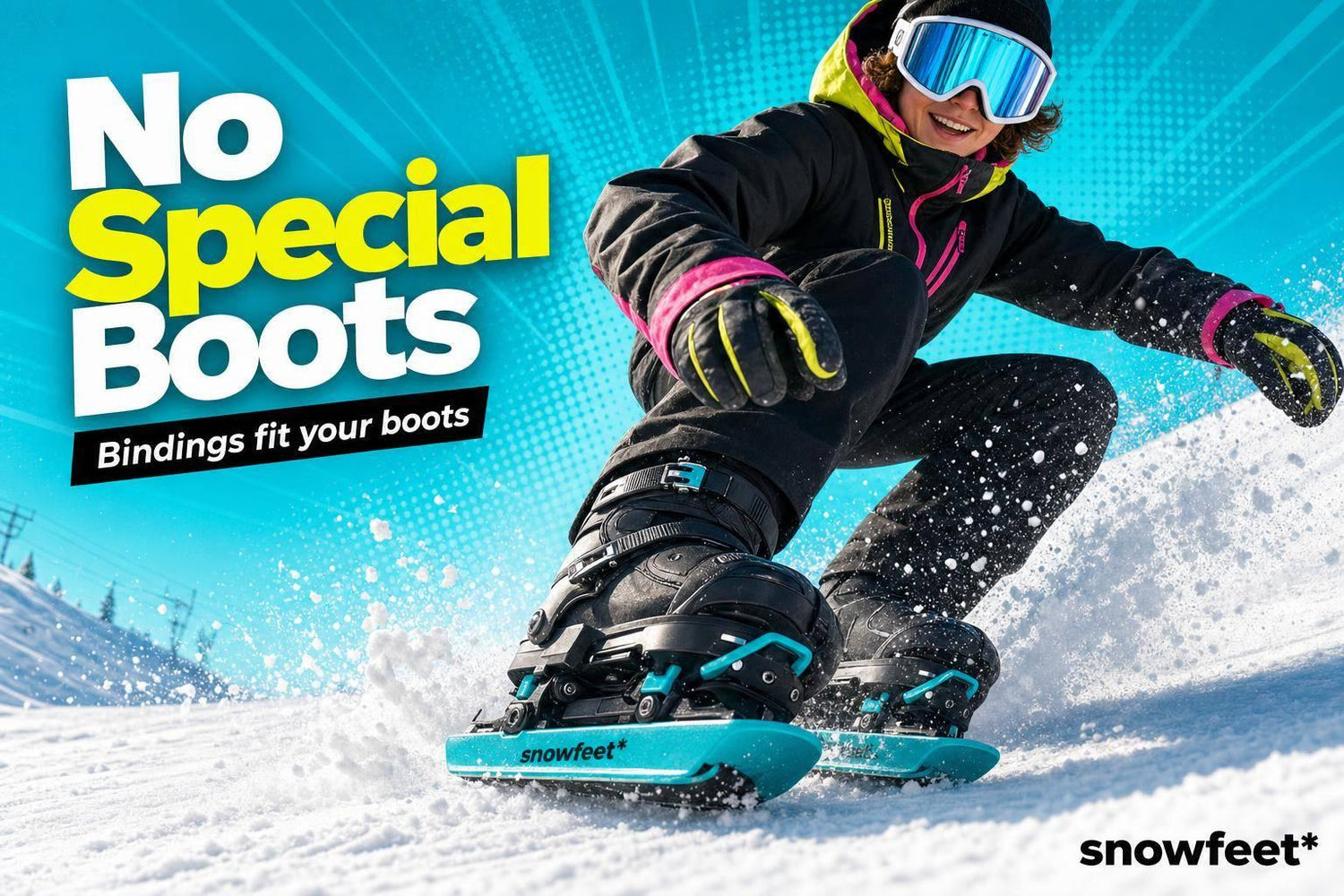
No - short skis usually don’t need special boots. In most cases, the binding matters more than the ski length.
If I were giving the short answer in the shop, I’d put it like this:
- 38 cm and 50 cm mini skis: work with winter boots or snowboard boots
- 44 cm Skiskates: work with ski boots or snowboard boots, based on binding type
- 65 cm, 99 cm, and 120 cm skiblades: usually work with ski boots, with some models also set up for snowboard boots
- Regular winter boots do not work on skiblades
That’s the whole game: match the binding to the boots you already own.
A few numbers make this easier:
- Mini skis come in 15 in. and 20 in.
- Skiskates come in 17 in.
- Skiblades come in 26 in., 39 in., and 47 in.
- Many Snowfeet models fit boot sizes from about US 4.5 to 14.5, depending on setup
Long skis still do better for deep powder, high-speed carving, and hard charging. But short skis are often easier to learn, easier to carry, and more fun for casual days, travel, and tight turns. That’s why a lot of riders pick them in the first place.
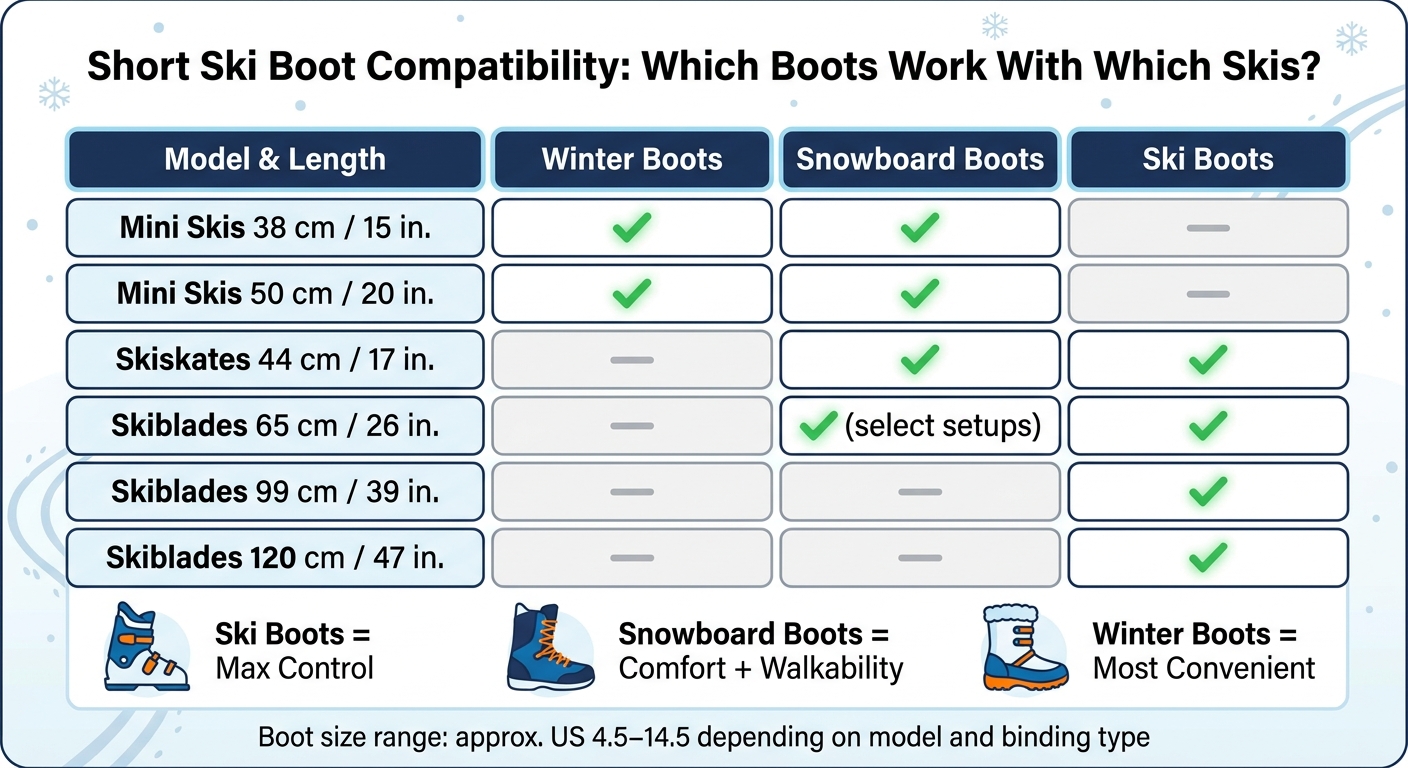
Short Ski Boot Compatibility Chart: Which Boots Work With Which Skis?
Bindings for Short Skis | All You Need to Know
Quick Comparison
| Model | Length | Boot Type |
|---|---|---|
| Snowfeet mini skis | 38 cm / 15 in. | Winter boots or snowboard boots |
| Snowfeet mini skis | 50 cm / 20 in. | Winter boots or snowboard boots |
| Skiskates | 44 cm / 17 in. | Ski boots or snowboard boots |
| Skiblades | 65 cm / 26 in. | Ski boots, with some snowboard boot setups |
| Skiblades | 99 cm / 39 in. | Ski boots |
| Skiblades | 120 cm / 47 in. | Ski boots |
So, if you’re asking, “Do I need to buy ski boots too?” the answer is often no. You just need the setup that fits your boots, your riding style, and how much control you want. Nice and simple :)
Snowfeet* 38 cm and 50 cm Mini Skis: No Ski Boots Needed
The 38 cm (15 in.) and 50 cm (20 in.) Snowfeet mini skis* use strap bindings that work with regular winter boots or snowboard boots. So, you can skip ski boots altogether. Both models fit US sizes 6–13 and come with tool-free adjustable bindings.
The big choice comes down to this: easy comfort or more control. If you want to use the boots you already have, regular winter boots make things simple. If you want a tighter, more supportive feel, snowboard boots are the better pick.
Regular Winter Boots vs. Snowboard Boots on Snowfeet* Mini Skis
Both types work well, but they shine in different settings.
Regular winter boots are the easy choice for backyard hills and laid-back rides. They’re warm, comfy, and odds are you already own a pair. Snowboard boots give you more ankle support and better edge control, which helps on groomed resort slopes. They’re also still much easier to walk in than ski boots, which, let’s be honest, can feel like walking in plastic buckets.
Use waterproof winter boots with firm ankle support. Riders under US size 6 should use snowboard boots for a more secure fit.
| Regular Winter Boots | Snowboard Boots | |
|---|---|---|
| Comfort | Highest - feels natural | High - flexible but supportive |
| Control | Moderate - fine for casual use | Better - more ankle support |
| Warmth | Varies by boot quality | Generally very high |
| Portability | Excellent - no extra boots to pack | Good - bulkier but walkable |
| Best Use Case | Backyard hills, casual rides | Groomed slopes, resort runs |
So here’s the plain-English version: the 38 cm model leans more toward grab-and-go convenience, while the 50 cm gives you a bit more stability underfoot.
Who Should Choose the 38 cm or 50 cm Setup
The 38 cm is Snowfeet's most portable option*. It’s small enough to fit in a standard backpack, which is pretty wild for something you can ride downhill. That makes it a strong pick for first-timers, families, and travelers who want gear that’s easy to carry and simple to learn on.
The 50 cm PRO gives you more length, which means more stability and easier turns, especially in light powder. It also has a higher tip and tail plus a narrowed base made to help with carving on ungroomed terrain.
For beginners and travelers, this is the easiest Snowfeet* setup if you want to ride in the boots you already own. No extra boot bag. No clunky ski boots. Less hassle, more snow time :)
If you want a short-ski setup that gets closer to ski-boot-style performance, the 44 cm Skiskates are the next move.
sbb-itb-17ade95
Snowfeet* Skiskates 44 cm: Ski Boots for Precision or Snowboard Boots for Comfort
The 44 cm (17 in.) Skiskates land right between mini skis and skiblades. And that shows up in the boot choice too.
Unlike the 38 cm and 50 cm mini skis, 44 cm Skiskates work with either ski boots or snowboard boots, based on the binding version you choose. You don’t need some odd extra boot. You just need the boot type that matches the binding. The bindings are adjustable and come with safety leashes, which makes this setup feel like a nice step up from mini skis without pushing you straight into a full ski-boot-only system.
That’s the sweet spot here: more precise than mini skis, but less rigid than a full ski-boot setup. The ski boot version fits US sizes 4.5–14.5. The snowboard boot version fits US sizes 6–14.5.
So, the short version is simple:
- Pick ski boots if you want more precision.
- Pick snowboard boots if you want more comfort and easier walking.
When Ski Boots Are the Better Choice
If you already own ski boots and want the most responsive ride, go with the ski boot binding.
Ski boots are stiffer, so they give you faster edge-to-edge response and more direct power transfer. On snow, that means tighter control. You’ll feel it most on harder snow, steeper runs, and carved turns where edge hold matters.
If your style is more about accuracy than lounging around in comfy boots, this is the better fit.
When Snowboard Boots Make More Sense
Snowboard boots are the comfort pick.
They’re easier to walk in, softer on your feet, and less stiff while riding. That makes them a good match for people who want a more relaxed feel. For snowboarders, there’s another perk: Skiskates let each leg move on its own, which gives you a more playful feel than a snowboard. You’re not locked into one board, and that changes the whole vibe.
They also make it easier to try short skis without buying a full ski boot setup. That’s a nice bonus if you’re testing the waters and don’t want to go all-in on day one.
Here’s the side-by-side:
| Ski Boots | Snowboard Boots | |
|---|---|---|
| Control | Maximum edge hold, sharp response | Moderate; more lateral flex |
| Comfort | Lower - stiff plastic construction | High - soft and cushioned |
| Mobility (Walking) | Clunky off the slope | Feels closer to regular boots |
If you want a longer setup that feels more like skiing, the 65 cm, 99 cm, and 120 cm Skiblades switch back to standard alpine ski boots.
Snowfeet* Skiblades 65 cm, 99 cm, and 120 cm: Standard Ski Boots Work, With Some Flexible Options
If you're moving up from Skiskates, this is where things start to feel a lot more like regular skiing. The 65 cm (26 in.), 99 cm (39 in.), and 120 cm (47 in.) Snowfeet* Skiblades work with standard alpine ski boots if you already have them. Regular winter boots won’t work.
These models sit closest to full skis in the Snowfeet* lineup. And on some setups, you can also pick snowboard boot bindings if you want a softer, more laid-back feel.
Best Boot Match for the 65 cm, 99 cm, and 120 cm Models
At this point, the big question is simple: how much stiffness and support do you want from your boots?
The 65 cm model is the smallest and quickest of the group. It’s made for fast turns and easy carving. It works with both standard ski-boot bindings and snowboard boot bindings. If you go with the ski boot version, the weight is about 3.79 lbs per pair. The snowboard boot version weighs 5.89 lbs per pair.
The 99 cm model hits a sweet spot for many beginners. It gives you a nice balance between stability and easy turning. It’s steadier than the 65 cm when you pick up speed, but still much easier to turn than full-length skis. For mixed resort days, this one is a solid all-around pick.
The 120 cm model is the fastest of the three and feels the most planted at speed. This is the one that gets the most out of a precise ski-boot setup. If edge control and stability matter most to you, boot stiffness matters more here too.
Here’s the sizing part you’ll want to double-check before you order:
- Standard ski-boot bindings fit US sizes 4.5–14.5
- Pro Ski Boot Bindings fit 26–36.5 MP
- Snowboard Boot Bindings fit US sizes 6–14.5
If you're using older boots, give the sizing a close look. Saves headaches later. Nobody wants a gear surprise on the way to the lift :)
How Snowfeet* Compares With Snowblades and Long Skis
Long skis still do better in deep powder and when you're going very fast. That part hasn’t changed. But on most resort days, Snowfeet* Skiblades are much easier to carry, pack, and travel with.
One thing Snowfeet* does better than older snowblades is the boot setup. Older snowblades were usually tied to one ski-boot style. Snowfeet* gives you more room to choose, depending on the model. That’s a nice plus if you care about comfort as much as control.
| Feature | Snowfeet* Skiblades (65–120 cm) | Traditional Long Skis |
|---|---|---|
| Boot Flexibility | Ski boots, with snowboard boot options on some setups | Standard ski boots only |
| Portability | High - lightweight and easy to carry | Low - bulky and heavy |
| Learning Curve | Very short | Longer - requires more practice |
| Stability | Moderate to high, especially at 99–120 cm | High - best for speed and powder |
So the boot choice is pretty straightforward: ski boots if you want the most precise feel, and snowboard boots on select setups if comfort matters more.
Conclusion: Match Your Short Skis to the Boots You Already Own
Bottom line: no, short skis do not require ski boots. You just need the right model for the boots you already have.
The 38 cm and 50 cm mini skis work with winter boots or snowboard boots. The 44 cm Skiskates work with ski boots or snowboard boots, based on the binding version. The 65 cm, 99 cm, and 120 cm Skiblades are best with ski boots, though some setups also work with snowboard boots.
Here’s the simple trade-off:
- Ski boots give you the most control
- Snowboard boots are easier to walk in
- Winter boots are the most convenient
None of these is the wrong pick. It comes down to what matters most to you: comfort, control, or ease.
For casual riders, beginners, travelers, and snowboarders, Snowfeet* makes it easy to use the boots you already own and skip the ski-boot hassle.
FAQs
How do I know which binding fits my boots?
Choose the binding that matches the boots you already own when you buy Snowfeet* gear.
Ski-boot bindings fit standard alpine ski boots. They give you classic control and suit more aggressive riding.
Snowboard-boot bindings fit snowboard boots or sturdy winter boots. They feel more comfortable, make walking easier, and give you more flex for tricks.
Snowfeet* adjustable, tool-free bindings keep setup simple. :)
Are short skis safe for beginners?
Yes. Short skis are usually safe and beginner-friendly. Snowfeet products are made to feel easier than long skis, so many new riders pick them up faster if they’re open to trying something a bit different.
Their small size makes them easier to turn and less intimidating. That can help beginners feel more in control while they learn how to stop and link turns. For the best start, use them on groomed runs and wear sturdy boots that fit well, with bindings tightened the right way.
Which short ski length should I choose?
Choose based on how stable you want the ride to feel:
- 38 cm or 50 cm Mini Ski Skates/Snowfeet PRO: the easiest to control and carry. If you want a bit more balance underfoot, 50 cm feels steadier.
- 44 cm Skiskates: playful and skate-like, with tight turns and a nimble feel, but they’re less stable at higher speeds.
- 65 cm, 99 cm, or 120 cm Skiblades: more length means more support, more stability, and a feel that’s closer to regular skis.











Laat een reactie achter
Deze site wordt beschermd door hCaptcha en het privacybeleid en de servicevoorwaarden van hCaptcha zijn van toepassing.